Organizations across KSA and UAE are investing heavily in digital transformation, yet many leadership teams still struggle to articulate what a digital workspace actually is. The confusion is real, and it costs money. Digital solutions yield 10x ROI for regional enterprises within a single year, yet most organizations stumble before they even align on terminology. This guide cuts through the noise, giving you a clear definition, a breakdown of core components, measurable business impact data, and a practical implementation framework built for C-level decision-makers in the Gulf region.
Table of Contents
- Defining digital workspace: The executive perspective
- Core components and architecture of a digital workspace
- Business impact: Productivity, retention, and ROI
- Implementation strategies: Steps for executive success
- Common challenges, risks, and executive oversight
- Ready to unlock digital workspace value?
- Frequently asked questions
Key Takeaways
| Point | Details |
|---|---|
| Clear definition matters | Understanding the difference between digital workspace, workplace, and DEX is critical for executive decision making. |
| Integrated architecture drives value | Core elements like collaboration, automation, and governance yield higher productivity and ROI when unified. |
| Change management is essential | Successful initiatives place people and processes above technology to achieve lasting adoption. |
| Benchmark ROI is high | KSA/UAE enterprises can realize up to 10x ROI in the first year with a robust digital workspace. |
| Governance ensures long-term gains | Ongoing oversight and DEXOps frameworks help organizations avoid tool sprawl and sustain transformation. |
Defining digital workspace: The executive perspective
Before exploring the components, it is essential to align on what “digital workspace” actually means at a senior leadership level. The term gets used interchangeably with “digital workplace” and “DEX” (Digital Employee Experience), but these are distinct concepts with different strategic implications.
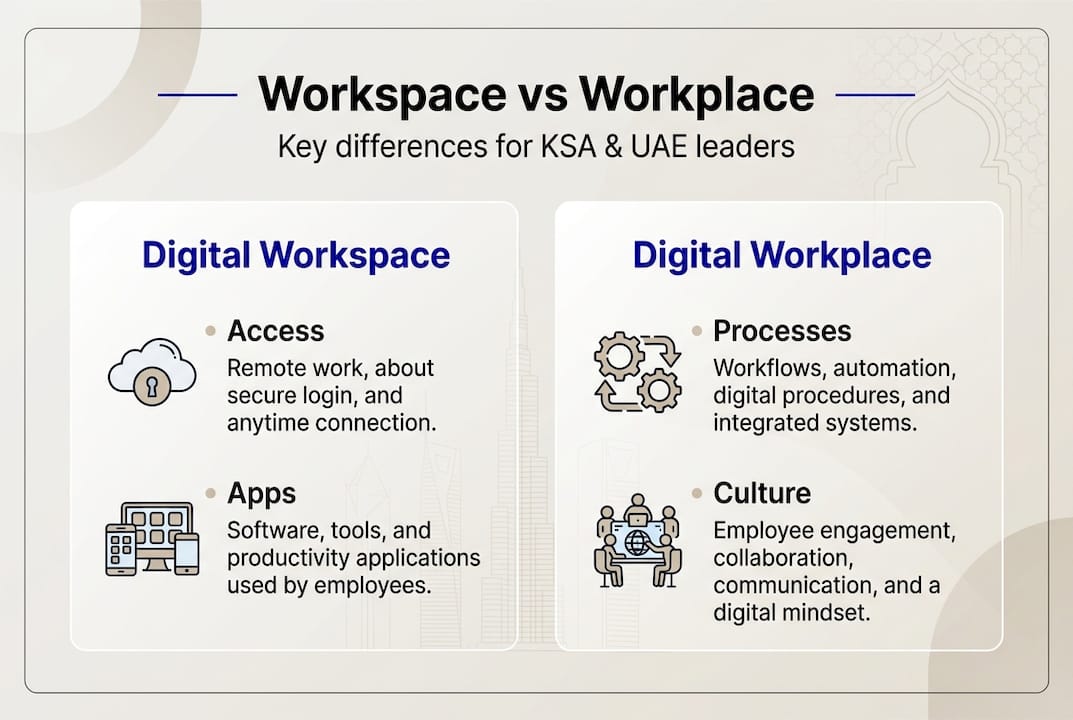
A digital workplace overview describes the broader organizational ecosystem, including culture, processes, and technology, that enables modern work. A digital workspace, by contrast, is the specific virtual environment where employees access tools, data, and applications to do their jobs, regardless of location. Think of it as the cockpit inside the aircraft, while the digital workplace is the entire airline operation.
DEX, or Digital Employee Experience, is the outcome. It measures how employees perceive and interact with that cockpit. As Gartner defines it, a digital workplace is “the virtual equivalent of a physical office, comprising an integrated ecosystem” of tools and services. Forrester adds nuance by positioning DEX as the perception and outcome layer, separate from the infrastructure itself.
Why does this matter for your strategy? Because vendors often blur these lines to sell broader platform deals. When your leadership team conflates workspace with workplace or DEX, you risk buying the wrong solution at the wrong scope. Clarity here is not semantic. It is financial.
| Concept | Definition | Strategic focus |
|---|---|---|
| Digital workspace | Virtual environment for accessing tools and data | Productivity and access |
| Digital workplace | Broader ecosystem of culture, process, and technology | Organizational transformation |
| DEX | Employee perception of digital tools and experiences | Adoption and satisfaction |
Understanding your digital ecosystem at this level of precision is what separates organizations that get ROI from those that accumulate shelfware.
Core components and architecture of a digital workspace
With the definition clarified, the next step is to lay out the essential elements that power a digital workspace. Gartner’s digital workplace guidance identifies six core components that every enterprise-grade digital workspace must address.
- Collaboration tools: Platforms like Microsoft Teams or Slack that enable real-time and asynchronous teamwork across geographies
- Communication platforms: Unified messaging, video conferencing, and announcement channels that replace fragmented email chains
- Knowledge management: Centralized repositories, AI-driven learning experience platforms (LXPs), and document systems that surface the right information at the right time
- Automation: Workflow automation and RPA (Robotic Process Automation) that eliminate repetitive manual tasks and accelerate approvals
- Unified endpoint management: Device and access governance that ensures security across laptops, mobile devices, and remote connections
- Governance and compliance: Policies, access controls, and audit trails that protect data and meet regulatory requirements in KSA and UAE
In regional contexts, these components must also account for Arabic language support, on-premise deployment preferences for government and banking sectors, and alignment with Vision 2030 workforce nationalization goals. AI in digital transformation is increasingly embedded across all six layers, from intelligent search in knowledge bases to predictive analytics in collaboration platforms.

| Component | Common platforms | Vision 2030 relevance |
|---|---|---|
| Collaboration | Microsoft Teams, Zoom | Remote and hybrid workforce enablement |
| Knowledge management | SharePoint, AI-driven LXPs | Upskilling and Saudization programs |
| Automation | UiPath, IBM BAW | Operational efficiency mandates |
| Endpoint management | Microsoft Intune, VMware | Cybersecurity and data sovereignty |
| Governance | Azure AD, on-premise IAM | Regulatory compliance in banking and government |
Pro Tip: Map every technology component to specific employee personas and top business processes before you select a platform. A procurement officer in Riyadh has different workflow needs than a field engineer in Abu Dhabi. Persona-driven architecture prevents tool sprawl and drives adoption from day one.
Business impact: Productivity, retention, and ROI
Understanding architecture is crucial, but what matters most for C-levels is measurable business value. The numbers here are compelling and regionally validated.
Forrester reports a 17% reduction in employee churn for organizations that invest in integrated digital experience tools. That is not a soft metric. In a region where talent competition is fierce and Saudization and Emiratization targets are rising, retaining skilled employees has direct financial value. Integrated collaboration also cuts project delivery times, meaning your teams ship faster with fewer coordination bottlenecks.
On the ROI side, KSA and UAE enterprises have documented 10x returns within the first year of deploying integrated digital solutions, particularly when ERP systems are connected to collaboration and automation layers. AI-powered efficiency gains compound this further, with organizations recovering hours of manual work per employee per week through intelligent automation.
The qualitative gains matter too. Organizations that invest in human-centric digital experiences report higher Return on Experience (ROX), a metric that captures how employee satisfaction translates into customer outcomes and organizational agility. When your people trust their tools, they focus on value-creating work instead of fighting systems.
“The organizations seeing the highest ROI are not the ones with the most tools. They are the ones where every tool serves a clear business purpose and employees actually use them.” — Tamer Badr, Singleclic
For a structured view of how these gains materialize over time, the digital transformation roadmap framework provides a phased approach that regional enterprises have used to sequence investments for maximum impact. You can also review DEX impact measurement methodologies to build your own internal business case.
Implementation strategies: Steps for executive success
Now that you see the business impact, clear steps are needed to translate strategy into scalable execution. The Digital Workplace Strategy Guide outlines a proven methodology that aligns with how leading organizations in KSA and UAE approach this challenge.
- Conduct a maturity audit. Assess your current digital tools, adoption rates, and process gaps. This baseline prevents you from investing in capabilities you already have or skipping foundational steps.
- Define personas and goals. Identify the top five to eight employee personas in your organization and map their critical workflows. Set measurable goals tied to business outcomes, not technology features.
- Select and align your technology stack. Choose platforms that integrate natively, support Arabic UI where needed, and meet your data residency requirements. Avoid point solutions that create silos.
- Build governance and change management frameworks. Assign ownership, define policies, and create a structured communication plan. Human-centric change management is the single biggest predictor of adoption success.
- Run a controlled pilot. Launch with one business unit or geography. Measure adoption, gather feedback, and iterate before scaling.
- Scale and iterate. Use pilot learnings to refine the rollout. Build feedback loops so the workspace evolves with your workforce.
- Track KPIs continuously. Monitor adoption rates, collaboration quality scores, productivity gains, and ROX. Adjust investment based on data, not assumptions.
Pro Tip: Use your maturity audit results to create a “stop doing” list alongside your investment roadmap. Eliminating redundant tools often funds the new platform without additional budget. A well-structured digital onboarding workflow accelerates time-to-productivity for new hires and reduces early attrition significantly.
For Vision 2030 alignment, build upskilling modules directly into your digital workspace. Connecting learning platforms to daily workflows means employees develop capabilities without leaving their primary work environment. This directly supports nationalization targets while improving organizational capability.
Common challenges, risks, and executive oversight
Even with the right strategy, pitfalls can derail digital workspace programs if not actively addressed at the executive level. The most common failure mode is not a technology problem. It is a governance problem.
Key risks to monitor:
- Tool sprawl: Adding platforms without retiring old ones creates fragmentation, increases IT costs, and frustrates employees who must navigate multiple systems
- Vendor lock-in: Choosing proprietary ecosystems without exit strategies limits your negotiating power and future flexibility
- Poor adoption: Technology that employees avoid delivers zero ROI, regardless of its technical capabilities
- Digital literacy gaps: In mixed-workforce environments, uneven digital skills create two-tier productivity that undermines collaboration
- Technostress: Overloading employees with notifications, platforms, and constant connectivity erodes the productivity gains you invested to achieve
Gartner’s research on digital workplace risks highlights that fragmented AI and automation implementations can actually increase rework when processes are not mapped first. The solution is process-first thinking: document and optimize workflows before automating them.
“Risks outweigh benefits without governance. Fragmented AI and automation can increase rework. Map your processes first for true efficiency gains.” — Tamer Badr, Singleclic
Forrester’s DEXOps framework addresses the post-launch challenge directly. DEXOps is the operational discipline of continuously monitoring, measuring, and improving the digital employee experience after go-live. Without it, digital workspaces degrade over time as workforce needs evolve and technology drifts out of alignment.
For KSA and UAE organizations, additional regional risks include data sovereignty requirements, Arabic language support gaps in global platforms, and cultural change management nuances that generic playbooks miss. Reviewing digital disruption examples from the MENA region gives you concrete reference points for what has worked and what has failed in comparable organizations.
Executive oversight means scheduling quarterly digital workspace reviews at the leadership level, not delegating this entirely to IT. The workspace is a strategic asset. Treat it like one.
Ready to unlock digital workspace value?
With a clear understanding of digital workspace architecture, business impact, and risk management, the next step is finding a partner who can turn your strategy into measurable results. Singleclic has spent over a decade delivering enterprise digital transformation across KSA, UAE, and Egypt, working with organizations in healthcare, banking, government, and construction to build workspaces that actually perform.
Our team specializes in business process management, process automation for enterprises, and ERP for operational efficiency — the three pillars that turn a digital workspace from a collection of tools into a competitive advantage. Whether you need a maturity assessment, a phased implementation roadmap, or a fully managed rollout, we bring the regional expertise and technical depth to deliver. Reach out to our team and let us show you what optimized looks like for your organization.
Frequently asked questions
How does a digital workspace differ from a digital workplace?
A digital workspace is the virtual toolkit your employees use to work from anywhere, while a digital workplace refers to the broader ecosystem of culture, processes, and technology that surrounds digital work. The workspace is a component inside the workplace.
What is the first step to implementing a digital workspace?
Start with a maturity assessment to identify your current tool landscape, adoption gaps, and business priorities before committing to any platform investment. Gartner’s phased approach confirms this as the foundation of every successful implementation.
What quantifiable ROI can KSA/UAE enterprises expect from digital workspaces?
Regional organizations have documented 10x ROI within year one from integrated digital solutions, alongside a 17% reduction in churn and measurable gains in project delivery speed.
What are the top risks with digital workspace implementation?
The most common risks include vendor lock-in, fragmented technology stacks, poor user adoption, and the absence of ongoing governance. Gartner identifies DEXOps as the operational discipline needed to manage these risks after launch.
How can C-level leaders ensure long-term digital workspace success?
Prioritize human-centric change management alongside technology selection, establish continuous measurement frameworks, and hold quarterly executive reviews to keep the workspace aligned with evolving business needs.