Managing digital onboarding across the healthcare and banking sectors in Saudi Arabia and the UAE can feel overwhelming without a clear plan. Each organization faces unique regulatory demands and operational pressures that require precise workflows. By focusing on comprehensive role integration and cultural immersion, leaders can shape onboarding processes that accelerate productivity, reduce errors, and support compliance. This guide walks through practical steps to build adaptable, automated onboarding systems that align with strategic goals and modern technology.
Table of Contents
- Step 1: Define Onboarding Objectives And User Roles
- Step 2: Configure Digital Onboarding Requirements
- Step 3: Integrate Workflows With Core Enterprise Systems
- Step 4: Automate Verification And Compliance Checks
- Step 5: Test And Optimize Onboarding Processes
Quick Summary
| Key Insight | Explanation |
|---|---|
| 1. Define clear onboarding objectives | Align objectives with organizational goals to enhance role integration and cultural adaptation for new employees. |
| 2. Assign specific user roles | Establish a collaborative workflow by defining roles like HR Representative, Direct Manager, Buddy, and IT Department for effective onboarding. |
| 3. Automate compliance checks | Implement automation tools, like AI and biometric systems, to streamline verification processes and enhance regulatory compliance. |
| 4. Integrate with core systems | Ensure seamless data flow by integrating onboarding workflows with systems like CRM, ERP, and HRIS for enhanced efficiency. |
| 5. Continuously test and optimize | Regularly measure performance metrics and gather user feedback to refine the onboarding processes for better experiences. |
Step 1: Define onboarding objectives and user roles
Successfully implementing a digital onboarding workflow starts with crystal-clear objectives and precisely defined user roles. This critical first step sets the foundation for a smooth, efficient integration process for new team members across enterprises in Saudi Arabia and the UAE.
To effectively define your onboarding objectives, you’ll want to align them with your organization’s broader strategic goals. Organizational socialization research highlights that robust onboarding encompasses far more than simple orientation – it’s about comprehensive role integration and cultural immersion.
Key objectives to consider include:
- Accelerate employee productivity by providing clear role expectations
- Reduce early-stage turnover through comprehensive introduction processes
- Facilitate cultural adaptation for new team members
- Standardize onboarding experiences across different departments
When defining user roles, focus on creating a collaborative workflow that assigns specific responsibilities to each stakeholder. Typical roles might include:
Here’s a summary of digital onboarding roles and their strategic impact:
| Role | Main Responsibility | Business Impact |
|---|---|---|
| HR Representative | Handles initial documentation | Speeds regulatory compliance |
| Direct Manager | Delivers tailored training | Boosts role clarity and productivity |
| Buddy/Mentor | Guides cultural integration | Improves employee retention |
| IT Department | Provides system and tech access | Ensures seamless tech enablement |
- HR Representative: Initial paperwork and policy introduction
- Direct Manager: Role-specific training and performance expectations
- Buddy/Mentor: Cultural integration and informal guidance
- IT Department: Technology access and system onboarding
Digital onboarding is not just about processes – it’s about creating meaningful connections that help new employees feel welcomed and empowered.
Our low-code platform, Cortex, can help streamline these objectives by allowing organizations to design flexible, customizable onboarding workflows that adapt to specific enterprise needs.
Pro tip: Create a visual role matrix that clearly outlines each stakeholder’s specific onboarding responsibilities to eliminate confusion and ensure smooth handoffs.
Step 2: Configure digital onboarding requirements
Digital onboarding configuration is a critical process that transforms how organizations integrate new members while ensuring regulatory compliance and operational efficiency. In the dynamic business environments of Saudi Arabia and the UAE, this step demands precision and strategic thinking.

Client onboarding best practices reveal that configuring digital requirements involves multiple complex layers, particularly for financial institutions navigating intricate regulatory landscapes.
Key configuration elements include:
- Identity verification protocols
- Compliance management systems
- Risk assessment frameworks
- Documentation validation processes
Configuration strategies differ significantly between B2B and B2C contexts:
Compare B2C, B2B, and Hybrid onboarding configurations:
| Approach | Key Focus | Benefits | Typical Use Case |
|---|---|---|---|
| B2C | Fast automation | Rapid user activation | Retail, digital marketplaces |
| B2B | Deep due diligence | Improved risk management | Finance, enterprise services |
| Hybrid | Balanced risk and speed | Customizable experience | Banking, large organizations |
- B2C Approach: Focus on speed and automation
- B2B Approach: Emphasize comprehensive due diligence
- Hybrid Approach: Balanced risk management
Effective digital onboarding configuration is not about creating barriers, but about building seamless, secure pathways for new stakeholders.
Our Cortex low-code platform enables organizations to design flexible workflows that adapt to these varied requirements, supporting both rapid consumer onboarding and meticulous enterprise-level verification processes.
Pro tip: Design your digital onboarding configuration with modularity, allowing easy adjustments as regulatory requirements and organizational needs evolve.
Step 3: Integrate workflows with core enterprise systems
Integrating digital onboarding workflows with core enterprise systems represents a transformative strategy for organizations seeking operational excellence across Saudi Arabia and the UAE. This critical step enables seamless data flow and reduces manual intervention, ultimately enhancing organizational efficiency.
Enterprise system integration involves creating a cohesive digital ecosystem that connects disparate applications and business processes, enabling sophisticated automation and data consistency across multiple platforms.
Key systems to integrate include:
- Customer Relationship Management (CRM) systems
- Enterprise Resource Planning (ERP) platforms
- Human Resources Information Systems (HRIS)
- Identity Management databases
Successful integration requires a strategic approach:
- Identify core system interfaces
- Map data transfer requirements
- Establish secure authentication protocols
- Design real-time synchronization mechanisms
Enterprise system integration is not just a technical exercise, but a strategic initiative that transforms how organizations manage information and people.
Our Cortex low-code platform provides robust integration capabilities, allowing organizations to design flexible workflows that connect multiple enterprise systems with minimal custom coding.
Pro tip: Prioritize standardized API connections and implement robust error-handling mechanisms to ensure smooth data transmission across different enterprise platforms.
Step 4: Automate verification and compliance checks
Automating verification and compliance checks transforms how enterprises in Saudi Arabia and the UAE manage regulatory requirements, reducing manual effort and minimizing potential human error. This critical step ensures your digital onboarding workflow meets stringent legal and security standards while maintaining operational efficiency.
Digital onboarding technologies leverage advanced tools like biometrics, AI, and document verification software to validate identities and streamline compliance processes across complex regulatory landscapes.
Key automation technologies include:
- Biometric verification systems
- Artificial Intelligence document scanners
- Real-time database cross-referencing
- Machine learning fraud detection algorithms
Effective compliance automation requires a comprehensive approach:
- Implement multi-layered verification protocols
- Integrate AI-powered document analysis
- Create secure, traceable audit trails
- Configure automatic regulatory compliance checks
Automation is not about replacing human judgment, but about enhancing precision and reducing administrative overhead in compliance processes.
Our Cortex low-code platform enables organizations to design flexible, intelligent verification workflows that adapt to evolving regulatory requirements while maintaining robust security standards.
Pro tip: Develop a dynamic compliance ruleset that can be quickly updated to reflect changing regulatory landscapes without requiring extensive system reconfiguration.
Step 5: Test and optimize onboarding processes
Testing and optimizing digital onboarding processes is crucial for enterprises in Saudi Arabia and the UAE seeking to enhance user experience and operational efficiency. This final step ensures your workflow remains adaptive, responsive, and aligned with evolving organizational needs.
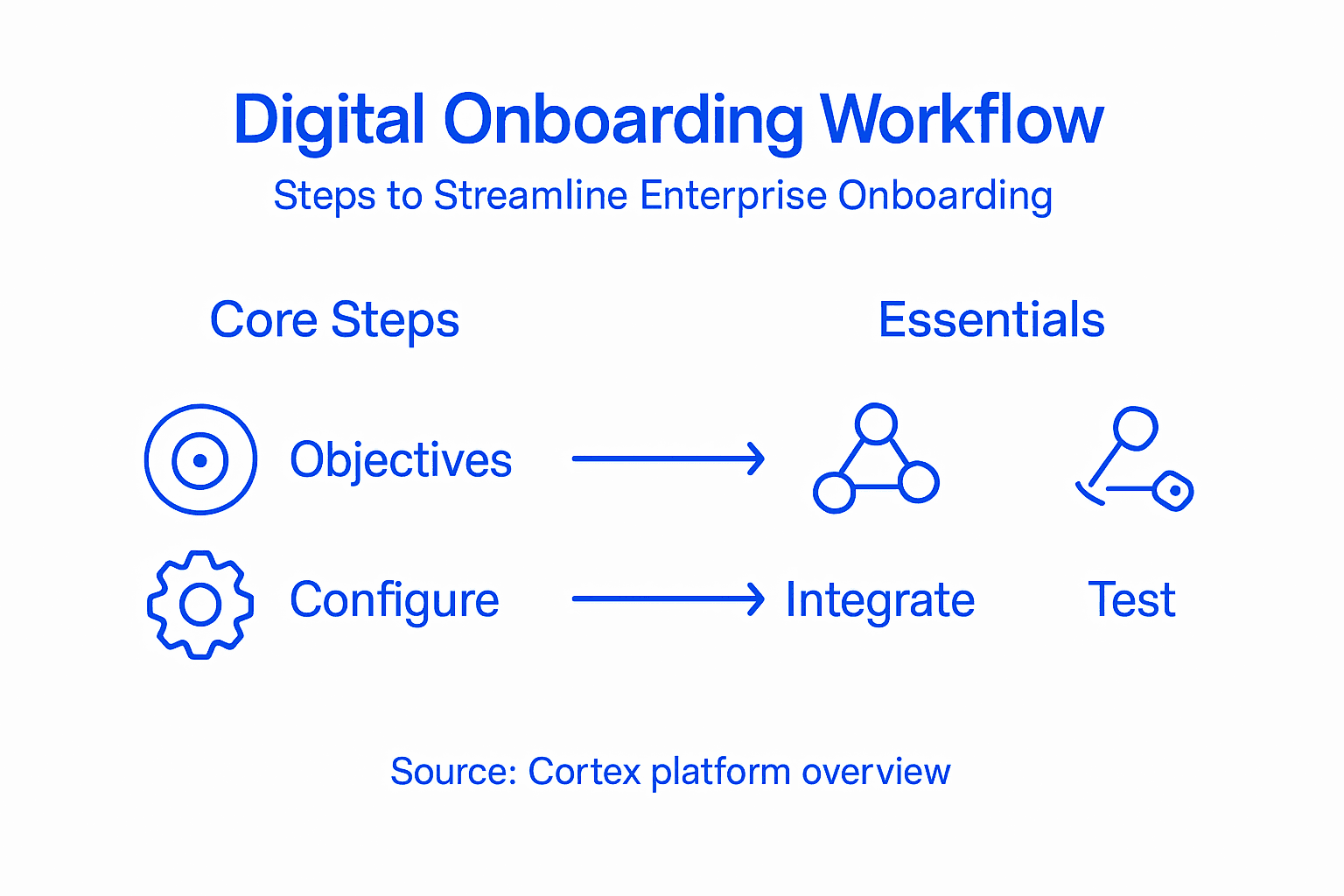
Digital onboarding best practices emphasize continuous measurement and refinement of key performance metrics to identify potential improvements and maintain compliance.
Key testing and optimization strategies include:
- Performance metrics tracking
- User experience analysis
- Completion rate monitoring
- Compliance validation checks
A comprehensive optimization approach requires:
- Define clear performance benchmarks
- Implement regular user feedback mechanisms
- Analyze drop-off points in onboarding journey
- Conduct periodic workflow audits
Optimization is not a one-time event, but a continuous process of incremental improvements driven by data and user insights.
Our Cortex low-code platform provides robust analytics and testing capabilities, enabling organizations to rapidly iterate and enhance their digital onboarding workflows with minimal technical overhead.
Pro tip: Establish a quarterly review process that systematically evaluates onboarding performance metrics, allowing for agile adjustments and continuous improvement.
Unlock Seamless Digital Onboarding with Singleclic’s Cortex Platform
The article highlights key challenges enterprises face when implementing digital onboarding workflows such as defining clear onboarding objectives, configuring secure verification processes, integrating with core systems, and continuously optimizing operations. These pain points can slow down new hire productivity and create compliance risks especially within complex environments like Saudi Arabia and the UAE.
At Singleclic, we understand the critical need to transform these challenges into competitive advantages. Our Arabic-enabled low-code platform, Cortex, empowers you to build flexible, fully integrated onboarding workflows without coding — accelerating role clarity, automating compliance, and enabling real-time process improvements. Trusted by 60+ enterprises across the region, including top healthcare and banking organizations, Cortex brings you a scalable solution designed to meet local regulatory and business needs.
Take control of your enterprise’s onboarding journey now. Explore how our digital transformation expertise and innovative platforms can help you optimize employee integration and compliance effortlessly. Visit Singleclic to learn more and start your transformation today. You can also discover our Business Process Automation and AI & Low-Code Platform Development services to see how we power smarter workflows.
Frequently Asked Questions
What are the key objectives for implementing a digital onboarding workflow?
To effectively implement a digital onboarding workflow, your key objectives should include accelerating employee productivity, reducing early-stage turnover, facilitating cultural adaptation, and standardizing onboarding experiences across departments. Start by aligning these objectives with your organization’s strategic goals to foster an efficient integration process.
How can I define user roles in the onboarding process?
Define user roles by assigning specific responsibilities to each stakeholder involved in the onboarding process, such as HR representatives, direct managers, buddies or mentors, and IT departments. Create a visual role matrix to clarify these roles and ensure seamless handoffs between participants.
What are the essential elements to configure in digital onboarding?
Essential elements for configuring digital onboarding include identity verification protocols, compliance management systems, risk assessment frameworks, and documentation validation processes. Prioritize these elements to create a secure and efficient onboarding experience, ideally within the first few weeks of a new hire’s start date.
How do I integrate onboarding workflows with core enterprise systems?
Integrate onboarding workflows by identifying core systems such as CRM, ERP, and HRIS. Map out data transfer requirements and establish secure authentication protocols to ensure seamless data flow across these systems, aiming for real-time synchronization wherever possible.
What automation technologies can enhance verification and compliance checks?
To enhance verification and compliance checks, utilize automation technologies such as biometric verification systems, AI document scanners, and real-time database cross-referencing. Implement multi-layered verification protocols to streamline compliance checks and reduce manual effort significantly.
How can I test and optimize my digital onboarding processes?
Test and optimize your digital onboarding processes by tracking performance metrics, analyzing user feedback, and monitoring completion rates. Conduct periodic workflow audits to identify drop-off points and implement changes, aiming for continuous improvements over time.