Modern organizations in Saudi Arabia and the United Arab Emirates face mounting pressure to enable fast, secure, and seamless collaboration across their teams. For C-level leaders and IT decision-makers in construction, healthcare, or banking, the difference between generic software and a true digital workplace is significant. Moving beyond just technology adoption, a digital workplace blends infrastructure, culture, and optimized workflows to deliver measurable efficiency gains. This article clarifies the core concepts, features, and sector-specific advantages executives need to drive operational outcomes with confidence.
Table of Contents
- Defining Digital Workplace And Core Concepts
- Types Of Digital Workplace Solutions Today
- Key Features Driving Digital Workplaces
- Sector-Specific Use Cases And Benefits
- Critical Risks, Gaps, And Adoption Challenges
Key Takeaways
| Point | Details |
|---|---|
| Digital Workplace Integration | Viewing the digital workplace as an integrated transformation enhances collaboration, efficiency, and organizational effectiveness. |
| Core Concepts Importance | Emphasizing digital competence, evolving organizational culture, and optimizing processes are essential for successful implementation. |
| Adaptive Solutions | Combining various digital workplace solutions creates a cohesive system that addresses specific operational challenges. |
| Change Management | Prioritizing change management and digital literacy is crucial for overcoming adoption barriers and maximizing technology investments. |
Defining Digital Workplace and Core Concepts
The digital workplace is far more than a collection of software tools or cloud platforms. It represents a fundamental shift in how organizations enable their teams to work, collaborate, and create value. At its core, a digital workplace combines technology infrastructure, organizational processes, company culture, and management practices into a unified ecosystem designed to support modern work. Research on digital workplace definitions demonstrates that this transformation extends beyond mere digitization of existing processes—it requires rethinking how people interact with technology, with each other, and with their work itself.
For organizations in the construction, healthcare, and banking sectors across Saudi Arabia and the United Arab Emirates, understanding this distinction becomes critical. Your teams are managing complex projects, patient records, and financial transactions that demand seamless collaboration across departments, locations, and time zones. A true digital workplace provides your workforce with access to the right information, applications, and communication channels at any moment, from any location. This capability directly impacts operational efficiency. When a construction project manager in Riyadh needs to communicate with site engineers, when a healthcare provider in Dubai must access patient histories instantly, or when a banking institution requires real-time data for compliance reporting, the digital workplace ensures these interactions happen without friction. The infrastructure must support not just connectivity, but genuine productivity and decision-making speed.
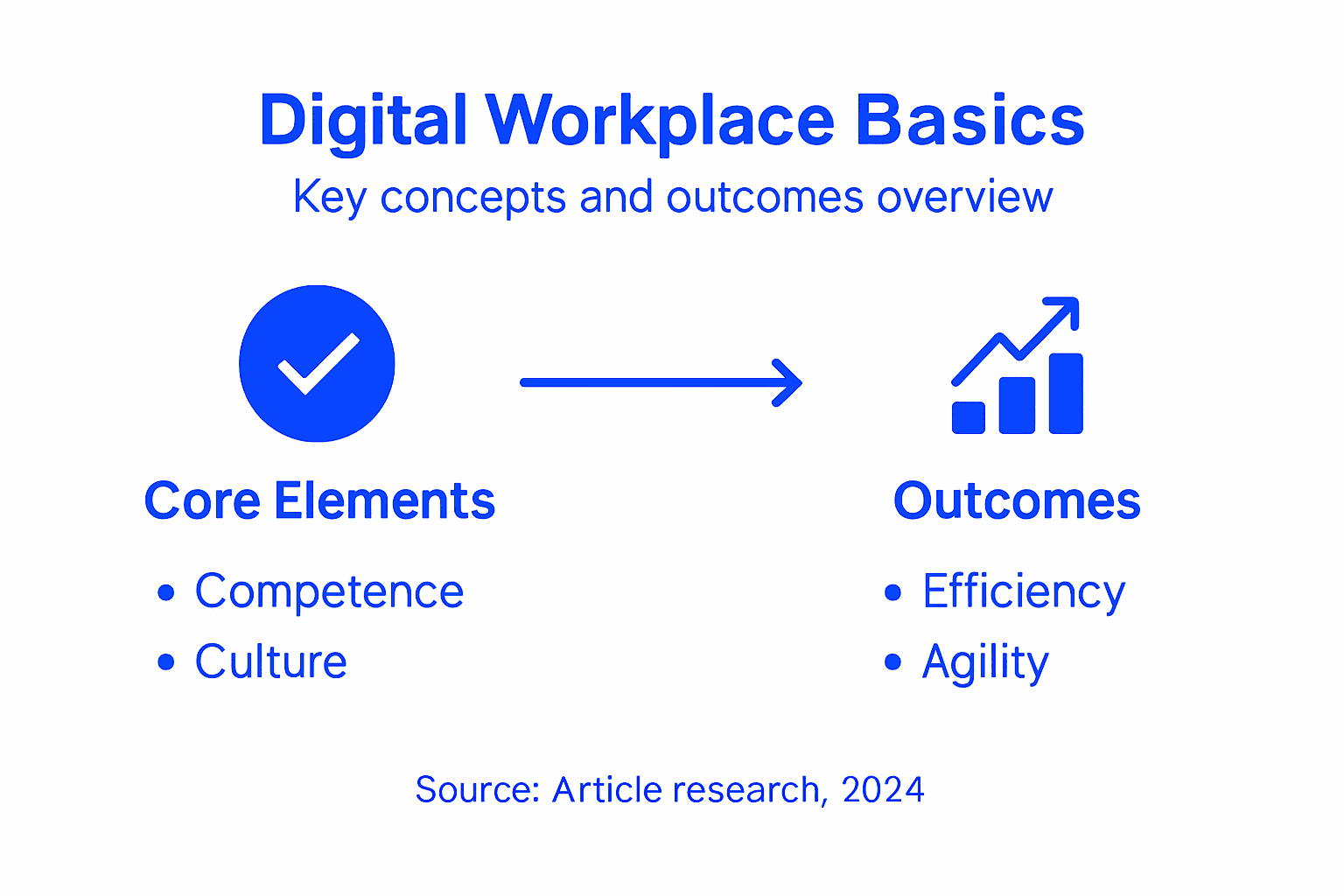
Core concepts underpinning the digital workplace include three interconnected elements. First, digital competence stands as a cornerstone—your teams need capabilities aligned with modern workplace demands. Professional digital competence frameworks like DigComp emphasize the technical and behavioral skills required to thrive in digital environments, from cloud application usage to cybersecurity awareness to remote collaboration techniques. Second, the organizational culture must evolve to embrace this transformation. This means encouraging flexible work arrangements, promoting transparent communication channels, and fostering trust in technology-enabled collaboration. Without this cultural alignment, even the best technical infrastructure will underperform. Third, process optimization ensures your existing workflows benefit from digital enablement. Rather than simply moving old processes online, successful digital workplaces redesign workflows from the ground up, eliminating redundancies and improving handoffs. Your organization’s approach to understanding digital transformation across different organizational areas will determine how effectively you implement these concepts.
Here’s how core digital workplace concepts interconnect and impact organizational outcomes:
| Concept | Main Focus | Key Outcome |
|---|---|---|
| Digital Competence | Skills for digital tools and workflows | Improved team effectiveness |
| Organizational Culture | Attitudes toward new ways of working | Higher adoption and trust |
| Process Optimization | Redesigning workflows for digital use | Increased efficiency and agility |
Implementing a digital workplace requires viewing it as an integrated transformation rather than a series of disconnected technology projects. Your executive teams must align on shared goals—whether that’s reducing project delivery times in construction, improving patient outcomes in healthcare, or accelerating loan processing in banking. The technology platforms matter, absolutely, but they succeed only when supported by clear governance, adequate training, and ongoing management. Solutions like our low-code platform Click Flow, designed specifically for MENA enterprises with full Arabic UI/UX and on-premise deployment options, enable organizations to design and optimize workflows without extensive coding requirements, allowing your teams to evolve processes in response to changing operational needs without constant IT intervention.
Pro tip: _Start your digital workplace journey by mapping your current state across technology, processes, and culture, then prioritize changes based on operational pain points rather than available tools—this ensures your transformation addresses real business challenges first and delivers measurable impact quickly.
Types of Digital Workplace Solutions Today
Today’s digital workplace market offers a diverse range of solutions, each addressing specific organizational needs. Rather than viewing these as isolated tools, successful organizations in Saudi Arabia and the United Arab Emirates combine multiple solution types to create a cohesive ecosystem. The core categories include social collaboration platforms that enable team connection and knowledge sharing, communication hubs that unify messaging and video conferencing, knowledge management systems that organize and preserve institutional knowledge, and workflow automation tools that eliminate manual handoffs. Different types of digital workplace technologies span communications, collaboration, and end-user computing solutions designed to optimize productivity and engagement. For a construction firm managing multiple job sites across the region, this might mean combining project collaboration platforms with real-time communication tools and mobile access solutions. For a healthcare institution, it could involve integrating patient data systems with staff communication channels and appointment management workflows. A banking organization might layer compliance tracking, secure communication protocols, and automated transaction workflows into their digital workplace infrastructure.

Social collaboration platforms form the backbone of many digital workplaces, particularly for organizations with distributed teams. These solutions provide spaces where employees can connect across departments and locations, share documents, discuss projects in real-time, and build organizational relationships. Communication hubs bring together email, instant messaging, video conferencing, and voice calling into unified interfaces, reducing tool fragmentation and decision fatigue. Knowledge management systems capture organizational intelligence, making critical information searchable and accessible rather than trapped in individual email inboxes or local file servers. Workflow automation tools like our low-code platform Click Flow enable teams to design, execute, and continuously improve business processes without relying on extensive IT resources. For construction projects tracking thousands of procurement decisions, healthcare facilities managing patient handoffs between departments, or banks processing loan applications across multiple approval stages, automation eliminates delays and human error. These solution types often work in concert, with automation triggering notifications through communication hubs, storing results in knowledge systems, and enabling teams to collaborate through social platforms.
When evaluating solutions for your organization, consider how different types integrate together. Top digital workplace solutions available in 2024 demonstrate varying approaches to integration, scalability, security, and user experience. Microsoft 365 packages communication, collaboration, and end-user computing into an integrated suite that works well for organizations already invested in the Microsoft ecosystem. Specialized platforms often excel in specific areas—a knowledge management system designed for healthcare organizations will embed compliance requirements and clinical workflows differently than one built for banking. Your decision should balance immediate pain points against long-term architectural flexibility. A construction company might prioritize mobile-first access and offline capability for site workers. A healthcare provider might emphasize security, HIPAA compliance, and integration with electronic health records. A bank needs robust audit trails, multi-factor authentication, and seamless connections to core banking systems. Understanding your approach to digital solutions for business ensures your technology selections reinforce your operational strategy rather than creating new bottlenecks.
Implementation complexity varies significantly based on solution types. Simple communication tool adoption might take weeks, while integrating workflow automation across your entire organization requires months of process analysis, design, and change management. Organizations frequently make the mistake of selecting tools first and then forcing processes to fit, rather than analyzing workflows first and selecting tools that enable optimal processes. Click Flow addresses this challenge by allowing your teams to design and adapt workflows without waiting for development cycles, meaning your digital workplace evolves as your business needs change. Starting with high-impact, lower-complexity solutions builds organizational confidence and momentum. A healthcare system might begin with unified communication to reduce missed messages between departments, then layer in workflow automation for appointment scheduling, and finally implement knowledge management for clinical best practices. This phased approach generates early wins while your organization learns digital workplace thinking.
Pro tip: Audit your current tools before selecting new solutions—most organizations discover they already own multiple capabilities scattered across unused licenses and forgotten subscriptions, allowing you to consolidate spending and train teams on existing systems before adding new platforms.
Key Features Driving Digital Workplaces
Successful digital workplaces share common architectural features that enable organizations to operate at speed and scale. These features go beyond simple technology adoption—they represent fundamental shifts in how work gets organized, authorized, and executed. The most impactful digital workplaces combine several key capabilities working in concert. First, unified collaboration platforms bring teams together regardless of physical location, combining messaging, document sharing, video conferencing, and project management into single integrated environments. Second, real-time data accessibility ensures decision makers across your organization can access current information instantly rather than waiting for reports or approvals. Third, automation and intelligent workflows eliminate repetitive manual tasks, freeing your teams to focus on higher-value work. Fourth, flexible access mechanisms including mobile applications and offline capabilities recognize that modern work happens everywhere. Key features like leadership digital competence and hybrid work enablement increasingly determine organizational success in competitive markets. For construction companies in the UAE managing multiple projects across different emirates, this means site managers can access project documentation, communicate with procurement teams, and approve change orders from the field. For Saudi healthcare institutions, it means clinicians can review patient histories, collaborate with specialists across different hospitals, and document care in real-time. For banking organizations, it means loan officers can access credit histories, communicate with underwriting teams, and move applications through approval pipelines without sequential handoffs that slow decisions.
Another critical feature driving digital workplace success is embedded intelligence and analytics. Modern digital workplaces don’t just store data—they surface insights automatically. Process analytics reveal bottlenecks and inefficiencies. Usage patterns highlight adoption gaps and training needs. Predictive capabilities help anticipate resource requirements before crises occur. Advanced human-computer interaction technologies including touchscreens and emerging immersive technologies are transforming how teams interact with information and systems. A construction firm can use analytics to identify why certain project types consistently miss deadlines and adjust resource allocation accordingly. A healthcare institution can analyze patient flow patterns to optimize staff scheduling. A bank can identify loan processing bottlenecks and route applications to increase throughput. The best digital workplaces also emphasize security and compliance by design rather than as an afterthought. This means encryption, multi-factor authentication, audit trails, and permission controls built into every interaction rather than bolted on afterward. Organizations in highly regulated sectors like banking and healthcare cannot afford security theater—they need genuine protection embedded at every level.
Organizational autonomy and distributed decision making represent perhaps the most overlooked feature of successful digital workplaces. When information flows freely and tools enable teams to take action without excessive approval layers, organizations move faster. A construction site manager who can identify a material shortage and immediately notify suppliers accelerates problem resolution. A healthcare team that can adjust staffing levels based on real-time patient census data improves care quality. A banking unit that can approve routine transactions without routing to multiple approval levels processes applications faster. This requires management culture evolution where leaders genuinely trust their teams to make good decisions with good information. Technology enables this shift, but organizational mindset determines whether the capability actually gets used. Click Flow facilitates this distributed decision-making approach by allowing business users to design and modify workflows without IT bottlenecks, meaning decisions about how work gets organized can happen at the speed of business rather than at the speed of IT project cycles.
The final foundational feature is inclusive user experience design. A digital workplace that only works on premium laptops with high-speed internet excludes frontline workers, international teams, and remote staff. Successful systems work across devices, support low-bandwidth scenarios, accommodate diverse accessibility needs, and function in multiple languages. For organizations operating across Saudi Arabia and the UAE with diverse workforces, this becomes critical. A construction platform that only works on desktop computers fails for site workers who need mobile access. A healthcare system that requires perfect internet connectivity struggles at field clinics or rural health centers. A banking interface designed only in English excludes staff and potentially customers who work in Arabic. Building these features into your digital workplace foundation determines whether transformation initiatives succeed or create new bottlenecks.
Pro tip: Prioritize workflow automation as your first digital workplace feature rather than communication tools—automation eliminates the friction that makes teams demand workarounds, and solving real operational pain points builds genuine adoption momentum that communication tools alone cannot generate.
Sector-Specific Use Cases and Benefits
Digital workplace implementations deliver dramatically different outcomes depending on industry context, operational constraints, and regulatory requirements. Construction organizations face unique challenges that differ fundamentally from healthcare and banking institutions. In the construction sector, digital workplaces solve immediate field realities. Project managers operating across multiple sites in Saudi Arabia and the UAE need real-time access to blueprints, material specifications, safety protocols, and procurement status without returning to offices. A construction digital workplace enables site supervisors to photograph construction progress, compare it against specifications, identify discrepancies, and immediately notify design teams—all from the job site. This eliminates the traditional cycle where issues get documented in the field, reported back to the office, discussed in meetings, and then communicated back to sites days later. The result is measurable reduction in rework, faster problem resolution, and improved project timelines. Material tracking becomes transparent, meaning procurement teams can anticipate shortages rather than discovering them when work stops. Safety documentation happens in real-time rather than through retrospective reports, improving incident prevention and regulatory compliance.
Healthcare organizations experience transformative benefits when digital workplaces break down communication silos between departments and locations. Digital workplace innovations in healthcare including improved collaboration and hybrid work enablement directly improve patient outcomes and operational efficiency. Consider a patient admitted to a hospital in Dubai who requires input from cardiology, neurology, and pulmonary specialists. Without integrated digital workplaces, these specialists work from separate systems, struggle to access each other’s notes, and coordinate through email or phone calls that delay care. With a unified digital workplace, specialists access comprehensive patient histories instantly, share diagnostic images in real-time, communicate through integrated messaging, and coordinate treatment plans without sequential handoffs. This acceleration reduces length of stay, improves clinical outcomes, and increases staff satisfaction by eliminating administrative friction. Administrative workflows also transform—appointment scheduling becomes automated, reducing no-shows and optimizing provider utilization. Prescription management integrates with pharmacy systems, preventing medication errors. Patient education materials deliver personalized information based on diagnoses and medications. Staff scheduling optimizes based on patient census and acuity levels rather than guesswork.
Banking institutions achieve operational transformation through digital workplaces that accelerate decision making and improve risk management. Loan officers working across branches in the Kingdom and the Emirates can access complete customer credit histories, previous interactions, and current exposures instantly rather than requesting information from multiple legacy systems. Underwriting teams receive loan applications with complete supporting documentation, decision-supporting analytics, and regulatory compliance checks already completed rather than gathering scattered information across email attachments and file servers. Approval workflows route applications intelligently based on complexity and size rather than moving sequentially through multiple people. The result is dramatically faster loan decisions—applications that historically took two weeks move through in two days. Compliance documentation happens automatically rather than through post-transaction manual review. Fraud detection systems analyze patterns in real-time rather than identifying problems days after transactions occur. Back-office operations consolidate data entry activities and eliminate manual reconciliation work that traditionally consumed 30 percent of operational staff time. Government and financial services digital workplace implementations demonstrate consistent improvements in operational responsiveness and service delivery quality across regulated sectors.
All three sectors benefit from common digital workplace advantages when implemented thoughtfully. Improved decision velocity means decisions happen faster because information flows instantly rather than through approval chains. Enhanced compliance happens because workflows embed regulatory requirements rather than addressing compliance separately. Better talent retention follows because staff appreciate working with modern tools and having autonomy to solve problems without bureaucratic overhead. Increased transparency enables leadership to understand operational realities rather than relying on delayed reports that obscure patterns. Scalability emerges because systems handle volume without proportional headcount increases. The critical success factor across all sectors is tailoring implementations to industry-specific workflows rather than forcing generic solutions. A construction company needs mobile-first interfaces and offline capability for field workers. A healthcare institution needs integration with electronic health records and compliance with patient privacy regulations. A banking organization needs real-time audit trails and multi-factor authentication for every transaction. Click Flow’s low-code platform architecture enables these sector-specific customizations without extensive development cycles, meaning your organization can evolve workflows to match your business model rather than the reverse.
This table highlights digital workplace benefits by industry sector:
| Sector | Primary Benefit | Sector-Specific Need |
|---|---|---|
| Construction | Faster project resolution | Mobile, offline access |
| Healthcare | Improved patient outcomes | Secure data integration |
| Banking | Accelerated loan decisions | Real-time compliance tracking |
Pro tip: Begin your digital workplace rollout with the highest-pain workflow in your industry—if construction teams lose days to material delays, start with procurement automation; if healthcare staff spends hours tracking patient location between departments, start with unified communication; if banking gets delayed by approval bottlenecks, start with workflow routing—solving genuine pain points generates adoption momentum that spreads to lower-priority initiatives.
Critical Risks, Gaps, and Adoption Challenges
Digital workplace transformations fail more often than they succeed, and understanding why matters. The most common failure pattern follows a predictable path: organizations invest heavily in technology, roll it out without adequate preparation, watch adoption stall, and eventually conclude the investment failed. The truth is more complex. The failures typically stem not from technology limitations but from organizational unreadiness. Significant gaps between required and available digital skills create major obstacles that prevent teams from using systems effectively, even when those systems are well-designed and properly configured. A construction company in Riyadh might deploy a sophisticated project management platform only to discover that site supervisors lack the digital literacy to navigate it effectively. A healthcare institution in Dubai might implement unified communication tools that clinicians don’t understand how to use, leading them to revert to email and phone calls while the new system sits idle. A banking organization in the Kingdom might provide advanced analytics dashboards that loan officers cannot interpret, resulting in underutilized capability. This skills gap creates a vicious cycle: teams don’t use systems because they lack competence, which means they never develop competence, which reinforces resistance to the technology.
Leadership challenges represent another critical adoption barrier often overlooked in digital workplace planning. Adoption hurdles are fundamentally social and organizational rather than purely technical, requiring shifts in competencies and leadership practices that many organizations underestimate. Managers accustomed to direct supervision and in-person validation struggle with distributed teams and asynchronous work. Executives invested in traditional decision-making hierarchies resist distributed autonomy that digital workplaces enable. Middle managers fear loss of authority when information flows freely and team members can escalate issues directly. These organizational dynamics create resistance that no amount of technology can overcome. A construction project manager trained to manage by physical presence and regular site visits must adapt to leading through data dashboards and real-time communication channels. A healthcare administrator comfortable with hierarchical approval processes must embrace clinical teams making treatment decisions with information access rather than waiting for administrative authorization. A banking executive accustomed to controlling information flow must learn to trust that better information access improves decisions rather than creating chaos. Without genuine leadership commitment to these mindset shifts, digital workplace technology becomes window dressing that doesn’t change how work actually happens.
Organizational culture and work practice gaps create perhaps the most subtle but consequential obstacles. Technology enables new ways of working, but culture determines whether teams actually adopt those new ways or simply apply old work practices using new tools. An organization might implement workflow automation tools but continue requiring manual approval sign-offs that duplicate the automated process. Teams might gain access to real-time project data but continue requesting status reports because habit and trust in the old process runs deeper than confidence in new systems. Departments might have unified communication platforms available but continue using email for sensitive discussions because organizational norms discourage direct conversation. These work practice gaps mean that expensive digital investments deliver minimal operational improvement because the underlying workflows remain unchanged. Additionally, security and compliance risks intensify when organizations move to distributed digital workplaces without strengthening governance frameworks. Remote access, mobile usage, and data accessibility create new vulnerability surfaces. Organizations must implement comprehensive cybersecurity programs, enforce multi-factor authentication, establish clear access controls, and maintain audit trails—but many rush this aspect of implementation, assuming legacy security approaches transfer to modern environments. This becomes particularly critical in banking and healthcare sectors where regulatory requirements demand rigorous controls.
Change management weakness compounds all these challenges. Organizations frequently underestimate the effort required to shift workforce behaviors and mindsets. Training typically focuses on technology features rather than helping people understand why their work practices must change and how new approaches improve their daily experience. Resistance gets labeled as obstruction rather than understood as a sign that change management is insufficient. Successful digital workplace transformations require sustained investment in communication, training, coaching, and cultural reinforcement over months and years, not weeks. They require visible leadership modeling of new ways of working. They require celebrating early adopters and creating peer-to-peer learning networks. They require patience with teams transitioning from old systems to new approaches. Organizations attempting rapid deployment without this change management infrastructure consistently encounter adoption plateaus where usage stalls well below full organizational capability. The solution involves building comprehensive transformation capacity alongside technology implementation. Click Flow supports this by enabling business users rather than IT specialists to refine workflows in response to adoption feedback, meaning your organization can evolve practices without prolonged development cycles while change management efforts have time to take root.
Pro tip: Before selecting technology, audit your organization’s current change management capacity, digital literacy across all staff levels, and leadership’s genuine commitment to distributed decision-making—if these gaps exist, address them through training and organizational development before deploying new digital workplace systems, because technology alone cannot bridge organizational readiness gaps that determine whether investments generate value or become expensive shelf-ware.
Unlock True Digital Workplace Potential with Singleclic
The article highlights that many organizations in Saudi Arabia and the UAE struggle to fully realize the benefits of digital workplaces due to gaps in digital competence, organizational culture, and workflow optimization. These challenges slow down operations and limit the value of technology investments. At Singleclic, we understand how critical it is to go beyond just technology deployment. We address the core pain points of skills development and change management alongside powerful solutions like our low-code platform Click Flow. This enables teams to design, automate, and evolve workflows effortlessly, accelerating decision-making and boosting productivity in sectors like construction, healthcare, and banking.
Take control of your digital transformation journey now with Singleclic where deep regional expertise meets world-class technology. Explore how our Business Process Automation and AI & Low-Code Platform Development help organizations elevate operations beyond digitalization and build a truly agile, connected workplace. Don’t settle for incomplete solutions or stalled adoption. Visit us today and start optimizing your digital workplace for real impact.
Frequently Asked Questions
What defines a digital workplace?
A digital workplace is a comprehensive ecosystem that integrates technology infrastructure, organizational processes, company culture, and management practices to enable modern work and collaboration.
How does a digital workplace impact operational efficiency?
A digital workplace enhances operational efficiency by providing teams with instant access to information, applications, and communication channels, facilitating seamless collaboration and faster decision-making.
What are the core concepts of a digital workplace?
The core concepts of a digital workplace include digital competence, organizational culture, and process optimization, all of which work together to improve productivity and workplace effectiveness.
What types of solutions are included in a digital workplace?
Digital workplace solutions typically include social collaboration platforms, communication hubs, knowledge management systems, and workflow automation tools, all aimed at enhancing team collaboration and efficiency.