A recent study found that 70% of digital transformation initiatives fail due to a lack of essential digital skills among leadership. For executives in KSA and UAE, where digital transformation accelerates at unprecedented pace, this gap is no longer acceptable. This article equips you with the critical digital competencies needed to drive operational efficiency, maintain competitive advantage, and position your organization for sustained growth in 2026 and beyond.
Table of Contents
- Introduction: The Strategic Imperative For Digital Skills
- How Digital Skills Enhance Operational Efficiency
- Why Digital Skills Are Essential For Competitiveness
- Key Digital Skills Executives Must Develop
- Common Misconceptions That Hinder Digital Skills Adoption
- Regional Challenges And Opportunities In Digital Skills Adoption
- Frameworks For Integrating Digital Skills With Business Strategy
- Practical Tools Supporting Digital Skills Development
- Conclusion And Next Steps For Executives
- Unlock Executive Digital Mastery With Singleclic Solutions
- Frequently Asked Questions
Key Takeaways
| Point | Details |
|---|---|
| Revenue Impact | Digital skills among executives drive 2.5x higher revenue growth in KSA and UAE markets. |
| Strategic Focus | Leadership digital competencies center on data literacy, AI oversight, and change management, not coding. |
| Regional Context | Tailored frameworks address unique KSA and UAE challenges like talent shortages and cultural adaptation. |
| Practical Tools | Low-code platforms, ERP systems, and AI analytics enable immediate skill application and value creation. |
| Continuous Learning | Ongoing executive development and change management ensure transformation success and competitive positioning. |
Introduction: The Strategic Imperative for Digital Skills
Digital skills are the foundation for executive success in KSA and UAE’s rapidly evolving digital economy. The region’s ambitious national visions demand leadership that can harness technology to achieve measurable business outcomes. Without digital fluency, executives struggle to evaluate opportunities, allocate resources effectively, or guide their organizations through complex transformations.
You don’t need to become a software engineer. However, understanding how digital tools create value, recognizing when automation makes sense, and interpreting data-driven insights are now baseline leadership capabilities. Organizations led by digitally competent executives adapt faster to market shifts, make smarter strategic bets, and build cultures that embrace continuous improvement.
Consider these essential digital leadership capabilities:
- Strategic data literacy for evidence-based decision-making
- Functional understanding of AI, automation, and cloud technologies
- Cybersecurity awareness to manage enterprise risk
- Change management skills to lead digital adoption
- Continuous learning mindset to stay ahead of emerging technologies
Leadership commitment triggers meaningful cultural shifts. When you actively develop digital skills, your teams follow. The result is an organization positioned to capitalize on regional opportunities while mitigating the risks of falling behind competitors who move faster.
How Digital Skills Enhance Operational Efficiency
Digital fluency translates directly into operational improvements that strengthen your bottom line. Executives who understand automation identify process bottlenecks and deploy solutions that reduce operational costs by up to 30%. This isn’t theoretical. Organizations across KSA and UAE are achieving measurable gains by applying digital skills to streamline workflows, eliminate manual errors, and accelerate decision cycles.
Data literacy empowers you to make faster, more confident choices. Instead of waiting weeks for reports, digitally skilled leaders access real-time dashboards, interpret key performance indicators instantly, and pivot strategies based on current conditions. This agility is critical in volatile markets where timing determines success or failure.
Integrating legacy systems with modern platforms requires executive oversight. You need to evaluate vendor claims, understand technical constraints, and balance innovation with operational stability. Digital skills give you the confidence to ask the right questions, challenge assumptions, and boost your organization’s efficiency in 2026 through informed technology decisions.
Impact on operational performance:
- Automation reduces manual processing time by 40 to 60 percent
- Data-driven decisions cut planning cycles from weeks to days
- Integrated systems eliminate duplicate data entry and associated errors
- Real-time monitoring enables proactive problem resolution
- Agile operations respond to market changes within hours, not months
Pro Tip: Start by mapping one critical process end to end. Identify manual handoffs, data silos, and approval bottlenecks. This exercise reveals immediate automation opportunities and builds your practical understanding of digital solutions.
Why Digital Skills Are Essential for Competitiveness
Competitive advantage in 2026 belongs to organizations led by executives who master digital capabilities. Research shows that executives with digital skills drive 2.5x higher revenue growth compared to peers lacking these competencies. This performance gap widens as markets digitize and customer expectations evolve.
Digital leadership enables rapid innovation. When you understand how technology creates value, you spot opportunities to improve customer experiences, launch new offerings, and enter adjacent markets ahead of competitors. This proactive stance contrasts sharply with reactive organizations struggling to keep pace with industry changes.
The GCC business environment rewards speed and adaptability. Digital skills empower you to make strategic bets with confidence, allocate resources to high-impact initiatives, and pivot quickly when market conditions shift. These capabilities matter enormously in sectors like banking, healthcare, and real estate where digital transformation strategies for GCC executives determine market position.
Competitive advantages of digital leadership:
- Faster time to market for new products and services
- Superior customer experiences through personalized digital interactions
- Better risk management via real-time monitoring and predictive analytics
- Stronger talent attraction by offering modern, efficient work environments
- Enhanced strategic partnerships with technology providers and innovators
Organizations with digitally skilled leadership navigate uncertainty more effectively. You anticipate disruptions, prepare contingency plans, and position your business to capitalize on change rather than merely survive it.
Key Digital Skills Executives Must Develop
Focus your development on five critical competency areas. Strategic data literacy comes first. You need to interpret analytics, understand statistical significance, and translate insights into actionable business decisions. This doesn’t mean mastering complex algorithms, but rather knowing which questions to ask and how to evaluate answers.

AI and machine learning require executive-level understanding. You should grasp how these technologies work in principle, recognize appropriate use cases, and evaluate vendor capabilities. When a team proposes an AI solution, you need sufficient knowledge to assess feasibility, cost, and expected return on investment.
Cybersecurity awareness is non-negotiable. Data breaches damage reputation, disrupt operations, and trigger regulatory penalties. Understanding common threats, basic protective measures, and your organization’s security posture enables informed risk management decisions.
Technology adoption and change management separate successful transformations from expensive failures. Digital tools deliver value only when people adopt them enthusiastically. Your ability to communicate vision, address resistance, and sustain momentum determines whether initiatives succeed or stall.
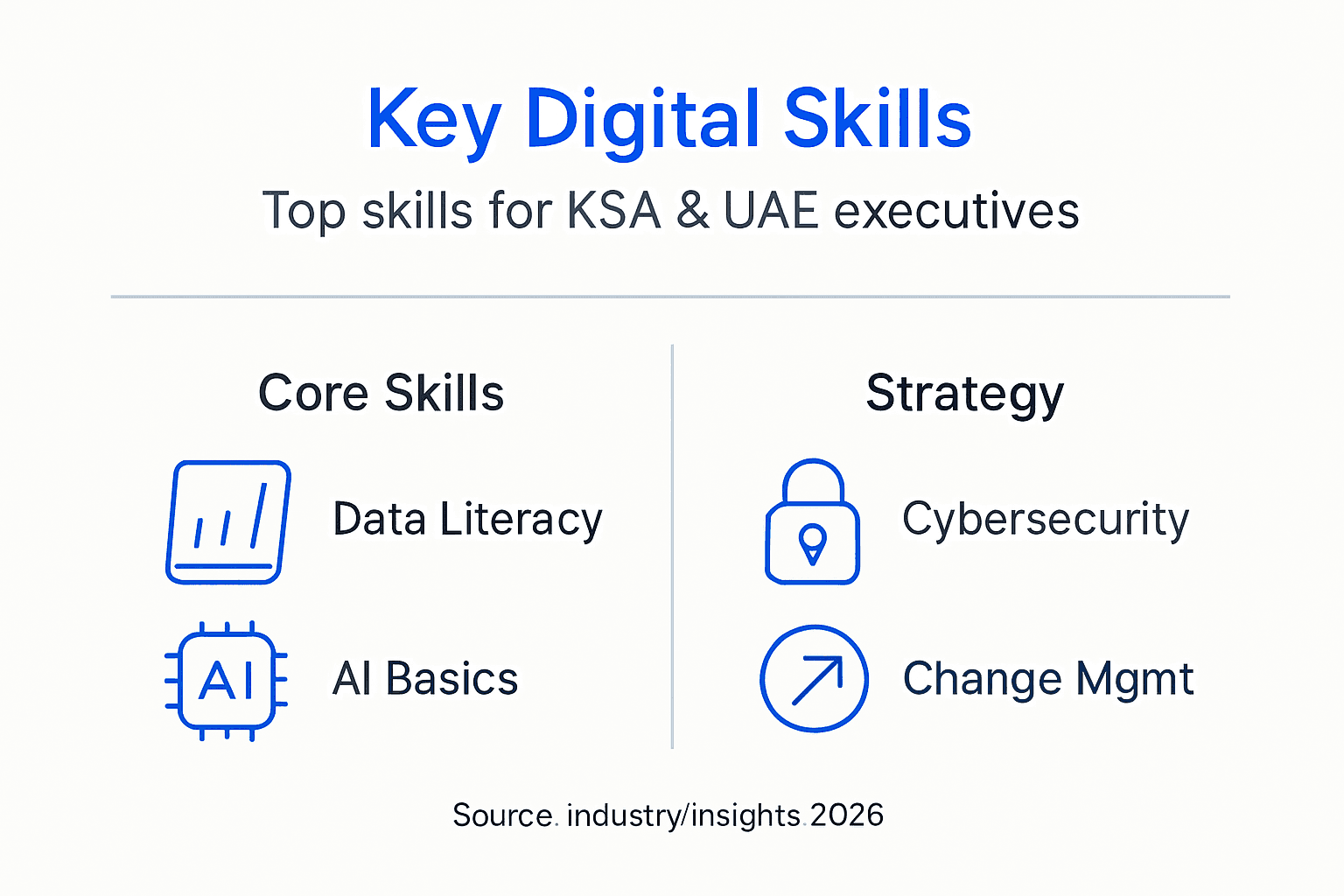
Continuous learning ensures your skills remain relevant as technology evolves. Commit to regular education through courses, conferences, and hands-on experimentation with essential digital skills for leaders.
| Skill Area | Executive Application | Business Impact |
|---|---|---|
| Data Literacy | Interpret dashboards, approve analytics investments | Faster, evidence-based decisions |
| AI Understanding | Evaluate use cases, oversee implementations | Competitive advantage through automation |
| Cybersecurity | Assess risks, approve security budgets | Protected assets and reputation |
| Change Management | Lead adoption, address resistance | Successful technology implementations |
| Continuous Learning | Stay current with emerging tech | Sustained competitive positioning |
Pro Tip: Dedicate two hours weekly to hands-on learning. Test a new tool, attend a webinar, or shadow your IT team. Direct experience builds intuition faster than passive reading.
Common Misconceptions That Hinder Digital Skills Adoption
Many executives believe digital skills mean coding or deep technical expertise. This misconception creates unnecessary barriers. What you need is strategic digital fluency, the ability to understand how technology creates business value, not how to build it yourself.
Another damaging myth suggests digital skills are optional for senior leaders. The evidence contradicts this. 70% of digital transformation initiatives fail due to leadership digital skill deficiencies. When you lack digital competence, you cannot evaluate proposals effectively, allocate budgets wisely, or guide teams through complex implementations.
Some leaders assume their existing business acumen suffices for the digital age. Traditional skills remain important, but insufficient. Technology fundamentally changes how value is created, delivered, and captured. Without digital literacy, you miss opportunities, misinterpret risks, and make suboptimal strategic choices.
“The biggest barrier to digital transformation is not technology. It’s leadership mindset and capability. Executives who refuse to develop digital skills condemn their organizations to irrelevance.”
Misconceptions to reject:
- Digital skills equal technical programming ability
- Senior executives can delegate all technology decisions to IT
- Business experience alone prepares leaders for digital transformation
- Digital skills are relevant only for technology companies
- Learning digital competencies requires years of formal training
Recognizing these misconceptions as false is your first step toward building the capabilities needed for success. Address common executive digital transformation challenges by committing to ongoing digital education and hands-on involvement in technology initiatives.
Regional Challenges and Opportunities in Digital Skills Adoption
KSA and UAE face specific hurdles in developing executive digital capabilities. Local digital talent shortages mean finding qualified trainers and advisors takes more effort. However, government initiatives like Saudi Vision 2030 and UAE’s Digital Government Strategy create supportive ecosystems with funding, infrastructure, and policy incentives for skill development.
Cultural factors influence adoption pace. Organizations with hierarchical structures may struggle to embrace the collaborative, experimental mindset digital transformation requires. Yet regional businesses increasingly recognize that survival depends on adaptation, creating openness to change when leaders champion it effectively.
Critical sectors present both challenges and opportunities. Healthcare, banking, construction, and government demand rigorous security and compliance, complicating technology adoption. These same sectors offer enormous efficiency gains and competitive advantages to organizations that successfully integrate digital capabilities.
Navigating regional adoption barriers:
- Partner with regional experts who understand local business context
- Start with pilot projects to demonstrate value before scaling
- Invest in developing internal digital talent alongside leadership skills
- Leverage government programs and incentives supporting digital transformation
- Build change management capabilities to address cultural resistance
Recognize that regional digital talent challenges and solutions require tailored approaches. Cookie-cutter programs designed for Western markets often miss the mark. Successful executive development blends global best practices with deep understanding of GCC business culture and regulatory environments.
Frameworks for Integrating Digital Skills with Business Strategy
A structured framework ensures digital skills translate into business results. Build yours on five pillars: data literacy, AI and automation, cybersecurity, change management, and continuous learning. Each pillar connects to specific strategic objectives and measurable key performance indicators.
Start by assessing your current state. Where do you and your leadership team stand on each pillar? Identify gaps between current capabilities and what your strategy requires. This honest evaluation guides investment in training, tools, and talent.
Link digital skill development directly to business outcomes. If operational efficiency is a priority, focus initially on automation and process optimization skills. If market expansion drives your strategy, emphasize data analytics and customer experience competencies. This alignment ensures resources flow to highest-impact areas.
Embed digital skill goals in annual planning and performance reviews. When executives know their advancement depends partly on digital capability growth, they prioritize learning. Regular progress reviews maintain accountability and allow course corrections.
| Framework Component | Strategic Link | Success Metric |
|---|---|---|
| Data Literacy | Evidence-based decisions | Reduction in decision cycle time |
| AI & Automation | Operational efficiency | Cost savings and error reduction |
| Cybersecurity | Risk management | Incident frequency and response time |
| Change Management | Technology adoption | User engagement and satisfaction scores |
| Continuous Learning | Innovation capacity | New initiatives launched per quarter |
Implementation best practices:
- Assign executive sponsors to each framework pillar
- Establish quarterly review cycles to track progress
- Celebrate wins publicly to reinforce positive change
- Adjust priorities based on market conditions and results
- Integrate digital skills assessment into leadership succession planning
Your framework should evolve as technology and business needs change. Build in regular review loops to maintain relevance. Explore proven approaches to integrate digital skills with strategy that deliver measurable results in GCC markets.
Pro Tip: Create a simple one-page scorecard tracking your leadership team’s progress on each framework pillar. Review it monthly to maintain focus and momentum.
Practical Tools Supporting Digital Skills Development
Low-code platforms offer executives hands-on experience building digital solutions without programming. You can prototype workflows, design dashboards, and automate processes using visual interfaces. This direct involvement deepens your understanding of what’s possible and builds confidence in evaluating technology proposals. Low-code platforms for executive empowerment accelerate learning by making abstract concepts tangible.
ERP and CRM systems serve as practical laboratories for developing data literacy. Working with these platforms exposes you to how information flows through your organization, where integration points exist, and which metrics matter most. You learn by doing, not just reading reports others prepare.
AI-powered analytics tools deliver predictive insights that support strategic decisions. Using these systems regularly trains your instinct for data-driven thinking. You begin to question assumptions, seek evidence, and recognize patterns that inform better choices. The combination of AI-driven ERP and analytics tools creates powerful capabilities accessible to non-technical leaders.
Tools that accelerate executive digital skill development:
- Low-code platforms for process design and workflow automation
- Business intelligence dashboards for real-time performance monitoring
- Collaboration platforms integrating communication and project management
- AI assistants that surface insights from large datasets
- Simulation tools for testing scenarios before implementation
Combining tools with structured training accelerates your digital maturity. Dedicate time to hands-on experimentation. Build a simple automation, create a custom report, or design a customer journey map using digital tools. These exercises transform theoretical knowledge into practical competence you’ll apply daily.
Conclusion and Next Steps for Executives
Digital skills are no longer optional for executives leading organizations in KSA and UAE. The evidence is clear: leadership digital competency directly impacts operational efficiency, competitive positioning, and financial performance. Organizations with digitally skilled executives achieve measurably better results in transformation initiatives, revenue growth, and market adaptation.
Your path forward requires commitment to continuous learning. Technology evolves constantly, and resting on current knowledge guarantees obsolescence. Invest time weekly in skill development, whether through formal courses, hands-on tool experimentation, or engagement with technology teams.
The frameworks and tools outlined in this article provide a roadmap. Start by assessing your current capabilities honestly. Identify your highest-priority skill gaps based on strategic objectives. Build a personal development plan with specific milestones and accountability mechanisms.
Taking action now positions your organization for sustained success in 2026 and beyond. The digital transformation journey demands leadership that understands technology, embraces change, and guides teams through complexity. Develop these capabilities deliberately, and you’ll outpace competitors still clinging to outdated leadership models.
Pro Tip: Schedule a quarterly digital skills review with trusted peers or advisors. External perspective helps you identify blind spots and stay accountable to your development goals.
Unlock Executive Digital Mastery with Singleclic Solutions
Building digital skills requires more than good intentions. You need practical frameworks, proven tools, and expert guidance tailored to regional business contexts. Singleclic delivers comprehensive solutions that accelerate your digital capability development and transformation success.
Start by evaluating your organization’s readiness. Our ERP readiness assessment identifies gaps and priorities before you invest significant resources. For executives ready to implement automation, our business process automation guide provides step-by-step frameworks proven across 60+ regional enterprises. Transform vision into action using our digital transformation checklist for leaders, designed specifically for GCC executives balancing innovation with operational stability. Partner with Singleclic to future-proof your leadership and achieve the operational efficiency your organization demands.
Frequently Asked Questions
What are the most critical digital skills for executives in KSA and UAE?
Focus on five core competencies: strategic data literacy for evidence-based decisions, functional AI understanding for evaluating use cases, cybersecurity awareness for risk management, change management capabilities to lead adoption, and commitment to continuous learning. These key digital skills for GCC executives deliver measurable business impact without requiring technical programming expertise.
How can executives measure the impact of enhanced digital skills on business performance?
Track operational cost reductions from automation, revenue growth rates compared to industry benchmarks, decision cycle times from weeks to days, and digital transformation project success rates. Monitor employee engagement scores during technology rollouts and customer satisfaction improvements from digital initiatives. These concrete metrics demonstrate return on investment in leadership digital capability development.
What challenges specific to the KSA and UAE should executives anticipate when adopting digital skills?
Expect local digital talent shortages requiring creative recruitment and development strategies, cultural resistance to collaborative and experimental work styles, and sector-specific demands around security and compliance particularly in banking and government. Address these regional digital talent challenges through tailored frameworks combining global best practices with deep understanding of GCC business culture and regulatory environments.
Which practical tools can help executives accelerate their digital skills development?
Leverage low-code platforms for hands-on process design without programming, ERP and CRM systems for developing data literacy through real organizational workflows, and AI-driven analytics for predictive insights supporting strategic decisions. Combine these tools with structured training and dedicated weekly practice time to transform theoretical knowledge into practical competence you’ll apply daily.