Every organization faces moments when outdated workflows slow progress and increase costs. For CIOs and CTOs in Saudi Arabia and UAE, navigating these challenges in healthcare and banking means deciding between minor improvements or a complete process overhaul. By embracing Business Process Reengineering, leaders can achieve dramatic gains in efficiency, quality, and service—fundamentally transforming their operational landscape and setting the stage for sustainable growth.
Table of Contents
- Defining Business Process Reengineering Today
- Key Principles and Common Misconceptions
- Industry Applications in Healthcare and Banking
- Steps and Technology Enablers for Success
- Risks, Pitfalls, and Change Management Musts
- Comparing BPR to Continuous Improvement Initiatives
Key Takeaways
| Point | Details |
|---|---|
| Radical Redesign Focus | Business Process Reengineering (BPR) emphasizes major transformations over minor adjustments, aiming for substantial performance improvements. |
| Core Principles | Successful BPR follows principles like outcome orientation, integrated workflows, and decentralizing decision-making to enhance efficiency. |
| Implementation Strategies | Adopting a holistic approach, including stakeholder engagement and change management, is crucial for effective BPR implementation. |
| Technology Integration | Utilizing modern technologies, such as low-code platforms and AI, can significantly improve the redesign and efficiency of business processes. |
Defining Business Process Reengineering Today
Business Process Reengineering (BPR) represents a strategic approach to organizational transformation that goes beyond incremental improvements. At its core, BPR is about fundamentally rethinking and radically redesigning core business processes to achieve dramatic performance enhancements.
According to research from leading organizational development experts, radical redesign of processes aims to deliver significant gains in critical areas like cost reduction, quality improvement, and service excellence. This methodology is not about minor tweaks, but comprehensive workflow reinvention.
Key characteristics of modern Business Process Reengineering include:
- Focusing on desired organizational outcomes
- Eliminating non-value-adding activities
- Integrating multiple workflow steps
- Empowering employees through structural changes
- Capturing information directly to prevent errors and duplication
Successful BPR implementation requires more than technical modifications. It demands a holistic approach that combines technological innovation, cultural transformation, and strategic alignment. Organizations in Saudi Arabia and UAE, particularly in sectors like banking and healthcare, are increasingly adopting BPR principles to drive operational efficiency.
Pro tip: Start your BPR journey by mapping existing processes comprehensively before attempting any redesign, ensuring you understand current workflow intricacies.
Key Principles and Common Misconceptions
Business Process Reengineering (BPR) operates on a set of fundamental principles that distinguish it from traditional process improvement methodologies. Seven core organizational principles guide successful BPR implementation, transforming how organizations approach workflow design and operational efficiency.
These core principles include:
- Organizing around outcomes instead of isolated tasks
- Enabling process users to perform direct work
- Integrating information processing within workflow activities
- Centralizing dispersed resources strategically
- Linking parallel activities for increased synchronization
- Decentralizing decision-making to operational levels
- Capturing data accurately at its original source
Contrary to popular belief, BPR is not limited to private sector organizations. Common misconceptions about BPR often prevent public sector entities and smaller organizations from leveraging its transformative potential. Many leaders mistakenly view BPR as merely incremental process improvement, when in reality, it represents a radical approach to organizational redesign.
In the context of Saudi Arabian and United Arab Emirates markets, BPR offers a strategic pathway for enterprises across sectors like banking, healthcare, and government services to dramatically enhance operational performance and competitive positioning.
Pro tip: Before initiating a BPR project, conduct a comprehensive organizational readiness assessment to identify potential resistance and develop targeted change management strategies.
Industry Applications in Healthcare and Banking
Business Process Reengineering plays a transformative role in critical sectors like healthcare and banking, offering innovative solutions to complex operational challenges. Improving health information systems represents a prime example of BPR’s potential to revolutionize organizational performance through strategic workflow redesign.
In the healthcare sector, BPR demonstrates remarkable impact through several key applications:
- Streamlining clinical workflow processes
- Reducing operational costs and cycle times
- Enhancing medical equipment management
- Standardizing central sterilization unit operations
- Improving patient safety and service quality
- Supporting sustainable ecological practices
- Minimizing administrative errors
For banking institutions in Saudi Arabia and the United Arab Emirates, BPR offers strategic opportunities to redesign operational workflows with enterprise resource planning (ERP) solutions. By integrating advanced technologies and reimagining traditional processes, financial organizations can achieve unprecedented levels of efficiency, customer satisfaction, and competitive advantage.

The implementation of BPR requires comprehensive change management strategies, top management support, and continuous process refinement. Organizations must approach transformation holistically, engaging operational staff and leveraging technology to create meaningful, sustainable improvements.
Pro tip: Develop a cross-functional BPR implementation team that includes both technological experts and frontline operational staff to ensure comprehensive and practical process redesign.
Steps and Technology Enablers for Success
Business Process Reengineering demands a strategic approach that integrates human expertise, technological innovation, and organizational alignment. Human-technology-organization frameworks provide a comprehensive blueprint for successful transformation, emphasizing the critical interplay between people, processes, and digital capabilities.
Key steps for effective BPR implementation include:
- Conducting thorough current process analysis
- Defining clear organizational objectives
- Engaging stakeholders across all levels
- Developing a robust change management strategy
- Selecting appropriate technological enablers
- Implementing continuous monitoring mechanisms
- Creating adaptive implementation roadmaps
Artificial Intelligence is revolutionizing BPR by enabling more sophisticated process redesign. AI-powered process optimization introduces advanced capabilities like predictive analytics, robotic process automation, and intelligent workflow redesign. In the Saudi Arabian and United Arab Emirates markets, organizations can leverage these technologies to drive unprecedented operational efficiency and competitive advantage.
Modern technology enablers for BPR include our low-code platform Cortex, which allows organizations to design, build, and optimize complex business processes without extensive coding. By supporting real-time process modifications and deep enterprise system integrations, such platforms become critical infrastructure for sustainable organizational transformation.
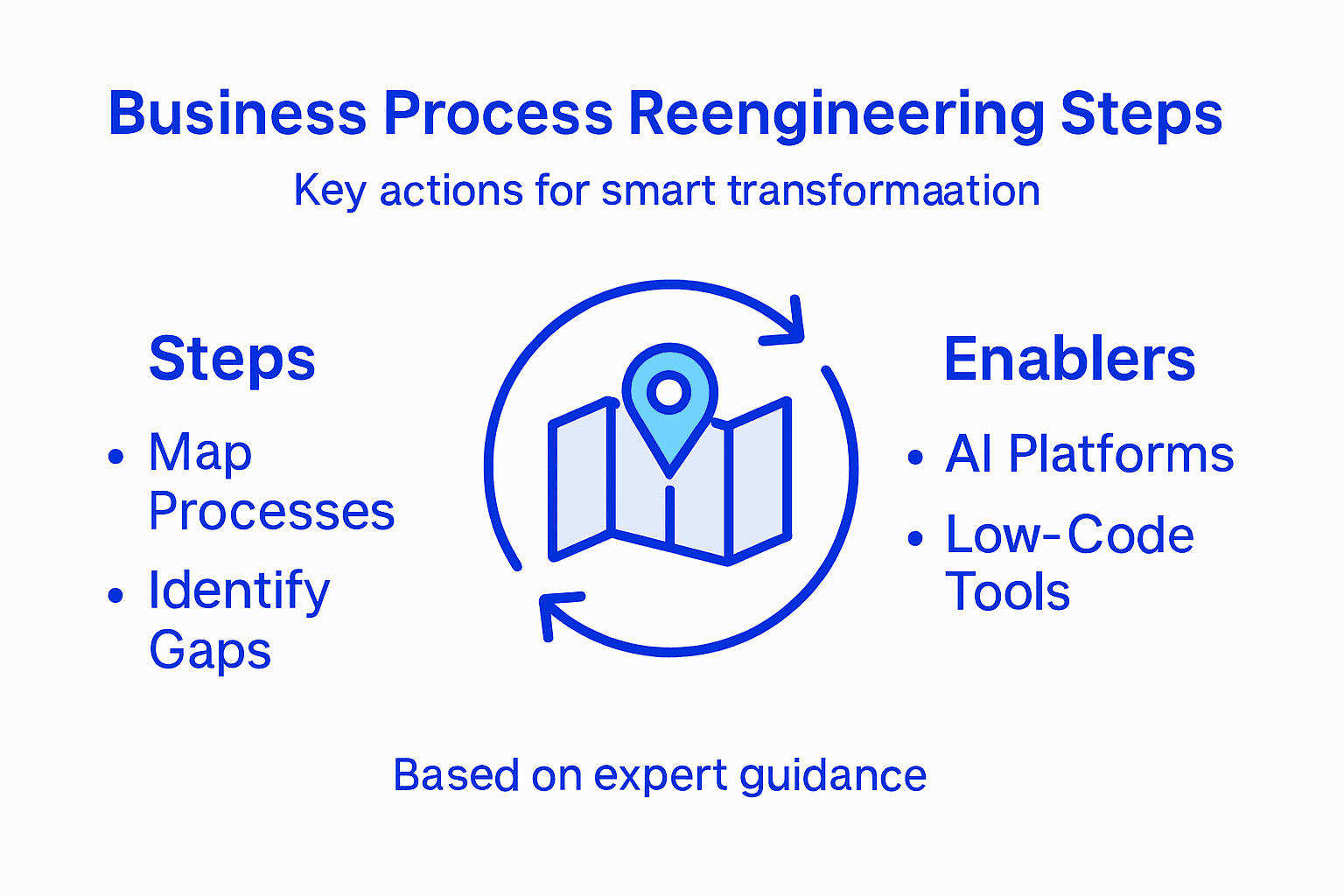
Here’s a summary of key technology enablers that support BPR success:
| Technology Enabler | Main Benefit | Typical Use Case |
|---|---|---|
| Low-code Platforms | Rapid process redesign | Integrating business applications |
| AI and Automation | Reduces manual work | Predictive analytics in operations |
| ERP Solutions | End-to-end visibility | Banking workflow integration |
Pro tip: Create a pilot program that tests BPR strategies in a controlled environment before full-scale implementation, allowing for iterative refinement and minimal organizational disruption.
Risks, Pitfalls, and Change Management Musts
Business Process Reengineering (BPR) is not without significant organizational challenges. Comprehensive risk management becomes critical in navigating the complex landscape of transformational initiatives, particularly in regions like Saudi Arabia and the United Arab Emirates where organizational cultures can vary dramatically.
Common risks and potential pitfalls in BPR implementation include:
- Substantial employee resistance to change
- Inadequate initial process planning
- Misalignment between technology and organizational goals
- Insufficient stakeholder engagement
- Poor communication strategies
- Lack of leadership commitment
- Underestimating cultural transformation requirements
Successful change management requires a multifaceted approach that addresses both technical and human dimensions of organizational transformation. Leaders must create robust communication channels, develop comprehensive training programs, and establish clear narratives that demonstrate the tangible benefits of process redesign for individual employees and the broader organizational ecosystem.
Our low-code platform Cortex provides strategic capabilities to mitigate these risks by enabling flexible, transparent process redesign with real-time modification capabilities. By supporting runtime workflow changes and deep enterprise integrations, organizations can implement BPR more incrementally and with greater adaptability.
Pro tip: Conduct periodic stakeholder sentiment assessments during BPR implementation to proactively identify and address potential resistance points before they escalate into significant organizational barriers.
Comparing BPR to Continuous Improvement Initiatives
Business Process Reengineering and Continuous Improvement represent complementary yet distinctly different approaches to organizational performance enhancement. Strategic process transformation techniques reveal nuanced differences that leaders must understand to select the most appropriate methodology for their organizational context.
Key distinctions between BPR and Continuous Improvement include:
- Scope of change
- Magnitude of transformation
- Implementation complexity
- Investment requirements
- Risk tolerance
- Timeframe for results
- Organizational readiness
Continuous Improvement methodologies like Lean and Six Sigma focus on incremental enhancements, making small, steady progress through systematic optimization. Business Process Reengineering, conversely, represents a more radical approach that fundamentally reimagines entire workflows, potentially involving significant technological investments and organizational restructuring.
Below is a comparison of Business Process Reengineering and Continuous Improvement approaches:
| Aspect | BPR | Continuous Improvement |
|---|---|---|
| Change Scope | Radical and organization-wide | Incremental and ongoing |
| Resource Requirement | High initial investment | Lower, spread over time |
| Typical Outcome | Dramatic performance leap | Steady gains over time |
| Risk Level | Higher due to disruption | Lower, less disruptive |
In the dynamic business landscapes of Saudi Arabia and the United Arab Emirates, organizations must strategically choose between these approaches. Our low-code platform Cortex enables flexible implementation strategies, supporting both incremental improvements and comprehensive process redesign, allowing businesses to adapt their transformation methodologies dynamically.
Pro tip: Conduct a comprehensive organizational diagnostic assessment to determine whether your current challenges require incremental improvements or a more radical business process reengineering approach.
Empower Your Business Process Reengineering with Singleclic Solutions
Business Process Reengineering requires more than simple adjustments. It demands a radical redesign of workflows supported by cutting-edge technology and strategic change management to unlock dramatic gains in efficiency, quality, and service. If your organization in Saudi Arabia, UAE, or Egypt is facing challenges like employee resistance, complex process integrations, or the need for real-time optimization, you need a partner who understands the unique demands of your market and industry.
Singleclic combines deep expertise in ERP & CRM implementation, Business Process Automation, and AI-powered low-code platforms like Cortex to turn your BPR ambitions into sustainable reality. Cortex’s on-premise deployment, full Arabic UI/UX, and runtime workflow flexibility address the core BPR principles of eliminating non-value activities and enabling dynamic process redesign without downtime. Discover how our end-to-end solutions help transform complex workflows in banking, healthcare, telecom, and government sectors into streamlined operations designed for growth.
Ready to drive smart change through Business Process Reengineering and elevate your operational efficiency? Visit Singleclic’s homepage and explore our Business Process Automation and AI & Low-Code Platform Development services today. Take the next step toward transformative optimization today.
Frequently Asked Questions
What is Business Process Reengineering (BPR)?
Business Process Reengineering (BPR) is a strategic approach that involves fundamentally rethinking and radically redesigning core business processes to achieve significant performance improvements.
How does BPR differ from Continuous Improvement initiatives?
BPR focuses on radical, organization-wide changes that can lead to dramatic performance leaps, while Continuous Improvement emphasizes incremental enhancements and ongoing optimization of existing processes.
What are the key principles of successful BPR implementation?
Successful BPR implementation typically involves organizing around outcomes, empowering process users, integrating information processing within workflows, and engaging stakeholders across all levels.
What role does technology play in Business Process Reengineering?
Technology, including low-code platforms and Artificial Intelligence, enables organizations to redesign processes more efficiently, automate manual tasks, and improve overall operational effectiveness.
Recommended
- Business Process Reengineering Guide for Optimized Operations
- Change Management Process Workflow for Efficient Operations
- Business Process Automation Solutions | Singleclic
- Unlocking Efficiency: How Business Process Automation Reduces Costs and Boosts Productivity | Singleclic
- Website Redesign Step by Step for Business Growth – Lind Creative
- INUSUAL | Cambio Organizacional: Clave Para Culturas Ágiles