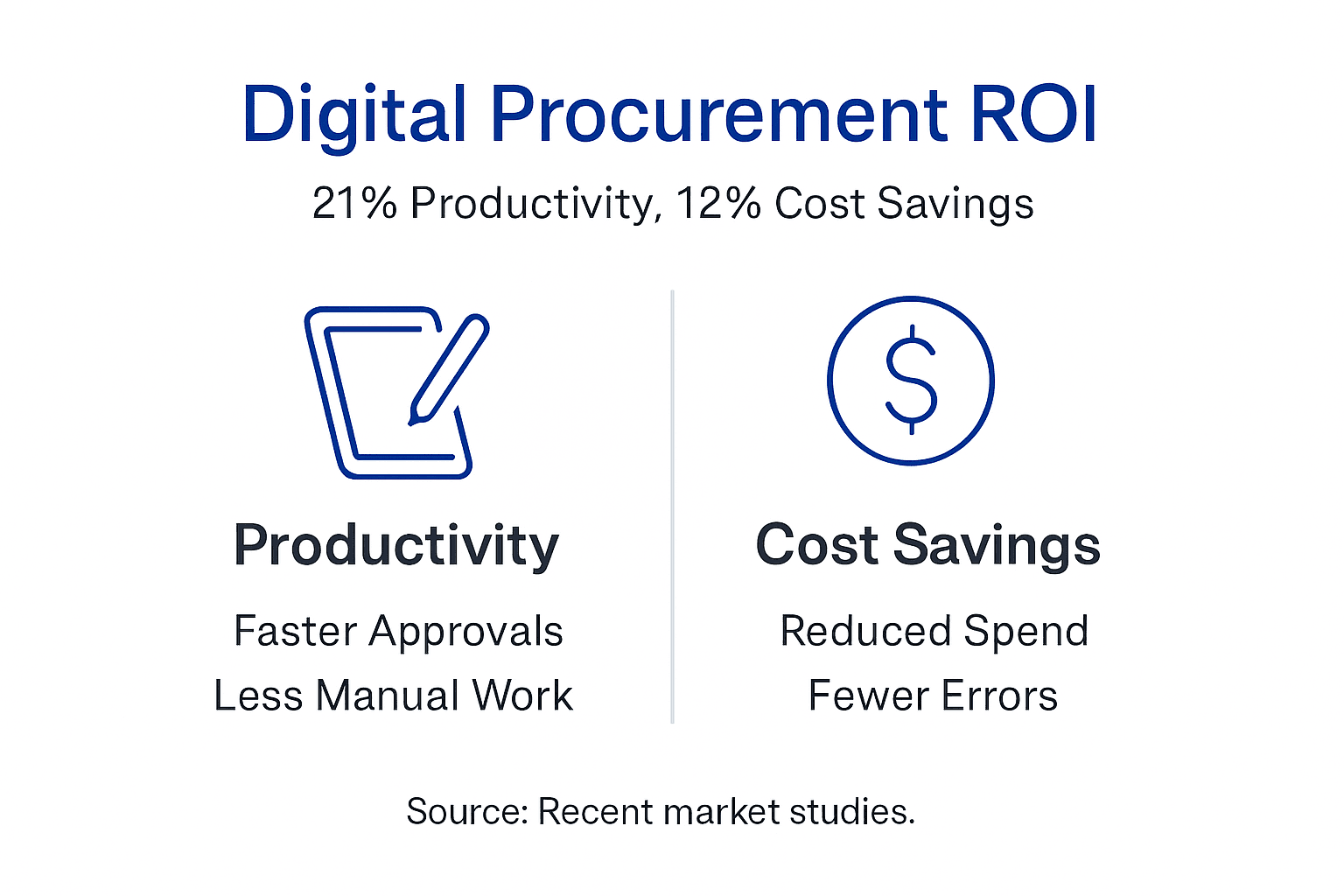
Organizations adopting digital procurement tools can increase productivity by 21%, reduce costs by 12%, and improve revenue by 11% within 12 to 18 months. For C-level executives in KSA and UAE, these numbers aren’t abstract promises. They represent measurable transformation in how procurement teams operate daily. This guide clarifies what digital procurement truly means, the technologies enabling it, quantified ROI, common pitfalls to avoid, proven implementation frameworks, and specific impacts across regional sectors from construction to healthcare.
Table of Contents
- Definition And Scope Of Digital Procurement
- Key Technologies Driving Digital Procurement
- Quantified Benefits And ROI Of Digital Procurement
- Common Misconceptions And Pitfalls In Digital Procurement
- Implementation Frameworks And Best Practices
- Regional Relevance: Digital Procurement In KSA And UAE
- Discover Singleclic’s Solutions For Digital Procurement Success
Key Takeaways
| Point | Details |
|---|---|
| Definition & Scope | Digital procurement automates manual workflows using AI, RPA, and cloud platforms to transform traditional buying processes. |
| Core Technologies | AI-driven analytics, robotic process automation, blockchain verification, and predictive modeling power modern procurement systems. |
| Quantified ROI | Adoption delivers 21% productivity gains, 12% cost reductions, and 11% revenue improvements within 12 to 18 months. |
| Implementation Success | Executive sponsorship, phased rollouts, stakeholder engagement, and continuous optimization prevent common failure points. |
| Regional Impact | KSA and UAE sectors like construction, healthcare, and banking gain workflow efficiency, compliance improvement, and accelerated growth. |
Definition and Scope of Digital Procurement
Digital procurement represents a fundamental shift from manual, paper-based purchasing to intelligent, automated workflows powered by technology. Unlike traditional procurement that relies on spreadsheets and email chains, digital procurement automates manual tasks, consolidates data, improves workflows, and enhances communication and supplier relationship management. It goes beyond simple digitization of documents.
The evolution follows three distinct stages. Traditional procurement depends on human judgment for every decision, creating bottlenecks and inconsistency. E-procurement introduced online catalogs and basic digital workflows but still required significant manual intervention. Digital procurement integrates artificial intelligence, machine learning, and advanced analytics to make autonomous decisions, predict needs, and optimize spending patterns without constant human oversight.
Key distinctions include:
- Traditional procurement operates through paper requisitions, manual approvals, and disconnected supplier communications
- E-procurement digitizes forms and catalogs but maintains linear, human-driven approval chains
- Digital procurement employs intelligent automation, real-time analytics, predictive ordering, and seamless ERP integration
- Advanced systems learn from historical data to recommend suppliers, flag anomalies, and optimize contract terms automatically
This transformation aligns with broader digital roadmap for operational excellence initiatives that C-level leaders pursue across enterprise functions. The technology stack enables procurement teams to shift from transactional execution to strategic value creation, focusing on supplier innovation and risk management rather than processing purchase orders.
Key Technologies Driving Digital Procurement
Four core technologies transform procurement from reactive purchasing to proactive value creation. Understanding each component helps leaders evaluate platforms and build business cases for adoption.
Artificial Intelligence analyzes spend patterns across thousands of transactions to identify savings opportunities, predict demand fluctuations, and recommend optimal suppliers based on performance history. Machine learning models improve continuously, adapting to changing business needs without manual reprogramming.
Robotic Process Automation handles repetitive tasks like invoice matching, purchase order creation, and supplier onboarding. RPA bots work 24/7 without errors, processing hundreds of transactions per hour that would take procurement teams days to complete manually.
Blockchain technology creates immutable records of supplier certifications, contract terms, and payment histories. This transparency reduces fraud risk, accelerates dispute resolution, and builds trust across supply chains, particularly valuable in regulated industries like healthcare and banking.
Predictive analytics forecast material price changes, supplier delivery risks, and demand variations. Procurement teams receive early warnings about potential disruptions, enabling proactive mitigation strategies rather than reactive crisis management.
Integration of AI, RPA, blockchain, and predictive analytics automate tasks and improve procurement decisions across the entire source-to-pay cycle. The low-code procurement automation approach makes these technologies accessible even for organizations without extensive IT resources.
| Feature | AI-Driven Analytics | Traditional Spend Reporting |
|---|---|---|
| Data Processing | Real-time analysis of millions of transactions | Monthly manual report compilation |
| Insight Generation | Predictive recommendations and anomaly detection | Historical trend descriptions |
| Decision Support | Automated approval routing and supplier selection | Human review of static dashboards |
| Accuracy | 99%+ with continuous learning | 85-90% with periodic updates |
| Response Time | Instant alerts and adjustments | Days to weeks for actionable insights |
Pro Tip: Focus on technologies that integrate seamlessly with your existing ERP and financial systems. Standalone tools create data silos that undermine the connectivity digital procurement promises.
Quantified Benefits and ROI of Digital Procurement
The business case for digital procurement rests on documented, repeatable performance improvements across productivity, cost control, and revenue generation. Research shows digital procurement adoption increases productivity by 21%, reduces costs by 12%, and improves revenue by 11% within 12 to 18 months.
Productivity gains stem from eliminating manual data entry, accelerating approval cycles, and freeing procurement professionals to focus on strategic supplier relationships rather than administrative tasks. Teams complete in hours what previously took weeks.

Cost reductions emerge through multiple mechanisms. Automated spend analysis identifies maverick purchasing where employees bypass negotiated contracts. Contract compliance monitoring prevents price leakage where suppliers charge more than agreed terms. Consolidated purchasing power across business units unlocks volume discounts previously fragmented across departments.
Standardizing procurement processes through digital tools eliminates inefficiencies and improves compliance, reducing audit findings and regulatory risks that carry significant financial penalties in sectors like healthcare and banking.
| Benefit Category | Typical Impact | Timeframe to Realize |
|---|---|---|
| Productivity Increase | 15-25% | 6-12 months |
| Cost Reduction | 10-15% | 12-18 months |
| Revenue Improvement | 8-12% | 12-24 months |
| Process Cycle Time | 40-60% faster | 3-6 months |
| Compliance Score | 25-35% improvement | 6-12 months |
Top value drivers enhancing procurement outcomes:
- Automated invoice matching reduces processing costs by 70% while eliminating payment errors
- Real-time spend visibility enables proactive budget management and prevents overspending
- Supplier performance scorecards identify underperforming vendors before they cause delivery failures
- Contract lifecycle management ensures renewals occur at optimal times, preventing unfavorable auto-renewals
- Predictive analytics forecast price increases, allowing strategic early purchasing or alternative sourcing
Key Statistic: Organizations achieve 21% productivity improvements by automating routine procurement tasks, allowing teams to focus on supplier innovation and risk management initiatives that drive competitive advantage.
The ROI extends beyond direct savings. Faster procurement cycles accelerate project timelines in construction and real estate. Improved supplier relationships in healthcare ensure medical supply continuity. Enhanced compliance in banking reduces regulatory exposure. These strategic benefits compound over time, as documented in studies of digital leadership in KSA procurement and broader ERP investment benefits.
Common Misconceptions and Pitfalls in Digital Procurement
Successful adoption requires clearing misconceptions that lead organizations to underestimate complexity or overestimate immediate results. Four myths particularly hinder progress.
Myth one suggests digital procurement simply means scanning paper documents into PDFs. Reality involves redesigning workflows, integrating systems, and changing how teams make decisions. Document digitization is step one of ten.
Myth two assumes technology alone drives transformation. Resistance to change and misbelief that digital procurement only digitizes paperwork are common barriers. Without change management, training, and cultural shifts, even the best platforms fail to deliver promised benefits.
Myth three claims only large enterprises benefit from digital procurement. Small and medium organizations in KSA and UAE often see faster ROI because they have fewer legacy systems to integrate and more agile decision-making processes. Cloud-based platforms eliminate the infrastructure investments that once created barriers to entry.
Myth four promises instant results. Digital procurement delivers transformative benefits, but realization follows a maturity curve. Quick wins appear in 3 to 6 months. Substantial ROI materializes in 12 to 18 months. Full optimization takes 24 to 36 months as teams develop expertise and refine processes.
Common failure points include:
- Insufficient executive sponsorship leading to budget cuts when initial challenges emerge
- Technology selection based on features rather than integration capabilities with existing systems
- Inadequate user training creating frustration and workarounds that undermine adoption
- Neglecting ongoing process optimization after initial implementation completes
- Underestimating data quality requirements, resulting in flawed analytics and poor decisions
The digital procurement pitfalls in MENA mirror global patterns but include regional factors like multilingual requirements, local regulatory compliance, and integration with government procurement portals.
Pro Tip: Establish a cross-functional steering committee with procurement, IT, finance, and operations representation from day one. Early stakeholder engagement and ongoing communication prevent the isolated IT project syndrome that dooms many digital initiatives.
Implementation Frameworks and Best Practices
A structured approach separates successful digital procurement transformations from abandoned pilots. The following framework provides a proven sequence for organizations in KSA and UAE.
- Conduct a comprehensive procurement maturity assessment examining current processes, technology landscape, team capabilities, and pain points
- Define clear, measurable objectives tied to business outcomes rather than technology features
- Secure executive sponsorship with visible CEO or CFO commitment and dedicated budget allocation
- Select technology partners based on regional experience, integration capabilities, and post-implementation support
- Design future-state processes before configuring software, avoiding the trap of automating broken workflows
- Execute phased rollout starting with high-impact, low-complexity use cases to build momentum
- Invest heavily in change management and training, allocating 30% of project budget to people initiatives
- Establish governance mechanisms for continuous monitoring, feedback collection, and process refinement
- Measure and communicate wins regularly, celebrating teams and reinforcing adoption behaviors
- Scale systematically across business units and geographies after proving value in initial deployment
Executive buy-in and strategic change management are essential for realizing benefits from digital procurement. Leaders must visibly champion the initiative, participate in steering committees, and hold teams accountable for adoption metrics.
E-procurement systems form the foundation. Implementing e-procurement automates requests, approvals, and contract management, reducing maverick spending and increasing transparency across the procurement lifecycle.
Critical success factors:
- Clear communication of why change matters, connecting procurement transformation to organizational strategy
- Realistic timelines that account for learning curves and process refinement
- Data migration strategy ensuring historical spend analysis supports future decisions
- Integration architecture linking procurement platforms with ERP, finance, and supplier systems
- Performance metrics balancing efficiency gains with strategic objectives like supplier diversity
The digital roadmap for operational excellence and digital transformation roadmap provide broader context for procurement initiatives within enterprise optimization programs. Procurement transformation rarely succeeds in isolation from finance, operations, and IT modernization efforts.
Pro Tip: Launch with a 90-day sprint focused on one high-visibility pain point, like reducing purchase order approval time from five days to five hours. Quick wins build credibility and momentum for longer-term process redesign.
The digital audit workflow optimization approach applies equally to procurement, ensuring controls and compliance requirements embed naturally into automated workflows rather than becoming post-implementation additions.
Regional Relevance: Digital Procurement in KSA and UAE
The KSA and UAE business environment creates unique drivers and opportunities for digital procurement adoption. Economic diversification initiatives, major infrastructure programs, and digital government mandates accelerate transformation across sectors.
Construction and real estate companies face complex multi-tier supplier networks, fluctuating material costs, and tight project timelines. Digital procurement enables real-time supplier performance tracking, predictive ordering to prevent material shortages, and automated compliance verification for safety certifications.
Healthcare organizations manage thousands of medical supply SKUs with strict regulatory requirements and life-critical availability needs. Procurement platforms provide lot traceability, expiration date management, and automated reordering based on consumption patterns, reducing stockouts while minimizing waste.
Banking and financial services require rigorous vendor due diligence, contract audit trails, and segregation of duties controls. Digital procurement embeds compliance checks into workflows, creates immutable approval records, and flags policy violations before transactions complete.
Government entities pursue transparency mandates, local content requirements, and e-government integration. Procurement systems generate automated reports for regulatory submissions, track SME participation, and connect seamlessly with national procurement portals.
Sector-specific impacts and regional challenges:
- Construction projects reduce material cost overruns by 15% through predictive analytics and supplier diversification
- Healthcare facilities improve medical supply availability to 99.5% while cutting inventory carrying costs by 20%
- Banks accelerate vendor onboarding from 45 days to 7 days while strengthening due diligence documentation
- Government agencies increase contract transparency scores by 40% and reduce procurement cycle times by 50%
- Common challenges include Arabic language requirements, integration with local ERP systems, and training teams accustomed to manual processes
Digital procurement in MENA sectors like construction, healthcare, and banking improves workflows, reduces downtime, and accelerates growth by addressing region-specific operational complexities.
The digital procurement success in MENA demonstrates how organizations overcome language barriers, regulatory complexity, and legacy system constraints through thoughtful platform selection and phased implementation strategies.
Regional procurement leaders prioritize platforms offering Arabic interfaces, local currency and tax handling, integration with government systems, and support from vendors with in-country presence. These requirements narrow technology options but ensure solutions address actual operational needs rather than generic global features.
Discover Singleclic’s Solutions for Digital Procurement Success
Singleclic delivers end-to-end digital procurement transformation for organizations across KSA, UAE, and Egypt. As an Odoo Silver Partner and Microsoft Dynamics 365 integrator, we implement ERP systems that embed procurement intelligence into your operational core. Our IBM BAW and BonitaSoft expertise automates approval workflows, eliminating bottlenecks that slow purchasing cycles.
C-level executives exploring digital procurement should assess ERP readiness to understand current capabilities and gaps. Our AI in ERP transformation approach embeds predictive analytics and intelligent automation directly into procurement modules. The business process automation guide outlines how procurement optimization fits within broader operational excellence initiatives.
Frequently Asked Questions
What are the first steps to start digital procurement?
Begin with a maturity assessment evaluating current processes, technology infrastructure, and team readiness. Identify high-impact pain points like slow approval cycles or maverick spending. Secure executive sponsorship and define measurable objectives before selecting technology platforms.
How does digital procurement improve supplier relationships?
Automated performance tracking provides objective data for supplier discussions. Self-service portals reduce administrative burden on suppliers while improving communication transparency. Predictive analytics enable collaborative demand planning, helping suppliers optimize their operations to serve you better.
Can SMEs in KSA and UAE benefit from digital procurement?
Absolutely. Cloud-based procurement platforms eliminate infrastructure costs that once created barriers. SMEs often see faster ROI due to simpler processes and quicker decision-making. Many platforms offer modular pricing, allowing organizations to start small and scale as benefits materialize.
What role does data security play in digital procurement?
Procurement systems access sensitive supplier contracts, pricing data, and competitive information. Platforms must provide encryption, role-based access controls, and audit trails. For banking and government sectors, on-premise deployment options address data sovereignty requirements while maintaining functionality.
How long does it take to see ROI from digital procurement solutions?
Quick wins like faster approval cycles appear within 3 to 6 months. Measurable cost reductions and productivity gains materialize in 12 to 18 months. Full optimization including cultural adoption and process maturity takes 24 to 36 months. Phased implementation delivers incremental value throughout the journey.
What integration capabilities should procurement platforms provide?
Essential integrations include ERP systems for financial data synchronization, supplier portals for order and invoice exchange, contract management systems for compliance tracking, and business intelligence tools for advanced analytics. API availability ensures future connectivity as your technology ecosystem evolves.