TL;DR:
- Data privacy has become a strategic, board-level concern in Saudi Arabia and the UAE, with enforcement actions and penalties increasing. Organizations must adopt operational controls, appoint clear ownership, and leverage low-code technology to ensure compliance across multiple jurisdictions and legacy systems. Proper integration of privacy into daily processes builds customer trust, reduces risks, and transforms regulatory obligations into a competitive advantage.
Data privacy is not an IT checkbox. For executives in Saudi Arabia and the UAE, the role of data privacy has shifted into a board-level strategic concern, one with real financial, legal, and reputational consequences. Both kingdoms are now enforcing personal data protection laws with active investigations and published penalties. Yet many organizations still treat privacy as a compliance afterthought, something legal or IT handles quietly in the background. That thinking is expensive. This article walks you through the regulatory terrain, the operational controls that actually work, and where technology can close the gaps faster than you might expect.
Table of Contents
- Key takeaways
- The role of data privacy: definitions and principles
- Saudi Arabia and UAE data privacy regulations
- Operational best practices for data privacy programs
- Technology platforms and data privacy compliance
- Common pitfalls in data privacy programs
- My perspective on where executives get this wrong
- How Singleclic supports data privacy governance in the Gulf
- FAQ
Key takeaways
| Point | Details |
|---|---|
| Regulations carry real teeth | Saudi Arabia has issued 48 PDPL enforcement decisions and imposes fines up to SAR 5 million per violation. |
| UAE is a multi-layered environment | Federal PDPL, DIFC, and ADGM each have distinct rules. A single compliance workflow will not cover all three. |
| Legacy data is a hidden liability | PDPL scope covers archives and backups, not just active systems. Many organizations miss this entirely. |
| Technology accelerates compliance | Low-code platforms can automate consent workflows and breach notifications without expensive custom development. |
| Privacy protects more than data | Organizations that build privacy into operations earn stronger customer trust and suffer fewer enforcement surprises. |
The role of data privacy: definitions and principles
Before getting into local laws, it helps to understand what data privacy actually means as a discipline, and how it differs from data security. Data privacy, formally known as information privacy, governs how personal data is collected, used, shared, and retained. Data security, by contrast, focuses on protecting data from unauthorized access. You can have excellent security and still have a privacy violation if you use customer data in ways they did not consent to.
The foundational principles of modern privacy law, drawn from frameworks like the EU’s GDPR, include:
- Lawfulness and consent. Data must be collected with a legal basis, most commonly explicit consent from the individual.
- Purpose limitation. Data collected for one purpose cannot be repurposed without fresh consent or legal justification.
- Data minimization. Collect only what you need. Storing data “just in case” is a liability, not an asset.
- Data subject rights. Individuals have rights to access, correct, delete, and port their data.
- Accountability. Organizations must be able to demonstrate compliance, not just claim it.
The GDPR, now in its tenth year since enforcement began in 2018, serves as the global reference point for these principles. Both Saudi Arabia and the UAE built their frameworks with GDPR as a benchmark, though each has distinct local characteristics that matter greatly for compliance planning.
Understanding these core principles is the starting point for data privacy explained at the operational level. They are not abstract ideals. They translate directly into policies, contracts, system configurations, and staff behavior.
Saudi Arabia and UAE data privacy regulations
The importance of data privacy in KSA and UAE becomes concrete when you look at what each jurisdiction actually requires, and what happens when you fall short.
Saudi Arabia’s PDPL
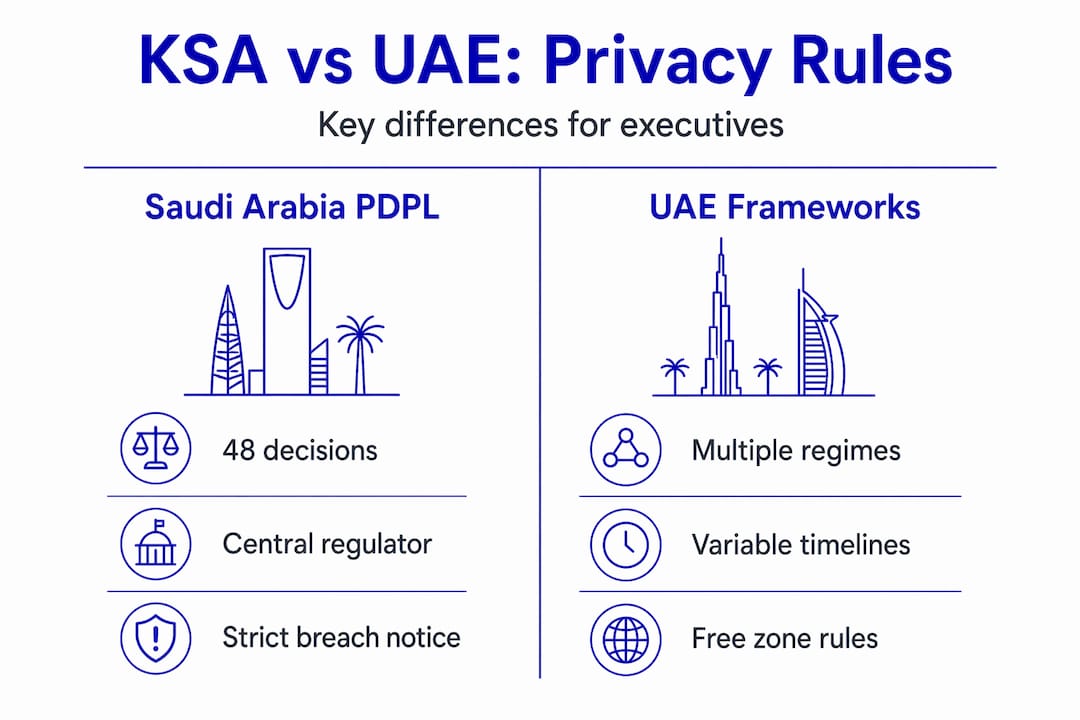
Saudi Arabia’s Personal Data Protection Law (PDPL), enforced by the Saudi Data and Artificial Intelligence Authority (SDAIA), applies to any organization processing the personal data of Saudi residents, regardless of where the organization is headquartered. The law covers controller and processor roles similar to GDPR, imposes specific requirements around sensitive data categories (health, financial, genetic), and mandates a 72-hour breach notification window for incidents affecting personal data. Penalties are not symbolic. Fines reach SAR 5 million per violation, and criminal penalties including imprisonment apply for unlawful handling of sensitive data. As of January 2026, SDAIA had issued 48 enforcement decisions, a signal that supervision is active, not theoretical.
UAE’s layered framework
The UAE presents a more complex picture. Organizations operating in the UAE may fall under multiple regimes simultaneously. The comparison below illustrates the key differences:
| Regime | Scope | Breach notification | Key regulator |
|---|---|---|---|
| UAE Federal PDPL | Mainland businesses processing personal data | Not yet fully specified | UAE Data Office |
| DIFC Data Protection Law | DIFC-based entities and cross-border transfers | 72 hours to Commissioner | DIFC Commissioner of Data Protection |
| ADGM Data Protection Regulations | ADGM-based entities | 72 hours to FSRA | ADGM Registration Authority |
The DIFC and ADGM regimes maintain separate procedures for legal bases, breach notification timelines, and data subject request handling. If your organization operates in both a free zone and the mainland, you cannot use a single compliance program to satisfy all three regulators. Each requires its own tailored approach.
The impact of data privacy laws in the region is also reputational. Government and enterprise procurement processes increasingly require proof of data privacy compliance. Not having it costs contracts, not just penalties.
Operational best practices for data privacy programs
Getting privacy compliance off the ground requires more than a policy document. Here is what actually moves the needle in organizations across Saudi Arabia and the UAE:
- Appoint clear ownership. A Data Protection Officer (DPO) or designated privacy lead needs formal authority, access to senior leadership, and a defined escalation path. Privacy champions embedded in business units help translate policy into daily practice.
- Build your Records of Processing Activities (ROPA). This is a structured inventory of every process that touches personal data, including the legal basis, data categories, retention periods, and third-party processors involved. Without a ROPA, you cannot assess your exposure.
- Conduct Data Protection Impact Assessments (DPIAs). Any new system, product, or business process that involves significant data processing should go through a DPIA before launch, not after.
- Cover your entire data lifecycle. PDPL compliance requires lifecycle-wide data inventory, including archives, backups, and legacy systems. This is one of the most frequently missed requirements during audit preparation.
- Integrate breach response with security incident management. Aligning privacy breach notification with cybersecurity incident response runbooks means your team can meet the 72-hour reporting window without scrambling. The two disciplines must work from the same playbook.
- Manage cross-border transfers explicitly. Both PDPL and UAE laws restrict transfers of personal data outside the country without adequate safeguards. This affects cloud vendors, SaaS tools, and international HR systems.
- Train staff regularly and document it. Privacy awareness training reduces the human error that causes most data incidents. It also demonstrates accountability to regulators if an incident does occur.
Pro Tip: When building your data subject request (DSR) workflow, design it to route requests by jurisdiction from day one. UAE organizations with mainland and free zone operations need separate processing tracks to satisfy multi-jurisdiction regulator expectations independently.
For a structured approach to compliance in KSA and UAE, the frameworks that work best are the ones built into operations, not layered on top.

Technology platforms and data privacy compliance
How to ensure data privacy in the digital age is increasingly a technology question, not just a governance question. The good news is that you do not need to build complex custom systems to get there. Low-code platforms have changed the equation significantly for organizations in Saudi Arabia and UAE.
Singleclic’s Cortex platform, an Arabic-enabled, on-premise low-code platform built for MENA enterprises, allows organizations to design and automate privacy workflows without writing code. Consent capture, data subject request routing, breach notification timelines, and ROPA maintenance can all be automated through configurable workflows. For banks and government entities in KSA and UAE, on-premise deployment keeps data within national borders, which addresses cross-border transfer restrictions directly.
Beyond low-code, technology helps in several specific ways. Automated consent management platforms capture and record consent at the point of collection, creating an auditable trail. AI-assisted data classification tools identify where sensitive data lives across your systems, including in legacy databases that manual audits often miss. Integration with ERP and CRM systems means privacy controls operate within the business processes your teams already use, rather than in a separate compliance silo.
The balance to maintain is between innovation speed and privacy protection. New product features, AI models, and customer-facing applications all process personal data. Building privacy review into your product development cycle, not as a final gate but as a recurring checkpoint, keeps both regulators and customers satisfied.
Pro Tip: When evaluating any new SaaS tool or enterprise platform, require vendors to provide a Data Processing Agreement (DPA) and a record of their sub-processor list before contracting. This protects your organization under both PDPL and UAE laws and is faster than conducting a full privacy audit after deployment.
Common pitfalls in data privacy programs
Even organizations with dedicated privacy teams fall into patterns that create risk. These are the mistakes Singleclic sees most frequently among businesses in KSA and UAE:
- Assuming GDPR compliance is enough. GDPR is a useful foundation, but Saudi PDPL and UAE laws have distinct requirements, including specific rules around sensitive data categories and local residency obligations. GDPR-ready does not mean regionally compliant.
- Treating free zones as outside the compliance scope. Operating in DIFC or ADGM does not exempt an organization from data privacy obligations. It adds a separate, parallel set of them. Many executives underestimate this.
- Ignoring legacy systems and backup archives. Data stored in older systems, decommissioned applications, or tape backups still falls under PDPL’s scope. A compliance program that only covers active production databases is incomplete.
- Running privacy and cybersecurity as separate functions. When a data breach occurs, both teams need to act within hours. Disconnected incident response processes make it nearly impossible to meet notification deadlines.
- Failing to document DSR handling. Regulators do not just want to know you responded to a data subject request. They want to see the workflow, the timeline, the outcome, and the record. Undocumented responses are treated the same as no response.
These pitfalls are avoidable. The common thread is treating privacy as a one-time project rather than a continuously managed function within your organization’s operations.
My perspective on where executives get this wrong
I’ve worked with organizations across Saudi Arabia, the UAE, and Egypt through compliance transformations, and the pattern I keep seeing is the same. Executives understand that data privacy matters in principle. What they underestimate is how fast the enforcement environment is moving and how much operational readiness actually requires.
In my experience, the biggest gap is not in policy documentation. It is in the connection between the compliance framework and what actually happens when a system fails or a staff member makes a mistake. You can have a perfect ROPA and a signed DPO appointment letter, and still miss a 72-hour notification window because your security and privacy teams operate from different runbooks.
What I’ve learned after working through dozens of these programs is that data governance for C-level leaders is not about legal defensiveness. It is about operational maturity. The organizations that handle privacy well are the ones that have integrated it into how they build, hire, procure, and operate. Privacy readiness becomes a competitive signal to enterprise customers and government partners who are now asking for it explicitly in RFPs.
My honest advice: stop waiting for a regulatory incident to force the investment. The PDPL and UAE privacy laws are not constraints on your business. They are a framework that, when properly implemented, gives your customers a reason to trust you with their data. That trust is a business asset, and it compounds.
— Tamer
How Singleclic supports data privacy governance in the Gulf
Singleclic works with organizations across Saudi Arabia, the UAE, and Egypt to integrate privacy compliance into their core operations, not as a separate workstream, but as part of how they run ERP, CRM, and business process automation. Whether you are preparing for a PDPL audit, mapping your data flows across a multi-jurisdiction UAE structure, or automating your breach response workflow, the Singleclic team brings both regional regulatory knowledge and proven technology delivery. The ERP implementation checklist for the Middle East is a practical starting point for aligning your enterprise systems with compliance requirements. For executives looking to automate privacy workflows at scale, the business process automation guide covers how to build audit-ready, privacy-conscious processes from the ground up. Reach out to Singleclic directly to discuss what a tailored privacy governance program looks like for your organization.
FAQ
What is the role of data privacy for businesses in Saudi Arabia?
Data privacy in Saudi Arabia means complying with the PDPL, which requires lawful data collection, breach notification within 72 hours, and protection of sensitive personal data. Non-compliance carries fines up to SAR 5 million per violation and potential criminal penalties.
How does the UAE data privacy framework differ from Saudi PDPL?
The UAE operates under a federal PDPL and separate DIFC and ADGM free zone regulations, each with distinct breach notification rules and legal bases for processing. Organizations with operations in multiple UAE jurisdictions must maintain separate compliance workflows for each regime.
What are the most important data privacy best practices for executives?
Appoint a Data Protection Officer, maintain a Records of Processing Activities document, conduct Data Protection Impact Assessments for new systems, and align breach notification with your cybersecurity incident response process. These four actions address the majority of regulatory exposure under both PDPL and UAE laws.
Does GDPR compliance satisfy Saudi PDPL requirements?
No. While both frameworks share core principles, Saudi PDPL includes specific local requirements around sensitive data categories, data residency, and breach notification that GDPR compliance alone does not satisfy. Organizations need a dedicated PDPL gap assessment.
How can low-code platforms help with data privacy compliance?
Low-code platforms like Singleclic’s Cortex allow organizations to automate consent capture, data subject request routing, and breach notification workflows without custom development. For organizations in KSA and UAE, on-premise deployment options also address cross-border data transfer restrictions directly.