TL;DR:
- A Microsoft Dynamics 365 partner in KSA is certified to implement, customize, and support ERP and CRM systems for Saudi businesses. They ensure local compliance with ZATCA, VAT, and Zakat requirements, reducing project risks and accelerating deployment. Choosing a partner with industry-specific experience, transparent pricing, and a strong local presence improves success and user adoption.
A Microsoft Dynamics 365 partner in KSA is a certified organization that implements, customizes, and supports Dynamics 365 ERP and CRM systems for Saudi businesses. These partners carry Microsoft certifications and deep knowledge of Saudi-specific requirements, including ZATCA e-invoicing mandates, VAT at 15%, and Zakat compliance. For any Saudi business evaluating ERP and CRM options, the right partner determines whether a deployment succeeds or stalls. Choosing without that local expertise is the single most avoidable risk in any enterprise technology project.
What services does a Microsoft Dynamics 365 partner in KSA provide?
Dynamics 365 partners deliver a wide range of services that go well beyond basic software installation. Expert services tailored to Saudi regulations include implementation, compliance setup, system integration, and ongoing support. Each of these service areas directly affects how quickly your business reaches full operational capacity after go-live.
The core services you can expect from a qualified partner include:
- ERP and CRM implementation: Partners configure Dynamics 365 Finance and Operations or Business Central for your chart of accounts, approval workflows, and reporting structures. They also set up Dynamics 365 CRM modules for sales, customer service, and field operations.
- Saudi compliance configuration: This covers VAT at 15%, Zakat calculations for Saudi entities, and full ZATCA Phase 2 e-invoicing integration. Getting this right at the architecture stage prevents costly rework later.
- System integration: Partners connect Dynamics 365 to your existing payroll systems, banking portals, warehouse management tools, and third-party platforms through APIs and middleware.
- Data migration: Clean migration of historical financial records, customer data, and inventory from legacy systems is a distinct project phase that requires careful mapping and validation.
- Training and post-go-live support: On-site workshops in Riyadh, Jeddah, and Dammam improve user adoption and reduce the support burden on your IT team after launch.
- Ongoing consulting: Partners review system performance, recommend module upgrades, and help you adapt configurations as your business grows or regulations change.
Pro Tip: Ask any partner candidate to show you a compliance configuration checklist specific to ZATCA Phase 2. If they cannot produce one immediately, their Saudi compliance experience is likely shallow.
Key benefits of working with a Dynamics 365 partner in Saudi Arabia
Working with a certified Dynamics 365 partner reduces project risk and shortens the time to a working system. Certification means the partner has passed Microsoft’s technical assessments and demonstrated real deployment experience. That matters because uncertified providers often discover compliance gaps mid-project, which delays go-live and increases costs.
The five most concrete benefits Saudi businesses gain are:
- Built-in local compliance from day one. Dynamics 365 supports VAT and Zakat for Saudi entities when configured correctly. A certified partner builds this into the architecture phase, not as an afterthought.
- A single source of truth for your operations. Saudi businesses using Dynamics 365 gain a centralized data hub that connects finance, operations, and customer records. That unified view speeds up decisions and reduces reporting errors.
- Faster deployment aligned to your fiscal calendar. Partners who understand the Saudi fiscal year structure schedule go-live dates to avoid month-end and year-end blackout periods. This protects your finance team from running two systems simultaneously during critical close periods.
- Reduced audit risk. Correct ZATCA e-invoicing setup from the start means your electronic invoices pass the Fatoora portal validation without manual corrections. Errors caught post-go-live are far more expensive to fix.
- Stronger user adoption. Local consultants who conduct training in Arabic and understand Saudi business culture achieve higher adoption rates than remote or offshore trainers. Higher adoption means your investment in the platform pays back faster.
A partner’s local presence in cities like Riyadh, Jeddah, or Dammam also means faster response times when issues arise. Remote-only support models often fail at the most critical moments, specifically during go-live week.
How to choose the right Dynamics 365 partner in KSA for your business
Selecting the right Dynamics 365 consultants in KSA requires more than checking a Microsoft partner directory. The directory confirms certification status, but it tells you nothing about industry depth, project management quality, or how the partner handles compliance edge cases. Use the following criteria to evaluate candidates seriously.
- Verify Microsoft certification tier. Microsoft’s partner program uses tiers based on demonstrated competency and customer success scores. A higher tier signals more verified deployments, not just sales volume.
- Check industry references. Ask for two or three references from businesses in your sector, whether that is construction, healthcare, retail, or government. A partner who has deployed Dynamics 365 for a hospital group in Jeddah understands healthcare workflows in a way that a generalist partner does not.
- Assess ZATCA and multi-entity experience. Saudi groups with multiple legal entities need partners who have configured intercompany transactions and consolidated reporting under Saudi accounting standards. Ask directly how many multi-entity projects they have completed.
- Demand full pricing transparency upfront. Upfront clarity on pricing and compliance drives project success. Any partner who cannot give you a fixed-scope proposal with clear change-order terms is a financial risk.
- Evaluate their project management methodology. Partners who use structured methodologies like Microsoft’s Sure Step or an equivalent phased approach deliver more predictable outcomes than those who work informally.
- Confirm post-go-live support terms. Find out exactly what is covered in the first 90 days after launch, what the response time SLA is, and whether support is delivered locally or from an offshore center.
Pro Tip: Request a sample project plan from any shortlisted partner. A well-structured plan will show fiscal calendar alignment, compliance milestones, and user acceptance testing phases as distinct items. A vague plan is a warning sign.
Checking how to select an implementation partner before you issue an RFP will sharpen your evaluation criteria and help you ask the right questions during vendor presentations.

What is the typical Dynamics 365 implementation timeline in KSA?
ERP solutions partners in KSA typically complete mid-sized enterprise deployments in 10 to 16 weeks from initial assessment to go-live. Standard mid-sized deployments follow this range consistently across the Saudi market. The exact duration depends on data complexity, the number of legal entities, and how much custom development is required.
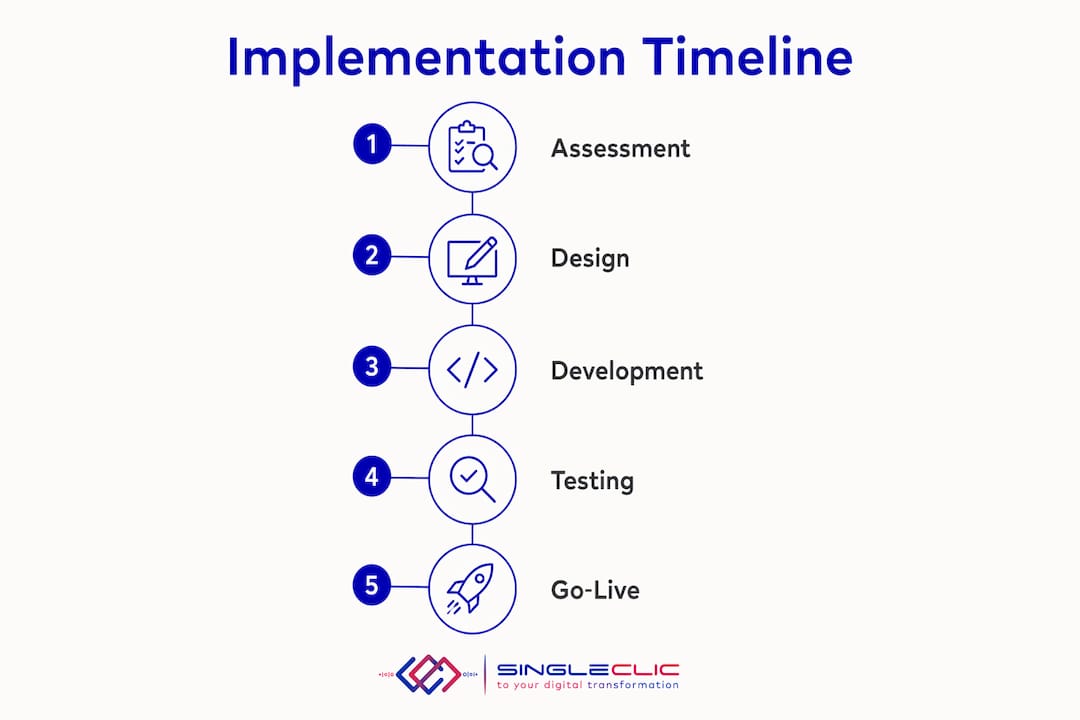
The table below shows the standard phases and their typical durations:
| Phase | Typical duration | Key deliverables |
|---|---|---|
| Assessment and scoping | Weeks 1–2 | Business requirements document, gap analysis |
| Architecture and design | Weeks 3–4 | System design, compliance blueprint, integration map |
| Data migration and build | Weeks 5–9 | Migrated data, configured modules, ZATCA setup |
| User acceptance testing | Weeks 10–12 | Test scripts, issue log, sign-off documentation |
| Training and go-live prep | Weeks 13–14 | Training sessions, cutover plan |
| Go-live and hypercare | Weeks 15–16 | Live system, daily support, issue resolution |
Aligning project phases with the client’s fiscal calendar reduces risk and improves adoption. For Saudi businesses, this means avoiding go-live dates in the final two weeks of the Hijri fiscal year or during Ramadan, when operational capacity is reduced.
Rushed user acceptance testing is the most common cause of failed go-lives in the Saudi market. Teams that compress testing to meet an arbitrary deadline discover critical issues in production, which is far more disruptive than a two-week delay in the testing phase. A good partner will hold the line on testing timelines even when internal stakeholders push for an earlier launch.
Pro Tip: Build a two-week buffer between your user acceptance testing sign-off and your go-live date. Use that time for final data validation and cutover rehearsal. Partners who resist this buffer are prioritizing their own project close-out over your operational safety.
For a deeper look at what each phase involves, the ERP implementation steps playbook covers the full sequence with practical guidance.
Key Takeaways
Choosing the right Microsoft Dynamics 365 partner in KSA determines whether your ERP or CRM deployment delivers operational value or becomes a costly rework project.
| Point | Details |
|---|---|
| Certification matters | Verify Microsoft partner tier and check references from your specific industry before shortlisting. |
| Compliance must come first | ZATCA, VAT, and Zakat configuration belongs in the architecture phase, not added after go-live. |
| Timeline is 10–16 weeks | Mid-sized Saudi deployments follow this range; align go-live dates with your fiscal calendar. |
| Pricing transparency reduces risk | Demand a fixed-scope proposal with clear change-order terms before signing any contract. |
| Local presence drives adoption | On-site training in Riyadh, Jeddah, or Dammam produces higher user adoption than remote-only support. |
What I’ve learned from Dynamics 365 deployments across Saudi Arabia
After working on enterprise technology projects across KSA, UAE, and Egypt for over a decade, the pattern I see most often is this: Saudi businesses spend months evaluating software features and almost no time evaluating the partner’s compliance depth. That is the wrong priority.
The software is the same regardless of which certified partner sells it. What differs is whether the partner has actually configured ZATCA Phase 2 for a multi-entity Saudi group before, or whether your project will be their first attempt. That distinction is worth more than any feature comparison.
The second thing I have seen consistently is that projects without upfront pricing clarity always expand in scope and cost. Partners who cannot give you a fixed proposal at the start are telling you something important about how they manage risk. They are transferring it to you.
The most successful deployments I have observed share one characteristic: the partner treated the fiscal calendar as a hard constraint from day one. Go-live dates were set backward from the client’s year-end, not forward from the project start date. That single discipline prevents the most common and most painful failure mode in Saudi ERP projects.
My advice to any Saudi business decision-maker is straightforward. Spend 30% of your evaluation time on compliance credentials and 30% on references from your industry. The remaining 40% can cover everything else. A partner who passes those two tests will handle the rest.
— Tamer Badr
Singleclic’s Dynamics 365 services for Saudi businesses
Singleclic operates as a Microsoft Dynamics 365 partner with over 10 years of delivery experience across KSA, UAE, and Egypt, and a team of 70+ consultants and engineers. Clients in Saudi Arabia include Miahona, Saba Medical Clinics in Jeddah, and Al Weddad Charity.
Singleclic handles the full implementation cycle for Dynamics 365 Finance and Operations and Dynamics 365 CRM, including ZATCA Phase 2 configuration, multi-entity setups, and Arabic-language training. For organizations that need process automation beyond what Dynamics 365 covers natively, Singleclic’s Cortex low-code platform connects approvals, workflows, and legacy systems without custom code. Explore Singleclic’s customized Dynamics 365 solutions to see how these services apply to your sector and business size.
FAQ
What is a Microsoft Dynamics 365 partner in KSA?
A Microsoft Dynamics 365 partner in KSA is a certified organization that implements, customizes, and supports Dynamics 365 ERP and CRM systems for Saudi businesses, including configuration for ZATCA, VAT, and Zakat compliance.
How long does a Dynamics 365 implementation take in Saudi Arabia?
Mid-sized enterprise deployments typically take 10 to 16 weeks from assessment to go-live, depending on data complexity and the number of legal entities involved.
What Saudi compliance requirements does Dynamics 365 cover?
Dynamics 365 can be configured to handle VAT at 15%, Zakat for Saudi entities, and ZATCA Phase 2 e-invoicing. A certified partner builds these requirements into the system architecture from the start.
How do I evaluate Dynamics 365 consultants in KSA?
Check Microsoft certification tier, request industry-specific references, and ask for a fixed-scope proposal with transparent pricing. Partners who cannot provide these three items carry higher project risk.
Does Singleclic provide Dynamics 365 implementation services in Saudi Arabia?
Singleclic delivers Dynamics 365 ERP and CRM implementations across KSA with local consultants, ZATCA compliance configuration, and post-go-live support in Riyadh, Jeddah, and Dammam.
Recommended
- How to Choose the Right Microsoft Dynamics 365 Implementation Partner in Saudi Arabia | Singleclic
- Microsoft Dynamics: Transforming Enterprise Operations
- Microsoft Dynamics 365 Business Central: A Complete Guide
- What Is Microsoft Dynamics 365? A Leader’s Guide to Connected ERP, CRM, and Intelligent Automation | Singleclic