TL;DR:
- AI transformation involves redesigning workflows and governance with AI to produce unique outcomes. CEO leadership and continuous oversight are essential for success, especially in regulated regions like Saudi Arabia and UAE.
AI transformation is the systemic redesign of an organization’s workflows, governance, and decision-making through artificial intelligence, producing outcomes that automation alone cannot deliver. Unlike a software upgrade or a digitization project, this shift requires CEO and board ownership from day one. Research from Bain & Company shows fewer than 50% of CEOs feel confident building AI capabilities at the pace the market demands. For enterprises in Saudi Arabia and UAE operating under Vision 2030 and national AI strategies, that confidence gap is the most urgent leadership problem to solve.
How does AI transformation differ from digital transformation?
Digital transformation and AI transformation are not the same thing, and confusing them is expensive. Digital transformation automates deterministic workflows. A purchase order follows a fixed path; an invoice matches a predefined rule. The outcome is predictable every time. AI transformation operates differently. It replaces and augments human judgment in situations where the answer is probabilistic, not fixed.

AI transformation is inherently probabilistic, requiring organizations to design human-agent collaboration models that balance intent, judgment, and execution. That is a fundamentally different engineering and governance challenge than installing an ERP or moving files to the cloud.
The maturity model below captures where most organizations sit today and where AI transformation takes them.
| Dimension | Digital transformation | AI transformation |
|---|---|---|
| Workflow type | Deterministic, rule-based | Probabilistic, adaptive |
| Maintenance model | One-time upgrade | Continuous monitoring and retraining |
| Decision ownership | Human, supported by data | Shared between humans and AI agents |
| Leadership owner | IT or CIO | CEO and board |
| Governance model | Policy compliance | Output monitoring and risk management |
| Maturity zone | Zones 2–3 (digitized, automated) | Zone 4 (autonomous execution within governance) |
Most organizations running modern SaaS technology sit in Zones 2 or 3 of the ACE Framework maturity model. Zone 4, where AI makes and executes decisions within defined governance boundaries, is where structural competitive advantage lives. Getting there requires a different leadership posture, not just a bigger technology budget.
What leadership imperatives drive successful AI transformation?
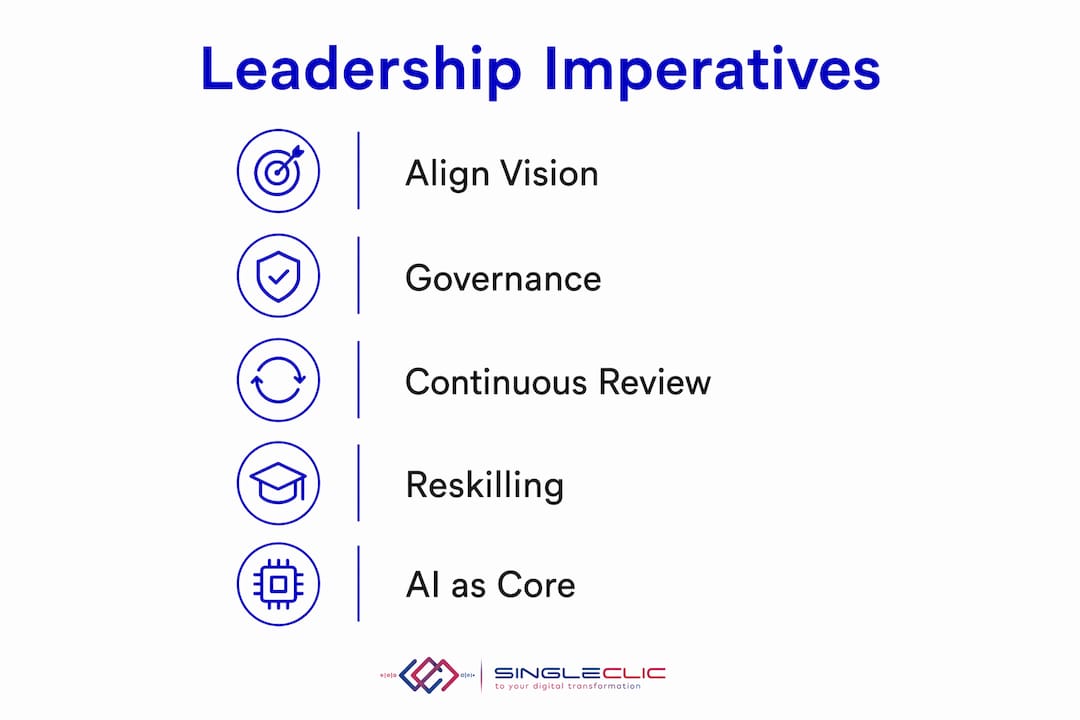
CEO ownership is the single most important factor in AI transformation success. This is not a delegation task. Bain research shows that CEO-led companies anchoring AI in clear business purpose, with explicit permission for teams to experiment, generate stronger adoption and measurable impact. Walmart’s customer-driven AI strategy and Siemens’ industrial AI sponsorship are two examples of this pattern at scale.
The leadership behaviors that produce results are specific and repeatable:
- Invest time directly. CEOs who dedicate 15–25% of their agenda to AI priorities signal that this is not an IT project. That signal changes how the rest of the organization allocates attention and budget.
- Anchor every initiative in customer or business impact. AI pilots that cannot connect to a revenue, cost, or risk outcome lose funding in the second budget cycle.
- Create psychological safety for failure. Teams that fear being blamed for a failed model will not experiment. Leaders must protect learning, not just results.
- Shift from certainty to curiosity. The most effective AI leaders ask continuous questions rather than issuing directives. They treat AI outputs as hypotheses to test, not answers to accept.
- Build accountability for scale. Pilots are easy. Converting a successful proof of concept into enterprise-wide adoption requires governance structures, not just enthusiasm.
Pro Tip: Schedule a monthly AI review at the board level, not just the executive committee. Boards that see AI metrics alongside financial metrics make faster resource decisions and reduce the organizational inertia that kills promising pilots.
The benefits of AI integration compound when leadership treats AI as a core operating principle rather than a project portfolio. The difference shows up in speed of adoption and depth of organizational change.
How do you design an AI-first operating model?
Redesigning your operating model for AI means shifting from human-centric role structures to agentic networks where AI agents and people collaborate on outcomes. BCG research describes this as reorienting company structure from individual job functions to cross-functional teams that integrate AI agents, data pipelines, and human judgment at every decision point.
The practical steps to get there follow a clear sequence:
- Map your current workflows. Identify which processes are deterministic and already automated, and which require judgment. The judgment-heavy processes are your AI transformation targets.
- Define human touchpoints explicitly. For each AI-augmented workflow, specify where a human must review, override, or approve. Leaving this undefined creates both compliance risk and operational confusion.
- Build cross-functional AI teams. Pair data engineers, domain experts, and process owners in the same team. AI agents fail when they are designed by technologists without input from the people who understand the business context.
- Automate in stages. Start with 30–50% of a workflow’s tasks before moving to broader automation. This lets you measure impact and catch model errors before they propagate.
- Establish continuous governance. Assign ownership for monitoring model outputs, setting retraining triggers, and managing human review queues.
The scale of impact from this approach is significant. Automating 30–50% of workflows through AI freed 3 million hours of human capacity in a global bank, generating a projected 150% ROI over five years. That is the equivalent of 1,700 full-time employees redirected to higher-value work.
Pro Tip: Do not automate a broken process. If a workflow is inefficient today, AI will execute that inefficiency faster and at greater scale. Fix the process logic first, then apply AI.
Workflow automation outcomes at this scale require more than technology. They require a governance layer that treats AI outputs as operational data, not black-box decisions.
| Operating model element | Before AI transformation | After AI transformation |
|---|---|---|
| Decision speed | Days to weeks | Minutes to hours |
| Human capacity allocation | Routine task execution | Judgment, oversight, and exception handling |
| Process adaptability | Quarterly update cycles | Real-time workflow adjustment |
| Risk management | Periodic audit | Continuous output monitoring |
Why does the people side of AI transformation matter most?
Technology is the smaller half of the problem. BCG research from late 2025 shows that 70% of the value in AI-driven change comes from people-related actions rather than technology. That finding reframes the entire transformation agenda. Your AI investment will underperform if your change management approach is weak.
The behaviors that drive adoption are grounded in behavioral science, not IT project management. Seven principles consistently improve uptake:
- True agreement. Get real leadership alignment on AI priorities before announcing them. False consensus at the top creates confusion at every level below.
- Agency. Give employees meaningful choices about how AI tools enter their workflows. People adopt what they help shape.
- Earned uptake. Let teams see AI deliver value in their own context before requiring adoption. Mandated tools without demonstrated benefit generate resistance.
- Emotional feedback. Celebrate early wins visibly and specifically. Vague praise does not reinforce behavior; named outcomes do.
- Ritual. Build regular leadership check-ins focused on execution details, not strategy slides. BCG research shows that scheduled leadership rituals maintain clarity and momentum during complex AI-driven change.
- Storytelling. Use relatable examples from within the organization, not vendor case studies. A story from a peer in the same company is ten times more persuasive than an external benchmark.
- Momentum. Sequence initiatives so that each success creates energy for the next. Avoid launching too many pilots simultaneously; diffused effort produces diffused results.
Maintaining uniquely human capabilities, including judgment, logic, and domain expertise, is the ultimate competitive advantage in AI-enabled enterprises. AI handles the volume; humans handle the meaning. Organizations that blur this boundary end up with neither reliable AI outputs nor engaged employees.
Reskilling is not optional. Employees whose roles change because of AI need a visible path to a new, valued contribution. Without that path, you lose the institutional knowledge that makes AI models accurate in the first place. The real productivity gains from AI materialize when people and AI systems are designed to complement each other, not compete.
Key takeaways
AI transformation delivers structural competitive advantage only when CEO ownership, continuous governance, and people-centered change management operate together from the start.
| Point | Details |
|---|---|
| AI transformation is not digital transformation | AI operates probabilistically and requires continuous governance, unlike rule-based digital automation. |
| CEO ownership is non-negotiable | Leaders who invest 15–25% of their agenda on AI generate stronger adoption and measurable ROI. |
| Workflow redesign unlocks capacity | Automating 30–50% of workflows can free millions of hours and deliver 150% ROI over five years. |
| People drive 70% of AI value | Change management, reskilling, and behavioral adoption matter more than the technology itself. |
| Governance must be continuous | AI models degrade without active monitoring, retraining, and human review protocols. |
What I’ve learned leading AI transformation in Saudi Arabia and UAE
After more than a decade working with enterprises across KSA, UAE, and Egypt, the pattern I see most often is this: organizations invest heavily in AI tools and almost nothing in the organizational redesign required to use them well. The technology arrives. The governance does not.
The regional context makes this harder. Many enterprises in Saudi Arabia and UAE carry legacy approval structures where decisions flow upward through multiple layers before anything changes. AI transformation does not fit that model. It requires distributed decision authority, real-time oversight, and the willingness to act on probabilistic outputs. That is a cultural shift, not just a technical one.
What actually works is starting with a single, high-visibility workflow that the CEO cares about personally. When the top leader sees AI deliver a measurable outcome in their own priority area, the organizational resistance drops significantly. I have watched this happen at healthcare organizations, government entities, and financial institutions across the region.
Platforms like Singleclic’s Cortex Low-Code make the integration layer manageable. Cortex connects ERP, CRM, legacy systems, and approval workflows in Arabic, on-premise, without requiring custom code for every change. That matters enormously in regulated industries like banking and government, where data sovereignty is not negotiable.
The biggest mistake I see is treating AI as a technology upgrade rather than treating AI like electricity, a fundamental power source that changes how every part of the organization operates. When you frame it that way, the governance, the reskilling, and the leadership commitment all make sense. They are not overhead. They are the infrastructure.
— Tamer Badr
How Singleclic supports AI transformation for enterprises in Saudi Arabia and UAE
Singleclic works with C-level leaders across KSA, UAE, and Egypt to move AI from pilot to production at enterprise scale.
Microsoft Dynamics 365 serves as the integrated ERP, CRM, and intelligent automation backbone for organizations ready to operate at Zone 4 maturity. Singleclic customizes Dynamics 365 deployments and pairs them with Cortex Low-Code to build AI-first workflows that connect approvals, data, and people in real time. Clients including Emirates Health Services, QNB, and Emaar Misr have used this combination to automate complex processes while maintaining the governance and human oversight that regulated industries require. If you lead an enterprise in Saudi Arabia or UAE and want to move beyond digitization into genuine AI-driven operations, explore Singleclic’s AI process automation capabilities or speak directly with the team.
FAQ
What is AI transformation in simple terms?
AI transformation is the redesign of an organization’s core workflows, governance, and decision-making using artificial intelligence to create outcomes that rule-based automation cannot deliver. It requires CEO ownership and continuous governance, not just technology deployment.
How is AI transformation different from digital transformation?
Digital transformation automates fixed, rule-based processes. AI transformation handles probabilistic decisions, requires continuous model monitoring, and demands board-level leadership rather than IT-led project management.
What is the biggest risk in AI transformation?
The biggest risk is under-investing in people and governance while over-investing in technology. BCG research shows 70% of AI transformation value comes from people-related actions, meaning change management and reskilling are as critical as the AI platform itself.
How long does AI transformation take?
There is no fixed timeline, but organizations that automate 30–50% of targeted workflows typically see full payback within two years when CEO ownership and governance structures are in place from the start.
Where should a C-level leader in Saudi Arabia or UAE start?
Start with one high-visibility workflow that the CEO cares about directly, build a cross-functional team around it, and establish governance before scaling. Connecting that workflow to an integrated platform like Microsoft Dynamics 365 accelerates the path from pilot to enterprise adoption.