TL;DR:
- The Model Context Protocol (MCP) is an open standard that enables AI models to securely connect with external tools and data sources through a unified interface. It replaces complex, custom integrations with a scalable, governance-oriented protocol that simplifies enterprise AI deployment. MCP supports secure, interoperable, and scalable AI workflows, making it essential for digital transformation in the Middle East and beyond.
The Model Context Protocol (MCP) is an open-standard, client-server protocol that enables AI models to securely discover, connect to, and interact with external tools, data sources, and services through a single standardized interface. Introduced in november 2024 by Anthropic, MCP has since been adopted by major AI providers including OpenAI and Google DeepMind. For business leaders in Saudi Arabia, the UAE, and across the MENA region, understanding what MCP is and how it works is no longer optional. It is the foundation of any serious enterprise AI strategy.
What is MCP and how does its architecture work?
MCP, which stands for Model Context Protocol, is best understood as a universal adapter for AI systems. Before MCP, connecting an AI model to a database, an ERP system, or a CRM required a custom-built connector for every single pairing. MCP replaces that fragmented approach with one consistent protocol that any compliant AI application can use.
The architecture rests on three components:
- MCP Host: The AI application itself, such as an AI assistant or an agent embedded in your enterprise software. The host initiates requests and manages the overall session.
- MCP Client: The connector layer inside the host application. It handles communication between the AI model and the external world, translating requests into the protocol’s standard format.
- MCP Server: A lightweight service that sits in front of your external resources, whether that is a database, a CRM, a file system, or a third-party API. The server exposes specific tools and data to the AI client in a controlled way.
Communication uses JSON-RPC 2.0, a structured message format transmitted over transports including standard input/output (stdio) and HTTP. This means every request and response follows a predictable, machine-readable structure. Predictability matters because it lets you audit, log, and govern AI behavior at the protocol level.
Pro Tip: When evaluating AI platforms for your enterprise, ask vendors whether their product supports MCP natively. Native support means you avoid building and maintaining custom connectors every time you add a new data source.
One detail that surprises many leaders: MCP is not a data storage system. It does not store information or act as a function registry. It is purely a communication protocol. Your data stays where it lives today. MCP simply defines how an AI model is allowed to ask for it and act on it.
| Component | Role | Example |
|---|---|---|
| MCP Host | AI application that initiates requests | AI assistant in Microsoft Dynamics 365 |
| MCP Client | Protocol connector inside the host | SDK embedded in your enterprise AI layer |
| MCP Server | Bridge to external tools and data | Connector to your ERP, CRM, or file system |
| Transport | Message delivery mechanism | JSON-RPC 2.0 over HTTP or stdio |
What business challenges does MCP solve for MENA enterprises?
The core problem MCP addresses is known as the N×M integration problem. If you have five AI models and ten data sources, you theoretically need fifty custom connectors. MCP eliminates that complexity by giving every AI model and every data source a single standard to speak. One protocol replaces fifty bespoke integrations.

For enterprises in Saudi Arabia and the UAE, where digital transformation programs are accelerating under Vision 2030 and similar national agendas, this matters enormously. IT teams are already stretched. Adding custom AI connectors to every new tool is unsustainable.
MCP solves four specific problems for enterprise leaders:
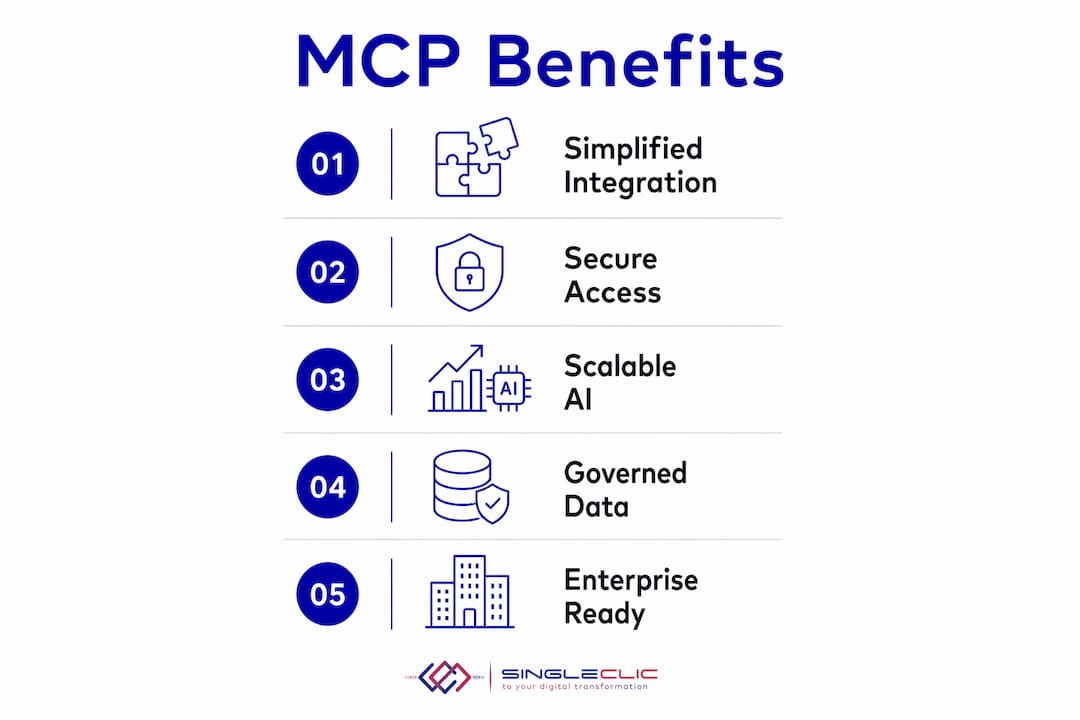
- Integration overhead. Custom connectors require ongoing maintenance. When an API changes, every connector that touches it breaks. MCP shifts that burden to the MCP server layer, which is maintained once and shared across all AI clients.
- Security and access control. MCP enables granular access controls at the server level. You define exactly which data and actions each AI model is permitted to access. This is critical for regulated industries like banking and healthcare, where organizations such as QNB and Emirates Health Services operate under strict data governance requirements.
- Scalability. Adding a new AI tool to your environment no longer means writing new connectors. You add an MCP server for the new tool, and every compliant AI client can use it immediately.
- Composable AI workflows. MCP supports modular AI agents that interact with multiple services without bespoke coding. This is the foundation of composable enterprise architecture, where you assemble AI capabilities from interoperable parts rather than building monolithic systems.
“The shift from siloed AI tools to composable AI ecosystems is the defining architectural change of this decade. MCP is the protocol that makes that shift possible for enterprises that take governance seriously.”
For organizations evaluating secure AI deployments, MCP’s access control model deserves close attention. It gives your security team a defined perimeter around every AI interaction, which is far more auditable than open API access.
How does MCP compare to other AI integration methods?
Understanding the MCP definition requires knowing what it is not. Three concepts are commonly confused with MCP: custom API integrations, function calling, and Retrieval-Augmented Generation (RAG).
Custom API integrations are point-to-point connections built for a specific AI model and a specific service. They work, but they do not scale. Every new pairing requires new code. MCP replaces this with a universal standard that any compliant system can adopt without custom development.
Function calling is a feature built into many large language models that lets the model request a specific function to be executed. MCP and function calling are complementary, not competing. Function calling is the AI’s way of saying “I want to do something.” MCP is the standardized channel through which that request travels and gets fulfilled securely.
Unlike Retrieval-Augmented Generation, MCP enables two-way communication. RAG focuses on pulling information into an AI model’s context before it generates a response. MCP allows the AI to both retrieve information and perform actions, such as updating a record, triggering a workflow, or calling an external service, during the interaction itself. That distinction is significant for enterprise use cases where AI needs to do more than answer questions.
Key advantages MCP holds over proprietary alternatives:
- Interoperability. Any MCP-compliant AI client works with any MCP-compliant server, regardless of vendor.
- Dynamic tool discovery. AI clients discover available tools at runtime, meaning you can add capabilities without redeploying the AI model itself.
- Governance. Security policies live at the MCP server layer, giving your IT and compliance teams a single point of control. Resources on cloud security governance confirm that centralized access control at the protocol level significantly reduces the risk of unauthorized data exposure.
One limitation leaders should understand: enterprises must translate legacy APIs into JSON-RPC 2.0 to communicate with MCP servers. This is an architectural decision that requires planning. For organizations running older ERP or CRM systems, a translation layer or middleware component will be necessary.
Practical implications of MCP for enterprise digital transformation
MCP’s real value shows up when you connect it to the systems your business already runs. Think about an AI assistant embedded in your ERP. Without MCP, that assistant can only access data the vendor has explicitly pre-connected. With MCP, it can reach your CRM, your approval workflows, your document management system, and your analytics platform, all through a single governed protocol.
Singleclic’s Cortex platform is built for exactly this kind of integration. Cortex is an Arabic-enabled, on-premise low-code platform that connects ERP, CRM, approvals, legacy systems, and workflows in a single environment. When MCP-compliant AI agents interact with Cortex-managed processes, the result is AI that can read data, trigger actions, and update records across your entire enterprise stack, without requiring custom code for each connection. You can read more about AI’s role in ERP transformation to see how this plays out in practice.
Thousands of MCP servers and SDKs are now available across enterprise application categories, which means the ecosystem has matured rapidly since the protocol launched in late 2024. Your team does not need to build MCP servers from scratch for common platforms.
Practical steps for MENA business leaders adopting MCP:
- Audit your current AI integrations. Identify every point-to-point connector your AI tools rely on today. These are your highest-priority candidates for MCP migration.
- Prioritize high-value data sources. Start with the systems your AI assistants query most often, typically your ERP, CRM, and document repositories.
- Define access policies before deployment. MCP’s security model is only as strong as the policies you configure at the server level. Involve your compliance and IT security teams from day one.
- Plan for legacy API translation. Older systems will need a JSON-RPC 2.0 translation layer. Budget for this work upfront rather than discovering it mid-project.
- Evaluate agentic AI readiness before scaling. MCP enables autonomous AI agents, but your organization needs governance frameworks in place before those agents operate at scale.
Pro Tip: Do not treat MCP adoption as an IT project. Treat it as a governance decision. The protocol defines what your AI is allowed to do inside your enterprise. That conversation belongs in the boardroom, not just the server room.
MCP accelerates autonomous AI by giving agents a reliable, governed channel to interact with real-world data. That capability is what separates AI assistants that answer questions from AI agents that complete tasks.
Key Takeaways
MCP is the open protocol that makes enterprise AI integration governable, scalable, and interoperable, replacing dozens of custom connectors with a single standard that every compliant AI system can use.
| Point | Details |
|---|---|
| MCP definition | An open-standard client-server protocol enabling AI models to connect to external tools and data through one standard interface. |
| Core architecture | Three components: MCP Host, MCP Client, and MCP Server, communicating via JSON-RPC 2.0. |
| Business value | Eliminates the N×M connector problem, cutting integration overhead and maintenance costs significantly. |
| Security advantage | Granular access controls at the MCP server level give compliance teams a defined perimeter around every AI interaction. |
| Enterprise action | Audit existing AI connectors, define access policies, and plan legacy API translation before deploying MCP at scale. |
Why MCP is the protocol MENA leaders cannot afford to ignore
I have spent over a decade working with enterprise technology teams across Saudi Arabia, the UAE, and Egypt. The pattern I see most often is this: organizations invest heavily in AI tools, then discover those tools cannot talk to each other or to the systems that hold the data that actually matters. The result is a collection of AI pilots that never scale.
MCP changes that equation. What strikes me most about this protocol is not its technical elegance. It is the governance model. For the first time, you have a standard that lets your security team define exactly what an AI model is allowed to see and do, at the protocol level, before a single query runs. That is not a technical detail. That is a boardroom conversation.
The organizations I see moving fastest on MCP adoption are not the ones with the largest IT budgets. They are the ones where business leadership understands that AI integration is a governance problem first and a technology problem second. They start by mapping their data access policies, then build the MCP server layer to enforce those policies, then connect their AI tools.
My advice to any MENA business leader reading this: do not wait for your AI vendor to solve this for you. The ecosystem around MCP is growing fast, and the organizations that build MCP-ready architectures now will have a significant head start when agentic AI becomes the operational standard, which is closer than most leaders realize.
— Tamer Badr
How Singleclic connects MCP-ready AI to your enterprise systems
Singleclic works with enterprise leaders across Saudi Arabia, the UAE, and Egypt to build AI-ready architectures that connect ERP, CRM, and workflow systems through governed integration layers. The Cortex low-code platform provides the process automation backbone that MCP-compliant AI agents need to take real action inside your organization, from approvals and data updates to cross-system workflows.
If you are evaluating how AI can work across your Microsoft Dynamics 365 environment, Singleclic’s connected ERP and CRM solutions provide the integration foundation that makes MCP adoption practical and governed. With 70+ consultants across the region and 100+ enterprise clients, Singleclic brings both the technical depth and the regional context that MCP implementation requires.
FAQ
What does MCP stand for in technology?
MCP stands for Model Context Protocol. It is an open-standard protocol introduced by Anthropic in november 2024 that standardizes how AI models connect to external tools, data sources, and services.
How does MCP differ from a standard API?
A standard API is a point-to-point connection built for a specific integration. MCP is a universal protocol that any compliant AI client can use to connect to any compliant server, eliminating the need for custom connectors for each pairing.
Is MCP secure enough for regulated industries?
MCP enables granular access controls at the server level, meaning your security team defines exactly which data and actions each AI model can access. This makes it suitable for regulated sectors like banking and healthcare when properly configured.
What is the relationship between MCP and RAG?
RAG retrieves information to augment an AI model’s response before generation. MCP enables two-way communication, allowing AI to both retrieve data and perform actions during an interaction, making it a broader integration standard than RAG alone.
Do enterprises need to replace existing systems to adopt MCP?
No. MCP works alongside existing systems. Legacy APIs require a JSON-RPC 2.0 translation layer to communicate with MCP servers, but your underlying data and applications remain in place.