TL;DR:
- Effective data governance improves security, compliance, and operational efficiency, delivering significant ROI.
- Frameworks like DAMA-DMBOK and DCAM help organizations build and assess governance maturity.
- Clear authority and automation are critical to sustaining governance programs and reducing risks in the Gulf region.
Data governance returns $3.20 for every dollar invested, yet most executives in Saudi Arabia and the UAE still treat it as a compliance checkbox rather than a strategic asset. That framing is costly. Organizations with mature governance programs report 66% improved security posture and 52% fewer data breaches — numbers that matter deeply to CIOs and CTOs operating under PDPL and SAMA mandates. This guide cuts through the jargon, explains the frameworks that actually work in regional enterprise environments, and gives you a practical roadmap to build a governance program that pays for itself.
Table of Contents
- Defining data governance: More than compliance
- Key frameworks and models: DAMA-DMBOK, DCAM, and mesh approaches
- Empirical ROI and risk mitigation: Benchmarking results
- Implementation methodology: Stepwise guide for Saudi/UAE leaders
- Governance and automation: Authority, AI, and flexible controls
- Fresh perspective: What most frameworks and experts miss
- How Singleclic empowers robust data governance
- Frequently asked questions
Key Takeaways
| Point | Details |
|---|---|
| Clear frameworks matter | Adopting DAMA-DMBOK or DCAM frameworks gives structure and clarity for governance programs. |
| ROI drives buy-in | Data governance delivers measurable savings and security improvements, making stakeholder support easier to secure. |
| Local adaptation is key | Tailoring governance to regional laws and high-risk domains ensures compliance and effectiveness. |
| Authority prevents failures | Explicit rule ownership avoids bottlenecks and keeps governance agile even in automated environments. |
| Automation and AI evolving | Integrating automated controls and AI oversight is vital for future-proofing governance. |
Defining data governance: More than compliance
Data governance is the set of processes, policies, roles, standards, and metrics that ensure the effective and secure use of organizational data. That definition sounds dry, but the business outcomes it produces are anything but. Done well, governance improves regulatory compliance, strengthens security, accelerates analytics readiness, and lifts team productivity across every department that touches data.
The most common misconception is equating data governance with data management. Data management is the technical practice of storing, processing, and moving data. Governance is the authority layer sitting above it — the rules about who can access what, who owns which data definitions, and what quality standards apply. Without governance, even the best data infrastructure becomes a liability.
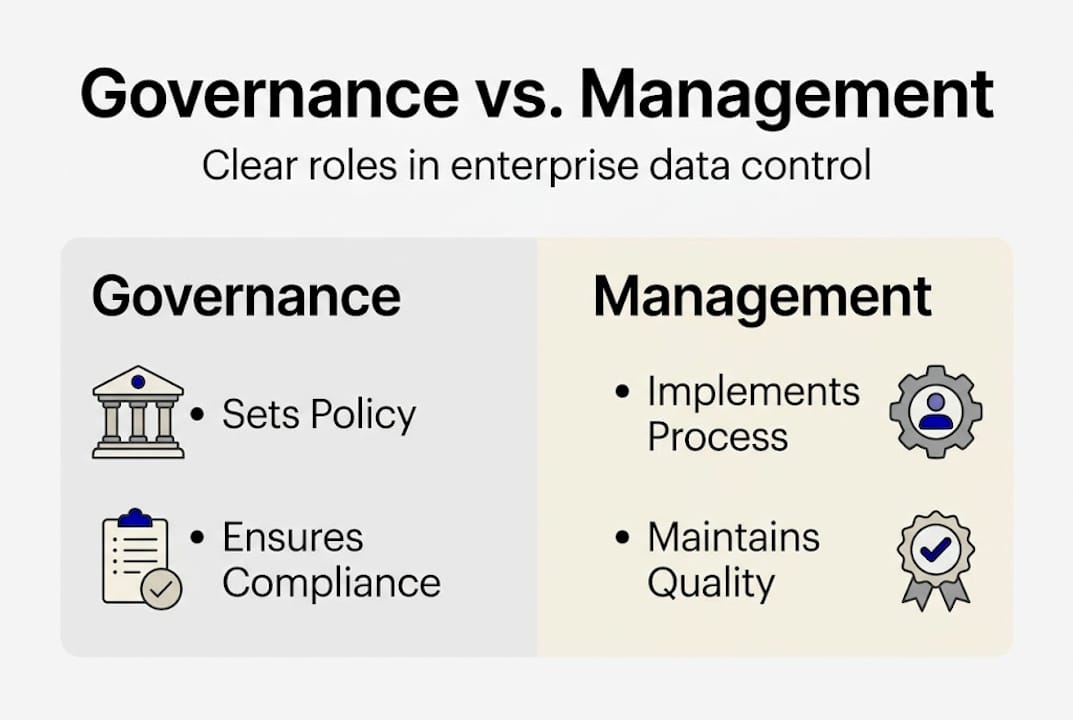
For organizations in Saudi Arabia and the UAE, this distinction carries extra weight. Regulators like SAMA and TDRA expect demonstrable controls, not just technical safeguards. Aligning with data privacy standards means your governance program must address policy documentation, data classification, and audit trails — not just encryption and firewalls.
Here are the core business outcomes a well-designed governance program delivers:
- Regulatory compliance: Structured policies map directly to PDPL, GDPR-equivalent, and sector-specific mandates.
- Risk reduction: Clear data ownership reduces the chance of unauthorized access or misuse.
- Operational efficiency: Consistent data definitions eliminate rework caused by conflicting reports.
- Analytics readiness: Trusted, well-cataloged data shortens the path from raw information to business insight.
Two frameworks dominate best-practice guidance globally. The DAMA-DMBOK covers 15 core knowledge areas with governance at the center, providing a holistic reference for organizations building programs from scratch. The DCAM (Data Management Capability Assessment Model) focuses on maturity assessment and control design, making it ideal for organizations that need to benchmark current capabilities before investing further.
“Governance is not about locking data down. It is about making data trustworthy enough that people actually use it to make decisions.” — Tamer Badr, Singleclic
Pro Tip: Before selecting a framework, audit how your teams currently define key business terms like ‘customer’ or ‘revenue.’ Inconsistent definitions are the clearest signal that governance is missing, and fixing them delivers immediate, measurable value.
If you are working through a broader digital compliance guide for GCC projects, data governance is the foundational layer that makes every other compliance effort more efficient.
Key frameworks and models: DAMA-DMBOK, DCAM, and mesh approaches
Now that we understand what data governance covers, let’s explore the frameworks that enable real-world implementation.
The DAMA-DMBOK covers 15 core areas, with governance sitting at the center of all other disciplines including data quality, metadata management, and master data management. It is the most widely adopted reference globally and works well for organizations that want a single, authoritative governance standard applied enterprise-wide.
The DCAM takes a different angle. Rather than prescribing what governance should look like, it assesses how mature your current capabilities are across eight components. This makes it particularly useful for CIOs who need to present a gap analysis to the board before requesting budget.
| Framework | Best for | Governance style | Regional fit |
|---|---|---|---|
| DAMA-DMBOK | Building from scratch | Centralized, comprehensive | Strong for PDPL alignment |
| DCAM | Maturity benchmarking | Control-focused | Useful for SAMA audits |
| Data mesh | Federated enterprises | Domain-driven, decentralized | Emerging in large UAE conglomerates |
Data mesh is the newest model gaining traction. Instead of a central governance team owning all data rules, mesh distributes ownership to domain teams — finance owns financial data, operations owns operational data. Each domain publishes data as a product, with agreed quality and access standards. The appeal is agility. The risk is fragmentation.
The authority crisis in data governance is most acute in mesh environments: when domain teams disagree on a rule, who has the final say? Organizations that adopt mesh without answering that question clearly tend to create more confusion than they resolve.
For Saudi and UAE enterprises navigating SAMA and TDRA compliance, a hybrid approach often works best. Use DAMA-DMBOK as the enterprise standard for regulated data domains, and allow mesh principles for internal analytics or innovation teams where agility matters more than strict uniformity.
Pro Tip: Name a Chief Data Officer or Data Governance Lead before selecting any framework. The framework is a tool. Without a named authority who can resolve rule conflicts, no framework will stick.
Building process compliance in Saudi/UAE environments requires that governance decisions have a clear escalation path — something mesh models must explicitly design for.
Empirical ROI and risk mitigation: Benchmarking results
With these frameworks in mind, let’s dig into what ROI and risk mitigation actually look like for business leaders.

Nucleus Research found that data governance returns $3.20 per dollar invested, driven by three measurable categories: infrastructure and administration cost savings, engineer productivity gains, and security improvements. These are not soft benefits — they show up in budget lines.
Key benchmarks to anchor your business case:
| Benefit category | Measured impact |
|---|---|
| ROI on governance investment | $3.20 per $1 spent |
| Security posture improvement | 66% better |
| Data breach reduction | 52% fewer incidents |
| Engineer productivity gain | Significant reduction in data prep time |
The security numbers deserve special attention. In a region where regulatory penalties for data breaches are rising sharply, a 52% reduction in breach incidents is not just a technical win — it is a legal and reputational shield.
When prioritizing where to start, focus your pilot on the domains with the highest risk and highest business value:
- Customer data — Directly tied to PDPL obligations and revenue analytics.
- Financial data — Subject to SAMA oversight and audit requirements.
- Employee data — Increasingly regulated under labor and privacy laws.
- Operational data — Drives efficiency gains when quality is enforced.
Measuring ROI from governance requires tracking the right metrics from day one. Cost savings come from eliminating duplicate data stores and reducing manual reconciliation. Productivity gains appear when analysts spend less time cleaning data and more time generating insights. Security improvements are tracked through incident frequency and audit pass rates.
Pro Tip: Set a baseline before your pilot launches. Measure how many hours your team spends on data reconciliation each week. That number becomes your most persuasive ROI story six months later.
Understanding ROI in enterprise migration follows a similar logic — governance applied early in a migration project consistently reduces rework costs and accelerates go-live timelines.
Implementation methodology: Stepwise guide for Saudi/UAE leaders
Now, let’s turn these benchmarks into a practical step-by-step plan.
A proven stepwise methodology moves through six phases: assess maturity, secure executive sponsorship, define RACI (Responsible, Accountable, Consulted, Informed), run a pilot, automate quality controls, and then scale.
- Assess current maturity — Use DCAM or a simplified self-assessment to identify your biggest gaps. Focus on data quality, ownership clarity, and policy documentation.
- Secure executive sponsorship — A governance program without C-suite backing stalls within months. Present the ROI benchmarks from Section 4 to make the case.
- Define RACI for data ownership — Every critical data domain needs a named owner, a steward, and a clear escalation path. Ambiguity here is the single biggest cause of governance failure.
- Run a focused pilot — Choose one high-risk domain (customer or financial data) and apply your chosen framework fully. Measure quality scores and compliance rates before expanding.
- Automate quality and lineage controls — Manual governance does not scale. Integrate automated data quality checks, lineage tracking, and policy enforcement into your data pipelines.
- Scale and iterate — Expand domain by domain, using pilot metrics to refine your approach.
Common pitfalls to avoid:
- Over-centralization: A single governance team cannot review every data decision. Build federated stewardship with clear escalation to a central authority.
- Unclear rule ownership: If no one can change a rule, the rule becomes an obstacle rather than a guardrail.
- Skipping automation: Manual quality checks create bottlenecks and are inconsistently applied.
“The organizations that succeed with governance are the ones that treat it as an operating model change, not an IT project.” — Tamer Badr, Singleclic
Avoiding cloud data protection pitfalls is easier when governance policies are defined before cloud migration begins. Similarly, embedding governance into data security in transformation programs prevents costly retrofits later. For leaders new to formal governance, a review of IT governance basics provides useful context on how data governance fits within the broader IT control environment.
Pro Tip: In Saudi Arabia and the UAE, start your pilot with data domains that touch SAMA or TDRA-regulated processes. Early wins in regulated areas build credibility with both regulators and internal stakeholders.
Governance and automation: Authority, AI, and flexible controls
With implementation underway, organizations now face the advanced challenges of authority and automation.
One of the most underappreciated nuances in governance is contextual data quality. A customer address that is perfectly valid for marketing purposes may be legally insufficient for a financial services contract. The same data point, different quality standard. Traditional governance frameworks often miss this, applying a single quality rule across all use cases.
The intersection of data and AI governance adds another layer of complexity. As organizations deploy AI models that make automated decisions — credit scoring, patient triage, procurement approvals — the data feeding those models needs governance controls that go beyond traditional stewardship. AI governance asks not just “is this data accurate?” but “is this data appropriate for this algorithmic use?”
Key challenges organizations face at this stage:
- Authority over automated rules: When an AI model flags a data record as non-compliant, who has the authority to override it? Without a clear answer, automated controls create bottlenecks.
- Opaque computational controls: Machine learning models can enforce data rules in ways that are difficult to audit, creating compliance risk in regulated environments.
- Policy topology for mesh environments: In federated architectures, each domain needs local policies that still connect to enterprise standards. Designing that topology requires deliberate governance architecture.
Practical advice: Build a governance layer that explicitly separates automated enforcement from human authority. Automation handles routine quality checks and lineage tracking. Humans retain authority over rule changes, exceptions, and escalations. This balance keeps your program agile without sacrificing accountability.
For organizations building AI-driven data security capabilities, integrating data governance controls early in the AI development lifecycle is far less disruptive than retrofitting them after deployment.
Fresh perspective: What most frameworks and experts miss
Beyond frameworks and benchmarks, here is what really makes data governance work in the Saudi and UAE context.
Most governance guides focus on selecting the right framework or calculating ROI. Those things matter. But the organizations we see struggle most are not struggling because they chose DAMA-DMBOK over DCAM. They are struggling because nobody can answer the question: “Who has the authority to change this rule?”
The authority crisis in governance is real, and it is more acute in the Gulf region where organizational hierarchies are formal and cross-functional authority is rarely explicit. When a business unit in Riyadh and a compliance team in Dubai disagree on a data classification rule, the absence of a named decision-maker means the rule simply does not get updated. That is how governance programs calcify into obstacles.
Business agility depends on governance that can evolve. Rigid, over-centralized programs create the illusion of control while actually slowing down the business. The goal is not perfect rules. It is rules that are trusted, owned, and maintainable. Understanding data’s business impact at a strategic level helps leaders frame governance as an enabler rather than a constraint — which is the mindset shift that separates programs that thrive from those that stall.
How Singleclic empowers robust data governance
If you’re ready to advance your data governance journey, here’s how Singleclic can help.
Singleclic works with enterprise clients across KSA, UAE, and Egypt to design and implement governance programs that deliver measurable results — not just documentation. Our approach connects operational excellence with practical process automation, so your governance controls are enforced automatically rather than manually chased.
Whether you need an ERP readiness assessment that incorporates data governance requirements, or a full governance program design aligned with SAMA and PDPL, our team of 70+ consultants brings the regional expertise and technical depth to move fast. Reach out to Singleclic to start with a focused assessment of your current governance maturity and a clear roadmap to your first measurable win.
Frequently asked questions
What are the essential elements of a data governance framework?
The core elements include policies, roles, processes, standards, and metrics that guide how data is used, maintained, and protected across the organization.
How do Saudi/UAE organizations ensure compliance with local regulations?
By adapting global frameworks like DAMA-DMBOK to align with PDPL, SAMA, and TDRA standards, and prioritizing high-risk domains such as customer and financial data first.
What is the ROI of implementing data governance?
Empirical studies show a $3.20 return per dollar invested, along with significant cost savings and security improvements typically realized within the first year.
How does data governance differ from AI governance?
Data governance controls information quality, access, and policy; AI governance adds oversight for algorithms, models, and the automated agents that consume and act on that data.
What are common pitfalls to avoid during implementation?
Avoid over-centralization, unclear rule ownership, and skipping automation — the three factors most likely to stall a governance program before it delivers measurable value.