TL;DR:
- Regular process reviews boost productivity and support successful digital transformation.
- Proper preparation involves clear objectives, stakeholder engagement, and process mapping.
- Continuous measurement and leadership support are essential for sustaining improvements.
Inefficient processes quietly drain resources, slow down teams, and erode competitive advantage before most leaders even notice the damage. Organizations conducting quarterly process reviews achieve 23% higher productivity, yet many executives across KSA, UAE, and Egypt still treat process reviews as a reactive exercise rather than a strategic discipline. The cost of inaction compounds fast: missed growth targets, compliance gaps, and a workforce stuck in workarounds. This guide walks you through a proven, step-by-step methodology for conducting process reviews that deliver real operational gains, with practical advice tailored for MENA leaders navigating digital transformation at scale.
Table of Contents
- What makes process reviews essential for business growth
- Preparation: Prerequisites for an effective process review
- Step-by-step: How to conduct an effective process review
- Overcoming common process review challenges in the MENA region
- Measuring and sustaining results after process reviews
- Rethinking process reviews: What most leaders get wrong, and how to get it right
- Accelerate your operational transformation with expert support
- Frequently asked questions
Key Takeaways
| Point | Details |
|---|---|
| Process reviews boost outcomes | Regular process reviews drive measurable gains in productivity, revenue, and efficiency for organizations. |
| Preparation is critical | Proper groundwork with clear objectives, data, and cross-functional teams ensures effective reviews. |
| Combine methodologies | Hybrid incremental and radical improvement with digital tools delivers fast, sustainable impact. |
| Monitor and adapt | Sustaining gains requires ongoing measurement with KPIs and adapting strategies as business needs evolve. |
What makes process reviews essential for business growth
A business process review is a structured evaluation of how work actually gets done across your organization, compared to how it should get done. It surfaces inefficiencies, redundancies, and bottlenecks that erode performance over time. For executives driving digital transformation, these reviews are not optional checkpoints. They are the foundation of operational excellence.
The business case is compelling. Process improvement delivers 15 to 20% revenue growth and 15 to 25% cost reduction for organizations that apply it consistently. Those are not marginal gains. They represent the difference between a business that scales efficiently and one that grows in cost faster than it grows in revenue.
Process reviews generate several measurable outcomes when conducted properly:
- Increased productivity through the elimination of manual, duplicated, or unnecessary steps
- Faster cycle times across procurement, approvals, customer service, and reporting
- Cost savings from reduced rework, error rates, and resource waste
- Improved compliance by aligning workflows with regulatory and quality standards
- Better digital readiness by identifying where automation and AI can be applied
In a digital transformation context, process reviews become even more critical. You cannot automate a broken process and expect better results. Before deploying ERP systems, RPA bots, or AI tools, you need to understand what your processes actually look like today. Skipping this step is one of the most common reasons technology implementations fail to deliver their promised ROI.
“The biggest mistake organizations make is layering technology on top of inefficient processes and calling it transformation. Real transformation starts with understanding your workflows first.” — Tamer Badr, Singleclic
Organizations that skip regular reviews also accumulate what you might call process debt: layers of workarounds, informal approvals, and shadow systems that make future change harder and more expensive. Explore process improvement tips to understand how C-level leaders are addressing this challenge across the region.
Preparation: Prerequisites for an effective process review
A process review without proper preparation produces incomplete findings and weak recommendations. Before you begin, you need the right foundation in place.
The essential prerequisites include:
- Clear objectives: Define what success looks like before you start. Are you reducing cycle times, cutting costs, or preparing for an ERP rollout?
- Stakeholder engagement: Involve process owners, frontline staff, IT, compliance, and finance from the outset
- Mapped current processes: You need a baseline. Without documented workflows, you are reviewing assumptions, not reality
- Available data and KPIs: Cycle times, error rates, throughput, and cost per transaction are the metrics that reveal the truth
- Cross-functional team alignment: Siloed reviews produce siloed recommendations. Build a team that spans business units
A structured review checklist should cover documentation standards, role definitions, KPI baselines, compliance requirements, and risk plans before any analysis begins.
| Prerequisite area | What to prepare | Why it matters |
|---|---|---|
| Documentation | Current process maps, SOPs, policy docs | Establishes the baseline for comparison |
| Metrics | Cycle times, error rates, cost per task | Provides objective evidence of performance |
| Compliance | Regulatory requirements, audit standards | Ensures changes do not introduce new risk |
| Roles | RACI matrix, process ownership | Clarifies accountability for improvements |
| Risk plans | Impact assessments, rollback plans | Protects operations during change |
Following structured process management steps ensures you capture the right inputs before moving into analysis. A solid process mapping guide can also accelerate this phase significantly.
Pro Tip: Integrate digital tools like AI-powered process mining or RPA early in the preparation phase. These tools automate data collection from your existing systems and generate accurate process maps in a fraction of the time manual mapping takes, reducing preparation time and improving accuracy.
Organizations that skip preparation often discover their data is fragmented across silos, their process documentation is outdated, and key stakeholders are resistant because they were not consulted early. These process reengineering considerations are worth reviewing before you finalize your preparation approach.

Step-by-step: How to conduct an effective process review
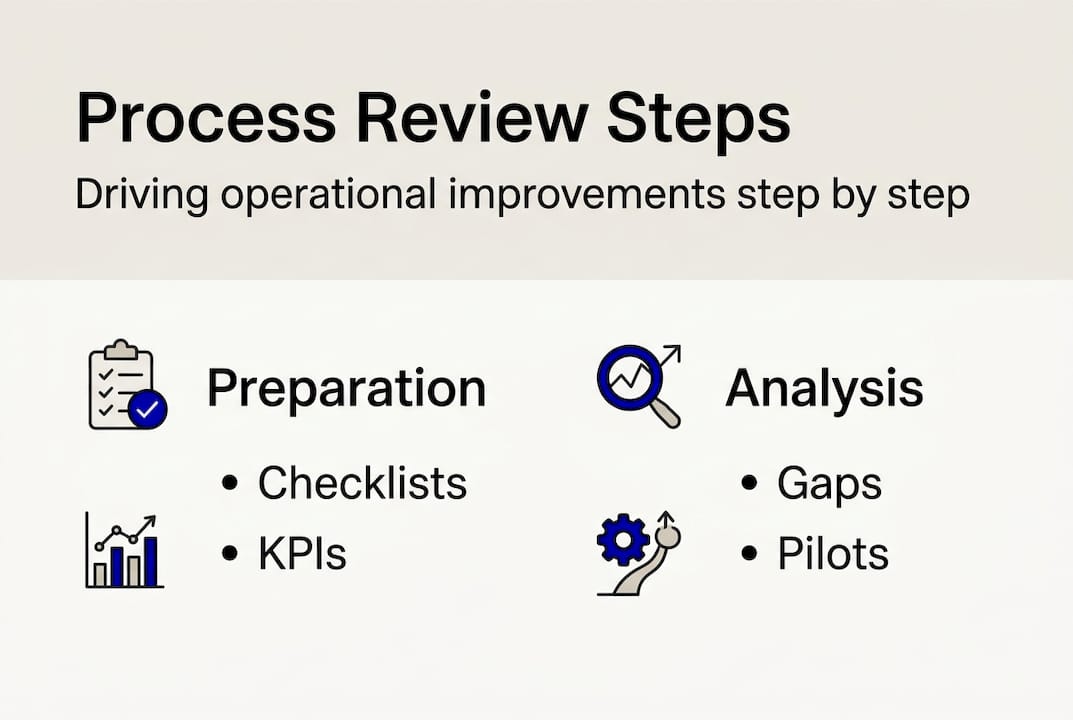
With preparation complete, you can follow a structured five-step methodology that consistently delivers results. These five steps are: align to strategic goals, collect data, analyze and map workflows, identify improvements, then implement and monitor.
- Align to strategic goals: Start by connecting the review to your organization’s priorities. A process review that is not anchored to business outcomes produces findings that nobody acts on.
- Collect data: Gather quantitative data (cycle times, volumes, error rates) and qualitative input (staff feedback, customer complaints). Both matter.
- Analyze and map workflows: Visualize how work actually flows, not how it is supposed to flow. Process mining tools are especially effective here for large, complex operations.
- Identify improvements: Prioritize findings by impact and feasibility. Not every inefficiency is worth fixing immediately. Focus on changes that deliver the most value with the least disruption.
- Implement and monitor: Roll out changes in controlled pilots before full deployment. Track KPIs and OKRs to confirm the improvement is real and sustained.
When deciding on your improvement approach, the choice between radical redesign and incremental improvement matters:
| Approach | Best used when | Typical impact | Risk level |
|---|---|---|---|
| BPR (radical) | Core process is fundamentally broken | 30 to 50% efficiency gain | High |
| Lean (incremental) | Process works but has waste | 20 to 30% cycle time reduction | Low to medium |
Lean is often the right starting point for organizations early in their transformation journey. BPR is appropriate when a process is so broken that incremental fixes will not move the needle. Review the process reengineering guide to understand when radical change is justified.
Pro Tip: Always pilot your changes in one business unit or region before scaling. Pilots surface implementation issues early, build internal champions, and give you real data to refine the approach before a full rollout. Learn more about analyzing processes for automation to strengthen your implementation phase.
Overcoming common process review challenges in the MENA region
Execution is where many well-planned process reviews stall. MENA organizations face both universal and region-specific obstacles that leaders need to anticipate.
The most common hurdles include employee resistance, data silos, and change management challenges. In the MENA context, these are compounded by a few additional dynamics:
- Hierarchical decision-making: In many organizations across KSA and UAE, process change requires executive sponsorship at the highest level. Without it, middle management will not commit.
- Rapid organizational growth: Companies scaling quickly often have informal processes that were never documented, making reviews harder to execute.
- Digital skills gaps: Not all team members are equally comfortable with digital tools, which slows adoption of new workflows and systems.
- Language and localization: Arabic-language process documentation and system interfaces are often overlooked, creating friction during rollout.
Here is how to address these challenges effectively:
- Assign a senior executive as the visible sponsor of the review process
- Build cross-functional teams that include both technical and operational staff
- Communicate the purpose and expected outcomes clearly and repeatedly
- Use incremental pilots to demonstrate value before asking for full organizational commitment
- Invest in training and change management alongside the technical implementation
“In the MENA region, the human side of process change is often underestimated. Technology is the easy part. Getting people aligned is where the real work happens.” — Tamer Badr, Singleclic
Integrating technology early, particularly through the automation guide frameworks, helps reduce manual resistance by making new processes easier to follow than old ones. Post-implementation, use conformance checking to verify that the new process is actually being followed, not just documented. Strategies for driving smart change can further support your change management approach.
Measuring and sustaining results after process reviews
The review does not end at implementation. Sustaining the gains requires a deliberate measurement and reinforcement strategy.
Start by selecting KPIs that are directly tied to the improvements you made. Generic metrics produce generic insights. If you reduced an approval workflow, measure approval cycle time specifically. If you automated a data entry process, track error rates and processing volume.
A practical measurement framework includes:
- Weekly dashboards for operational KPIs visible to process owners
- Monthly reporting to department heads on improvement progress versus baseline
- Quarterly management reviews to assess whether gains are holding and identify new improvement opportunities
- Annual strategic reviews to realign process performance with business goals
Conformance checking using KPIs and OKRs is one of the most reliable methods for maintaining gains after process reviews. It compares actual process execution against the intended model, flagging deviations before they become embedded habits.
Best practices for sustaining improvements include:
- Assign clear process ownership so someone is accountable for performance over time
- Embed training into onboarding so new staff learn the improved process from day one
- Use digital enablers like workflow automation and real-time dashboards to make the right process the easiest path
- Schedule reviews proactively rather than reactively
Pro Tip: The most resilient organizations blend radical and incremental improvements in phases. Start with quick, high-visibility wins using Lean techniques to build momentum, then pursue deeper BPR initiatives with the organizational confidence you have earned. Explore automation-driven efficiency strategies to see how leading MENA organizations are sustaining their gains.
Rethinking process reviews: What most leaders get wrong, and how to get it right
Most organizations approach process reviews as a one-time event tied to a system implementation or audit cycle. That is the wrong mental model. A process review is not a project with a start and end date. It is an ongoing discipline that evolves with your business.
The evidence supports a hybrid approach. Hybrid incremental and radical approaches with pilots consistently outperform all-in radical redesigns, which often encounter resistance and implementation fatigue. The organizations that get this right combine structured, phased reviews with strong executive sponsorship and a genuine commitment to digital culture.
In MENA markets specifically, the leaders who sustain results are those who treat business process management as a core organizational capability, not a consulting engagement. They build internal teams with process expertise, invest in digital tools that make process visibility continuous, and create feedback loops between frontline staff and leadership. Rigid frameworks fail because they cannot adapt. The organizations winning on operational excellence are the ones experimenting, learning, and iterating faster than their competitors.
Accelerate your operational transformation with expert support
If you are ready to move from strategic intent to measurable operational results, Singleclic brings the regional expertise and proven frameworks to make it happen. Our team of 70+ consultants across KSA, UAE, and Egypt has helped organizations like Emirates Health Services, QNB, and Emaar Misr redesign their core processes and embed sustainable improvements.
Explore our business process management solutions to see how we structure transformation engagements for MENA enterprises. If you are evaluating technology platforms, assess ERP readiness before committing to implementation. And if automation is your next step, discover the power of process automation in large enterprises. Schedule a consultation with our team to build your roadmap.
Frequently asked questions
What is the best frequency for conducting process reviews?
Quarterly process reviews are shown to achieve 23% higher productivity for large organizations, making them the recommended cadence for enterprises seeking consistent operational improvement.
How can digital tools like AI or RPA enhance process reviews?
Digital tools automate data collection and workflow mapping, significantly reducing preparation time. Integrating AI and RPA early in the review cycle also surfaces improvement opportunities that manual analysis typically misses.
Which KPIs are most useful for process reviews?
Cycle times, error rates, and compliance with standards are the most actionable KPIs. A structured review checklist should include these metrics as baseline measurements before any changes are made.
What is the main difference between Lean and BPR approaches?
Lean focuses on incremental waste reduction within existing processes, while BPR targets radical redesign of core workflows. The right choice depends on whether your process needs refinement or a complete rebuild.