More than 60 percent of enterprises in Saudi Arabia and UAE struggle to maintain process efficiency amid rapid digital change. Whether you are leading a technology initiative or planning a large scale upgrade, business process mapping is a proven method that American executives use to drive results. Understanding key workflows, gathering actionable requirements, and visualizing data flows bring operational clarity and set the foundation for practical transformation. This article details clear steps to uncover inefficiencies and optimize processes for lasting performance.
Table of Contents
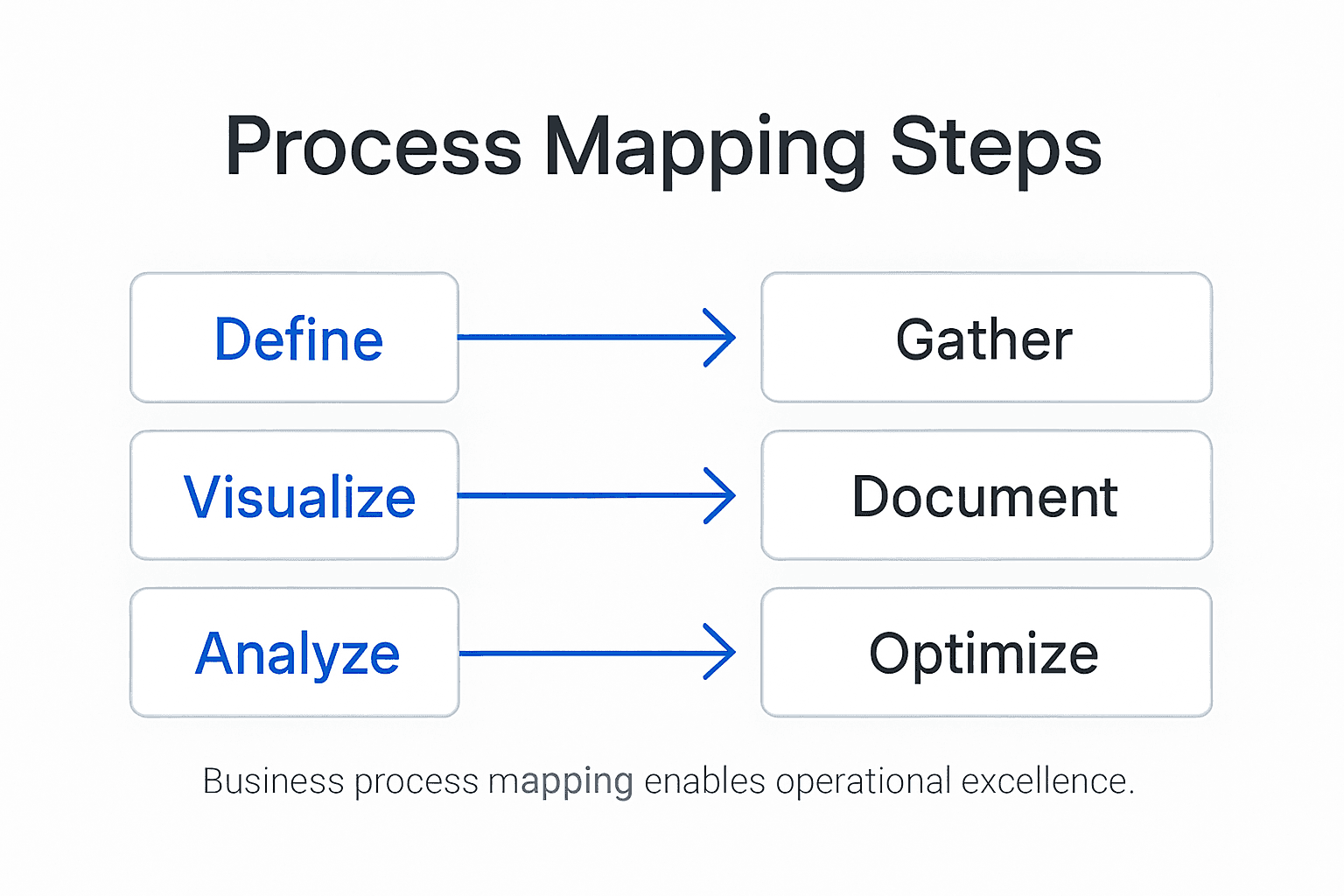
- Step 1: Define Key Processes And Gather Requirements
- Step 2: Visualize Current Workflows And Map Data Flows
- Step 3: Analyze Inefficiencies And Identify Improvement Areas
- Step 4: Optimize Processes And Align With Technology
- Step 5: Validate Improvements And Monitor Performance
Quick Summary
| Key Insight | Detailed Explanation |
|---|---|
| 1. Conduct Stakeholder Interviews | Engage various departments to gain diverse perspectives on current workflows. Use open-ended questions for comprehensive insights. |
| 2. Utilize Visual Tools for Clarity | Create standardized workflow diagrams to document processes clearly, using tools like swim lane diagrams for better understanding. |
| 3. Focus on Identifying Bottlenecks | Analyze operational workflows to pinpoint inefficiencies and areas for improvement, leveraging process mining techniques for detailed insights. |
| 4. Align Processes with Technology | Integrate automation into workflows by leveraging low-code platforms, ensuring processes adapt to technological advancements effectively. |
| 5. Establish Performance Metrics | Create a balanced scorecard with both quantitative and qualitative measures to validate improvements and track ongoing performance. |
Step 1: Define key processes and gather requirements
Defining key processes and gathering requirements are critical foundations for successful business process mapping. In this stage, you will systematically identify and document the core operational workflows that drive your organization’s performance.
Start by conducting comprehensive stakeholder interviews across different departments. Your goal is to understand the current state of business processes from multiple perspectives. Ask open ended questions that reveal how work actually gets done. Use requirements management techniques to capture nuanced operational details. Map out each process step chronologically, noting inputs, outputs, roles responsible, and potential bottlenecks.
In Saudi Arabia and UAE, enterprises increasingly recognize the importance of structured process documentation. Leverage your team’s institutional knowledge during this phase. Request documentation like existing workflow charts, standard operating procedures, and performance metrics. Cross reference these materials to validate the information gathered during interviews.
Our low code platform Cortex can help streamline this requirements gathering phase by providing visual mapping tools that make complex process documentation more intuitive. Create preliminary process flow diagrams that can be easily reviewed and refined with stakeholders.
Pro tip: Always validate your process maps with frontline employees who execute these workflows daily. Their ground level insights often reveal critical nuances that management might overlook.
Step 2: Visualize current workflows and map data flows
Visualization transforms complex business processes into clear, comprehensible diagrams that reveal operational insights. In this critical phase, you will create graphical representations of your organization’s workflows that highlight interactions, dependencies, and potential optimization opportunities.

Utilize Business Process Model and Notation standards to develop standardized workflow diagrams that communicate process details effectively. Start by creating swim lane diagrams that map each process step to specific departments or roles. Capture every interaction point, decision node, and information transfer. Pay special attention to handoff moments where work transitions between teams or systems.
In Saudi Arabia and UAE, enterprises are increasingly adopting sophisticated visualization techniques. Leverage our Cortex low code platform to build interactive process maps that allow real time collaboration and modification. Use color coding and different shape symbols to distinguish between activities, decision points, and data flows. Ensure your visual representation captures both the operational sequence and the underlying data movements.
Focus on documenting not just the current state but also identifying potential bottlenecks and inefficiencies. Your goal is to create a comprehensive visual narrative that tells the story of how work actually gets done in your organization.
Pro tip: Always validate your workflow diagrams with multiple stakeholders to ensure accuracy and capture nuanced operational details that might be missed in initial documentation.
Step 3: Analyze inefficiencies and identify improvement areas
Analyzing business process inefficiencies is a strategic endeavor that transforms raw operational data into actionable insights. In this critical stage, you will systematically dissect your workflow diagrams to uncover performance bottlenecks, redundant activities, and opportunities for optimization.
Leverage advanced process mining techniques to conduct a forensic analysis of your operational workflows. Examine process log data to trace exact transaction paths, measuring time spent at each stage and identifying unexpected deviations from standard procedures. In the context of Saudi Arabia and UAE enterprises, this granular analysis becomes crucial for maintaining competitive edge. Our Cortex low code platform can help you visualize these complex analytical results, highlighting critical performance metrics and potential improvement zones.
Focus on quantitative and qualitative assessment methods. Calculate key performance indicators like cycle time, resource utilization, and error rates. Look beyond surface level metrics to understand underlying root causes. Are delays caused by communication gaps? Do certain process steps require unnecessary approvals? Engage directly with team members to gather contextual insights that pure data might not reveal.
Pro tip: When analyzing inefficiencies, prioritize improvements that deliver maximum impact with minimal disruption to existing workflows.
Step 4: Optimize processes and align with technology
Optimizing business processes requires a strategic approach that seamlessly integrates operational workflows with cutting edge technological solutions. In this crucial phase, you will transform your mapped processes into streamlined, technology enabled systems that drive organizational efficiency.
Process mining technologies enable precise alignment between business operations and technological infrastructure. Leverage our Cortex low code platform to map existing processes against potential technological interventions. Identify automation opportunities where manual tasks can be replaced with intelligent digital workflows. In Saudi Arabia and UAE, forward thinking enterprises are increasingly adopting such technological optimization strategies to maintain competitive advantages.
Focus on creating modular, flexible process architectures that can rapidly adapt to changing business requirements. Evaluate each process step for potential digital transformation potential. Consider factors like workflow complexity, repetitive tasks, error prone manual interventions, and potential return on technological investment. Prioritize technologies that offer scalability, real time monitoring, and seamless integration with existing enterprise systems.
Pro tip: When aligning processes with technology, always conduct pilot tests on smaller workflow segments to validate effectiveness before full scale implementation.
Step 5: Validate improvements and monitor performance
Validating process improvements represents the critical final phase of your business process mapping journey. In this stage, you will systematically measure the effectiveness of your implemented changes and establish robust performance tracking mechanisms that ensure ongoing operational excellence.
Utilize quality improvement validation techniques to create comprehensive performance measurement frameworks. Develop control charts and run charts that track key performance indicators in real time. Our Cortex low code platform enables dynamic performance visualization, allowing you to monitor workflow efficiency across different operational segments. In Saudi Arabia and UAE, enterprises are increasingly adopting data driven validation approaches to maintain competitive advantages and demonstrate tangible business improvements.
Establish both quantitative and qualitative performance metrics. Quantitative metrics might include cycle time reduction, resource utilization percentages, and error rate improvements. Qualitative metrics should capture stakeholder feedback, employee satisfaction, and strategic alignment. Create a balanced scorecard approach that provides holistic insights into your process transformation efforts. Schedule regular review sessions to assess progress, identify emerging optimization opportunities, and ensure continuous improvement.
Here’s how different performance metrics contribute to effective process validation:
| Metric Type | Example Metric | Purpose |
|---|---|---|
| Quantitative | Cycle time reduction | Tracks efficiency improvement |
| Quantitative | Error rate decrease | Measures process reliability |
| Quantitative | Resource utilization | Assesses optimal use of resources |
| Qualitative | Employee satisfaction | Evaluates morale and engagement |
| Qualitative | Stakeholder feedback | Captures user experience insights |
| Qualitative | Strategic alignment | Ensures process meets objectives |
Pro tip: Implement a quarterly performance review process that compares current metrics against your original baseline to validate the sustained impact of your process improvements.
The following table summarizes key techniques and their impact for each stage of business process mapping:
| Stage | Key Technique | Expected Outcome |
|---|---|---|
| Requirements Gathering | Stakeholder interviews | Complete process understanding |
| Workflow Visualization | Swim lane diagrams | Clear depiction of responsibilities |
| Inefficiency Analysis | Process mining | Data-driven improvement targets |
| Technology Alignment | Low code automation | Faster and more consistent tasks |
| Validation and Monitoring | Performance dashboards | Ongoing improvement measurement |
Drive Operational Excellence with Singleclic’s End-to-End Solutions
Business process mapping is essential for uncovering inefficiencies and aligning workflows with technology to boost performance. If you are struggling with accurately visualizing your processes or identifying root causes of bottlenecks in your organization, you are not alone. Many enterprises in Saudi Arabia and UAE seek to move beyond simple documentation toward dynamic optimization supported by real-time monitoring and low-code automation platforms. This article highlights steps like requirements gathering, process visualization, and performance validation that are critical to achieving operational excellence.
At Singleclic, we understand these challenges. Our Arabic-enabled low-code platform Cortex empowers organizations to design, automate, and evolve their business processes without writing code. Cortex supports real-time optimization while integrating deeply with enterprise systems — perfect for industries like banking, government, and healthcare across the region. As a leader in Business Process Automation and digital transformation, we combine proven platforms like Odoo, Microsoft Dynamics 365, IBM BAW, and UiPath to ensure your business runs smarter and faster.
Are you ready to transform your business processes and achieve lasting operational improvements? Explore how Singleclic’s innovative BPM solutions can unlock new levels of efficiency and agility today. Visit Singleclic to learn more and schedule a consultation with our experts. Take the first step toward elevating your organization beyond digitalization — move into true optimization with Singleclic.
Frequently Asked Questions
What are the first steps in business process mapping for operational excellence?
To start business process mapping, identify key processes and gather requirements by conducting stakeholder interviews. Map out current workflows chronologically to document inputs, outputs, roles, and potential bottlenecks, ensuring comprehensive understanding of your operations.
How can I visualize current workflows effectively?
You can visualize current workflows by creating graphical representations like swim lane diagrams that show interactions and dependencies. Use standardized notation to ensure clarity and detail, which will help highlight inefficiencies and optimization opportunities.
What techniques can I use to analyze process inefficiencies?
Utilize advanced process mining techniques to analyze workflow diagrams and identify performance bottlenecks or redundant activities. Focus on measuring key performance indicators, such as cycle time and resource utilization, to pinpoint areas requiring improvement and develop targeted strategies.
How do I align optimized processes with technology?
To align optimized processes with technology, assess each step for opportunities for automation and digital transformation. Prioritize modular design, allowing you to adapt processes easily, and consider pilot testing new technologies on small segments before full-scale implementation.
What steps should I take to validate process improvements?
Validate process improvements by creating performance monitoring frameworks that utilize both quantitative and qualitative metrics. Regularly track progress against initial baselines and conduct quarterly reviews to ensure sustained impact and continuous improvement in operational efficiency.
Recommended
- Best BPM Solutions for Business Efficiency | Singleclic
- Discover the Best BPM Solutions 2025 | singleclic
- Business Processes in ERP: Streamlining Operations for Maximum Efficiency | Singleclic
- Business Process Automation Solutions | Singleclic
- Understanding Managing Customer Expectations in Diesel Services – My WordPress