TL;DR:
- Business continuity is the organizational discipline that ensures critical functions persist during disruptions, beyond just IT recovery.
- Implementing a comprehensive, regularly tested BCM program aligned with standards like ISO 22301 is vital for Gulf businesses navigating rapid digital transformation and regional risks.
Business continuity is not a backup plan you dust off after a crisis hits. It is the organizational discipline that keeps your operations running, your revenue flowing, and your stakeholders confident when disruption strikes. For business leaders in Saudi Arabia and UAE, where digital transformation is accelerating faster than most risk frameworks can keep pace with, understanding what is business continuity at a strategic level is no longer optional. This guide cuts through the confusion, explains how business continuity planning actually works, and gives you the tools to build real organizational resilience.
Table of Contents
- Key takeaways
- What is business continuity management
- How to build your business continuity plan
- Business continuity vs. disaster recovery vs. crisis management
- Why business continuity matters for Gulf businesses
- Best practices for ensuring business continuity
- My perspective on BCM in the Gulf
- How Singleclic helps you build operational resilience
- FAQ
Key takeaways
| Point | Details |
|---|---|
| BCM is broader than IT recovery | Business continuity management covers operations, people, communication, and technology together. |
| BIA is your starting point | A Business Impact Analysis identifies which functions are critical and defines recovery time objectives. |
| Treat it as a living program | Static plans fail. Regular testing and updates are what separate resilient organizations from ones that collapse. |
| Gulf businesses face unique risks | Cyber threats, supply chain dependencies, and regional regulatory requirements demand localized BCM strategies. |
| Low-code platforms accelerate agility | Tools like Singleclic’s Cortex platform allow organizations to adapt and update continuity workflows without delays. |
What is business continuity management
Business continuity is the process of ensuring that critical business functions can continue during and after a disruption. That disruption could be a cyberattack, a power failure, a key supplier going offline, a pandemic, or a regulatory crisis. What matters is that your organization has a pre-designed response that limits the damage and restores normal operations as quickly as possible.
Business continuity management, or BCM, is the broader discipline that governs this process. It is not a one-time project. BCM integrates three layers that work together: Crisis Management, which handles leadership decisions and communication during an event; Disaster Recovery, which restores IT systems and data; and Business Continuity, which keeps non-IT operations functional across the disruption period.
Understanding these three layers matters because most organizations only invest in one of them, usually IT disaster recovery, and then assume they are covered. They are not.
Key terms you need to know:
- BIA (Business Impact Analysis): The process of identifying your most critical functions, the dependencies they rely on, and what happens operationally and financially if they go down.
- RTO (Recovery Time Objective): The maximum acceptable time your systems or operations can be offline before the damage becomes unacceptable.
- RPO (Recovery Point Objective): The maximum acceptable data loss, measured in time, before a disruption causes irreversible harm.
- MTPD (Maximum Tolerable Period of Disruption): How long a business function can be down before it threatens the entire organization.
For organizations operating in Saudi Arabia and UAE, BCM also carries regulatory weight. Financial institutions, healthcare providers, and government-adjacent businesses face specific operational resilience expectations from regulators like SAMA and the UAE Central Bank. Aligning your BCM program with ISO 22301, the international standard for business continuity management systems, gives you a recognized framework and demonstrates due diligence to auditors and partners alike.
Pro Tip: Don’t wait for a regulatory audit to trigger your BCM program. Organizations that implement ISO 22301 proactively tend to discover operational gaps they never knew existed, and fix them before they become crises.
How to build your business continuity plan
Business continuity planning follows a structured sequence. Skipping steps in this sequence, especially the early analytical phases, is the most common reason plans fail when tested under real conditions.
Here is a practical approach, broken down into the phases that matter most:
-
Conduct a threat assessment. Start by identifying the disruption scenarios most relevant to your context. In the Gulf, this means factoring in regional risks such as geopolitical supply chain disruptions, extreme heat affecting infrastructure, and the rising rate of cybersecurity threats targeting critical industries in KSA and UAE.
-
Perform a Business Impact Analysis. The BIA is the analytical engine of your entire plan. A well-executed BIA identifies critical functions, maps their dependencies, and establishes RTOs, RPOs, and MTPDs for each. Without this, your recovery strategies are guesswork.
-
Develop response and recovery strategies. For each critical function identified in the BIA, you design a recovery path. This includes backup systems, alternate work locations, communication protocols, and decision authority matrices that make clear who does what and when.
-
Document and formalize the plan. In the Gulf context, legal documentation matters. Insurance coverage, contractual obligations with vendors, and regulatory compliance requirements all need to be reflected in your formal business continuity plan.
-
Test the plan under realistic conditions. Tabletop exercises, simulation drills, and full operational tests are how you find the gaps before a real incident does. Treating BCM as a living program rather than a document exercise is what separates organizations that recover quickly from those that do not.
-
Review and update continuously. Every major organizational change, new vendor relationship, system upgrade, or regulatory update is a reason to revisit your plan. BCM is not an annual checkbox. It is an ongoing management discipline.
One area where Gulf organizations are gaining a significant advantage is low-code automation. Singleclic’s Cortex platform, for example, allows teams to modify continuity workflows in real time without waiting for IT development cycles. When a crisis hits and your plan needs rapid adjustment, that kind of agility is not a luxury. It is a competitive necessity.
Pro Tip: When designing your communication protocols, test them independently of everything else. Communication breakdowns are responsible for more continuity failures than technical outages. Make sure your escalation paths work even when your primary systems are down.
Business continuity vs. disaster recovery vs. crisis management
These three terms get used interchangeably in boardrooms across the Gulf, and that confusion causes real damage to organizational resilience. Here is a clear comparison:
| Dimension | Business continuity | Disaster recovery | Crisis management |
|---|---|---|---|
| Primary focus | Keeping operations running | Restoring IT systems and data | Managing people, communication, and decisions |
| Scope | Enterprise-wide | Technology and data | Leadership and stakeholder response |
| Triggered by | Any disruption to critical functions | IT failure, cyberattack, data loss | High-impact events requiring executive decisions |
| Timeframe | Throughout the disruption | Post-incident restoration | During and immediately after the event |
| Outcome | Maintained service delivery | Recovered systems | Controlled, coordinated response |
The critical insight here is that siloing these three disciplines creates catastrophic gaps. Consider a scenario where a cyberattack takes down your ERP system in Dubai. Your IT team restores the system within 24 hours. But if your crisis management team never communicated with customers, regulators, or employees during the outage, and your operations team had no manual fallback for processing orders, you have still failed. Technically, IT recovery succeeded. Organizationally, the disruption cost you far more than it needed to.
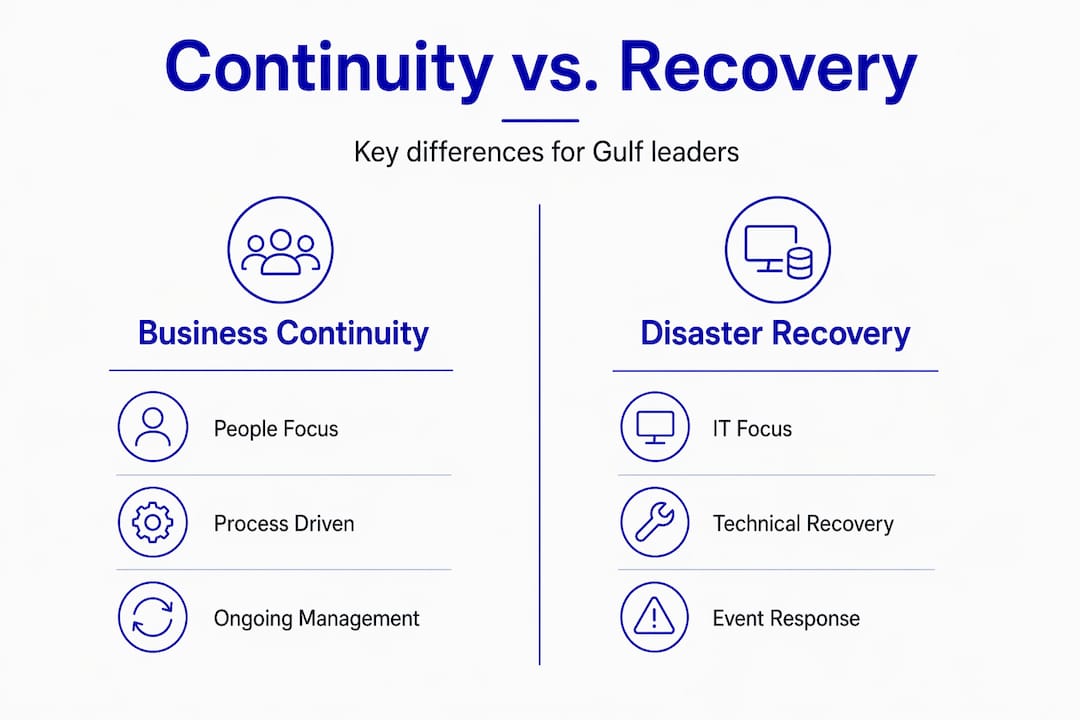
BCM programs that confuse IT recovery with full continuity management consistently underinvest in the operational and crisis layers. For businesses in Saudi Arabia and UAE, where stakeholder trust and regulatory relationships are deeply personal, that underinvestment carries outsized reputational risk.
Why business continuity matters for Gulf businesses
The numbers are stark. Over 70% of companies lacking a comprehensive business continuity plan fail to recover from significant disruptions. That statistic is not just a global average. It reflects a pattern that plays out in every market, including Saudi Arabia and UAE, where organizations often assume their scale or brand reputation provides a buffer. It does not.

The importance of business continuity is growing alongside digital transformation in the Gulf. Both KSA’s Vision 2030 and UAE’s digital economy agenda are driving rapid adoption of cloud systems, digital payments, and interconnected supply chains. Each of those integrations creates new dependencies and new points of failure. The global BCM market is projected to reach $72.96 billion by 2030, growing at 6.7% annually, precisely because organizations worldwide are recognizing this exposure.
The business case for BCM in the Gulf goes beyond avoiding catastrophe:
- Reduced downtime costs. Every hour of unplanned operational downtime carries direct financial loss, and in capital-intensive sectors like real estate, banking, and healthcare, those costs accumulate fast.
- Financial and regulatory protection. An untested IT migration cost TSB £48.65 million in regulatory fines in 2018. Gulf regulators are increasingly applying similar scrutiny to operational resilience.
- Supply chain resilience. External partner failures can cascade through your operations even when your own systems are fully functional. For KSA and UAE companies with complex logistics and vendor networks, this is a frequent and underplanned risk.
- Reputation management. How your organization communicates and performs during a disruption shapes stakeholder perception for years. A well-executed continuity response builds trust in ways that normal operations cannot.
- Support for hybrid work. With distributed teams across KSA and UAE, continuity strategies need to account for remote access security, communication dependencies, and variable IT environments.
For organizations pursuing digital resilience, BCM is not a separate workstream. It is built into how you design, automate, and govern your operations from the beginning.
Best practices for ensuring business continuity
The difference between organizations with theoretical BCM programs and ones with real resilience comes down to a consistent set of practices. Here is what actually works:
- Make BCM a leadership responsibility, not an IT task. The CEO and senior leadership team must own the program. When continuity planning sits only in the IT department, it never gets the cross-functional investment it requires.
- Run realistic scenario exercises, not just tabletop drills. Tabletop exercises have value, but they do not test execution. Schedule full operational simulations at least annually, including testing your communication protocols under pressure.
- Integrate BCM with your ERP and automation systems. If your business process automation architecture does not account for continuity scenarios, you will discover the gaps during a live crisis.
- Plan for vendor and supplier failures explicitly. Map your critical third-party dependencies and define what happens when each one fails. This is especially relevant for Gulf companies with cross-border supply chains.
- Use low-code platforms to keep plans current. Singleclic’s Cortex platform allows organizations to update workflows and response procedures in real time, without raising IT development tickets. That speed matters when threats evolve faster than traditional development cycles.
- Document authority and decision rights clearly. Who can authorize an emergency vendor contract? Who communicates with regulators? Who declares a full business continuity event? These decisions need predefined answers, not real-time debates.
Pro Tip: After every disruption event, even small ones, run a structured post-incident review. The most valuable BCM improvements come from learning what the plan missed in real conditions, not from theoretical updates in a conference room.
My perspective on BCM in the Gulf
I have worked with organizations across Saudi Arabia and UAE that have invested heavily in IT disaster recovery tools and then presented those tools as their business continuity program. The confidence is genuine. The gap is significant.
In my experience, the most dangerous BCM failure mode is not the organization that has no plan. It is the organization that has a plan that has never been tested, never been updated after a major system change, and lives in a PDF on a shared drive. When a real disruption hits, that plan does not get executed. People improvise. And improvisation under pressure, with no pre-designed authority structure or communication framework, produces outcomes that are far worse than the original disruption.
What I have seen work, particularly for Gulf enterprises managing complex operations across multiple entities, is treating BCM as a continuous operational discipline with a clear owner at the executive level. Not a project. Not a compliance exercise. A management function.
The adoption of low-code platforms has genuinely changed how fast organizations can adapt their continuity plans. When I see teams using tools like Cortex to rebuild and test response workflows in real time, the agility difference compared to traditional documentation-heavy approaches is dramatic. The organizations getting this right in KSA and UAE are not the ones with the thickest BCM binders. They are the ones with the most practiced teams and the most adaptable systems.
— Tamer
How Singleclic helps you build operational resilience
If this article has clarified what business continuity management requires, the natural next question is where to start.
Singleclic works with organizations across Saudi Arabia and UAE to design and implement the systems that make continuity possible. From ERP implementation in the Middle East that accounts for operational resilience from day one, to ERP readiness assessments that identify where your current infrastructure creates continuity risk, the team brings over a decade of regional delivery experience. Singleclic’s Cortex low-code platform gives your organization the flexibility to adapt continuity workflows without lengthy development cycles. Contact Singleclic to discuss where your program stands and what it would take to build resilience that holds under real pressure.
FAQ
What is business continuity in simple terms?
Business continuity is the process of keeping your organization’s critical operations running during and after a disruption. It covers people, processes, technology, and communication, not just IT systems.
What are business continuity plans?
Business continuity plans are documented strategies that define how an organization responds to disruptions, who is responsible for each action, and how critical functions are maintained or restored within defined timeframes.
How does business continuity differ from disaster recovery?
Disaster recovery focuses specifically on restoring IT systems and data after an incident. Business continuity covers the full operational picture, including non-IT functions, staffing, supply chains, and stakeholder communication.
Why is business continuity important for companies in Saudi Arabia and UAE?
Gulf organizations face a combination of accelerating digital transformation, complex supply chain dependencies, and increasing regulatory scrutiny. Without BCM, over 70% of businesses fail to recover from significant disruptions.
How do you ensure business continuity effectively?
Effective continuity requires a Business Impact Analysis to identify critical functions, documented and tested response strategies, integrated crisis management protocols, and a commitment to treating BCM as an ongoing program rather than a one-time planning exercise.