TL;DR:
- SaaS adoption in government improves efficiency, transparency, and citizen service quality when governed properly. It reduces costs through unified procurement, accelerates service delivery, and enhances data management while addressing security via strong governance frameworks. Strategic platform choices and low-code tools are crucial to avoid vendor lock-in and enable agile, compliant digital transformation.
The role of SaaS in government is frequently misunderstood. Many public sector leaders in MENA assume that cloud-based software introduces unacceptable security risks or clashes with data sovereignty requirements. The reality is almost the opposite. When managed with the right governance frameworks, SaaS delivers measurable gains in efficiency, cost control, citizen service quality, and institutional transparency. This guide walks you through what is actually driving SaaS adoption in government today, how agencies are capturing real value, and what decision-makers in Saudi Arabia, UAE, and across the region need to consider before committing to a platform.
Table of Contents
- Key takeaways
- Why governments are accelerating SaaS adoption
- Core benefits of SaaS for public sector agencies
- Governance, security, and compliance in government SaaS
- Strategic considerations in SaaS platform selection
- Applying SaaS effectively in MENA governments
- My perspective on SaaS and the future of government IT
- How Singleclic supports government SaaS and digital transformation
- FAQ
Key takeaways
| Point | Details |
|---|---|
| Governance enables security | Strong policies turn security concerns into adoption drivers, not barriers. |
| Procurement frameworks unlock savings | Unified SaaS agreements can generate billions in cost savings across agencies. |
| Platform choice has lasting impact | Your first major SaaS platform shapes your entire technology ecosystem for years. |
| MENA faces unique regulatory needs | Sovereignty laws in Saudi Arabia and UAE require on-premise or sovereign cloud options. |
| Low-code accelerates transformation | Platforms like Cortex empower non-technical government staff to build and automate without coding. |
Why governments are accelerating SaaS adoption
The numbers make the case clearly. The government software market is growing at a 13.8% CAGR in 2026, driven primarily by digital governance priorities and demand for AI-integrated analytics. That growth is not coincidental. It reflects a structural shift in how public sector institutions think about technology.
Legacy systems have become a genuine liability. Agencies running decade-old on-premise software face rising maintenance costs, security vulnerabilities, and an inability to respond quickly to changing policy mandates. Migrating to SaaS removes the burden of managing physical infrastructure and shifts responsibility for updates, patches, and uptime to the vendor.
Budget pressure is another accelerant. Governments across the MENA region are under intense scrutiny to demonstrate value for public money. SaaS shifts capital expenditure to predictable operating expenditure, which makes budgeting more transparent and easier to justify to oversight bodies.
For Saudi Arabia and UAE specifically, national transformation agendas such as Vision 2030 and UAE’s digital government strategy have created formal mandates for cloud adoption in government. Agencies are not just permitted to modernize. They are expected to. The key drivers accelerating this shift include:
- Demand for AI-powered analytics and decision support tools
- Pressure to reduce per-transaction costs in citizen service delivery
- Need for real-time data visibility across departments
- Mandated interoperability between government entities
- Talent shortages that make maintaining legacy systems increasingly difficult
Understanding how technology shapes government operations is the first step toward building a credible adoption roadmap for your agency.
Core benefits of SaaS for public sector agencies
The SaaS benefits for government go well beyond convenience. They translate into measurable outcomes that matter to citizens, auditors, and finance committees alike.
Cost savings through unified procurement represent one of the most tangible wins. The U.S. General Services Administration’s OneGov program demonstrates what scale can achieve: the program has saved $1.15 billion and given 3.4 million federal employees access to AI tools. A comparable unified procurement framework in the Gulf could deliver similar returns. In fact, Snowflake’s OneGov agreement already offers federal agencies 20 to 50% discounts on compute and 26.67% on storage at scale. These are not marginal gains.

Service delivery speed improves because SaaS platforms deploy updates continuously. A citizen portal running on SaaS can add a new service or modify an existing workflow in days rather than the months typically required in a traditional IT cycle. That responsiveness directly affects public satisfaction.
Data management and analytics become genuinely useful when housed in a cloud-native architecture. Departments that previously operated in data silos can share structured information across a common platform, enabling evidence-based policy decisions rather than guesswork. When combined with AI capabilities, this creates real potential for predictive service planning.
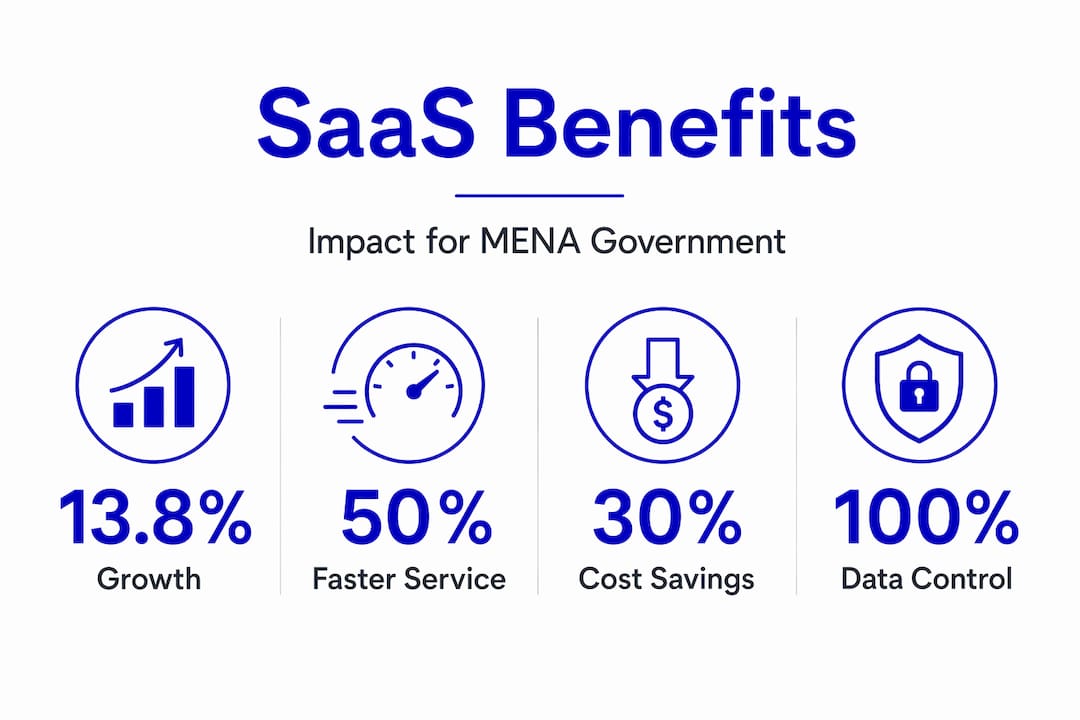
Transparency and accountability improve naturally when government operations run on auditable, centralized platforms. Every transaction, approval, and exception is logged and accessible to authorized reviewers without requiring complex data retrieval from local servers.
Scalability is particularly valuable in government contexts where mandates shift suddenly. An agency tasked with a new program can scale its software environment up within days rather than commissioning new hardware procurement that takes months. You can explore how SaaS drives smarter operations to understand why this adaptability is increasingly considered a strategic requirement rather than a nice-to-have.
Governance, security, and compliance in government SaaS
This is where most government SaaS conversations stall. Security concerns dominate the debate, but research tells a more nuanced story. Governance frameworks and performance expectancy are the strongest predictors of cloud adoption intention in government. Perceived risk, on its own, is not a statistically significant barrier when governance policies are already in place.
That finding has practical implications for your agency. Security does not need to be solved before you adopt SaaS. It needs to be governed alongside adoption.
What effective SaaS governance looks like in practice:
- Data residency policies that specify where citizen data can be stored and processed, enforced through contract terms with vendors
- Access control frameworks that tie user permissions to job roles and require multi-factor authentication
- Audit log requirements built into vendor service agreements, not bolted on afterward
- Incident response protocols that assign clear responsibilities between the agency and the vendor
- Compliance mapping that aligns vendor capabilities with regional regulations, whether that is Saudi Arabia’s NCA cybersecurity controls, UAE’s IAS standards, or broader GDPR-influenced frameworks
Pro Tip: Before signing any SaaS contract, require a compliance matrix from the vendor that maps their security controls to the specific regulatory framework your agency operates under. This takes the guesswork out of compliance verification and gives your legal team a concrete document to review.
Security and privacy concerns become adoption enablers, not blockers, when governance policies are strong. That shift in framing matters. Agencies that approach SaaS adoption with clear governance from the start move faster and encounter fewer post-deployment compliance problems. You can review how cloud adoption benefits enterprises and what unique requirements government environments add to the picture.
Strategic considerations in SaaS platform selection
The biggest mistake government agencies make is treating SaaS procurement as a transactional IT decision rather than a long-term architectural commitment. Platform lock-in is a critical hidden risk. The platform you choose first shapes your agency’s technology ecosystem for years, often without anyone realizing it at the time of selection.
Here is why. Once your agency standardizes workflows on a SaaS platform, AI tools, automations, and new capabilities are added as extensions of that same platform. AI expansion happens at the employee level rather than through new procurements. Each employee who builds a workflow or an AI agent on Platform A deepens the dependency without a formal procurement decision being made. By the time the agency recognizes the lock-in, migration is expensive and disruptive.
A practical approach to thoughtful platform selection involves these steps:
- Define outcomes first. Write your requirements around what the platform must achieve for citizens and staff, not around vendor feature lists.
- Assess interoperability. Confirm that the platform integrates with your existing and planned systems through open APIs, not proprietary connectors.
- Evaluate data portability. Before you commit, establish how you would export your data if you ever needed to switch vendors.
- Pilot before scaling. Run a bounded pilot across one department and measure actual outcomes against stated goals before signing enterprise agreements.
- Consider low-code capabilities. Platforms that offer low-code tools allow your non-technical staff to build and adapt processes without waiting for IT queues.
Pro Tip: Ask every SaaS vendor to demonstrate a data export of your own test data before the contract is signed. Vendors that make this difficult are signaling that exit will be hard. That is a meaningful data point for your decision.
Singleclic’s low-code platform Cortex is built specifically for MENA government environments. It supports full Arabic UI/UX, on-premise deployment, and runtime workflow changes without downtime. That means your teams can adapt processes in response to policy changes without raising a change request with a vendor. Explore why low-code suits government digital transformation efforts to see what that flexibility looks like in practice.
Applying SaaS effectively in MENA governments
MENA governments face a specific combination of regulatory requirements, budget cycle structures, and cultural expectations that shape how SaaS adoption actually works on the ground.
Saudi Arabia and UAE are at the forefront of this shift. Both countries have established sovereign cloud and digital efficiency goals that directly influence which SaaS vendors can operate in government contexts. Data must often remain within national borders, which rules out certain global SaaS deployments entirely. Local data centers or sovereign cloud options become prerequisites, not preferences.
One underappreciated challenge is cloud cost management. Consumption-based pricing models are unfamiliar territory for finance teams accustomed to fixed capital budgets. Without real-time monitoring and clearly defined spending controls, SaaS costs can escalate quickly past initial projections.
| Challenge | MENA-specific consideration | Recommended approach |
|---|---|---|
| Data sovereignty | Strict laws in Saudi Arabia and UAE | Require in-country hosting or sovereign cloud certification |
| Procurement cycles | Annual budget cycles limit flexible SaaS spending | Negotiate multi-year contracts aligned to budget periods |
| Legacy integration | Core government systems still on-premise | Use hybrid cloud architecture and middleware integration layers |
| Digital skills gaps | Limited internal SaaS expertise | Invest in vendor training and low-code tools to reduce IT dependency |
| Cost management | Variable consumption models unfamiliar | Implement FinOps practices with real-time usage dashboards |
Public sector cloud adoption in MENA requires accounting for sovereignty and compliance in ways that private sector deployments typically do not. That is not a reason to slow down. It is a reason to plan more carefully. You can find detailed guidance on integrating cloud in government systems to address the technical side of this integration challenge.
My perspective on SaaS and the future of government IT
I’ve worked alongside government agencies in Saudi Arabia, UAE, and Egypt long enough to notice a pattern. The agencies that struggle most with SaaS adoption are not the ones with the most complex technical environments. They are the ones that made their first platform choice without a clear governance policy in place and are now locked into a vendor relationship that limits what they can do next.
What I’ve learned is that the platform decision is genuinely the most consequential IT choice a government agency makes in any given decade. Not the device refresh. Not the cybersecurity vendor. The SaaS platform. Because once workflows, approvals, and citizen services are built on a foundation, everything else grows from it.
I’ve also seen security fears used as a reason to avoid SaaS altogether, when the research is clear that governance frameworks neutralize the risk. My honest take is that agencies using “security concerns” as a reason to keep aging on-premise systems are actually accepting greater risk, not less. Unpatched legacy systems are a far larger threat surface than a well-governed cloud deployment.
The most exciting shift I see right now is low-code platforms entering government IT. When a ministry official can modify an approval workflow in an afternoon without writing code or waiting months for IT delivery, the pace of government service improvement changes fundamentally. That is what platforms like Cortex are making possible across the region today. The agencies that invest in building internal capability around these tools will move faster than those waiting for centralized IT to catch up.
— Tamer
How Singleclic supports government SaaS and digital transformation
If your agency is evaluating SaaS adoption or looking to maximize the value of existing cloud investments, the path forward usually involves more than selecting a software vendor. It requires aligning your ERP architecture, automating core processes, and building internal capability so your teams can adapt without depending entirely on external consultants.
Singleclic has supported government and enterprise clients across Saudi Arabia, UAE, and Egypt for over a decade, delivering ERP implementations, business process automation, and low-code platform deployments tailored to MENA regulatory requirements. Our ERP implementation checklist for the Middle East is a practical starting point for agencies preparing for their next major digital transformation project. For C-level leaders focused on process efficiency, our business process automation guide offers a structured framework for identifying and prioritizing automation opportunities across your agency. We are ready to support you at every stage, from strategy to deployment to post-go-live optimization.
FAQ
What is the role of SaaS in government operations?
SaaS enables government agencies to deliver services faster, reduce infrastructure costs, and improve data visibility without managing on-premise software. It supports efficiency, transparency, and scalability across public sector functions.
How does SaaS help government agencies save money?
Unified SaaS procurement agreements generate significant discounts on compute and storage, and eliminate recurring hardware and maintenance costs. Programs like GSA’s OneGov have demonstrated over $1 billion in documented savings.
What are the main security concerns with SaaS in government?
Data residency, access control, and regulatory compliance are the primary concerns. Research shows these are manageable through governance frameworks, and well-governed SaaS deployments are often more secure than legacy on-premise systems.
How do Saudi Arabia and UAE approach SaaS adoption differently?
Both countries require data sovereignty compliance, meaning government data must often remain within national borders. This makes sovereign cloud options and on-premise deployment capabilities prerequisites for SaaS vendors operating in these markets.
What is a low-code platform and why does it matter for government?
A low-code platform allows non-technical staff to build and modify workflows without writing code. In government, this reduces dependency on IT queues and allows agencies to adapt processes quickly when mandates or service requirements change.