Every ambitious leader in Saudi Arabia and the UAE knows the pressure to modernize operations while staying secure and compliant. The search for Software as a Service (SaaS) solutions is not just about technology, but about achieving reliable agility across healthcare and banking. Choosing the right SaaS model helps organizations access powerful digital tools on demand without the heavy burden of hardware investments, setting a strategic foundation for true operational efficiency and long-term growth.
Table of Contents
- Defining SaaS Solutions For Enterprises
- Key Types And Deployment Models
- Essential Features And Integration Approaches
- Real-World Applications In Healthcare And Banking
- Cost, Security, And Compliance Considerations
- Comparing SaaS With On-Premise Alternatives
Key Takeaways
| Point | Details |
|---|---|
| Transformative SaaS Model | SaaS provides flexible, scalable software solutions accessible via the internet, revolutionizing software delivery for enterprises in Saudi Arabia and UAE. |
| Diverse Cloud Service Models | IaaS, PaaS, and SaaS each serve different organizational needs, offering unique benefits in infrastructure, application development, and software delivery. |
| Integration and Compliance Importance | Robust integration strategies and compliance with local regulations are critical for the successful implementation of SaaS solutions in the MENA region. |
| Cost and Security Management | Comprehensive governance frameworks focused on cost optimization and multi-layered security measures are essential for effective SaaS implementation. |
Defining SaaS Solutions for Enterprises
In the evolving digital landscape of enterprise technology, Software as a Service (SaaS) represents a transformative approach to software delivery and management. At its core, SaaS provides businesses across Saudi Arabia and UAE with flexible, scalable software solutions accessed entirely through internet-based platforms.
Understanding cloud computing models reveals how SaaS fundamentally differs from traditional software deployment. Unlike conventional on-premise systems, SaaS applications run on remote infrastructure, allowing organizations to access powerful tools without massive upfront hardware investments. This model enables enterprises to leverage cutting-edge technologies with minimal technical overhead.
Key characteristics of enterprise SaaS solutions include:
- Subscription-based pricing models
- Automatic software updates and maintenance
- Seamless scalability across organizational needs
- Accessible from multiple devices and locations
- Enhanced security through centralized management
Our regional low-code platform, Cortex, exemplifies this approach by providing Arabic-enabled, on-premise solutions specifically designed for MENA enterprises. These platforms empower organizations to design, automate, and evolve complex business processes without extensive coding requirements.
Pro tip: When evaluating SaaS solutions, prioritize platforms offering robust integration capabilities and scalable architecture tailored to your specific industry needs.
Key Types and Deployment Models
Enterprises in Saudi Arabia and UAE are increasingly adopting diverse cloud computing service models that provide flexible technology solutions. Cloud computing architectures offer multiple approaches to software and infrastructure management, each tailored to specific organizational requirements.
Three primary cloud service models dominate the enterprise landscape:
Here’s a concise comparison of the main cloud service models for enterprises:
| Model | Primary Focus | Typical Use Cases | Business Impact |
|---|---|---|---|
| IaaS | Virtual infrastructure | Storage, networking, computing | Maximizes flexibility, reduces hardware spend |
| PaaS | Application development | Custom apps, integrations | Speeds up innovation and deployment |
| SaaS | Complete software delivery | CRM, ERP, analytics | Simplifies IT, cuts upfront costs |
- Infrastructure as a Service (IaaS): Provides virtualized computing resources
- Platform as a Service (PaaS): Offers development and deployment environments
- Software as a Service (SaaS): Delivers fully functional applications online
Deployment models further diversify how organizations implement cloud solutions. These include public cloud, private cloud, hybrid cloud, and community cloud configurations. Each model presents unique advantages in terms of control, security, and operational flexibility.
Selecting the right cloud deployment model can significantly impact an organization’s digital transformation strategy and operational efficiency.
For businesses in the MENA region, hybrid cloud approaches often provide the most balanced solution. By combining public and private cloud infrastructure, organizations can maintain strict data privacy standards while leveraging scalable, cost-effective technologies.
Pro tip: Conduct a comprehensive infrastructure assessment before selecting your cloud deployment model to ensure alignment with your specific business requirements and compliance standards.
Essential Features and Integration Approaches
Successful SaaS solutions for enterprises in Saudi Arabia and UAE demand sophisticated integration strategies that enable seamless data exchange and operational efficiency. Modern organizations require robust integration approaches that transcend traditional software connectivity, focusing on creating intelligent, interconnected digital ecosystems.
Key features of effective SaaS integration include:
- Real-time data synchronization
- Comprehensive API connectivity
- Secure authentication protocols
- Automated workflow capabilities
- Scalable infrastructure support
- Compliance and data governance mechanisms
Middleware platforms play a critical role in enterprise SaaS integration, acting as strategic connectors between diverse software applications. These platforms facilitate communication across complex technological landscapes, enabling organizations to bridge gaps between legacy systems and modern cloud-based solutions.
Enterprise integration is not just about connecting systems, but about creating a unified, intelligent technological environment that drives operational excellence.
For businesses in the MENA region, integration approaches must balance technological sophistication with regional compliance requirements. Our low-code platform Cortex demonstrates this principle by providing Arabic-enabled integration capabilities that support enterprise-grade security and seamless system connectivity.
Pro tip: Prioritize integration platforms that offer flexible, vendor-agnostic connectivity and support real-time data transformation to maximize your technological investment.
Real-World Applications in Healthcare and Banking
Enterprise SaaS solutions are dramatically transforming operational paradigms in critical sectors like healthcare and banking across Saudi Arabia and UAE. Healthcare technology platforms are revolutionizing patient care through cloud-based electronic health records, telemedicine capabilities, and AI-powered diagnostic tools.
Key SaaS applications in healthcare include:
- Electronic medical record management
- Remote patient monitoring systems
- Telemedicine consultation platforms
- AI-driven diagnostic support tools
- Secure patient data integration
- Compliance tracking mechanisms
In the banking sector, SaaS solutions enable financial institutions to streamline complex operational processes while maintaining robust security standards. These platforms facilitate critical functions such as customer relationship management, fraud detection, regulatory compliance, and digital payment processing.
SaaS technologies are not merely technological upgrades, but strategic transformations that redefine organizational capabilities and competitive advantage.
Our regional low-code platform Cortex exemplifies how technology can be tailored to meet the unique requirements of Middle Eastern enterprises. By providing Arabic-enabled, enterprise-grade solutions, we empower organizations to leverage advanced SaaS capabilities while respecting local technological and cultural nuances.

Pro tip: Conduct a comprehensive digital maturity assessment before implementing SaaS solutions to ensure precise alignment with your organization’s specific operational requirements and strategic objectives.
Cost, Security, and Compliance Considerations
Navigating the complex landscape of SaaS solutions demands a comprehensive understanding of governance frameworks that balance cost management, security, and regulatory compliance. For enterprises in Saudi Arabia and UAE, these considerations are not just technical requirements but strategic imperatives that directly impact organizational resilience and competitive positioning.
Critical dimensions of SaaS governance include:
- Cost optimization strategies
- Data protection mechanisms
- Identity and access management
- Regulatory compliance tracking
- Continuous security monitoring
- Risk mitigation protocols
Enterprise-grade security requires a multi-layered approach that transcends traditional perimeter-based defenses. Encryption, multi-factor authentication, and automated policy enforcement become essential tools for protecting sensitive organizational data across cloud environments.
Effective SaaS governance is not about restricting technological innovation, but about creating intelligent, adaptable frameworks that enable secure digital transformation.
Our regional low-code platform Cortex addresses these challenges by providing Arabic-enabled, on-premise solutions that respect local regulatory landscapes while delivering enterprise-grade security and compliance capabilities.
Pro tip: Implement a comprehensive digital governance framework that includes regular security audits, automated compliance monitoring, and adaptive risk management strategies.
Comparing SaaS With On-Premise Alternatives
Enterprises in Saudi Arabia and UAE face critical decisions when selecting between SaaS and on-premise software solutions. Each model presents unique advantages and challenges that directly impact organizational efficiency, security, and long-term technological strategy.
Key comparative dimensions include:
- Initial investment costs
- Infrastructure maintenance requirements
- Scalability and flexibility
- Data control and security
- Customization capabilities
- Compliance and regulatory alignment
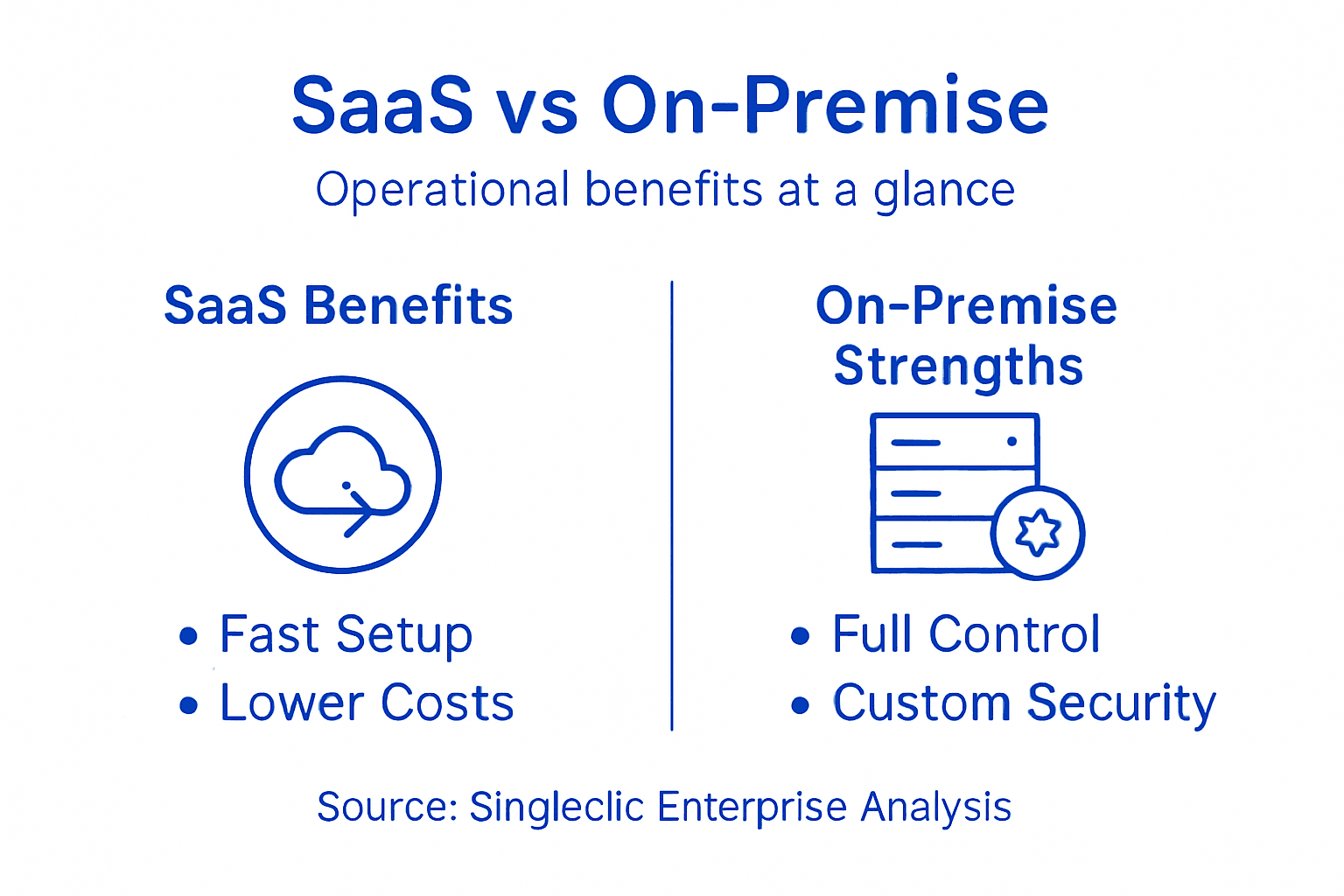
SaaS solutions offer significant advantages in terms of rapid deployment, reduced upfront costs, and automatic system updates. On-premise alternatives provide complete control over infrastructure, making them attractive for organizations with strict data privacy and customization requirements.
For quick reference, here’s how SaaS and on-premise solutions differ across key business dimensions:
| Dimension | SaaS Approach | On-Premise Approach |
|---|---|---|
| Cost Structure | Subscription, predictable budget | Large upfront, variable maintenance |
| Control | Limited infrastructure control | Full data and infrastructure control |
| Scalability | Rapid, nearly unlimited | Requires hardware upgrades |
| Security | Centralized, managed by vendor | Managed internally by IT team |
The optimal solution is not about choosing between SaaS and on-premise, but finding the right balance that aligns with your specific organizational needs and strategic objectives.
Our regional low-code platform Cortex bridges this gap by providing Arabic-enabled, flexible solutions that can be deployed on-premise or via cloud, offering organizations in the MENA region unprecedented technological adaptability.
Pro tip: Conduct a comprehensive infrastructure and compliance assessment to determine the most suitable deployment model for your specific organizational requirements.
Unlock Smarter Operations with Tailored SaaS Solutions
The article highlights how SaaS drives operational excellence through scalable, secure, and integrated platforms. Many enterprises in Saudi Arabia and UAE face challenges such as balancing data privacy with agility, navigating complex cloud deployment models, and ensuring seamless integration across legacy and modern systems. These pain points demand solutions that not only simplify IT management but also empower organizations to optimize workflows, enhance real-time decision making, and maintain strict compliance.
At Singleclic, we understand these critical issues and deliver specialized solutions designed for your unique market. Our Arabic-enabled low-code platform, Cortex, facilitates rapid business process automation and real-time workflow optimization without extensive coding. As experts in ERP & CRM implementation and enterprise AI, we combine top-tier technologies like Microsoft Dynamics 365 and IBM BAW with deep regional expertise to help you modernize operations effectively.
Explore how our comprehensive services can transform your enterprise and address challenges discussed in the article today.
Ready to move beyond traditional SaaS limits and achieve true operational optimization Visit Singleclic now to discover tailored digital transformation solutions that fit your enterprise needs and accelerate growth.
Frequently Asked Questions
What are the main advantages of using SaaS solutions for enterprises?
SaaS solutions offer numerous advantages, including reduced upfront costs, automatic software updates, seamless scalability, and easy accessibility from multiple devices. This flexibility allows organizations to leverage cutting-edge technologies without the burden of extensive hardware investments.
How do SaaS solutions enhance operational efficiency?
SaaS solutions enhance operational efficiency by automating processes, facilitating real-time data synchronization, and providing comprehensive integration capabilities. This leads to improved collaboration, faster decision-making, and streamlined operations across departments.
What types of businesses can benefit from SaaS solutions?
Businesses across various industries can benefit from SaaS solutions, particularly those requiring customer relationship management (CRM), enterprise resource planning (ERP), analytics, and other software applications that enhance productivity and operational efficiency.
How do SaaS solutions ensure data security and compliance?
SaaS solutions ensure data security through centralized management, encryption, multi-factor authentication, and continuous security monitoring. Additionally, they help organizations comply with regulations by offering features like automated compliance tracking and risk mitigation protocols.
Recommended
- Unlocking Business Growth with Odoo CRM: 6 Key Benefits for CEOs and SMBs | Singleclic
- How CRM SaaS solutions are Changing the Industry | Singleclic
- SaaS vs PaaS vs IaaS: What’s the Difference? | Singleclic
- How AI is Revolutionizing Business Operations | Singleclic
- Performing Arts Studio Management Software – StudioManaging
- Yritysleasing ja renkaat – Tehokkuutta PK-yrityksille