Low-code application development lets organizations design, build, and deploy business applications using visual tools, drag-and-drop interfaces, and reusable components — with minimal hand-written code. For UAE enterprises, this is not a convenience feature. It is a competitive necessity.

The pressure is real: government mandates under the UAE Digital Government Strategy, rising customer expectations across Dubai and Abu Dhabi, and a persistent shortage of senior developers are all converging at once. Low-code addresses each of these directly. Platforms like Singleclic’s Cortex, Microsoft Dynamics 365, and IBM BAW give business and IT teams the ability to ship working applications in weeks rather than quarters, without waiting on large development backlogs.
What distinguishes leading low-code platforms in UAE deployments:
- Visual modeling with drag-and-drop workflow design
- Reusable components and pre-built templates for common business processes
- ERP and CRM integration connecting to Microsoft Dynamics 365, Odoo, and legacy systems
- Role-based access control and audit trails for regulated industries
- On-premise or sovereign cloud hosting for banks, government agencies, and healthcare providers
- Arabic UI/UX support for MENA-specific deployments
The UAE low-code development platform market is growing significantly, driven by finance, healthcare, government, and retail sector investments. That figure alone signals how seriously UAE enterprises are treating this shift.
Table of Contents
- Why low-code application development delivers measurable ROI for UAE enterprises
- What core features should you look for in a low-code platform?
- How fast is the low-code market growing in the UAE?
- Security, governance, and compliance in low-code development
- How Cortex by Singleclic addresses UAE enterprise low-code needs
- Challenges and limitations you should plan for
- Comparing popular low-code platforms used in UAE and US markets
- Best practices for successful low-code adoption in your organization
- How low-code changes IT staffing and skill requirements
- Real-world low-code projects in UAE: what success looks like
- Singleclic helps UAE enterprises build and automate faster with Cortex
- Key takeaways
Why low-code application development delivers measurable ROI for UAE enterprises
The financial case for rapid application development in UAE is well-documented. Studies indicate that low-code adoption significantly reduces development time and technology costs, while improving return on investment over several years.
Beyond the numbers, the operational shift matters just as much. UAE executives increasingly view low-code as a financial lever that replaces unpredictable project-based coding costs with subscription models, improving capital efficiency and making budgeting far more predictable.
Key benefits for UAE enterprises:
- Faster time-to-market: Applications that once took several months can now go live in a fraction of the time using low-code platforms, with studies indicating development cycles can be up to 90% faster compared to traditional coding.
- Lower development costs: Reduced dependency on large specialist teams cuts both build and maintenance spend
- Business-IT collaboration: Non-technical staff can contribute to application design, reducing bottleneck requests
- Agility: Workflow changes can be made at runtime, without redeployment or downtime
- Predictable pricing: Subscription-based licensing replaces variable project costs
Pro Tip: UAE CIOs consistently highlight the low-code and Agile combination as the most effective stack for innovation. Pair two-week sprint cycles with your low-code platform to test, gather feedback, and iterate before committing to full-scale deployment. You reduce risk and accelerate learning simultaneously.
What core features should you look for in a low-code platform?
Not every platform delivers the same capabilities, and the gap becomes obvious once you move past simple form-building into enterprise-grade workflows. Here is what distinguishes platforms that scale from those that stall.

Visual modeling and drag-and-drop design remain the baseline. Any platform worth evaluating lets business analysts map processes visually without writing a single line of code. The better ones, like Cortex and Microsoft Dynamics 365’s Power Platform layer, allow runtime changes to live workflows without taking systems offline.
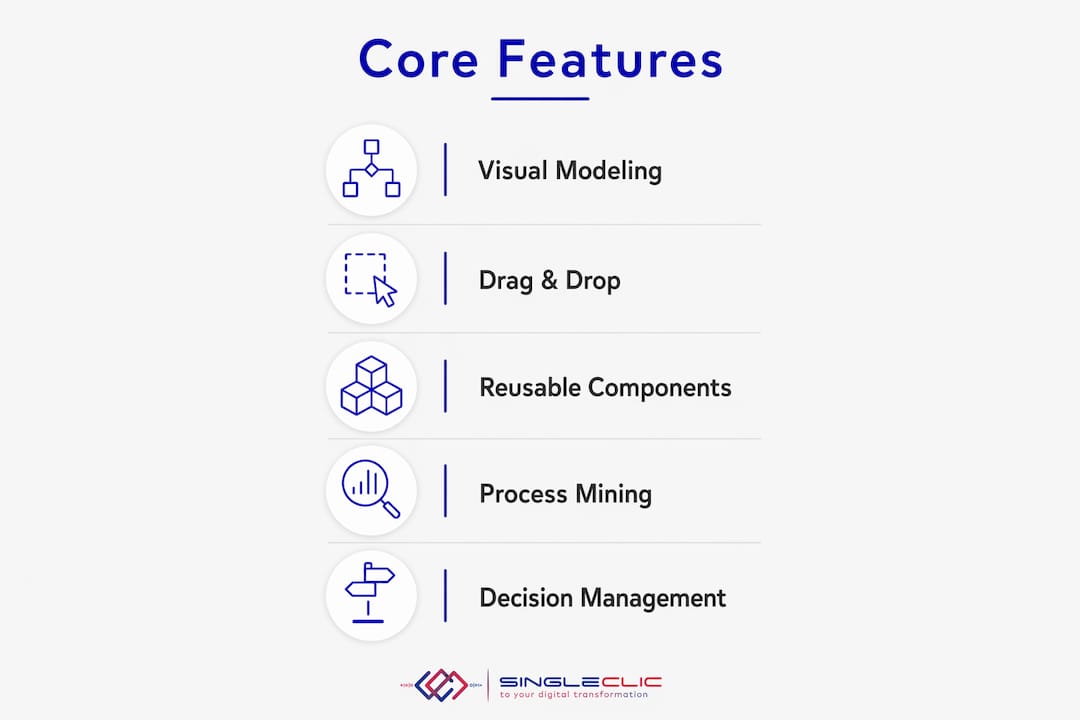
Reusable components and templates cut development time on repeat processes. A healthcare provider building a patient intake portal should not be rebuilding approval logic from scratch every time. Pre-built modules for common workflows — approvals, notifications, document routing — are what make the speed claims credible.
Integration depth is where many platforms fall short. UAE enterprises typically run heterogeneous environments: Microsoft Dynamics 365 for ERP, Odoo for specific verticals, legacy government systems, and custom databases. A low-code platform that cannot connect to these via standard APIs or native connectors creates more fragmentation, not less.
Additional features that matter in regulated UAE environments:
- Role-based access control (RBAC) limiting data visibility by user function
- Audit trails capturing every workflow action for compliance reporting
- Data residency controls keeping sensitive records within UAE borders
- Multi-language support, including full Arabic UI/UX for MENA deployments
- Collaboration tools enabling citizen developers and IT to co-build without stepping on each other
IBM BAW (Business Automation Workflow) adds process mining and decision management on top of standard low-code capabilities, making it a strong fit for complex, rules-heavy workflows in banking and government.
How fast is the low-code market growing in the UAE?
The adoption curve in the UAE is steep. Approximately 86% of UAE CIOs consider low-code platforms essential for enterprise application development, reflecting strong enterprise interest and penetration. The GCC low-code market is valued at USD 1.1 billion, with the UAE and Saudi Arabia leading adoption due to advanced IT infrastructure and national digital strategies.
Market signal: By the end of 2026, Gartner forecasts that 70% of new enterprise applications will be built on no-code or low-code platforms, up from less than 25% just a few years ago.
Three forces are accelerating this in the UAE specifically. The UAE Digital Government Strategy mandates digital-first service delivery across public agencies. The UAE Artificial Intelligence Strategy 2031 is pushing AI integration into core operations, and 97% of UAE organizations already report embedding AI agents into workflows, according to KPMG’s UAE Tech Report 2026. Low-code platforms are the practical delivery mechanism for much of this AI-enabled automation.
The US market offers a useful benchmark. Enterprise low-code adoption in the US is more mature in terms of governance frameworks and vendor ecosystems, but the UAE is closing that gap quickly, particularly in government and financial services. The difference is that UAE adoption is being actively shaped by national strategy rather than purely market forces, which creates faster institutional uptake.
The challenge that comes with rapid growth is governance. Skills shortages, shadow IT, and fragmented application portfolios are the predictable side effects of fast adoption without structure. Addressing these upfront separates successful programs from expensive experiments.
Security, governance, and compliance in low-code development
Speed without governance is how shadow IT proliferates. When business teams can build and deploy applications independently, the risk of unsanctioned data flows, unaudited processes, and security gaps rises sharply. Lack of governance causes security risks and fragmented apps despite the speed advantages low-code provides.
For UAE enterprises, compliance requirements add a specific layer of complexity. The UAE Personal Data Protection Law (PDPL) governs how personal data is collected, processed, and stored. Financial institutions operating in ADGM or DIFC environments face additional data residency requirements. Healthcare providers must align with Dubai Health Authority and Abu Dhabi Health Authority standards.
On-premise or sovereign cloud hosting is critical for UAE financial, government, and healthcare sectors precisely because of these demands. Platforms that offer only public cloud deployment are a non-starter for banks and government agencies that cannot allow data to leave UAE borders.
Essential governance and security requirements for enterprise low-code in the UAE:
- Data residency enforcement keeping all records within UAE-approved infrastructure
- Encryption at rest and in transit across all application layers
- Audit trails and activity logs for every workflow action, accessible for regulatory review
- Role-based access control preventing unauthorized data access across departments
- Change management controls requiring IT approval before citizen-developer apps go to production
- Vendor lock-in assessment ensuring portability if you need to migrate platforms
Explore cloud vs. on-premise hosting models for low-code in the Middle East to understand which deployment approach fits your compliance profile.
How Cortex by Singleclic addresses UAE enterprise low-code needs
Singleclic built Cortex specifically for MENA enterprises, and the design decisions reflect that. Most global low-code platforms are built for Western markets and retrofitted for Arabic-language requirements. Cortex starts with full Arabic UI/UX as a core capability, not an add-on.
The platform sits at the intersection of low-code software and Open BPM, connecting approvals, ERP data, CRM workflows, legacy systems, and document management into unified digital processes. Organizations can design and deploy complex workflows without writing code, then modify those workflows at runtime without taking systems offline. For a bank processing loan approvals or a government agency managing citizen service requests, that runtime flexibility is operationally significant.
Singleclic’s client portfolio across the UAE includes Emirates Health Services, Dubai Healthcare City, and QNB, each operating in sectors where compliance, auditability, and Arabic-language support are non-negotiable. The Cortex platform has been deployed in these environments alongside Microsoft Dynamics 365 and IBM BAW integrations, giving organizations a connected automation layer rather than a standalone tool.
Cortex differentiators for UAE enterprise deployments:
- Full Arabic UI/UX built natively, not translated
- On-premise deployment for banks, government agencies, and healthcare providers
- Unlimited user licensing without per-seat cost escalation
- Runtime workflow changes with no downtime or redeployment
- Deep ERP/CRM integration with Microsoft Dynamics 365, Odoo, and IBM BAW
- Real-time process monitoring and optimization dashboards
Pro Tip: If your organization runs Microsoft Dynamics 365 or Odoo alongside a separate BPM layer, Cortex can serve as the connective tissue. Rather than building point-to-point integrations, use Cortex to orchestrate approvals and data flows across both systems from a single process canvas.
Learn more about low-code platforms in the MENA region and how regional enterprises are structuring their adoption strategies.
Challenges and limitations you should plan for
Low-code is not a universal solution, and the vendor marketing rarely leads with the constraints. Understanding them upfront saves you from expensive course corrections later.
Customization ceilings are the most common frustration. Most platforms handle 80% of standard business workflows well. The remaining 20%, involving complex conditional logic, highly specific integrations, or unusual data models, often requires traditional development or platform-specific scripting. If your core process falls into that 20%, a low-code platform may extend your timeline rather than compress it.
Vendor lock-in is a real structural risk. Applications built on proprietary low-code platforms are often difficult to migrate. The visual models, component libraries, and workflow definitions are platform-specific. Before committing to a platform, assess what a migration would cost if the vendor changes pricing, discontinues a feature, or is acquired.
Scalability under load varies significantly between platforms. A workflow that runs smoothly for 50 users may degrade at 5,000. Test performance at projected peak load before production deployment, not after.
Other limitations worth planning around:
- Skill gaps among citizen developers leading to poorly designed processes that IT must later fix
- Integration complexity with older legacy systems that lack modern APIs
- Governance overhead as the number of citizen-built applications grows without central visibility
- Security vulnerabilities introduced by non-technical builders who are unaware of data exposure risks
The enterprise low-code success framework that works in UAE organizations consistently involves upfront investment in integration architecture and governance policy, not just platform selection.
Comparing popular low-code platforms used in UAE and US markets
| Platform | Best fit | Key strength | Deployment options | UAE-specific consideration |
|---|---|---|---|---|
| Cortex (Singleclic) | Banks, government, healthcare in MENA | Arabic UI/UX, on-premise BPM, unlimited users | On-premise, private cloud | Built for UAE compliance and Arabic-language workflows |
| Microsoft Dynamics 365 + Power Platform | Enterprises already on Microsoft stack | Deep Office 365 and Azure integration | Cloud, hybrid | Strong partner ecosystem in UAE; DIFC/ADGM cloud regions available |
| IBM BAW | Complex, rules-heavy process automation | Process mining, decision management, enterprise BPM | On-premise, cloud | Preferred in UAE banking and government for audit-grade workflows |
| Odoo | SMEs and mid-market in real estate, construction | Modular ERP with built-in low-code customization | Cloud, on-premise | Singleclic is an Odoo Silver Partner with UAE-specific implementations |
The right choice depends on your existing technology stack, compliance requirements, and whether your primary need is process automation, application development, or ERP extension. For organizations already running Microsoft Dynamics 365, the Power Platform layer is the natural starting point. For regulated sectors requiring on-premise deployment with Arabic support, Cortex is purpose-built for that profile.
Best practices for successful low-code adoption in your organization
The organizations that get the most from enterprise low-code development share a common pattern: they treat it as a program, not a project. A single successful pilot is not a strategy.
Start with a high-visibility, bounded use case. Choose a process that is painful, well-understood, and owned by a single business unit. Loan approval workflows, employee onboarding checklists, and maintenance request routing are all strong candidates. Avoid starting with processes that touch multiple systems or require complex data transformations.
Establish a Center of Excellence (CoE) early. A CoE sets the standards for how citizen developers build, what templates are approved, and how applications move from prototype to production. Without it, you end up with dozens of disconnected apps that nobody can maintain.
Integrate governance from day one. Define who can publish to production, how applications are reviewed for security, and what happens when a citizen developer leaves the organization. These are not bureaucratic obstacles; they are what prevent a low-code program from becoming a liability.
Additional practices that consistently improve outcomes:
- Pair citizen developers with IT mentors during the first build cycle
- Use version control even for visual workflow definitions
- Document integration dependencies before building, not after
- Set performance benchmarks and test at scale before go-live
- Review the business process automation guide for executive-level framing of automation governance
How low-code changes IT staffing and skill requirements
The common fear is that low-code eliminates developer jobs. The reality is more nuanced. What low-code actually does is shift where developer expertise is most valuable.
Routine application builds, form creation, and workflow configuration move to business analysts and operations staff. Senior developers are freed to focus on integration architecture, security hardening, platform governance, and the genuinely complex logic that low-code cannot handle. The net effect in most UAE enterprises is not headcount reduction but reallocation.
The new skill that organizations consistently underinvest in is low-code governance and platform administration. Someone needs to own the platform, manage the component library, review citizen-built applications before production, and maintain integration connections. This role sits between traditional IT and business operations, and it is genuinely scarce in the UAE market right now.
Managing AI agents will become a critical workforce skill within five years, according to 96% of UAE organizations surveyed by KPMG. Low-code platforms are increasingly the delivery layer for AI-enabled workflows, which means the skill set required is expanding rather than contracting. The organizations building internal capability now will have a structural advantage as AI integration deepens.
Pro Tip: When hiring for low-code roles, prioritize candidates who understand IT and business collaboration over those with deep coding skills. The ability to translate business requirements into visual workflows is rarer and more valuable than syntax knowledge.
Real-world low-code projects in UAE: what success looks like
Singleclic has deployed Cortex and IBM BAW across regulated UAE sectors, and the patterns of successful projects are consistent.
Emirates Health Services implemented digital workflow automation connecting patient intake, approval routing, and reporting dashboards. The key requirement was on-premise deployment with full Arabic UI support, which ruled out most global SaaS platforms. Cortex handled the workflow layer while integrating with existing clinical systems.
Dubai Healthcare City used a similar approach for internal process automation, replacing manual approval chains with digitized workflows that provided real-time visibility into process status and compliance documentation.
QNB required audit-grade workflow automation for financial processes, where every action needed to be logged, timestamped, and attributable to a specific user. IBM BAW’s process mining capabilities provided the traceability the compliance team required, while Cortex handled the front-end workflow design.
Across these deployments, three factors consistently determined success: clear process ownership before the build started, integration with existing ERP and CRM systems from day one, and governance structures that gave IT visibility without blocking business teams from building. The cloud management considerations for these deployments also played a role in ensuring the right hosting model was selected for each regulatory environment.
Singleclic helps UAE enterprises build and automate faster with Cortex
UAE enterprises that need to move fast without compromising on compliance have a specific problem: most global low-code platforms were not designed for their environment. Singleclic’s answer is Cortex, an Arabic-enabled, on-premise low-code and BPM platform built specifically for MENA enterprises in banking, government, healthcare, and real estate.
Where global platforms require workarounds for Arabic workflows, data residency, and legacy ERP integration, Cortex handles these natively. Singleclic brings 10+ years of regional delivery experience, 70+ consultants across KSA, UAE, and Egypt, and a client portfolio that includes Emirates Health Services, QNB, and Dubai Healthcare City. The team also implements and integrates Microsoft Dynamics 365, Odoo, and IBM BAW, so Cortex fits into your existing stack rather than replacing it.
If your organization is planning workflow automation, ERP extension, or citizen development programs in the UAE, talk to Singleclic. The right starting point is a scoped conversation about your current process pain points and compliance requirements, not a generic platform demo.
Key takeaways
Low-code application development in the UAE delivers the fastest, most cost-effective path to enterprise automation when paired with proper governance and the right platform for your compliance environment.
| Point | Details |
|---|---|
| Speed and cost gains are proven | Studies indicate that low-code adoption reduces app development time by up to 90% and technology costs by up to 37% for UAE enterprises. |
| UAE market adoption is high | Approximately 86% of UAE CIOs consider low-code platforms essential for enterprise app development. |
| Governance prevents failure | Lack of upfront governance causes shadow IT, security gaps, and fragmented apps despite speed advantages. |
| Compliance requires on-premise options | UAE banks, government agencies, and healthcare providers need on-premise or sovereign cloud deployment to meet data residency requirements. |
| Singleclic’s Cortex is purpose-built for UAE | Cortex offers Arabic UI/UX, on-premise deployment, unlimited users, and deep ERP/CRM integration for MENA enterprises. |