Nearshore wins when your team needs real-time collaboration, fast iteration, and lower coordination overhead, particularly for product development where feedback loops drive quality. Offshore wins when cost is the dominant constraint and the work is well-specified, process-driven, and tolerant of asynchronous handoffs, like QA or maintenance. Most enterprise programs, though, land on a hybrid model rather than picking one side outright.
TL;DR:
- Nearshore teams near US time zones enable real-time collaboration, reducing rework and speeding up development cycles compared to offshore arrangements.
- Offshore costs per hour may be lower, but total project costs often equalize or favor nearshore when accounting for additional management and rework expenses.
- Fast staffing for senior and specialized roles is more predictable nearshore, while offshore offers larger pools for junior or high-volume, well-defined work.
- Regulatory compliance and data residency requirements can outweigh cost and collaboration factors, limiting offshore options for sensitive industries.
- Hybrid delivery models effectively balance nearshore speed with offshore scale, especially when clear transition triggers and hybrid roles are established upfront.
Table of Contents
- Nearshore vs offshore: the core trade-offs at a glance
- How do you compare offshore development cost against nearshore total cost of ownership?
- Does time-zone overlap really change how fast your team ships?
- Can you find the right talent fast enough in each market?
- What compliance and IP risks shift the balance toward one model?
- What hybrid models combine nearshore speed with offshore scale?
- Which five questions decide your model?
- Singleclic’s take on choosing between nearshore and offshore
- How Singleclic helps you build the right delivery model
- Sources
- FAQ
Nearshore vs offshore: the core trade-offs at a glance
The choice rarely comes down to geography alone. It comes down to how much your project depends on synchronous collaboration versus how much it depends on raw cost efficiency at scale.
Nearshore delivery, typically staffing from Latin America for US buyers, gives you working hours that overlap with your own team almost entirely. Offshore delivery, usually staffed from South Asia or Eastern Europe depending on your base, gives you a much larger talent pool and lower rates, but with a communication lag baked into every exchange.
- Time-zone overlap: Nearshore teams often share 4 to 8 hours of live working time with US-based buyers, enabling same-day standups and pair programming, according to Revelo’s engineering leadership guide.
- Cost vs total cost of ownership: Offshore hourly rates look cheaper on paper, but rework, extended QA cycles, and project management overhead can erase much of that gap.
- Talent scale: Offshore markets generally offer deeper benches of junior and mid-level engineers, useful when you need to staff a large team fast.
- Best-fit scenarios: Nearshore tends to suit iterative product development; offshore tends to suit QA, maintenance, and other process-driven workloads with locked requirements.
How do you compare offshore development cost against nearshore total cost of ownership?
Hourly rate comparisons are the wrong starting point. What matters is the effective cost per shipped feature, and that number depends on far more than what a vendor quotes on a proposal.
Nearshore engineers typically cost substantially less than onshore hires but are typically more expensive than offshore talent at equivalent seniority, according to Internative’s development cost breakdown. That gap narrows fast once you factor in what offshore projects actually cost to run.
- Rework from misunderstood requirements, often invisible until sprint three or four
- Slower cycle times from asynchronous handoffs, which stretch a two-day fix into a week
- Added project management hours needed to compensate for limited overlap
- Slower onboarding when documentation has to replace live conversation
Statistic Callout: Total cost of ownership, not the hourly rate, can flip the outcome entirely: a nearshore team billing $10 more per hour can still be cheaper per feature once rework and PM overhead are counted against an offshore alternative, per Internative’s cost analysis.
When you model this yourself, ask vendors for their historical rework rate and average PM hours per developer, not just their blended hourly figure. Our quality assurance guide breaks down how QA overhead specifically shifts these numbers on offshore contracts.
Does time-zone overlap really change how fast your team ships?
Yes, and the effect is measurable, not theoretical. Overlap determines whether your team can debug live, run architecture reviews together, or has to wait a full day for an answer to a blocking question.
Three overlap tiers shape daily reality:
- Full overlap (6 to 8 hours): Standups, pair programming, and live architecture sessions happen in real time, the pattern most nearshore engagements deliver for US teams, per Revelo.
- Partial overlap (2 to 4 hours): Daily syncs still work, but deep collaboration gets compressed into a narrow window.
- Minimal overlap (0 to 1 hour): Nearly everything runs asynchronously, and decisions that would take minutes in person can take a full day.
Engineering leaders who have run both models report a notable drop in sprint velocity on teams with significant asynchronous work compared to teams with full overlap, according to Revelo’s guide for engineering leaders.
Pro Tip: If you’re stuck with minimal overlap, assign a dedicated bridge PM who works a shifted schedule and owns nothing but unblocking the offshore team. It’s cheaper than the velocity you’d otherwise lose.

Can you find the right talent fast enough in each market?
Speed to staff is where geography stops being abstract and starts affecting your launch date. Nearshore markets tend to concentrate mid to senior talent, but the pool is smaller, and a specific stack or niche skill set can mean a multi-week search.
Offshore markets, particularly in South Asia, offer far greater depth at junior and mid levels, which is exactly why they suit large-scale, well-specified work like QA operations, maintenance contracts, or follow-the-sun support, per Nearshore Coders’ 2026 outlook.
- Senior nearshore hires: often multiple weeks depending on stack rarity
- Senior offshore hires: sometimes faster to source, but with wider variance in vetting quality
- Rare or specialized skills (legacy systems, niche AI frameworks): offshore’s larger pool often wins
- Integrated senior teams that need to feel like an extension of your own staff: nearshore usually wins
One nuance worth flagging: senior nearshore rates in several markets have climbed enough that they now approach senior offshore rates, so the old assumption that offshore is always cheapest no longer holds cleanly at the top of the seniority ladder. Our offshore development center guide walks through how to structure a staffing plan around this shift.
What compliance and IP risks shift the balance toward one model?
Data residency and sector regulation can override every other factor on this list. If you’re in banking, healthcare, or government, the question isn’t just “nearshore vs offshore,” it’s whether either model satisfies your regulator.
- Confirm whether your sector mandates data stay within a specific jurisdiction before shortlisting any vendor location.
- Ask for SOC 2 or ISO 27001 certification as a baseline, not a bonus.
- For regulated industries, request on-premise or private-cloud deployment options rather than assuming shared infrastructure is acceptable.
- Verify how the vendor handles IP assignment in its contract template, not just in a sales conversation.
- Run a short security questionnaire before signing anything, covering access controls, breach history, and subcontractor use.
Our technology partner selection checklist covers the specific questions to ask before a vendor ever touches production data.
What hybrid models combine nearshore speed with offshore scale?
Few enterprise programs run purely nearshore or purely offshore for long. The strongest setups blend both, using each model where it performs best.
- Onshore architect, nearshore delivery: A senior architect stays close to the business, while a nearshore team handles day-to-day build work with near-full overlap.
- Nearshore core, offshore augmentation: A small nearshore team owns architecture and critical path work, while offshore engineers absorb high-volume, well-specified tasks.
- Offshore build, onshore project management: Best for cost-first projects with locked requirements, where a single onshore PM manages scope and quality gates.
Hybrid patterns like these are widely adopted for large or long-term programs precisely because they balance cost against collaboration risk, according to Internative’s analysis. Whichever pattern you choose, put the transition triggers in the contract upfront (a volume threshold, a milestone date) so shifting from one phase to the next doesn’t require renegotiation.
Which five questions decide your model?
Score each project before you pick a vendor location, not after. Choosing the model first and scoping the work second is a common mistake, per Internative.
- Project size and budget: Small, exploratory builds tolerate nearshore’s premium; large, multi-year builds can absorb offshore’s learning curve.
- Time-zone tolerance: High collaboration intensity points to nearshore; tolerance for async work opens the door to offshore.
- Compliance and security needs: Sector regulation can act as a veto, ruling out locations regardless of cost.
- Timeline urgency: Tight launch dates favor whichever market can staff seniority fastest, not whichever is cheapest.
- Talent specificity: Rare skills often push you toward offshore’s larger pool; integrated senior teams push you toward nearshore.
Pro Tip: Weight compliance as a veto factor, not a scoring factor. A project that scores well on cost and talent but fails a data residency requirement isn’t a close call, it’s disqualified.
Singleclic’s take on choosing between nearshore and offshore
Across ERP, CRM, and automation projects in the Middle East, the pattern holds: enterprises in regulated sectors, banking, healthcare, government, need collaboration and compliance more than rock-bottom rates, which usually points toward hybrid delivery rather than a pure offshore build. Singleclic typically recommends starting with a scoped pilot before committing to a full delivery model, then adjusting the mix as requirements firm up.
— Tamer Badr
How Singleclic helps you build the right delivery model
Singleclic is the regional alternative to a one-size-fits-all outsourcing vendor: instead of forcing your project into a single geography, we design the mix, nearshore-style regional delivery, offshore augmentation, or a fully managed team, around your compliance requirements and collaboration needs. Our engineers work across multiple locations, which means you get overlap with regional business hours along with specialized ERP, CRM, and automation expertise.
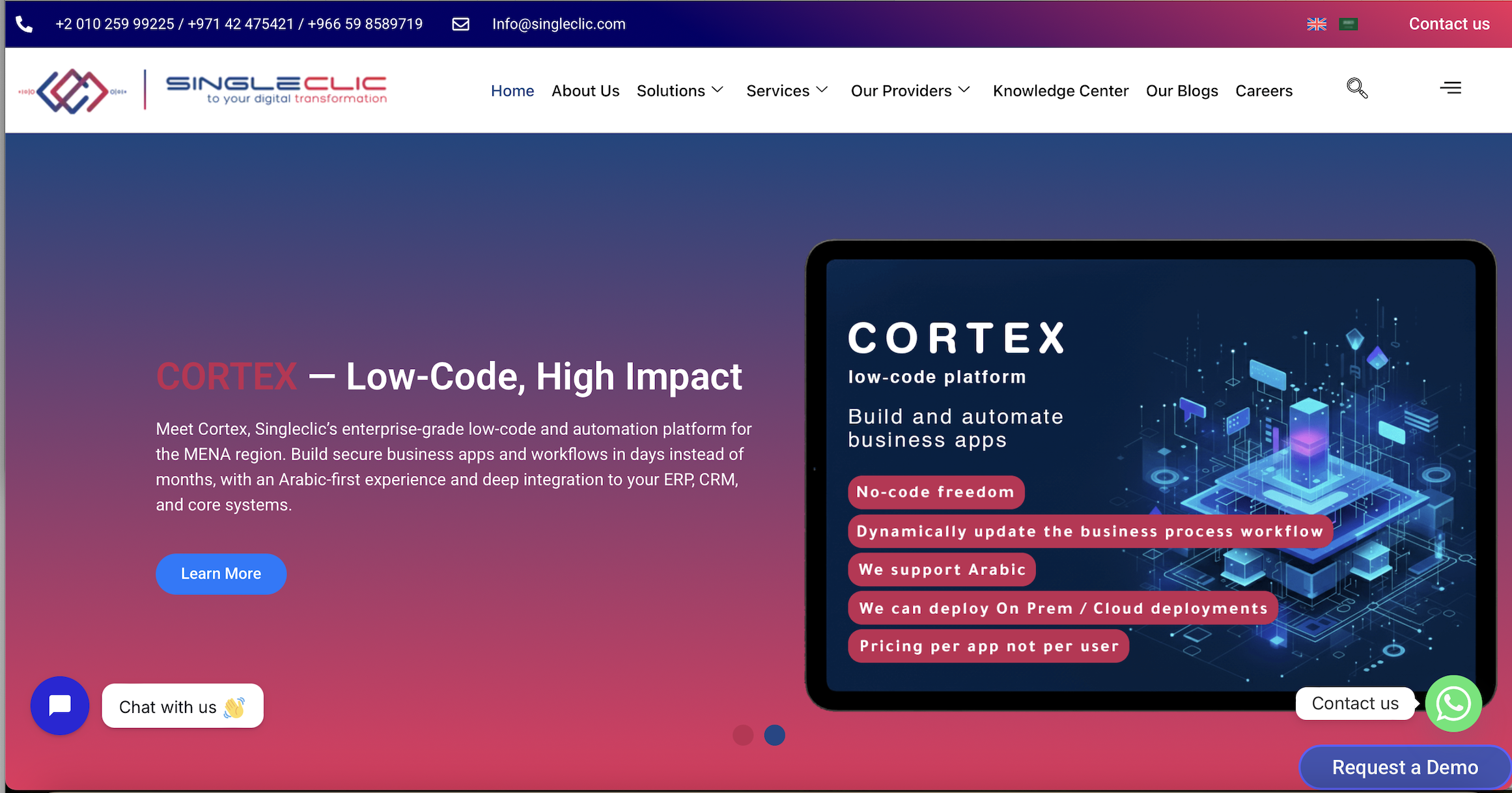
Our offshoring services cover staff augmentation and managed delivery teams, and we pair that with deep Microsoft Dynamics 365 and Odoo implementation experience for enterprises that need their outsourced team to actually understand ERP and CRM architecture, not just write code to spec. For organizations weighing whether to build in-house automation capacity or bring in a regional partner, our Cortex low-code platform gives you an Arabic-enabled, on-premise option for approvals, workflow, and legacy system integration without waiting on an offshore backlog. If you’re evaluating your next enterprise software program, start with a discovery call to score your project against the factors above.
Sources
This article draws on outsourcing cost and delivery frameworks from Internative’s nearshore vs offshore vs onshore breakdown, engineering velocity data from Revelo’s practical guide for engineering leaders, and use-case guidance from Nearshore Coders’ 2026 CTO outlook.
- Nearshore vs Offshore Outsourcing: Practical Guide for Engineering Leaders (2026)
- Nearshore vs Offshore Software Development: What US CTOs Need to Know in 2026 – Nearshore Coders Blog
FAQ
What is the difference between offshoring and nearshoring?
Offshoring means outsourcing to a distant country with little or no time-zone overlap, usually for lower cost and larger talent pools. Nearshoring means outsourcing to a nearby country with several hours of overlapping work time, trading some cost savings for faster collaboration.
What is meant by nearshore?
Nearshore refers to outsourcing work to a vendor or team in a nearby country, typically one sharing several time zones with the buyer, which supports real-time meetings and faster feedback than offshore arrangements.
Can you give an example of nearshore outsourcing?
A US company hiring a software development team in Mexico or Colombia to build a product feature, with daily standups happening during shared business hours, is a typical example of nearshore outsourcing.
What does onshore vs offshore mean?
Onshore means hiring a team within your own country, offering full time-zone alignment and cultural fit at the highest cost. Offshore means hiring a team in a distant country, usually at a much lower cost but with minimal working-hour overlap.
How does Singleclic decide between nearshore, offshore, and hybrid delivery?
Singleclic scores each project against factors like compliance requirements, collaboration intensity, and timeline urgency, then typically recommends a hybrid structure for enterprise ERP, CRM, and automation programs in regulated sectors. Current service details are available on the Singleclic services page.