What are Power Apps development services for enterprises?
Power Apps development services give enterprises a structured path to building custom, low-code business applications without the overhead of traditional software projects. Rather than starting from a blank codebase, your team works with a platform that handles the infrastructure while consultants focus on your actual business logic, data models, and integrations.
The core components of any serious engagement include:
- Discovery and process analysis: Mapping existing workflows before writing a single screen
- Architectural design: Choosing between canvas apps (full layout control for task-specific tools) and model-driven apps (structured data management for complex processes)
- Data integration: Connecting to Microsoft Dynamics 365, Odoo, IBM BAW, and legacy systems through prebuilt and custom connectors
- Application build and testing: User acceptance testing with real operational scenarios
- Post-launch managed support: Iterative improvements as your processes evolve
- Governance and lifecycle management: Version control, environment management, and compliance frameworks
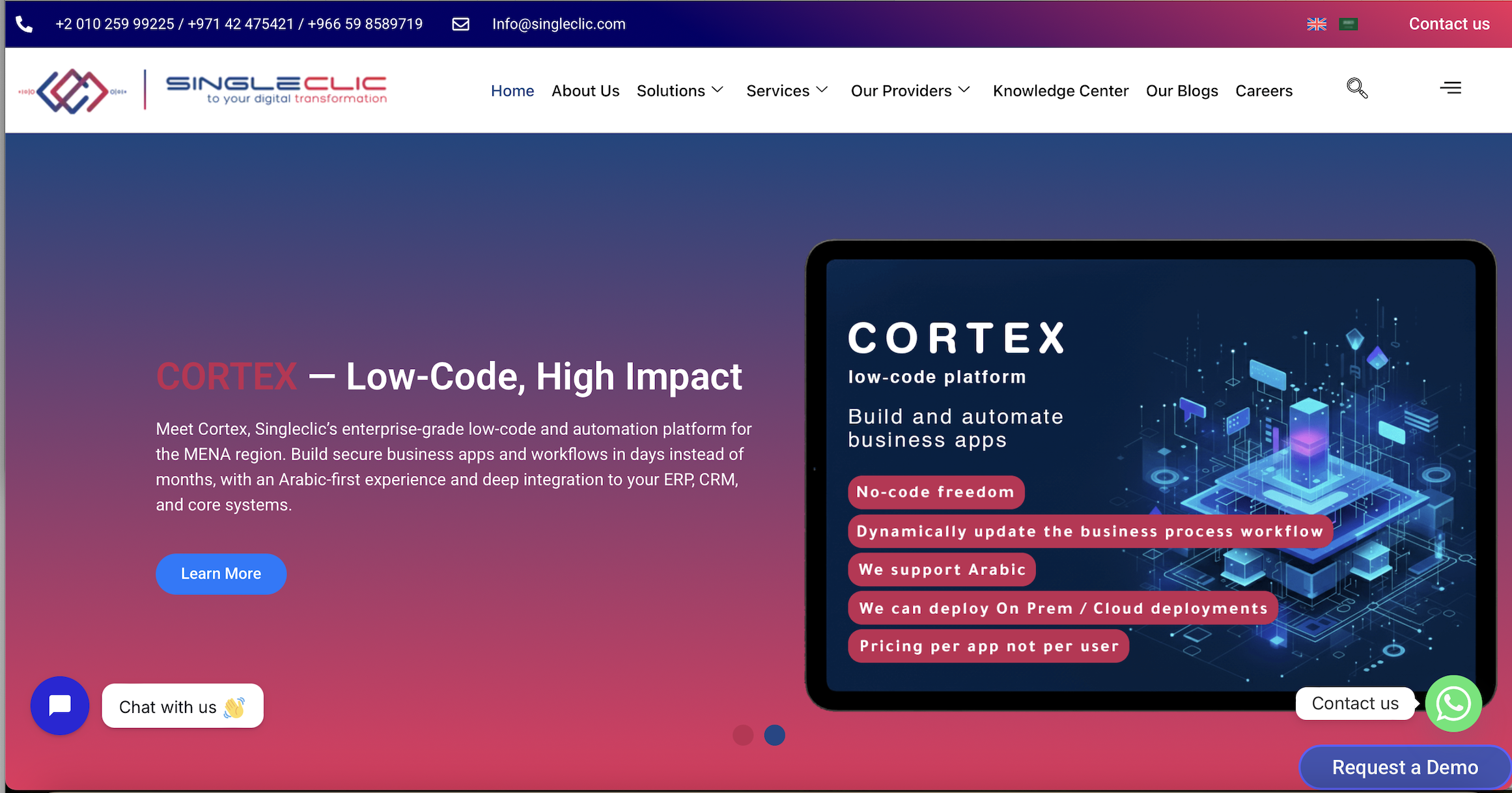
For MENA enterprises, platforms like Singleclic’s Cortex Low-Code Platform extend this further with full Arabic UI/UX, on-premise deployment, and deep ERP/CRM integration built specifically for regional compliance and operational needs.
Table of Contents
- How the Power Apps development lifecycle works for enterprises
- How does Power Apps integration with ERP and CRM systems work?
- Why low-code BPM platforms like Cortex give MENA enterprises a real advantage
- Why you should analyze business processes before building any Power Apps solution
- How Singleclic empowers enterprises with integrated Power Apps and low-code services
- Singleclic’s approach to Power Apps and low-code for MENA enterprises
- Key Takeaways
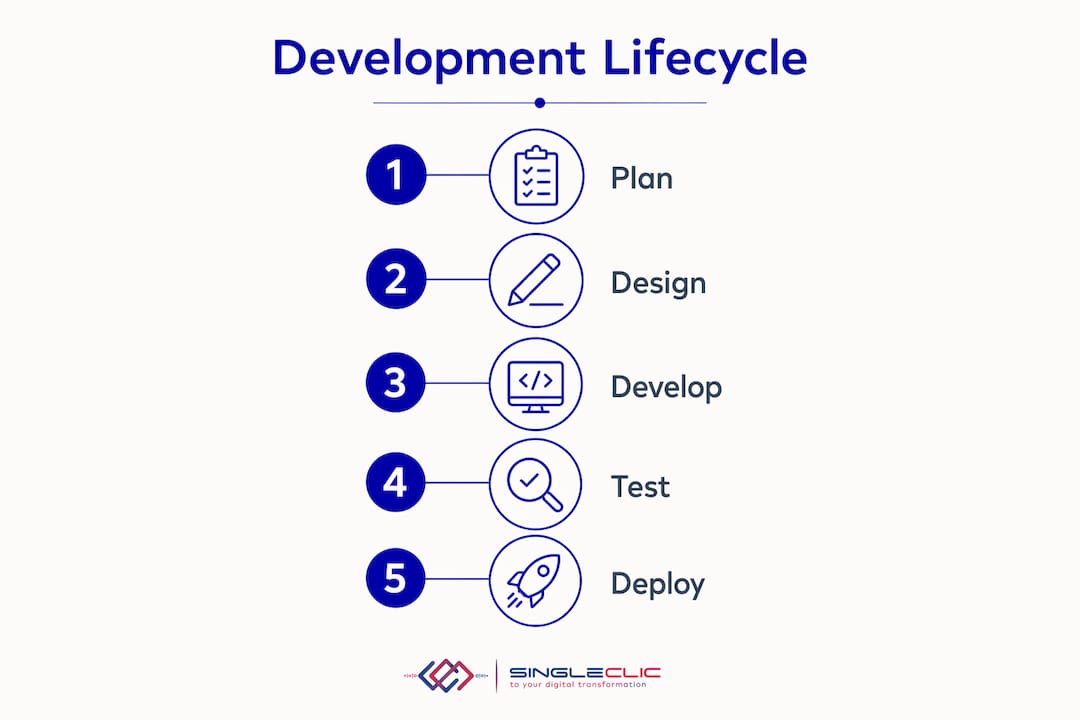
How the Power Apps development lifecycle works for enterprises
A well-run Power Apps project follows a repeatable sequence. Skipping phases is where most enterprise projects run into trouble.
-
Business process discovery: Document every workflow you want to automate. Identify which processes carry the highest operational cost and where manual handoffs create the most delay. Professional consulting starts here, not at the design tool.
-
Requirements and architecture design: Define data models, user roles, and integration points. Decide whether canvas or model-driven architecture fits each use case. Canvas apps suit targeted, task-specific workflows; model-driven apps handle complex, data-heavy processes built on Microsoft Dataverse.
-
Solution-based setup: Enterprise environments benefit from managed solutions with custom publishers to enforce organizational standards and enable clean import/export across development, staging, and production environments.
-
Data integration via connectors: Connect Power Apps to your ERP, CRM, and third-party systems. This is where the real operational value appears: a single app can pull live data from Dynamics 365, trigger approvals in IBM BAW, and write back to Odoo without any middleware layer.
-
Application build: Use drag-and-drop design, AI Copilot prompts, and prebuilt templates to accelerate development. AI Builder within Power Apps lets you add machine learning models for document processing, prediction, and classification without custom code.
-
User acceptance testing: Test against real business scenarios, not just technical specs. Involve the operations teams who will use the app daily.
-
Deployment and governance: Deploy through managed solutions. Establish security policies, permission structures, and compliance frameworks before go-live. A well-governed environment protects data quality and licensing costs across the organization.
-
Post-launch support and iteration: Apps need to evolve as processes change. Managed support keeps solutions performing and allows runtime workflow changes without downtime, a capability Cortex specifically supports for MENA enterprises.
Pro Tip: Use table segmentation in your Power Apps solutions to export only updated assets during releases. This minimizes unnecessary dependencies and keeps your environments clean across the full application lifecycle.
How does Power Apps integration with ERP and CRM systems work?
Integration is where enterprise Power Apps solutions either deliver real value or fall flat. Connecting Power Apps to your existing systems through prebuilt and custom connectors creates a unified data layer that eliminates duplicate entry and makes real-time reporting possible.
Key integration scenarios include:
- Microsoft Dynamics 365: Native connectors give Power Apps direct access to Dynamics 365 Finance and Operations, Sales, and Customer Service data. You can build approval apps, field service tools, and customer portals that read and write to Dynamics 365 in real time.
- Odoo: Custom connectors bridge Power Apps with Odoo modules for inventory, procurement, and project management, useful for construction and real estate enterprises running Odoo as their operational core.
- IBM BAW: Power Apps front ends can trigger and monitor IBM Business Automation Workflow processes, giving operations teams a modern interface over complex BPM workflows without replacing the underlying engine.
- Legacy systems: Custom connectors and Azure API Management let you surface data from on-premise databases and older ERP systems inside modern Power Apps interfaces.
Common integration challenges include data model mismatches, authentication complexity across systems, and managing API rate limits at enterprise scale. The mitigation is straightforward: map your data entities before building, use Microsoft Dataverse as a central data hub where possible, and test integrations under realistic load conditions.
For teams using Microsoft Teams for project coordination, Power Apps embeds directly into Teams tabs, putting process apps inside the collaboration tool your people already use.

Why low-code BPM platforms like Cortex give MENA enterprises a real advantage
The case for low-code in enterprise settings goes beyond faster development. For organizations in Saudi Arabia, UAE, and Egypt, the regional fit matters as much as the technology.
Cortex, Singleclic’s Arabic-enabled low-code BPM platform, addresses several gaps that generic platforms leave open:
- Full Arabic UI/UX: Government agencies and banks in the region require right-to-left interfaces and Arabic language support throughout, not just translated labels.
- On-premise deployment: Regulated industries including banking and government cannot move sensitive data to public cloud environments. Cortex deploys on-premise without sacrificing functionality.
- Unlimited users: Per-user licensing models create budget unpredictability at scale. Cortex’s model supports organization-wide rollout without per-seat cost escalation.
- Runtime workflow changes: Business rules change. Cortex allows workflow modifications without taking the system offline, which matters for 24/7 operations in healthcare and banking.
- Deep system integration: Cortex connects approvals, ERP data, CRM records, legacy systems, and document workflows into a single process layer.
- Faster time to value: Low-code platforms reduce build time significantly compared to traditional development, and organizations using Power Platform have reported significant ROI over a multi-year period driven by faster cycles and lower maintenance overhead.
Why you should analyze business processes before building any Power Apps solution
The most common reason Power Apps projects underdeliver is that teams start building before they understand what they are actually trying to fix. Technology chosen before the process is understood tends to automate the wrong thing faster.
A business-processes-first approach means identifying operational challenges, mapping decision points, and agreeing on success metrics before any screen is designed. This reduces rework, improves user adoption, and produces apps that people actually use rather than work around.
The practical difference shows up in scope. Teams that skip discovery often build apps that solve the visible symptom rather than the root cause, then spend months in change requests. Teams that invest two to three weeks in process analysis before development typically ship faster and with fewer post-launch issues.
Pro Tip: Before your first design session, document the five workflows that consume the most manual hours in your operations. These are your highest-ROI candidates for Power Apps automation, and they give your consulting partner a concrete starting point rather than a blank brief.
How Singleclic empowers enterprises with integrated Power Apps and low-code services
Singleclic brings together the consulting depth and platform capabilities that enterprise Power Apps projects require. As a Microsoft Dynamics 365 integrator, Odoo Silver Partner, and IBM BAW specialist, Singleclic covers the full integration stack that most MENA enterprises actually run.
Key capabilities include:
- End-to-end delivery: Discovery, architecture, build, integration, testing, deployment, and managed support under one engagement
- Cortex platform: On-premise, Arabic-enabled BPM and low-code platform for organizations that cannot use public cloud or need full process control
- Microsoft Dynamics 365 integration: Native expertise connecting customized Dynamics 365 solutions with Power Apps for finance, operations, and CRM workflows
- IBM BAW process automation: BPM implementations for complex, regulated workflows in banking, government, and healthcare
- Regional presence: 70+ consultants and engineers across KSA, UAE, and Egypt with 10+ years of delivery experience in the region
- Sector depth: Construction, real estate, healthcare, banking, telecom, and government, with clients including Emirates Health Services, QNB, AlBaraka, and Emaar Misr
- Managed offshoring: Technical team augmentation for enterprises that need ongoing development capacity without building an internal team
The combination of proprietary platform (Cortex) and partner ecosystem (Microsoft, Odoo, IBM) means Singleclic can meet enterprises where their current systems are, rather than requiring a full stack replacement.
Singleclic’s approach to Power Apps and low-code for MENA enterprises
Singleclic delivers what generic Power Apps vendors cannot: a fully integrated, regionally built solution that connects your ERP, CRM, BPM, and approval workflows into a single operational layer. Where most engagements stop at app delivery, Singleclic’s model includes Cortex as the process backbone, managed support for long-term evolution, and consultants who understand the regulatory and operational context of doing business in Saudi Arabia, UAE, and Egypt.
If your enterprise is running Microsoft Dynamics 365 or Odoo and needs Power Apps solutions that actually connect to your core systems rather than sitting alongside them, Singleclic is built for that exact problem. The team has delivered this for 100+ enterprise clients across the region’s most demanding sectors.
Talk to Singleclic’s team to map your highest-priority workflows and get a clear picture of what an integrated Power Apps and Cortex engagement looks like for your organization.
Key Takeaways
Enterprise Power Apps development services deliver the most value when integration with ERP and CRM systems is designed from the start, not added after the app is built.
| Point | Details |
|---|---|
| Process analysis comes first | Map your highest-cost workflows before any design work begins to avoid building the wrong solution. |
| Architecture choice matters | Canvas apps suit task-specific tools; model-driven apps handle complex, data-heavy processes on Dataverse. |
| Integration drives real ROI | Organizations using Power Platform have reported up to 188% ROI over three years through faster development and lower maintenance. |
| MENA enterprises need regional fit | Full Arabic UI/UX, on-premise deployment, and unlimited-user licensing address gaps that generic platforms leave open. |
| Singleclic delivers end-to-end | As a Dynamics 365 integrator, Odoo partner, and IBM BAW specialist, Singleclic connects Power Apps to your full enterprise stack with Cortex as the BPM backbone. |
Recommended
- Low-Code, High Impact: The Enterprise Business Case for Power Apps and Process Automation | Singleclic
- Unleashing the Power of Low-Code Development Platforms for Digital Transformation | Singleclic
- Low-Code Platforms: The Game Changer in Enterprise Digital Transformation | Singleclic
- Low-Code, High Impact: The New Engine of Enterprise Agility | Singleclic