TL;DR:
- Enterprise agility is the organization-wide capacity to adapt quickly and coherently in response to market changes. It involves redesigning governance, shifting authority closer to value creation, and fostering a leadership mindset rooted in courage and principles. Implementing it requires deliberate sequencing, technological enablement, and cultural transformation, especially in Gulf markets.
Enterprise agility is defined as an organization’s capacity to adapt rapidly and coherently at scale, sensing change across markets, reallocating resources deliberately, and keeping strategy actionable under real-world pressure. For business leaders in Saudi Arabia and the UAE, where Vision 2030 initiatives, digital mandates, and shifting consumer expectations collide, this capability is no longer optional. The Agile Alliance and PMI define enterprise agility as building “change readiness” across every function and level of an organization. It goes well beyond deploying Agile teams in IT. It means your entire organization, from the C-suite to frontline operations, can sense disruption and respond with speed and alignment.
What is enterprise agility and why does it matter now?
Enterprise agility is the organization-wide ability to adapt, decide, and execute faster than the environment changes, without losing strategic coherence. The 2026 Manifesto for Enterprise Agility positions this as a leadership and cultural capability, not a project management methodology. It encompasses operating models, governance structures, funding mechanisms, and human behavior, not just sprint cycles or backlogs.

PMI CEO Pierre Le Manh has stated that enterprise agility is non-negotiable for organizations that want to stay relevant and create value from constant change. The gap, however, is stark: ambition consistently exceeds actual implementation across most enterprises. That gap is exactly where organizations in the Gulf region lose competitive ground.
The importance of enterprise agility becomes clear when you consider what the alternative looks like. Organizations that rely on annual planning cycles, hierarchical approval chains, and siloed functional budgets cannot respond to a market shift in weeks. In the UAE’s financial services sector or Saudi Arabia’s rapidly expanding construction and real estate markets, that lag is costly.
What are the core values and principles behind enterprise agility?
The Manifesto for Enterprise Agility anchors four leadership and cultural values that distinguish genuinely agile enterprises from those simply running Agile pilots:
- Clear purpose with adaptive plans. Leaders guide with intent and direction, not rigid multi-year roadmaps. Plans are treated as hypotheses, updated as conditions change.
- Shared enterprise outcomes over functional optimization. Departments stop protecting their own metrics and start optimizing for what the whole organization needs to achieve.
- Continuous reinvention over preservation. The organization treats ongoing innovation as a core operating principle, not a periodic initiative.
- Human-centricity amid change. People are empowered with trust, resilience, and the authority to act. Change is designed with them, not done to them.
These values translate directly into how leaders design governance. Instead of gatekeepers who slow decisions, you build guardrails that define boundaries within which teams can act freely. Instead of funding activities and projects, you fund intent, giving teams the resources to pursue outcomes without requiring constant re-approval. This is a fundamental shift from how most large organizations in KSA and UAE currently operate.
The enterprise agility framework also requires moving authority closer to where value is actually created. A procurement team in Riyadh or a customer success function in Dubai should not need three layers of sign-off to respond to a client issue. Distributed authority, guided by clear principles, is what makes speed sustainable.
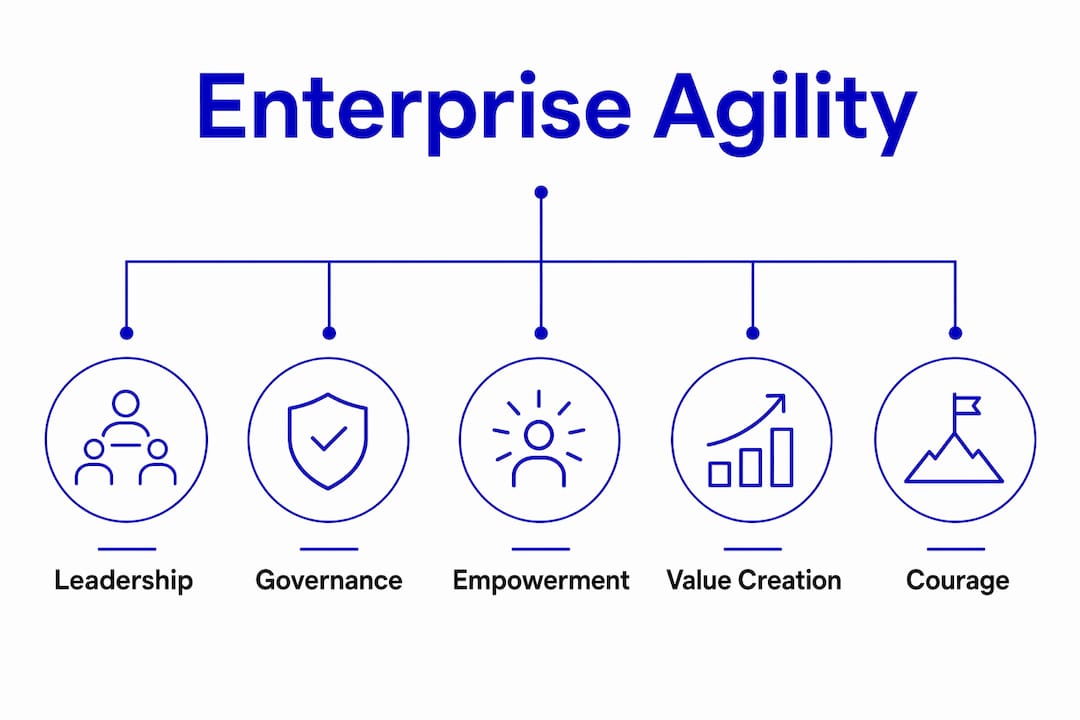
Pro Tip: Leadership courage matters more than process perfection. The organizations that succeed with enterprise agility are those where senior leaders visibly model adaptive behavior, not those with the most detailed transformation roadmaps.
How does enterprise agility differ from business agility and team-level Agile?
This distinction matters because confusing the three leads to expensive, ineffective transformations. Here is how they compare:
| Dimension | Team-level Agile | Business agility | Enterprise agility |
|---|---|---|---|
| Scope | Individual teams or squads | Specific business units or functions | Entire organization including governance and culture |
| Decision rights | Team autonomy within a project | Functional leadership discretion | Distributed authority across all levels |
| Primary focus | Delivery speed and iteration | Operational responsiveness | Strategic coherence plus adaptive execution |
| Governance model | Sprint ceremonies and backlogs | Departmental OKRs | Guardrails, funded intent, principle-based guidance |
| Impact level | Project outcomes | Unit performance | Organizational resilience and sustained growth |
Business agility in KSA and UAE often focuses on making specific functions, such as marketing, sales, or IT, more responsive. That is valuable. But it does not address the structural and cultural conditions that determine whether the whole organization can adapt.
Jim Highsmith, one of the original Agile Manifesto authors, is direct on this point: enterprise agility requires empowering people at all organizational levels to sense change and act independently, with or without top-down direction. Copying Agile rituals across departments does not achieve this. What you need is distributed judgment, the human capability to read a situation and make a sound decision without waiting for permission.
Many organizations in the region have invested in Agile coaching at the team level and seen modest gains. The ceiling they hit is almost always a governance ceiling, not a skills ceiling. Until funding, decision rights, and leadership behavior change at the enterprise level, team-level Agile produces local wins that do not compound into organizational capability.
How to achieve enterprise agility as a Middle East business leader
Implementing enterprise agility is not a single transformation project. It is a shift in how your organization is designed and led. Here is a practical sequence for leaders in Saudi Arabia and the UAE:
-
Assess your current agility readiness. Map where decisions actually get made versus where they should be made. Identify the approval chains that slow your fastest-moving teams. This diagnostic is the foundation of your enterprise agile transformation.
-
Redesign governance around guardrails, not gatekeepers. Replace approval-heavy processes with clear boundaries and principles. Define what teams can decide independently and what requires escalation. This single change often unlocks more speed than any Agile training program.
-
Shift funding from activities to intent. Annual project budgets tied to fixed deliverables are incompatible with enterprise agility. Move toward funding outcomes and allowing teams to determine how to achieve them within defined constraints.
-
Distribute authority near value creation. The teams closest to customers, operations, and markets should have the authority to act on what they observe. This is what distributed decision-making means in practice.
-
Leverage technology to remove bottlenecks. Low-code platforms reduce dependency on legacy IT queues, allowing business teams to build, modify, and automate processes without waiting months for development cycles. Singleclic’s Cortex platform, built specifically for MENA enterprises with full Arabic UI and on-premise deployment, is designed exactly for this purpose.
-
Align all functions toward shared enterprise outcomes. Finance, HR, operations, and technology must be measured against the same strategic goals, not optimized in isolation. This is the cultural work that takes the longest and matters the most.
Pro Tip: Speed without coherence creates fragmentation. Before pushing for faster decisions, make sure your leadership team has aligned on the principles and boundaries that will guide those decisions. Coherence is what makes distributed authority safe.
What are the measurable benefits and challenges of enterprise agility?
The benefits of enterprise agility are concrete and well-documented across industries. Organizations that successfully implement it report faster response to market shifts, higher rates of product and service innovation, stronger employee engagement, and more sustained revenue growth. In markets like the UAE’s banking sector or Saudi Arabia’s healthcare and government verticals, these outcomes translate directly into competitive position and stakeholder confidence.
Leaders across industries recognize enterprise agility as critical for staying relevant, yet research consistently shows that ambition outpaces actual adoption. The gap between recognizing the need and executing the change is where most organizations stall.
The challenges are real and should not be underestimated:
- Cultural resistance. Middle management often perceives distributed authority as a threat to their role. Without deliberate change management, this resistance quietly kills transformation efforts.
- Breaking functional silos. Departments optimized for their own metrics will not naturally collaborate toward enterprise outcomes. Incentive structures must change first.
- The strategy-execution gap. Many organizations articulate an agile strategy but maintain waterfall execution. The 7 digital transformation must-haves framework identifies this misalignment as one of the most common failure points.
- Measuring agility itself. Traditional KPIs measure efficiency and output, not adaptability. You need new metrics: decision cycle time, resource reallocation speed, and the rate at which strategy is updated in response to new information.
The critical enablers for overcoming these challenges include visible executive sponsorship, principle-based guidance rather than rigid frameworks, investment in leadership development alongside technology, and ongoing learning loops that treat complexity as a permanent condition rather than a problem to be solved once.
Key takeaways
Enterprise agility succeeds when leadership behavior, governance design, and technology enablement change together, not in isolation.
| Point | Details |
|---|---|
| Enterprise agility definition | It is the organization-wide capacity to adapt rapidly and coherently, not just a team-level Agile practice. |
| Governance redesign is foundational | Replace approval chains with guardrails and fund intent rather than fixed activities to unlock real speed. |
| Distributed authority drives results | Moving decision rights closer to value creation is what separates genuine agility from Agile theater. |
| Technology accelerates the shift | Low-code platforms like Cortex remove IT bottlenecks and let business teams act on change without delays. |
| Coherence prevents fragmentation | Speed must be paired with shared principles and aligned outcomes to avoid organizational churn. |
Why leadership mindset is the real differentiator in KSA and UAE markets
From my experience working with enterprises across Saudi Arabia and the UAE, the organizations that struggle most with enterprise agility are not the ones with the weakest technology. They are the ones where senior leaders treat agility as a program to be managed rather than a way of leading.
The 2026 Manifesto for Enterprise Agility gets this right. It frames agility as a leadership mindset that requires courage: the courage to reinvent how you fund work, how you make decisions, and how you measure success. That is uncomfortable for organizations built on hierarchical control, and it is especially challenging in markets where institutional authority carries significant cultural weight.
What I have seen work in the Gulf region is a deliberate sequencing. Leaders first align on principles and boundaries, then redesign governance, then invest in technology. When organizations reverse that order and start with technology, they end up with faster processes that still require slow approvals. The tools accelerate the wrong system.
Singleclic’s Cortex platform and our Agile ERP implementations are most effective when the leadership layer has already committed to distributing authority. Technology then becomes a genuine accelerator rather than an expensive layer on top of unchanged behavior. The organizations I have seen get this right in KSA and UAE are the ones that treat enterprise agility as a permanent operating principle, not a transformation project with an end date.
— Tamer
Build enterprise agility into your operations with Singleclic
If you are a business leader in Saudi Arabia, the UAE, or Egypt ready to move from agility as a concept to agility as an operating reality, Singleclic has the tools and expertise to support that shift.
Start with your ERP implementation readiness to identify where your current systems support or constrain adaptive execution. Explore our business process automation guide for C-level leaders to understand how automation removes the bottlenecks that slow decision-making. And if you want to see how Cortex, our Arabic-enabled low-code platform, can give your teams the ability to build and modify processes without IT queues, reach out to Singleclic directly. We have delivered enterprise agility solutions for clients including Emirates Health Services, QNB, and Emaar Misr, and we bring that same depth to every engagement.
FAQ
What is the enterprise agility definition in simple terms?
Enterprise agility is an organization’s ability to sense change and adapt quickly across all functions, leadership, governance, and culture, without losing strategic alignment. It goes beyond Agile teams to reshape how the entire organization makes decisions and allocates resources.
How is enterprise agility different from Agile methodology?
Agile methodology applies to teams and projects, focusing on iterative delivery. Enterprise agility applies to the whole organization, including funding models, governance structures, and leadership behavior, guided by principles rather than prescriptive frameworks.
What are the main benefits of enterprise agility for Middle East organizations?
The core benefits include faster market response, higher innovation rates, stronger employee engagement, and sustained growth. For organizations in Saudi Arabia and the UAE operating under Vision 2030 mandates, these outcomes directly support national competitiveness goals.
How do you start measuring enterprise agility?
Measure decision cycle time, the speed at which resources are reallocated in response to new information, and how frequently strategy is updated based on market signals. Traditional output metrics do not capture organizational adaptability.
Can low-code platforms support enterprise agility?
Yes. Low-code platforms reduce dependency on legacy IT bottlenecks, allowing business teams to build and modify processes independently. This directly supports distributed decision-making, one of the core requirements of enterprise agility.