Retail in Saudi Arabia and the wider Gulf is changing shape fast. Shopping malls in Riyadh and Jeddah still draw huge weekend crowds, but the same customers are just as likely to browse a brand’s app on their commute, order groceries for same-day delivery, or click “buy” from a social media post.
Vision 2030 has pushed retail modernization to the top of the national agenda, and consumers across the GCC now expect the kind of seamless, connected shopping experience they see from global retail leaders.
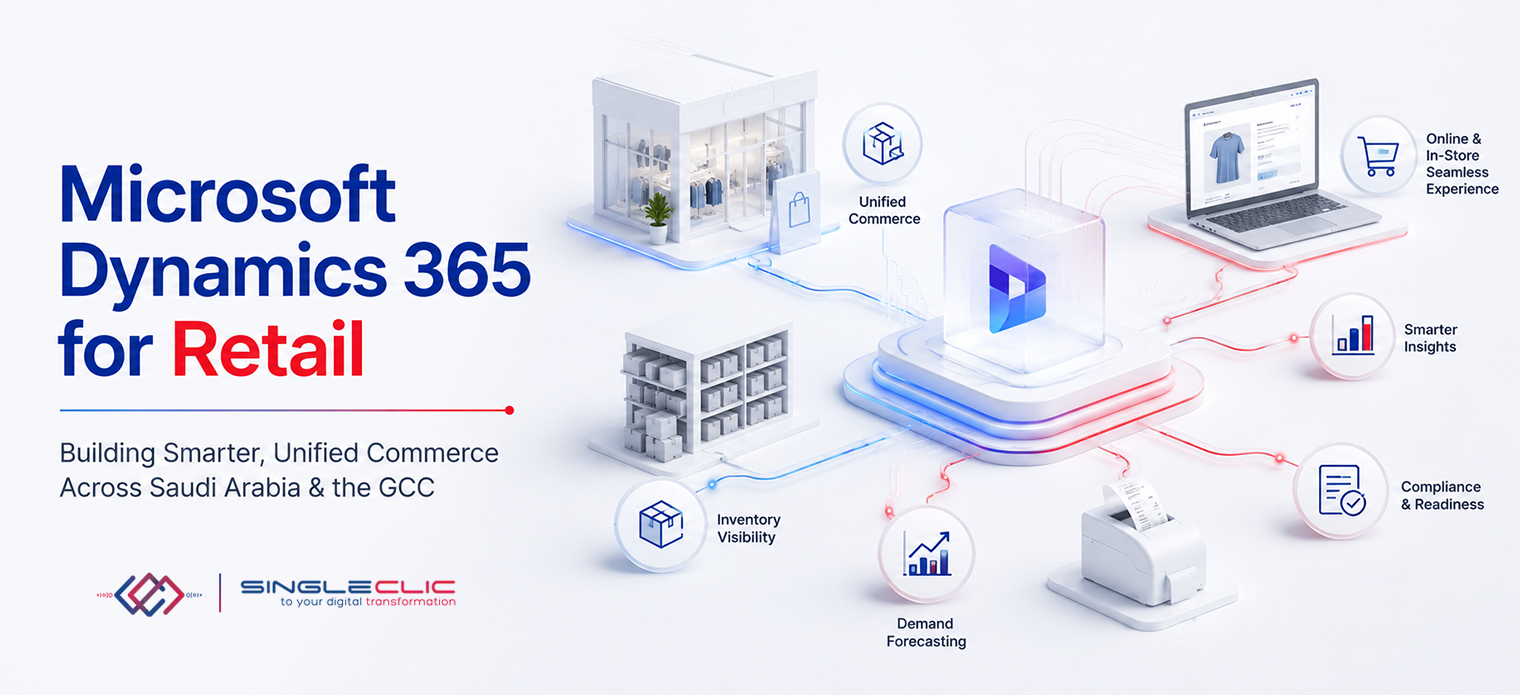
Microsoft Dynamics 365 for Retail has become a serious contender in these conversations. It’s built to unify commerce, from the point of sale to the warehouse to the online storefront, on a single platform.
For retail decision-makers in Saudi Arabia and the GCC comparing ERP and commerce platforms, understanding what Dynamics 365 actually solves, and where it fits, is a useful starting point before any vendor shortlist gets built.
Explore Solutions That Drive Business Growth
Retail Challenges You Can Solve With Microsoft Dynamics 365
Consistent and Effective Merchandising
Merchandising touches nearly every part of a retail business, and it’s also one of the hardest things to get right. Customer behavior shifts constantly, and that volatility makes it tough for retail teams to keep merchandising clear and consistent across channels.
Dynamics 365 Commerce, Microsoft’s omnichannel commerce solution, gives teams a way to manage and streamline merchandising as new channels and products come online. It also helps retailers time inventory purchases and store replenishment more accurately.
Rich product visuals, detailed descriptions, and centralized control over the full assortment all come together in one place, so retail teams can build, schedule, and track product information, categories, assortment plans, and pricing without jumping between systems.
Seamless Inventory Management
Inventory management is another persistent challenge, largely because it depends on tight alignment between logistics and sales. It’s a complicated process with many moving parts, and each one shapes whether products actually reach customers on time, which in turn shapes customer satisfaction.
We’ve seen this play out directly with our own clients: a wholesale home and garden decor business built a growth strategy around Dynamics 365 Business Central that let it scale operations and manage a high volume of inventory without losing control.
With Dynamics 365, retailers get an end-to-end view of the entire inventory process from a single, centralized location, which makes it far easier to get ahead of these challenges.
With Dynamics 365, retailers can:
- See their entire organization from one unified view
- Strengthen customer relationships and consistently exceed expectations
- Realize a faster return on their investment
- Manage inventory through one centralized platform
- Put built-in machine learning to work automating inventory management and reporting
Personalized and Omnichannel Experiences
Customer expectations have shifted dramatically, everywhere. Shoppers now check product availability on their phones, glance at promotions on digital in-store displays, and only then decide whether to buy on the spot or head into a store.
More than 80% of customers say they prefer an omnichannel experience, which makes delivering a strong customer experience essential for any retailer that wants to stay competitive.
Dynamics 365 Commerce helps retailers make sense of customer and business data as it happens, turning it into experiences that feel personal and improve the buying journey.
It also lets retailers build a consistent shopping experience across physical stores, the web, mobile, and call centers. That kind of connected experience has a real effect on revenue growth, customer satisfaction, and brand loyalty at every touchpoint a customer has with the business.
Stay Competitive and Future-Proof Your Business
Retail competition is fierce, and technology keeps raising the bar, from virtual assistants to chatbots to connected devices throughout the store. Retailers need new ways to attract customers and deepen engagement just to keep pace.
Dynamics 365 Commerce helps retailers stay agile as customer demands and available technology continue to evolve, building a foundation for long-term competitive advantage. It increases inventory visibility by automating processes across systems, strengthens engagement, lowers costs, and improves overall operational efficiency.
Backed by agile customer experience tools, real-time analytics, and deep, intelligence-driven insight, Dynamics 365 Commerce helps retailers transform how they interact with customers so they can stay ahead.
Keep Up with Trends to Meet Customer Expectations
Customer expectations shift by the day and keep getting harder to predict. Retailers have to rework their products continually, how they’re presented, how they’re sequenced, and how they’re priced to drive sales and stay aligned with what customers actually want.
Dynamics 365 Commerce applies advanced, machine-learning-backed analytics to give retailers predictive, optimized, and personalized insights into customer needs. It helps retailers attract new customers while continuing to exceed the expectations of the ones they already have.
With real-time visibility into products, customers, inventory, and orders, retailers can keep pace with shifting buying habits and market trends. Dynamics 365 also makes it simple to configure and manage a range of loyalty programs, helping build stronger loyalty to both the store and the brand.
Dynamics 365 Key Capabilities for Retailers
- Bring digital, in-store, and back-office operations together on one omnichannel platform to give customers a smooth, unified shopping experience.
- Coordinate promotions and operate consistently across every channel using accurate, real-time data.
- Turn customer insight into action, personalizing each experience and matching product selections to what customers actually want.
- Boost engagement by giving customers full access to your product catalog in-store or online, no matter where the stock happens to sit.
- Understand your customers through real-time data and recommendations, and reach them with the right message at the right moment.
- Stay purposefully connected with customers at every stage, from the moment demand arises through final delivery.
Transform Your Business with Microsoft Dynamics 365 ERP
Explore our ERP solutions and see how we help organizations streamline operations, improve visibility, and drive sustainable growth.
Inside Dynamics 365 for Retail: Commerce, POS, and Customer Insights
At its core, Dynamics 365 for Retail is built around three connected pillars.
Dynamics 365 Commerce
It brings together product catalogs, pricing, promotions, and order management across physical stores, e-commerce, call centers, and marketplaces, so retailers manage one source of truth instead of reconciling data between separate systems.
Point of sale (Store Commerce POS)
Whether on fixed tills, mobile devices, or self-checkout kiosks. Because it draws from the same central data as the online store, staff can check stock at another branch, process an online return in person, or look up a customer’s purchase history at the counter, all without switching systems.
Customer Insights
Gives retailers a consolidated view of shopper behavior across channels. Instead of guessing which customers are loyal, which are at risk of churning, or which products different segments actually respond to, retail teams get a data-driven picture they can act on, whether that’s a targeted promotion, a personalized offer, or a smarter loyalty program.
Together, these pillars are what people mean by “unified commerce”: one inventory, one customer record, one view of the business, regardless of where the sale happens.
Unlocking AI’s Retail Potential with Microsoft Copilot
Enhancing Shopper Journeys
Copilot fits naturally into the retail environment, drawing on data-driven insight to make shopping feel personal, whether a customer is browsing in-store or online.
Think of it as a shopping assistant working quietly in the background, built into a retailer’s app, website, or in-store kiosk, pointing shoppers toward the right products and smoothing out the path to purchase.
Connected to loyalty data and individual shopping history, Copilot can function much like a barista who already knows a regular’s usual order.
Retailers can put this to work by using Copilot to make the shopping journey, whether online, in the app, or at an in-store kiosk, more engaging and efficient through smarter search and product comparison.
Shoppers can search using everyday, natural language, and the results reflect their own shopping patterns rather than a generic list. Product comparisons aren’t fixed either; they adjust based on what matters most to that particular shopper. In a retail landscape where personalization is closely tied to conversion, experiences like this carry real potential to lift revenue.
Empowering Store Associates
Copilot’s role isn’t limited to customer-facing moments. It also gives store associates a deep well of resources and tools that make their day-to-day work faster and more effective, supporting real-time inventory checks, automating routine tasks, assisting with training, and answering questions in plain language the moment they’re asked.
Picture a new hire or junior associate on the floor, pulling out a mobile device or turning to a back-office Windows 11 Pro PC, asking about a procedure they don’t yet know, and getting a clear answer right away. It’s the equivalent of having a seasoned mentor on call around the clock.
Copilot works through the unstructured content sitting in standard operating procedures, guides, and the kind of dense PDFs and paper manuals most staff would rather avoid, turning that material into answers associates can actually use.
This helps retailers manage the ongoing challenges of high turnover and thin staffing, and it frees existing staff to spend their time on customers rather than administrative work, which shows up directly in the customer experience.
Smarter Store Operations
Copilot also gives store managers and back-office teams a clearer picture by pulling key insights together from multiple data sources at once.
It helps managers make sense of operational data, sales figures, inventory levels, and financial numbers quickly, and offers real-time suggestions on pricing, replenishment, and merchandising.
Frontline managers can get these answers delivered straight to a tablet or mobile device, putting actionable insight in their hands wherever they’re standing on the floor. For finance teams, it shortens the time it takes to close a fiscal period and surfaces deeper visibility into longer-term trends.
Bringing Copilot into the retail environment marks a meaningful step forward, with a few clear benefits standing out:
- Personalized Shopping Experience: Copilot shapes search results, product suggestions, and promotions around each customer’s individual preferences.
- Operational Efficiency: Copilot takes routine tasks off associates’ plates, freeing them to spend more time on work that actually adds value.
- Data-Driven Insight: Copilot draws on deep data processing and access to unstructured or siloed information to give store management insight it can act on.
Is Dynamics 365 the Right Fit for Your Retail Business? A Quick Self-Check
Before adding Dynamics 365 to a vendor shortlist, it’s worth honestly answering a few questions:
- Do you operate across more than one sales channel, physical stores, e-commerce, marketplaces, or a call center, and struggle to keep inventory or pricing consistent between them?
- Are seasonal periods like Ramadan or Eid consistently a source of stockouts or excess inventory because forecasting is manual or disconnected from actual sales data?
- Is your business required to comply with ZATCA e-invoicing, and are you currently managing that through a separate add-on or manual process rather than a natively integrated system?
- Do your store staff or online teams lack a single, real-time view of customer history, loyalty status, and stock availability?
- Are you planning to expand into new cities in Saudi Arabia or into other GCC markets in the next one to two years, and need a platform that scales with that growth?
If you answered yes to two or more of these, Dynamics 365 for Retail is likely worth a closer look. Every retail business has its own mix of legacy systems, regional requirements, and growth plans, so the right next step is usually a conversation grounded in your specific operations rather than a generic feature comparison.
Ready to Transform Your Retail Experience?
Singleclic is a Microsoft Dynamics 365 partner with hands-on experience helping retailers across Saudi Arabia, the UAE, and Egypt bring their stores, e-commerce, and back-office operations onto one connected platform.
From ZATCA-compliant e-invoicing to Copilot-powered store insights, our team can help you scope a unified commerce strategy built around how your business actually operates. Talk to our Microsoft Dynamics 365 experts at Singleclic to see how unified commerce can work for you.
FAQs
What is Dynamics 365 for Retail, and how is it different from a standard ERP system?
Dynamics 365 for Retail is Microsoft’s unified commerce platform for retailers, built on Dynamics 365 Commerce. Unlike a standard ERP that mainly handles back-office functions like finance and supply chain, it also connects point of sale, e-commerce, inventory, and customer data on one platform, giving retailers a single, real-time view across every sales channel.
Does Dynamics 365 support ZATCA e-invoicing for retailers in Saudi Arabia?
Yes. Dynamics 365 Finance includes built-in localization for Saudi Arabia that supports ZATCA’s e-invoicing requirements, covering both onboarding stages (compliance and production cryptographic stamp identifiers), along with digital signing, QR code generation, and real-time invoice submission. This applies to point-of-sale transactions as well as back-office invoicing, which matters for retailers specifically.
Can Dynamics 365 handle both in-store and online sales for the same business?
Yes. Dynamics 365 Commerce is built for omnichannel retail, meaning physical stores, e-commerce, mobile apps, call centers, and marketplaces all run on the same inventory, pricing, and customer data. A customer can start an order online and return it in-store, or check stock at another branch from the point-of-sale screen, without staff switching between separate systems.
How does Copilot actually help retail staff day to day?
Copilot gives store associates and managers faster access to information and routine task support, such as answering questions about store procedures, pulling up product or customer details at checkout, and surfacing replenishment or pricing suggestions based on current data. It’s meant to cut down on manual lookup and admin work so staff spend more time with customers.
How long does a typical Dynamics 365 retail implementation take?
Timelines vary based on the number of stores, channels, and legal entities involved, along with how much customization and data migration is needed. A mid-sized retailer with straightforward requirements might go live in a few months, while a multi-country GCC rollout with full ZATCA integration and legacy system migration typically takes longer. Getting a clear scope early, including compliance requirements, is the biggest factor in keeping a project on schedule.