Data-driven organizations are 19 times more likely to be profitable than their peers. For C-level executives across KSA, UAE, and Egypt, this statistic represents a fundamental shift in how enterprises must operate to remain competitive. Data-driven decision making replaces intuition with integrated, real-time insights, enabling faster, more accurate choices that directly impact operational efficiency. This guide explores how regional enterprises can harness this approach to optimize operations across construction, healthcare, banking, and beyond.
Table of Contents
- Introduction To Data-Driven Decision Making
- How Data-Driven Decision Making Enhances Operational Efficiency
- Key Technologies Enabling Data-Driven Decision Making In MENA Enterprises
- Common Misconceptions And Pitfalls In Data-Driven Decision Making
- Frameworks And Best Practices For Implementing Data-Driven Decision Making
- Case Studies From KSA, UAE, And Egypt Enterprises
- How Singleclic Can Help Your Enterprise Adopt Data-Driven Decision Making
- What Are The First Steps For An Enterprise To Become Data-Driven?
- How Can AI And Automation Improve Decision Making Without Replacing Human Judgment?
- What Challenges Are Specific To MENA Enterprises Adopting Data-Driven Decision Making?
Key takeaways
| Point | Details |
|---|---|
| Data replaces intuition | Data-driven decision making uses accurate, timely data instead of gut feelings to guide strategic and operational choices. |
| Technology enables transformation | ERP, CRM, AI, and automation platforms integrate data streams and automate decisions for faster, more profitable outcomes. |
| Misconceptions hinder adoption | Believing data eliminates all risk or ignoring cultural readiness are common pitfalls that derail implementation. |
| Maturity frameworks guide progress | Structured stages from awareness to real-time automation help enterprises systematically build data capabilities. |
| Regional ROI is proven | MENA case studies show 18% efficiency gains and significant cost reductions through integrated data strategies. |
Introduction to data-driven decision making
Data-driven decision making means using accurate, timely information to guide choices instead of relying on instinct or past experience alone. As digital transformation accelerates across KSA, UAE, and Egypt, executives face mounting pressure to modernize operations and compete globally. Yet many struggle with fragmented systems, siloed data, and incomplete visibility into their business.
This challenge is especially acute in sectors like construction, healthcare, and banking where regulatory compliance, operational complexity, and customer expectations demand precision. The role of data in the digital era has evolved from simple reporting to strategic asset management that drives competitive advantage.
Consider these realities:
- Data-driven organizations are 23 times more likely to acquire customers and 19 times more likely to be profitable compared to competitors who rely on intuition.
- 70% of digital transformations fail primarily due to poor data integration and lack of decision-centric strategies.
- Regional enterprises often face additional hurdles including Arabic language requirements, on-premise security needs, and varying levels of data literacy across teams.
The opportunity is clear. Organizations that master data-driven decision making can reduce costs, accelerate growth, and operate with exceptional efficiency. The question is not whether to adopt this approach, but how to do it successfully in your specific context.
How data-driven decision making enhances operational efficiency
Data-driven decision making delivers measurable improvements across four critical dimensions: speed, accuracy, profitability, and collaboration. Real-time access to integrated data means decisions happen faster, with less manual intervention and fewer errors.

Consider how AI-powered automation changes the game. Instead of waiting days for reports, executives see live dashboards showing exactly where bottlenecks exist. Instead of guessing which processes to optimize, you have evidence showing which changes will deliver the highest ROI. Data-driven decision making improves customer acquisition and profitability metrics while simultaneously reducing operational costs through smarter resource allocation.
The benefits compound across your organization:
- Speed: Decisions that once took weeks now happen in hours or minutes with automated alerts and predictive analytics.
- Accuracy: Machine learning identifies patterns humans miss, reducing errors in forecasting, inventory management, and resource planning.
- Profitability: Better customer targeting, optimized pricing, and reduced waste directly impact your bottom line.
- Collaboration: Shared data visibility breaks down departmental silos, enabling cross-functional teams to align around common goals.
Role of data analytics in operations becomes central to this transformation. When finance, operations, and customer service all work from the same real-time data, coordination improves dramatically. Projects stay on schedule. Customer issues get resolved faster. Strategic initiatives align with actual market conditions rather than outdated assumptions.
“The difference between good and great enterprises often comes down to decision speed. Data-driven organizations make better choices faster because they have the right information at the right moment.”
For MENA enterprises specifically, analytics and dashboards improve operational performance by providing Arabic-language interfaces and region-specific compliance tracking. This localization matters enormously for user adoption and regulatory requirements.
The path forward requires understanding both the technologies that enable these benefits and the implementation frameworks that ensure success. Data analytics and decision intelligence combine to create systems that not only report what happened but predict what will happen and recommend optimal actions.
Key technologies enabling data-driven decision making in MENA enterprises
Four technology categories form the foundation of data-driven decision making: ERP systems, CRM platforms, AI and machine learning, and low-code automation tools. Each plays a distinct role in collecting, integrating, analyzing, and acting on data.
ERP and CRM systems centralize your operational data. ERP and CRM systems are vital for integrating real-time streams from finance, supply chain, HR, and customer interactions. Without this integration, you cannot achieve the unified view needed for intelligent decisions. Odoo and Microsoft Dynamics 365 are leading choices for regional enterprises, offering flexibility and scalability.
AI and machine learning automate pattern recognition and prediction. These technologies analyze historical data to forecast demand, identify fraud, optimize routes, and personalize customer experiences. AI and low-code platforms enhance decision automation while supporting the data security requirements critical for banking and government sectors in KSA and UAE.
Low-code platforms like Cortex enable rapid customization without extensive coding. For MENA enterprises, this means building Arabic-enabled workflows, adapting processes to local regulations, and empowering business users to modify systems as needs evolve. The agility matters enormously in fast-changing markets.
Deployment considerations vary by sector:
| Technology | Key Feature | Best For | Deployment |
|---|---|---|---|
| ERP (Odoo, Dynamics 365) | Unified data model | All enterprise functions | Cloud or on-premise |
| CRM platforms | Customer lifecycle tracking | Sales, marketing, service | Cloud preferred |
| AI/ML engines | Predictive analytics | Strategic planning, operations | On-premise for sensitive data |
| Low-code (Cortex) | Arabic UI, rapid customization | Process automation, workflows | On-premise for banks/government |
For banking and government clients, cloud vs on-premise ERP decisions often favor on-premise due to data sovereignty requirements. Healthcare and construction typically benefit from hybrid approaches that balance security with accessibility.
Pro Tip: Start with ERP integration to establish your data foundation, then layer AI and automation on top. Trying to implement everything simultaneously creates complexity that often derails projects.
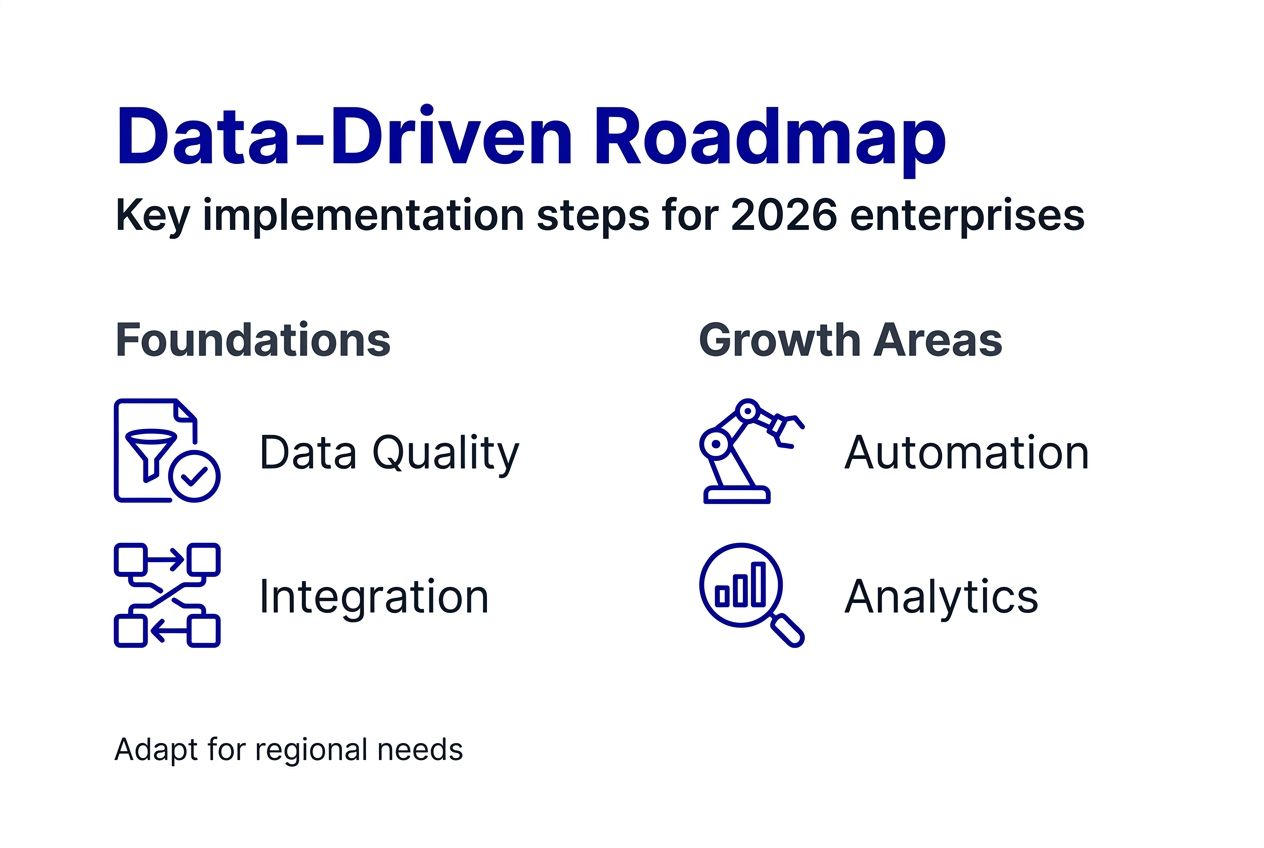
The digital transformation roadmap 2025 emphasizes phased implementation, allowing teams to build competency incrementally. Top digital trends 2026 for KSA and UAE show that successful enterprises prioritize integration depth over technology breadth, ensuring each system delivers measurable value before adding the next layer.
Common misconceptions and pitfalls in data-driven decision making
Three myths consistently undermine data-driven initiatives: believing data eliminates risk, assuming technology alone drives change, and underestimating cultural resistance.
Myth 1: Data removes all uncertainty. Data-driven decision making reduces but does not eliminate risks, requiring continued human oversight. Algorithms optimize within known parameters but struggle with unprecedented situations. The 2020 pandemic proved this dramatically when historical models failed to predict disruption. Human judgment remains essential for interpreting context, weighing ethical considerations, and making calls when data is incomplete.
Myth 2: Technology solves everything. The technology is only as good as the data quality, process design, and user adoption behind it. Many enterprises invest millions in systems but fail to clean legacy data, redesign outdated workflows, or train staff adequately. The result? Expensive tools that replicate old problems faster.
Myth 3: Data culture happens naturally. Cultural transformation requires deliberate effort. Executives must model data-driven behavior, reward evidence-based decisions, and create psychological safety for teams to challenge assumptions with data. Without this, employees revert to familiar intuition-based approaches regardless of available tools.
Common pitfalls include:
- Siloed implementation: Deploying analytics in one department without enterprise-wide integration limits value and creates conflicting metrics.
- Analysis paralysis: Waiting for perfect data before acting means competitors move faster with good enough information.
- Ignoring change management: Technical success without user buy-in leads to abandoned systems and wasted investment.
- Poor data governance: Inconsistent definitions, duplicate records, and unclear ownership undermine trust in insights.
Pro Tip: Appoint executive sponsors for data initiatives who can navigate political resistance and secure resources. The digital transformation roadmap 2025 emphasizes leadership commitment as the single biggest predictor of success.
Addressing these misconceptions early prevents costly mistakes. Successful enterprises balance technological capability with human expertise, creating systems that augment rather than replace judgment.
Frameworks and best practices for implementing data-driven decision making
A structured maturity model guides sustainable implementation. Most enterprises progress through five stages:
- Awareness: Recognizing data’s strategic value but lacking systematic collection or analysis.
- Reactive: Using data for historical reporting but not predictive insights.
- Proactive: Building forecasting capabilities and automating routine decisions.
- Predictive: Leveraging AI for scenario planning and optimization.
- Prescriptive: Achieving real-time, automated decision making with continuous learning.
Your implementation roadmap should follow these steps:
- Assess current maturity across departments using standardized criteria. Identify gaps in data quality, integration, skills, and culture.
- Integrate core systems starting with ERP and CRM to establish a unified data foundation. Prioritize high-impact processes first.
- Add AI and automation incrementally, focusing on use cases with clear ROI like demand forecasting or customer segmentation.
- Foster data culture through executive sponsorship, training programs, and celebrating data-driven wins publicly.
- Measure and refine continuously using feedback loops to improve accuracy and expand capabilities.
The digital transformation roadmap 2025 provides detailed guidance for each stage, with region-specific considerations for MENA markets.
Success metrics to track:
| Metric | Target Improvement | Measurement Period |
|---|---|---|
| Decision cycle time | 30-50% reduction | 6 months |
| Operational cost savings | 15-25% decrease | 12 months |
| Cross-functional collaboration score | 40% increase | 6 months |
| Customer acquisition cost | 20-30% reduction | 12 months |
| Process automation rate | 50-70% of routine tasks | 18 months |
Best practices include:
- Start small, scale fast: Prove value with pilot projects before enterprise-wide rollout.
- Prioritize data quality: Invest in cleaning and standardizing data before building analytics.
- Enable self-service: Empower business users with intuitive dashboards rather than creating analyst bottlenecks.
- Build cross-functional teams: Combine domain expertise with technical skills for better solutions.
- Maintain executive visibility: Regular steering committee reviews ensure alignment and resource allocation.
Leadership commitment cannot be overstated. When executives model data-driven behavior by asking for evidence, questioning assumptions, and celebrating analytical thinking, the entire organization follows. Conversely, when leaders make gut decisions despite available data, teams quickly learn that analytics are optional.
Case studies from KSA, UAE, and Egypt enterprises
Regional success stories demonstrate tangible ROI and provide blueprints for other enterprises.
Healthcare transformation in UAE: A major healthcare provider improved operational efficiency by 18% after implementing integrated ERP and AI analytics. The system connected patient scheduling, inventory management, and billing in real time, eliminating duplicate data entry and reducing wait times. Predictive models optimized staffing levels based on historical patterns and upcoming appointments. ERP in healthcare role and impact details how this integration works across clinical and administrative functions.
Banking automation in KSA: A large Saudi bank reduced operational costs by 22% through data-driven process automation. RPA handled routine transactions while AI fraud detection analyzed patterns across millions of accounts. The on-premise deployment met strict data sovereignty requirements while delivering cloud-like agility through Cortex’s low-code platform. Decision making improved from weekly reports to real-time dashboards showing liquidity, risk exposure, and customer behavior.
Construction efficiency in Egypt: A leading construction firm cut project delays by 31% using data-driven resource allocation. Integrated ERP tracked materials, equipment, and labor across multiple sites, automatically alerting managers to potential bottlenecks. Machine learning predicted delivery delays based on supplier performance, weather patterns, and traffic conditions, enabling proactive mitigation.
Common threads across these successes:
- Executive sponsorship secured resources and political support.
- Phased implementation allowed teams to build competency incrementally.
- Arabic language support and on-premise options addressed regional requirements.
- Measurable KPIs demonstrated value and justified continued investment.
- Change management programs prepared staff for new workflows and expectations.
These examples prove that data-driven decision making delivers results across industries when implemented thoughtfully with appropriate technology and organizational support.
How Singleclic can help your enterprise adopt data-driven decision making
Transforming your organization into a data-driven enterprise requires more than technology. It demands deep expertise in ERP integration, process automation, AI implementation, and change management tailored to MENA markets.
Singleclic brings 10+ years of regional delivery experience across KSA, UAE, and Egypt. We have helped 60+ enterprises including Emirates Health Services, QNB, and Emaar Misr build data-driven capabilities that deliver measurable efficiency gains. Our approach combines world-class platforms (Odoo, Microsoft Dynamics 365, IBM BAW) with Cortex, our Arabic-enabled low-code platform built specifically for MENA requirements.
We guide you through the entire journey: assessing ERP readiness, implementing integrated systems, automating processes, and building data culture. Our business process automation guide for C-level leaders and low-code platforms MENA guide provide frameworks proven across construction, healthcare, banking, and government sectors. With 70+ consultants across the region and 24/7 support, we are a true partner in your transformation.
What are the first steps for an enterprise to become data-driven?
Start by assessing your current data maturity level across key dimensions: data quality, integration, analytics capability, and organizational culture. This baseline helps prioritize investments and set realistic timelines. Secure executive sponsorship early, as leadership commitment predicts success more than any other factor. Begin integrating critical systems like ERP and CRM to establish a unified data foundation before layering advanced analytics.
How can AI and automation improve decision making without replacing human judgment?
AI excels at processing vast datasets, identifying patterns, and making routine decisions faster than humans. However, data-driven decisions still need human judgment for context interpretation, ethical considerations, and unprecedented situations. The optimal approach combines AI speed and accuracy with human creativity and wisdom. Executives should view AI as augmentation, not replacement, using technology to handle repetitive analysis while focusing their expertise on strategic choices that require nuanced understanding.
What challenges are specific to MENA enterprises adopting data-driven decision making?
Regional enterprises face unique requirements including Arabic language support, on-premise deployment for data sovereignty, and varying levels of digital literacy across teams. Banking and government sectors particularly need on-premise solutions that meet strict regulatory compliance while delivering modern capabilities. Cultural readiness also varies, with some organizations needing significant change management to shift from hierarchical, intuition-based decision making to collaborative, data-driven approaches. Successful implementations address these factors explicitly rather than assuming global best practices transfer directly.