For many executives in Saudi Arabia and UAE, transforming vast amounts of data into clear business value is a daily challenge. Data analytics blends mathematics, statistics, and computer science to generate actionable intelligence from complex information, supporting smarter decisions in construction and healthcare. This article highlights fundamental data analytics processes and explores how organizations in these sectors use real-world analytics tools to boost operational efficiency and strategic outcomes.
Table of Contents
- Data Analytics Defined And Core Principles
- Major Types And Key Capabilities Explained
- Strategic Applications In Construction And Healthcare
- Implementation Challenges And Success Factors
- Managing Risks, Compliance, And Data Security
Key Takeaways
| Point | Details |
|---|---|
| Data Analytics Transformation | Data analytics turns raw data into insights, enhancing decision-making and operational efficiency in industries like construction and healthcare. |
| Types of Analytics | Organizations can leverage various analytics types—descriptive, diagnostic, predictive, prescriptive, and cognitive—to optimize performance and strategic initiatives. |
| Implementation Challenges | Addressing resource constraints, data integration, and skills gaps is crucial for successful data analytics adoption within organizations. |
| Security and Compliance | Robust data governance frameworks are essential for safeguarding sensitive data and ensuring regulatory compliance in complex environments. |
Data Analytics Defined and Core Principles
Data analytics is a sophisticated discipline that transforms raw data into meaningful insights, driving strategic decision-making across industries in Saudi Arabia and UAE. At its core, this field blends mathematics, statistics, and computer science to extract valuable intelligence from complex datasets.
The fundamental process involves several critical stages:
- Data Collection: Gathering information from diverse sources
- Data Cleansing: Removing errors and inconsistencies
- Data Transformation: Organizing and preparing data for analysis
- Data Visualization: Presenting insights through graphical representations
- Predictive Modeling: Forecasting future trends and outcomes
Fundamental data analytics processes require sophisticated techniques that go beyond simple number crunching. Organizations leverage these methodologies to uncover hidden patterns, predict market behaviors, and optimize operational strategies.

In the context of regional enterprises, data analytics plays a pivotal role in driving operational excellence. Companies in Saudi Arabia and UAE are increasingly adopting advanced analytics frameworks to enhance decision-making, reduce operational costs, and gain competitive advantages. Our low-code platform, Cortex, enables businesses to design and implement complex data analysis workflows without extensive coding expertise.
Pro tip: Invest in robust data governance frameworks to ensure the quality and reliability of your analytics initiatives.
Major Types and Key Capabilities Explained
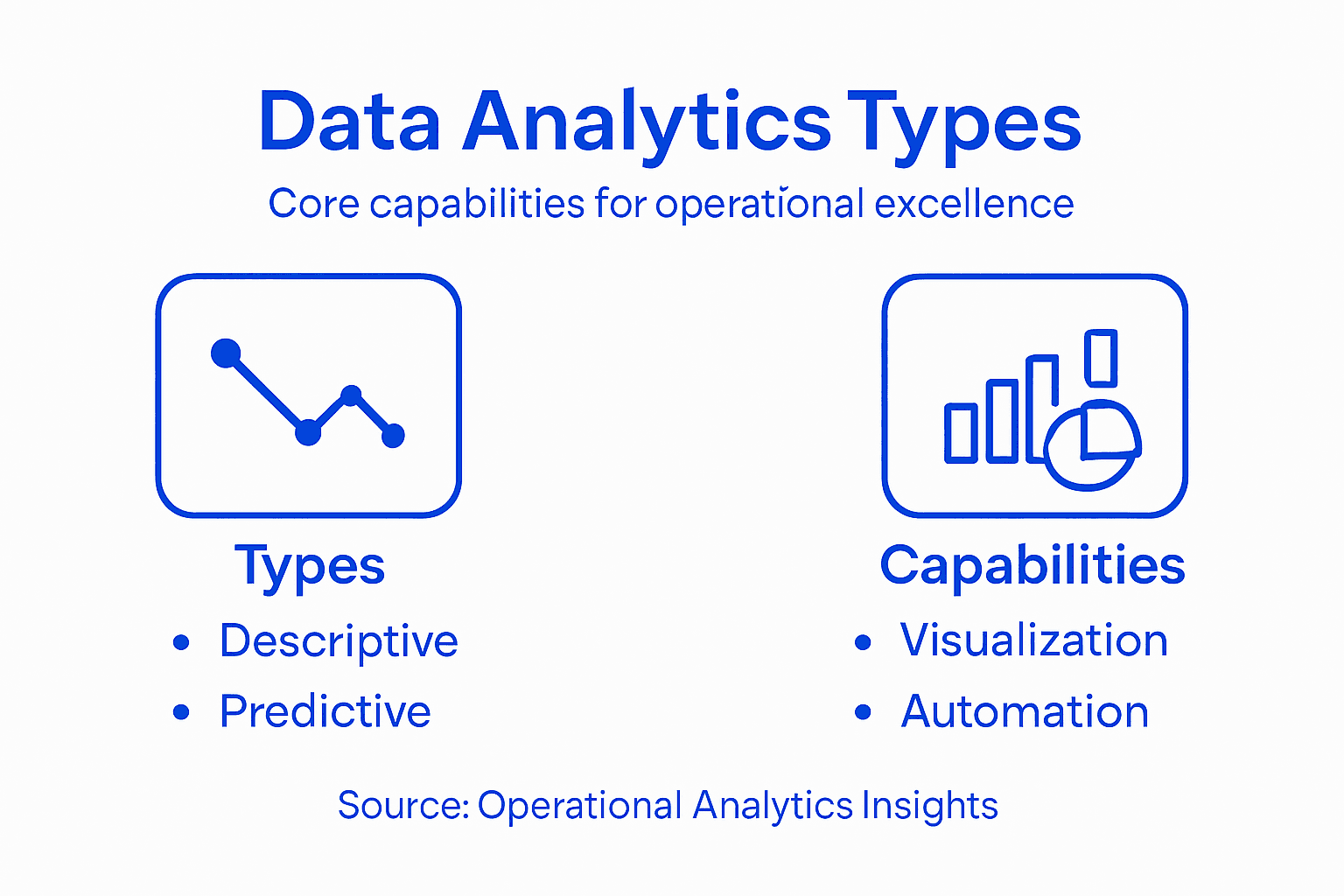
Data analytics encompasses several sophisticated types that enable organizations to transform raw information into strategic insights. Five essential analytics types provide comprehensive capabilities for understanding complex business landscapes and driving informed decision-making.
The primary types of data analytics include:
- Descriptive Analytics: Understanding what happened in the past
- Diagnostic Analytics: Explaining why something occurred
- Predictive Analytics: Forecasting potential future scenarios
- Prescriptive Analytics: Recommending specific actions
- Cognitive Analytics: Simulating advanced decision-making processes
In the context of Saudi Arabian and UAE enterprises, these analytics capabilities become powerful tools for strategic transformation. Organizations can leverage these methodologies to optimize operational efficiency, reduce costs, and create competitive advantages. Our Cortex low-code platform enables businesses to implement these advanced analytics workflows seamlessly, supporting real-time insights across diverse industry sectors.
Here’s a summary of how different types of data analytics support business transformation:
| Analytics Type | Primary Focus | Key Business Benefit |
|---|---|---|
| Descriptive | Past events and trends | Enables performance benchmarking |
| Diagnostic | Causes of observed outcomes | Improves root cause identification |
| Predictive | Future scenario forecasting | Enhances risk anticipation |
| Prescriptive | Optimal action recommendations | Guides strategic decision selection |
| Cognitive | Complex decision simulations | Supports advanced automation efforts |
Advanced data analytics transforms complex information into actionable business intelligence, bridging the gap between raw data and strategic decision-making.
To effectively implement these analytics capabilities, organizations must develop robust skills and technological infrastructure. Key analytics skills include proficiency in programming, statistical methods, and machine learning techniques that support comprehensive data interpretation.
Pro tip: Invest in continuous training and technological infrastructure to keep your data analytics capabilities adaptive and cutting-edge.
Strategic Applications in Construction and Healthcare
Data analytics has emerged as a transformative force in critical sectors like construction and healthcare, enabling organizations to unlock unprecedented levels of efficiency and strategic insight. Construction data analytics techniques provide powerful tools for optimizing project management, cost estimation, and risk mitigation across complex enterprise environments.
In the construction sector, data analytics delivers critical capabilities:
- Project Cost Estimation: Accurate forecasting of financial requirements
- Risk Identification: Proactive detection of potential project challenges
- Operational Efficiency: Streamlining workflow and resource allocation
- Performance Tracking: Real-time monitoring of project milestones
- Investment Valuation: Comprehensive assessment of project potential
Similarly, healthcare big data analytics revolutionizes patient care and institutional management. By integrating diverse data sources, healthcare providers can enhance diagnostic accuracy, personalize treatment plans, and optimize systemic operational efficiency.
Advanced analytics transforms raw data into strategic intelligence, bridging technological capability with actionable organizational insights.
Our Cortex low-code platform empowers organizations in Saudi Arabia and UAE to implement these sophisticated analytics workflows seamlessly. By supporting real-time data integration and interpretation across construction and healthcare domains, businesses can achieve unprecedented levels of operational excellence and strategic decision-making.
The following table compares data analytics applications in construction and healthcare sectors:
| Sector | Main Analytics Use | Impact on Operations |
|---|---|---|
| Construction | Cost estimation, risk | Reduces budget overruns |
| Healthcare | Patient data analysis | Improves diagnosis and efficiency |
Pro tip: Develop cross-functional data literacy programs to ensure your team can effectively leverage advanced analytics capabilities.
Implementation Challenges and Success Factors
Implementing data analytics strategies requires a nuanced approach that addresses complex organizational dynamics and technological considerations. Critical success factors encompass a multifaceted framework of leadership, technological infrastructure, and cultural transformation in data-driven enterprises.
Key implementation challenges include:
- Resource Constraints: Limited budget and technological capabilities
- Data Integration: Complexity of merging diverse data sources
- Organizational Resistance: Cultural barriers to technological adoption
- Skills Gap: Insufficient data literacy across teams
- Technology Infrastructure: Inadequate systems and computational capabilities
Organizations in Saudi Arabia and UAE must develop comprehensive strategies to overcome these challenges. This involves creating robust change management processes, investing in continuous training, and developing a data-centric organizational culture that embraces technological innovation.
Successful data analytics implementation requires a holistic approach that balances technological capabilities with human potential and organizational adaptability.
Our Cortex low-code platform provides a flexible solution for addressing these implementation challenges. By offering an Arabic-enabled, on-premise platform with real-time process optimization and seamless enterprise system integration, businesses can dramatically reduce barriers to data analytics adoption.
Pro tip: Establish a dedicated cross-functional data analytics team with clear governance structures to drive consistent implementation and organizational alignment.
Managing Risks, Compliance, and Data Security
Data security and compliance have become critical challenges for organizations navigating complex technological landscapes. Effective data governance frameworks are essential for protecting sensitive information and maintaining regulatory adherence across industries in Saudi Arabia and UAE.
Key risk management strategies include:
- Data Stewardship: Establishing clear ownership and accountability
- Quality Assurance: Implementing rigorous data validation processes
- Security Controls: Developing comprehensive access management protocols
- Regulatory Compliance: Maintaining alignment with evolving legal requirements
- Threat Monitoring: Continuous detection and mitigation of potential risks
Big data security challenges demand advanced technological and procedural approaches. Organizations must integrate sophisticated encryption techniques, robust access controls, and anonymization strategies to safeguard data integrity and confidentiality.
Data security is not a one-time implementation but a continuous, adaptive process that requires ongoing vigilance and strategic investment.
Our Cortex low-code platform provides a comprehensive solution for managing these complex security requirements. With on-premise deployment, full Arabic UI/UX, and deep enterprise system integrations, businesses can create secure, compliant data analytics workflows tailored to their specific organizational needs.
Pro tip: Conduct regular security audits and maintain a proactive approach to identifying and mitigating potential data vulnerabilities.
Elevate Your Operational Excellence with Advanced Data Analytics Solutions
The article highlights critical pain points around integrating complex data analytics capabilities such as predictive modeling, risk management, and real-time process optimization in sectors like construction and healthcare. Many organizations face challenges with data integration, skills gaps, and ensuring data security—all essential areas for driving true operational excellence. At Singleclic, we understand these specific difficulties and deliver tailored solutions to bridge the gap from raw data insights to impactful business outcomes.
Our Cortex low-code platform, designed for MENA enterprises, offers seamless automation and real-time analytics without requiring extensive coding expertise. With full Arabic UI/UX support, on-premise deployment, and deep enterprise system integrations, Cortex empowers your teams to manage data-driven workflows securely and efficiently. Whether you aim to implement predictive analytics or strengthen data governance frameworks, Singleclic combines technology and industry expertise to help you overcome implementation challenges and accelerate transformation across Saudi Arabia, UAE, and Egypt.
Explore how our AI and Low-Code Platform Development services can unlock the full potential of your data initiatives. Transform how your organization harnesses analytics by visiting Singleclic. Take the next step in driving operational excellence and future-proof your business today.
Ready to revolutionize your data analytics strategy with solutions that understand your regional and sector-specific needs Explore our advanced Business Process Automation and ERP/CRM implementation services to start optimizing your operations now. Contact us at Singleclic to learn more about unlocking value through cutting-edge digital transformation.
Frequently Asked Questions
What are the core principles of data analytics?
The core principles of data analytics include data collection, data cleansing, data transformation, data visualization, and predictive modeling. These stages enable organizations to derive meaningful insights from raw data.
What are the major types of data analytics?
The major types of data analytics are descriptive analytics, diagnostic analytics, predictive analytics, prescriptive analytics, and cognitive analytics. Each type serves a different purpose, from understanding past trends to forecasting future scenarios and recommending actions.
How does data analytics drive operational excellence in organizations?
Data analytics drives operational excellence by allowing organizations to optimize efficiency, reduce costs, uncover hidden patterns, and improve decision-making processes. It transforms complex information into actionable insights that guide strategic planning.
What challenges do organizations face when implementing data analytics strategies?
Organizations may face challenges such as resource constraints, data integration complexities, organizational resistance, skills gaps, and inadequate technology infrastructure when implementing data analytics strategies.