Organizations face mounting pressure to streamline operations while adapting to rapid market shifts. Cutting operational costs by 30% through strategic process optimization is no longer optional for competitive enterprises in Saudi Arabia and UAE. Business Process Management delivers measurable efficiency gains, transforming fragmented workflows into coordinated systems that accelerate decision-making and fuel growth across healthcare, banking, and government sectors.
Table of Contents
- Introduction To Business Process Management (BPM)
- How BPM Drives Operational Efficiency And Digital Transformation
- Integration Of BPM With Emerging Technologies
- Regional Relevance: BPM In Saudi Arabia And UAE Market Context
- Common Misconceptions About BPM
- Frameworks And Best Practices For Successful BPM Implementation
- Practical BPM Use Cases In KSA And UAE Industries
- Conclusion: Leveraging BPM For Future-Ready Organizations
- Explore Singleclic Solutions To Accelerate Your BPM Journey
- Frequently Asked Questions About BPM In KSA And UAE
Key takeaways
| Point | Details |
|---|---|
| Strategic optimization | BPM aligns process efficiency with business objectives, driving measurable cost reduction and operational agility. |
| Technology synergy | Integration with RPA and AI accelerates digital transformation through automated workflows and intelligent decision support. |
| Regional adaptation | Arabic UI and local compliance requirements shape successful BPM adoption across KSA and UAE enterprises. |
| Leadership commitment | Executive sponsorship and continuous performance measurement determine long-term BPM success and organizational impact. |
Introduction to business process management (BPM)
Business Process Management represents a holistic methodology for designing, executing, monitoring, and optimizing workflows that support organizational objectives. Unlike isolated automation efforts, BPM creates an integrated framework connecting every process touchpoint with strategic goals. This approach evolved from manual process documentation to sophisticated digital platforms enabling real-time monitoring and continuous improvement.
The strategic value emerges through systematic alignment between operational activities and business outcomes. Organizations implement BPM to eliminate redundancies, standardize procedures, and establish clear accountability across departments. Modern BPM platforms transform static process maps into dynamic systems that adapt to changing market conditions while maintaining compliance and quality standards.
Core BPM components include:
- Process modeling tools that visualize workflows and identify bottlenecks before implementation
- Performance measurement systems tracking cycle times, error rates, and cost per transaction
- Technology integration connecting BPM platforms with existing ERP, CRM, and data systems
- Cultural alignment programs ensuring teams embrace new workflows and governance structures
Successful BPM implementation requires viewing processes as organizational assets requiring deliberate management. Each workflow optimization contributes directly to competitive advantage through faster response times, lower operating costs, and improved customer experiences. Organizations following structured BPM steps establish foundations for sustained operational excellence.
How BPM drives operational efficiency and digital transformation
The financial impact of properly implemented BPM reaches beyond simple cost cutting. Organizations achieve 20-30% operational cost reduction by eliminating waste, reducing cycle times, and optimizing resource allocation. Manual task workload drops by half when repetitive activities shift to automated systems, freeing knowledge workers for strategic initiatives that generate revenue and innovation.
Process cycle time compression delivers immediate competitive advantages. Tasks requiring days or weeks complete in hours when approval chains, data entry, and validation steps execute automatically. This velocity improvement cascades throughout organizations, accelerating product launches, shortening sales cycles, and enhancing customer satisfaction through faster service delivery.
Organizational agility increases when business process automation enables rapid workflow modifications. Markets shift, regulations change, and customer expectations evolve constantly. BPM platforms allow businesses to redesign processes in response to external pressures without massive IT projects or operational disruption. Teams test new workflows, measure results, and scale successful changes across the enterprise.
Key efficiency drivers include:
- Standardized workflows eliminating duplicate efforts and inconsistent outputs
- Real-time visibility into process performance enabling proactive problem resolution
- Automated compliance checks reducing regulatory risk and audit costs
- Data-driven optimization identifying improvement opportunities through analytics
The combination of cost savings and operational flexibility creates sustainable competitive advantages. Companies investing in comprehensive BPM initiatives outperform competitors through superior process efficiency that translates directly to market share gains and profitability growth.
Integration of BPM with emerging technologies
Modern BPM platforms gain exponential power through integration with complementary technologies. Robotic Process Automation handles repetitive, rules-based tasks at machine speed with zero errors. Artificial intelligence adds intelligent decision support, pattern recognition, and predictive analytics to workflows. Low-code development environments enable business users to modify processes without coding expertise, dramatically reducing implementation timelines.
RPA’s role in business automation focuses on structured tasks like data extraction, form processing, and system integration. Software robots execute these activities 24/7 without breaks, maintaining perfect consistency across thousands of transactions. AI components analyze unstructured data, interpret customer intent, and recommend optimal actions based on historical patterns and real-time conditions.
Low-code BPM platforms democratize process improvement by removing technical barriers. Business analysts design workflows using visual interfaces, configuring rules and integrations through drag-and-drop tools. Changes deploy immediately without code compilation or extensive testing cycles. This agility proves essential in fast-moving markets where competitive advantage depends on rapid adaptation.

Singleclic’s Cortex platform exemplifies regional technology optimization. The Arabic-enabled interface supports native language workflows critical for user adoption across KSA and UAE organizations. On-premise deployment options satisfy banking and government security requirements while maintaining full functionality. Unlimited user licensing eliminates scaling constraints as organizations expand BPM initiatives across departments.
Pro Tip: Start technology integration with high-volume, low-complexity processes to build organizational confidence and demonstrate ROI quickly before tackling complex workflows requiring extensive change management.
Implementation sequence for technology-enhanced BPM:
- Map current processes and identify automation opportunities through workflow analysis
- Select appropriate technology combinations based on process characteristics and organizational readiness
- Deploy pilot programs in contained environments to validate technical integration and user acceptance
- Measure results against baseline metrics and document lessons learned for scaling
- Expand successful patterns across the enterprise while maintaining governance and quality standards
These technologies collectively enable business process automation strategies that were impossible with traditional approaches. Organizations gain capabilities to optimize processes continuously based on real-time data rather than periodic reviews and manual interventions.
Regional relevance: BPM in Saudi Arabia and UAE market context
Gulf Cooperation Council nations demonstrate strong commitment to operational modernization. 45% of GCC organizations invest in BPM as core digital transformation enablers, recognizing that process excellence underpins national economic diversification goals. Saudi Arabia’s Vision 2030 and UAE’s innovation initiatives drive demand for efficient government services and competitive private sector operations.
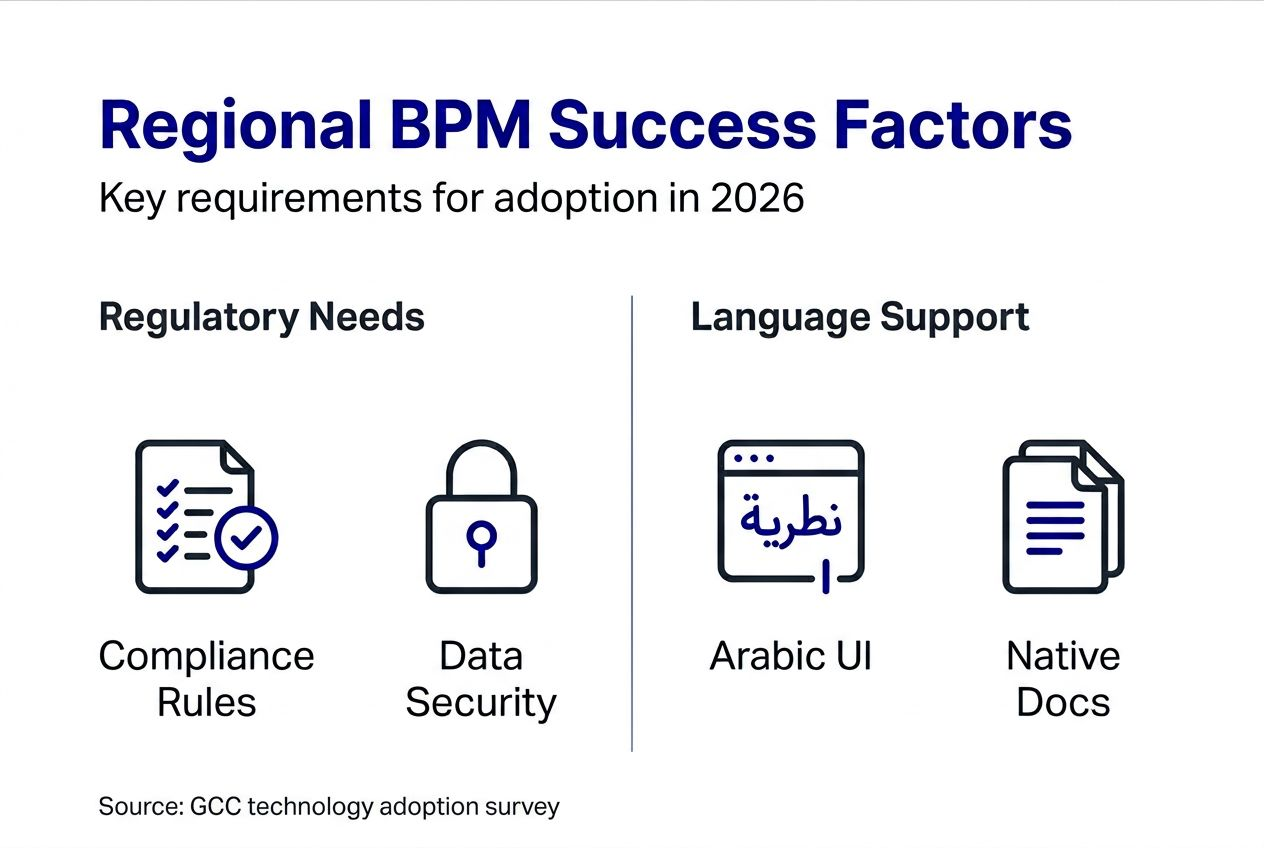
Arabic language support determines adoption success across regional enterprises. User interfaces, process documentation, and reporting dashboards must accommodate native language preferences to achieve organizational buy-in. Cultural factors influence workflow design, approval hierarchies, and communication patterns within processes. Solutions lacking localization face resistance regardless of technical sophistication.
Regulatory compliance requirements shape BPM implementations across sectors. Banking institutions navigate evolving financial regulations while maintaining operational efficiency. Healthcare providers balance patient privacy mandates with care coordination needs. Government agencies ensure transparency and accountability through documented, auditable workflows.
Industry-specific BPM adoption patterns:
| Sector | Primary BPM Drivers | Key Challenges |
|---|---|---|
| Healthcare | Patient onboarding, care coordination, regulatory compliance | System integration, data privacy, Arabic documentation |
| Banking | Risk management, compliance reporting, customer onboarding | Security requirements, legacy system integration |
| Government | Citizen services, transparency, inter-agency coordination | Change management, skills development, technology adoption |
| Construction | Project management, procurement, quality control | Mobile access, field operations, multilingual teams |
Successful regional implementations prioritize:
- On-premise deployment options addressing data sovereignty and security concerns
- Arabic-first design rather than translated interfaces bolted onto English systems
- Local support teams understanding cultural context and regulatory environments
- Flexible pricing models accommodating government procurement processes and budget cycles
These regional considerations transform business process management from generic methodology into culturally aligned capability supporting national development objectives while delivering enterprise-level efficiency gains.
Common misconceptions about BPM
Executives frequently conflate BPM with simple task automation, missing the governance and cultural transformation dimensions. True BPM establishes systematic process ownership, performance measurement, and continuous improvement cycles extending far beyond technology deployment. Organizations viewing BPM as purely technical initiative fail to achieve sustainable results.
Another persistent myth positions BPM as replacement for human judgment. Reality proves opposite in practice. Effective business process automation enhances decision-making by providing real-time data, eliminating information delays, and surfacing patterns invisible in manual systems. Knowledge workers gain leverage rather than losing relevance.
The perception that BPM belongs exclusively to IT departments limits organizational value. Process optimization affects every function from sales and marketing to finance and operations. Cross-functional BPM governance ensures initiatives address actual business needs rather than technical preferences. Business units must own process outcomes while IT provides enabling technology.
Misconceptions requiring correction:
- BPM projects conclude after initial implementation rather than establishing continuous improvement cycles
- Small process changes deliver negligible value compared to enterprise-wide transformations
- BPM platforms lock organizations into rigid workflows that cannot adapt to changing needs
- Successful BPM requires extensive technical expertise unavailable in most organizations
Pro Tip: Frame BPM initiatives around business outcomes like revenue growth and customer satisfaction rather than technical metrics to secure executive sponsorship and organizational engagement.
Addressing these misconceptions through education and pilot projects builds realistic expectations. Organizations understanding BPM’s full scope position themselves for transformational results rather than incremental improvements. The comprehensive approach to business process automation delivers sustainable competitive advantages through systematic operational excellence.
Frameworks and best practices for successful BPM implementation
Structured implementation frameworks prevent common pitfalls that derail BPM initiatives. Organizations following proven methodologies achieve measurable results faster while avoiding expensive false starts. Executive sponsorship and continuous KPIs rank among critical success factors determining long-term program viability and organizational impact.
Continuous performance dashboards provide visibility into process health and improvement opportunities. Key metrics include cycle time reduction, cost per transaction, error rates, and customer satisfaction scores. These indicators connect process changes directly to business outcomes, justifying ongoing investment and highlighting areas requiring additional attention.
Traditional versus modern BPM approaches differ substantially in agility and capability:
| Dimension | Traditional BPM | Modern AI-Enabled BPM |
|---|---|---|
| Process changes | Require IT involvement, weeks to deploy | Business users modify workflows, immediate deployment |
| Decision support | Rules-based logic only | AI-powered recommendations and predictive analytics |
| Integration | Custom coding for each system | Pre-built connectors and API frameworks |
| Scalability | Limited by infrastructure and licensing | Cloud-native architecture supporting unlimited scale |
Best practice implementation sequence:
- Establish executive steering committee with clear authority and accountability for BPM outcomes
- Conduct process discovery workshops identifying high-impact optimization opportunities
- Define success metrics aligned with strategic objectives before selecting technology platforms
- Deploy pilot programs demonstrating value and building organizational capability
- Scale proven patterns systematically while maintaining governance and quality standards
- Institute continuous improvement cycles capturing lessons learned and emerging opportunities
Sustaining BPM success requires cultural engagement beyond technology deployment. Training programs build process thinking throughout organizations. Recognition systems reward teams achieving efficiency milestones. Communication campaigns maintain visibility and momentum for multi-year transformation journeys.
Pro Tip: Establish Center of Excellence teams combining business process expertise with technical knowledge to support enterprise-wide BPM adoption and share best practices across departments.
Organizations following these structured approaches to business process automation achieve superior results through systematic execution rather than ad hoc efforts. Clear frameworks provide roadmaps guiding initiatives from concept through sustained operational impact.
Practical BPM use cases in KSA and UAE industries
Real-world implementations demonstrate BPM’s tangible impact across regional sectors. Healthcare organizations reduced patient onboarding times by 40% through AI-powered document processing and automated eligibility verification. Faster registration improves patient satisfaction while increasing facility capacity without adding administrative staff. Integrated workflows connect registration, scheduling, and care delivery systems previously operating in isolation.
Banking institutions shortened loan approval cycles from days to hours using governance frameworks that automate compliance checks and risk assessments. Digital workflows capture application data once, then route requests through appropriate approval chains based on amount, customer profile, and risk factors. Audit trails document every decision point, satisfying regulatory requirements while accelerating customer service.
Government agencies enhanced transparency and citizen satisfaction through localized BPM platforms supporting Arabic interfaces and mobile access. License renewals, permit applications, and service requests now complete online with real-time status updates. Backend integrations eliminate duplicate data entry across departments while maintaining security and compliance standards.
Additional industry applications:
- Construction firms coordinating procurement, quality control, and safety compliance across multiple project sites
- Telecom providers optimizing network maintenance workflows and customer service operations
- Real estate developers streamlining property sales processes from lead capture through closing documentation
- Retail organizations synchronizing inventory management, pricing, and promotional campaigns across channels
These examples illustrate business process management’s versatility across diverse operational contexts. Success patterns share common elements including executive sponsorship, phased implementation, and continuous measurement. Organizations achieve measurable ROI within months rather than years when BPM initiatives target high-volume processes with clear efficiency opportunities.
Conclusion: leveraging BPM for future-ready organizations
Business Process Management emerges as foundational capability for enterprises competing in dynamic markets. The combination of cost efficiency, operational agility, and strategic alignment positions BPM as essential investment rather than optional initiative. Organizations across Saudi Arabia and UAE recognize that systematic process optimization separates market leaders from followers.
Integration with RPA, AI, and low-code platforms multiplies BPM impact beyond traditional approaches. These technologies enable continuous improvement cycles impossible with manual methods. Real-time data and intelligent automation transform reactive organizations into proactive enterprises anticipating customer needs and market shifts.
Regionally optimized platforms addressing language, compliance, and cultural requirements accelerate adoption success. Solutions designed specifically for KSA and UAE markets overcome barriers that limit generic BPM implementations. Arabic interfaces, on-premise deployment, and local support prove essential for sustained organizational engagement.
Future-ready organizations prioritize BPM as strategic imperative supporting growth objectives and operational excellence. The question shifts from whether to implement BPM to how quickly organizations can realize benefits through systematic execution.
Explore Singleclic solutions to accelerate your BPM journey
Transforming operational efficiency requires more than generic tools. Singleclic delivers tailored business process management solutions combining Arabic-enabled platforms with deep regional expertise across healthcare, banking, government, and enterprise sectors. Our Cortex low-code platform supports on-premise deployment, unlimited users, and runtime workflow modifications without downtime.
Integrated capabilities span RPA implementation, AI-powered automation, and enterprise system integration. Over 60 organizations across KSA, UAE, and Egypt trust Singleclic for digital transformation initiatives delivering measurable results. Our consultants bring 10+ years of regional delivery experience, understanding unique challenges facing MENA enterprises.
Explore our AI-powered low-code platform designed specifically for organizations requiring Arabic support, regulatory compliance, and scalable automation. Connect with our team to discuss how BPM solutions accelerate your operational excellence goals in 2026 and beyond.
Frequently asked questions about BPM in KSA and UAE
What timeline can organizations expect for BPM implementation in KSA and UAE?
Pilot implementations typically complete within 8 to 12 weeks, demonstrating value and building organizational capability. Enterprise-wide deployments span 6 to 18 months depending on scope, existing system complexity, and change management requirements. Phased approaches deliver incremental benefits while minimizing disruption.
How important is Arabic language support in BPM solutions for regional adoption?
Arabic interfaces prove essential for user acceptance and organizational engagement across Gulf enterprises. Solutions lacking native language support face adoption resistance regardless of technical capabilities. Successful regional implementations prioritize Arabic-first design rather than translated versions of English platforms.
Can BPM initiatives succeed without prior automation experience?
Organizations new to automation achieve excellent results following structured methodologies with experienced implementation partners. Starting with high-value, low-complexity processes builds confidence and demonstrates ROI quickly. Success depends more on executive commitment and change management than technical sophistication.
What are the top KPIs to measure BPM success effectively?
Cycle time reduction, cost per transaction, error rates, and customer satisfaction scores provide comprehensive success indicators. Organizations should establish baseline measurements before implementation and track improvements monthly. Financial metrics including operational cost savings and productivity gains justify ongoing investment.
How does BPM integrate with existing ERP and CRM systems?
Modern BPM platforms offer pre-built connectors and API frameworks supporting seamless integration with enterprise systems like Odoo, Microsoft Dynamics 365, and legacy applications. Integration enables automated data exchange, eliminating duplicate entry while maintaining system-of-record integrity across the technology landscape.
Recommended
- Business Process Management: Driving Operational Excellence
- Business Process Optimization: Unlocking Operational Excellence
- Unlocking Efficiency: How Business Process Automation Reduces Costs and Boosts Productivity | Singleclic
- Business Process Automation Guide for C-Level Leaders
- Portfolio Partnership | Monster Property Partners