Many business leaders think solution development is just hiring developers to write code. That’s like believing construction is only about hammering nails. Real solution development is a strategic, end-to-end process that transforms how organizations operate across KSA, UAE, and Egypt. From initial strategy through deployment and continuous optimization, it’s the backbone of digital transformation in construction, healthcare, banking, and government sectors. This guide reveals what solution development truly involves, the frameworks that drive success, and how modern platforms accelerate results for MENA enterprises ready to compete in 2026 and beyond.
Table of Contents
- Understanding Solution Development: Beyond Coding
- The Role Of Digital Transformation Roadmaps In Solution Development
- Tailoring Solutions With ERP And Industry-Specific Needs
- Accelerating Solution Development With Low-Code Platforms
- Explore Tailored Solution Development Services At Singleclic
- Frequently Asked Questions
Key takeaways
| Point | Details |
|---|---|
| Comprehensive lifecycle | Solution development spans strategy, design, deployment, and ongoing optimization, not just coding tasks. |
| Strategic roadmaps essential | Digital transformation roadmaps align C-suite priorities, coordinate teams, and track measurable business outcomes. |
| Sector customization critical | Healthcare, construction, banking, and government each require tailored ERP features for compliance and workflows. |
| Low-code acceleration | Over 65% of businesses explore low-code platforms to reduce costs and speed innovation timelines. |
| Continuous improvement | Successful solutions evolve through quarterly updates based on performance data and market shifts. |
Understanding solution development: beyond coding
Solution development is the complete journey of creating digital products that solve real business problems. E2E digital product development covers the entire lifecycle from concept to market, ensuring every stage connects to strategic goals. It’s not about writing code in isolation. It’s about aligning technology with business outcomes, user needs, and operational realities.
The process involves multiple disciplines working together. Strategy teams identify opportunities and define success metrics. Architects design scalable systems that integrate with existing infrastructure. Developers build functionality while designers craft intuitive experiences. DevOps engineers ensure reliable deployment. Business analysts validate that solutions deliver promised value. Each role contributes essential expertise that coding alone cannot provide.
Think of solution development as building a bridge, not assembling furniture from a kit. You need geological surveys, structural engineering, environmental impact assessments, and ongoing maintenance plans. Similarly, enterprise solutions require deep understanding of business processes, regulatory requirements, user behavior patterns, and long-term scalability needs before a single line of code makes sense.
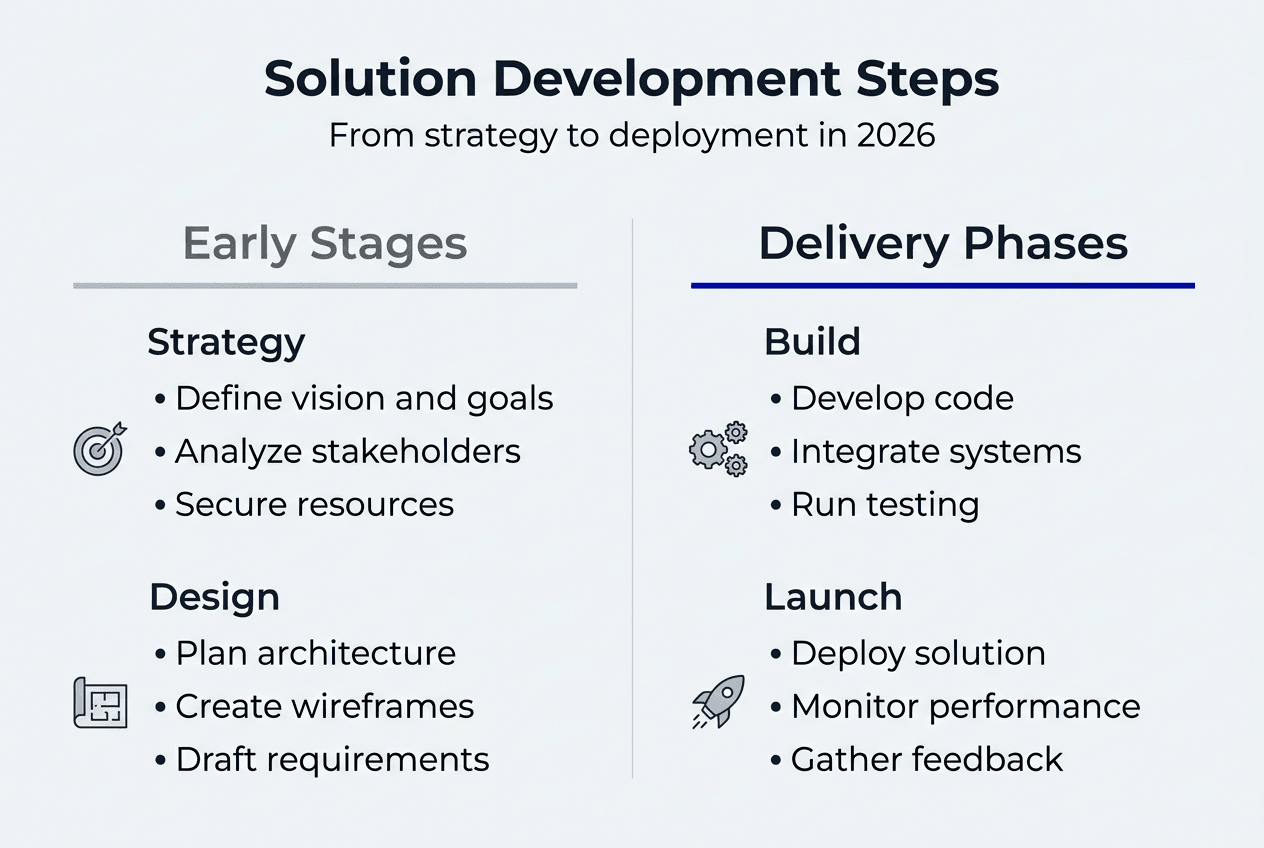
The typical solution development lifecycle includes these critical stages:
- Strategy and discovery: Define business objectives, identify pain points, analyze market opportunities, establish success criteria
- Validation and planning: Conduct feasibility studies, prototype concepts, gather stakeholder feedback, create detailed roadmaps
- Design and architecture: Map user journeys, design interfaces, plan system architecture, define integration points
- Development and testing: Build features iteratively, conduct quality assurance, perform security audits, optimize performance
- Deployment and launch: Execute rollout plans, train users, monitor systems, gather initial feedback
- Optimization and evolution: Analyze usage data, implement improvements, scale capacity, adapt to changing needs
Pro Tip: Engage business stakeholders from day one of solution development. Their operational knowledge prevents costly redesigns and ensures the final product actually solves real problems instead of theoretical ones.
How low-code improves business agility and faster decision making demonstrates how modern platforms compress traditional development timelines while maintaining quality and flexibility for rapidly changing business requirements.
“The difference between successful and failed digital initiatives often comes down to whether organizations treat solution development as a technical project or a business transformation that happens to use technology.”
The role of digital transformation roadmaps in solution development
Digital transformation roadmaps align C-suite priorities, secure investment, coordinate cross-functional work, and communicate progress across the organization. They’re the strategic framework that ensures solution development efforts connect to business outcomes rather than becoming isolated IT projects that fail to deliver measurable value.
A robust digital transformation roadmap contains five essential elements working together. First, it defines the value proposition by identifying specific customer and financial outcomes the transformation will unlock. Second, it maps required capabilities across people, processes, and technology that must evolve to achieve those outcomes. Third, it specifies platforms and data architectures that enable new capabilities while integrating with existing systems. Fourth, it redesigns the operating model to support new ways of working across departments and roles. Fifth, it establishes governance structures that maintain alignment and enable rapid decision making as conditions change.
Roadmaps organize initiatives into staged waves rather than attempting everything simultaneously. Each wave contains related projects with clear milestones, resource requirements, and benefit tracking mechanisms. Wave one typically focuses on foundational capabilities and quick wins that build momentum. Wave two scales successful pilots and addresses more complex integration challenges. Wave three pursues advanced capabilities that depend on earlier foundations being solid.
Quarterly roadmap reviews keep transformation efforts responsive to reality. These reviews analyze what’s working, what’s struggling, and what external factors have shifted. Based on evidence rather than assumptions, leadership adjusts priorities, reallocates resources, and sometimes kills initiatives that aren’t delivering promised value. This discipline prevents the common trap of continuing failed projects simply because they’re already underway.
| Roadmap Element | Primary Benefit | Implementation Focus |
|---|---|---|
| Value Definition | Ensures all efforts connect to measurable outcomes | Customer experience improvements, revenue growth, cost reduction |
| Capability Mapping | Identifies gaps between current and required abilities | Skills development, process redesign, technology enablement |
| Platform Strategy | Creates scalable foundation for multiple solutions | API architecture, data integration, cloud infrastructure |
| Operating Model | Enables new ways of working across silos | Team structures, decision rights, collaboration tools |
| Governance Framework | Maintains alignment while enabling speed | Investment criteria, progress metrics, escalation paths |
Pro Tip: Focus roadmap priorities on moves that unlock both customer value and financial outcomes simultaneously. Single-benefit initiatives often stall when budget pressures emerge or leadership attention shifts to other priorities.
For MENA organizations, digital transformation roadmaps drive business growth by connecting technology investments to regional market opportunities in construction, healthcare, banking, and government sectors where digital maturity varies significantly.
Leaders seeking practical guidance can explore digital transformation roadmap c level success strategies and follow a step by step digital roadmap for operational excellence tailored to enterprise complexity.
Tailoring solutions with ERP and industry-specific needs
ERP systems must be tailored for compliance and complex workflows in government, healthcare, and construction sectors. Generic configurations fail because each industry operates under different regulatory frameworks, manages distinct asset types, and requires specialized reporting capabilities that off-the-shelf systems don’t provide.
Government entities face unique procurement rules, budget controls, and transparency requirements. Their ERP systems need robust audit trails, multi-level approval workflows, and integration with national regulatory platforms. Healthcare organizations must comply with patient privacy laws, manage clinical workflows alongside administrative processes, and integrate with medical devices and lab systems. Construction companies require project-based accounting, subcontractor management, equipment tracking, and real-time cost controls across multiple simultaneous sites.

The consequences of poor ERP fit extend beyond inconvenience. Healthcare providers risk patient safety incidents when systems don’t support clinical protocols properly. Construction firms experience cost overruns when project accounting can’t track materials and labor accurately. Government agencies face audit findings and public criticism when financial controls prove inadequate. These aren’t theoretical risks but common outcomes when organizations choose ERP systems based on vendor reputation rather than functional alignment.
Microsoft Dynamics 365 offers government-specific modules that address public sector requirements out of the box. These include grant management, citizen service portals, regulatory compliance tracking, and integration with national identity systems common across KSA, UAE, and Egypt. Similarly, Odoo’s modular architecture allows healthcare providers to activate only the clinical, pharmacy, and patient management components they need while leaving irrelevant retail or manufacturing modules dormant.
| Sector | Critical ERP Features | Primary Benefits |
|---|---|---|
| Government | Budget controls, procurement workflows, audit trails, citizen portals | Regulatory compliance, transparency, efficient service delivery |
| Healthcare | Patient records, clinical protocols, pharmacy integration, billing | Patient safety, care quality, revenue cycle optimization |
| Construction | Project accounting, subcontractor management, equipment tracking | Cost control, timeline adherence, profitability visibility |
| Banking | Risk management, regulatory reporting, customer onboarding, fraud detection | Compliance assurance, operational efficiency, customer trust |
Pro Tip: Prioritize ERP systems that align with your long-term digital goals rather than just current needs. The cost of switching ERP platforms later far exceeds investing in the right fit initially, even if implementation takes longer.
Organizations wondering whether they’re ready for ERP transformation should start with how to assess ERP readiness before committing resources. Those new to enterprise systems benefit from the ERP explained guide that demystifies core concepts and implementation approaches.
The difference between ERP success and failure often comes down to customization discipline. Too little customization leaves critical workflows unsupported. Too much customization creates maintenance nightmares and upgrade barriers. The sweet spot involves configuring standard modules extensively while custom coding only truly unique requirements that provide competitive advantage.
Accelerating solution development with low-code platforms
Low-code platforms enable rapid development and accelerate digital transformation by reducing the technical barriers between business ideas and working applications. Over 65% of American businesses now explore low-code solutions to drive innovation while controlling costs, a trend rapidly expanding across MENA markets as organizations recognize the strategic advantage of development speed.
Traditional development requires specialized programmers who write thousands of lines of code for even simple applications. Low-code platforms provide visual interfaces where business analysts and citizen developers assemble pre-built components, configure workflows, and design user interfaces without deep programming knowledge. Professional developers still play crucial roles in complex integrations, security architecture, and performance optimization, but low-code dramatically expands who can contribute to solution development.
The speed advantage compounds over time. What traditionally takes months can launch in weeks. Updates that required development sprints now happen through configuration changes. Business users test ideas quickly, fail fast on bad concepts, and scale successful prototypes without waiting for IT backlogs to clear. This agility transforms how organizations respond to market changes, regulatory updates, and competitive threats.
Cost benefits extend beyond development speed. Low-code platforms reduce dependence on scarce technical talent, allowing organizations to deploy existing staff more strategically. Maintenance becomes simpler because visual models are easier to understand than thousands of code lines. Integration capabilities built into modern platforms eliminate custom connector development for common systems. Cloud deployment options remove infrastructure management overhead.
Implementing low-code development effectively requires a structured approach:
- Identify high-value use cases where speed and flexibility matter more than extreme customization or performance optimization
- Establish governance frameworks that balance innovation freedom with security, compliance, and architectural standards
- Train business analysts and power users on platform capabilities while setting realistic expectations about complexity limits
- Create reusable component libraries that accelerate future projects and maintain consistency across applications
- Integrate low-code platforms with existing development tools, version control systems, and deployment pipelines
- Monitor application performance and user adoption to identify optimization opportunities and scale successful solutions
- Maintain collaboration between IT teams and business units to ensure technical quality while preserving development speed
Pro Tip: Involve both IT professionals and business teams from the start of low-code initiatives. IT ensures security and integration quality while business teams validate that solutions actually address real workflow pain points.
Unlocking rapid prototyping with low code tools demonstrates how organizations test concepts quickly before committing to full development. Leaders evaluating options should review comparing low-code vs traditional development to understand tradeoffs. IT managers concerned about resource constraints will find how low code helps IT teams deliver more particularly relevant.
“Low-code platforms don’t replace professional developers. They multiply their impact by handling routine applications while freeing experts to focus on complex challenges that truly require deep technical expertise and creative problem solving.”
For MENA enterprises, low-code platforms like Cortex provide Arabic language support and on-premise deployment options critical for banking and government sectors with strict data sovereignty requirements. These regional considerations often determine platform viability regardless of technical capabilities.
Explore tailored solution development services at Singleclic
You’ve learned how solution development drives digital transformation across MENA’s most demanding sectors. Now it’s time to move from understanding to action. Singleclic brings 10+ years of regional expertise helping organizations in KSA, UAE, and Egypt design and implement solutions that actually work in real-world conditions, not just vendor demonstrations.
Our team of 70+ consultants and engineers has delivered transformation projects for Emirates Health Services, Dubai Healthcare City, QNB, AlBaraka, Emaar Misr, and GAHAR. We understand the regulatory complexity, cultural considerations, and operational realities that make MENA implementations different from Western markets. Whether you’re exploring ERP readiness, evaluating low-code platforms, or planning a comprehensive digital transformation roadmap, we provide the expertise and support that turns ambitious plans into measurable results.
Start with our practical resources designed for business leaders. The ERP readiness assessment helps you determine if your organization is prepared for enterprise system transformation. Our ERP explained guide demystifies core concepts for executives new to enterprise technology. The low-code platforms MENA guide explores how rapid development accelerates innovation while controlling costs.
Pro Tip: Leveraging expert partners who understand both global best practices and regional requirements accelerates your digital transformation journey while avoiding costly mistakes that organizations make when applying Western playbooks directly to MENA markets.
Frequently asked questions
What is solution development in digital transformation?
Solution development is the complete process of creating digital products that solve business problems, spanning strategy, design, development, deployment, and continuous optimization. It connects technology capabilities to business outcomes through structured methodologies that ensure solutions actually deliver promised value rather than just technical functionality.
How do digital transformation roadmaps guide solution development?
Digital transformation roadmaps provide the strategic framework that aligns solution development initiatives with business priorities, coordinates cross-functional teams, and tracks measurable outcomes. They organize work into staged waves with clear milestones, enabling organizations to adapt based on results rather than following rigid plans that ignore changing conditions.
Why do ERP systems need industry-specific customization?
Each sector operates under different regulatory frameworks, manages distinct workflows, and requires specialized reporting that generic ERP configurations don’t support. Healthcare needs clinical protocol integration, construction requires project-based accounting, government demands audit trails and procurement controls, and banking must handle risk management and fraud detection.
What advantages do low-code platforms offer for solution development?
Low-code platforms accelerate development by enabling business analysts and citizen developers to build applications through visual interfaces rather than writing code. This speed advantage, combined with lower costs and reduced dependence on scarce technical talent, allows organizations to test ideas quickly and respond faster to market changes.
How does Singleclic support solution development across MENA?
Singleclic provides end-to-end solution development services including ERP implementation, business process automation, low-code platform development, and enterprise AI across KSA, UAE, and Egypt. With 10+ years of regional experience and 70+ consultants, we deliver tailored solutions for construction, healthcare, banking, and government sectors that address both global best practices and local requirements.
What role does continuous optimization play in solution development?
Continuous optimization ensures solutions evolve based on actual usage data, changing business needs, and emerging technologies rather than remaining static after initial deployment. Quarterly reviews analyze performance metrics, user feedback, and market conditions to guide improvements that maintain solution relevance and maximize return on investment over time.
Recommended
- Leadership Role in Transformation: Boost Efficiency 40% in 2026
- What is digital maturity? A 2026 guide for executives
- Digital Transformation Roadmap for C-Level Success
- Singleclic: Download the 7-step digital transformation checklist for leaders to drive growth, align stakeholders, and optimize operations—start today.
- Master the multilingual call center process in 2026