TL;DR:
- Most organizations in KSA and UAE believe their CRM provides a complete customer view, but it only captures a fragment of their actual behavior. Building a true Customer 360 involves integrating data from multiple sources and ensuring it actively informs operational decisions across sales, marketing, and service teams. Activation of this unified data is essential for achieving measurable improvements in personalization, efficiency, and customer lifetime value.
Most business leaders in KSA and UAE assume their CRM gives them a complete picture of every customer. It doesn’t. What your CRM holds is a fragment: sales history, a few contact fields, and maybe some service tickets. Meanwhile, your customer’s real behavior lives scattered across e-commerce platforms, mobile apps, support systems, and social interactions. This fragmented reality costs organizations real money through missed upsell opportunities, poor personalization, and slow service resolution. This article walks you through what Customer 360 actually means, how it works technically, where it typically breaks down, and how you can apply it to drive measurable results across your operations.
Table of Contents
- What is a Customer 360 and why does it matter?
- How Customer 360 works: The core mechanics
- Identity resolution: The hardest problem in Customer 360
- Real value: Operational use cases for Customer 360 in KSA/UAE
- Why focusing on activation makes or breaks your Customer 360 investment
- Start your Customer 360 journey with the right tech foundation
- Frequently asked questions
Key Takeaways
| Point | Details |
|---|---|
| Single customer view | Customer 360 delivers one unified profile per customer across all interactions and systems. |
| Identity resolution is critical | Linking records to the right customer is the hardest but most vital step for data accuracy. |
| Action drives ROI | Real value comes only when unified profiles actually power automated and smarter business decisions. |
| Choose use cases first | Defining which business actions to automate should guide your Customer 360 strategy and technology choices. |
What is a Customer 360 and why does it matter?
The term gets used loosely, so let’s anchor it precisely. Customer 360 is not a software product. It is a strategic approach to building a complete, actionable picture of each customer by pulling data from every system that touches them.
“Customer 360 is the idea of creating and using a single, unified profile of each customer across an organization, built from multiple customer-data sources and made usable by teams across touchpoints.” Salesforce: 360-degree customer view
The critical phrase here is “made usable by teams across touchpoints.” A profile that lives in a data warehouse and never reaches your sales rep or contact center agent has zero operational value. Customer 360 is only complete when the unified data actually drives decisions and actions in the field.
So how does this differ from a traditional CRM? Your CRM captures what your sales and service teams record. Customer 360 pulls from your CRM plus every other system: billing, loyalty programs, website analytics, mobile app events, in-store transactions, and third-party data enrichment. The result is unified customer profiles that reflect the full relationship, not just what one department sees.
For KSA and UAE organizations specifically, this matters more than it might in other markets. Customer expectations in the region are high. Consumers switch providers quickly, especially in telecom, banking, and retail. Personalization is no longer a differentiator; it is a baseline expectation. Organizations operating across Arabic and English channels, managing both digital and in-person journeys, face compounded data complexity that makes a true Customer 360 both harder and more valuable to achieve.
The concrete business outcomes include:
- Better decisions at every level. When your operations, marketing, and service teams share the same customer view, decisions align with reality instead of assumptions.
- Meaningful personalization. Recommendations, offers, and service responses that reflect what each customer actually needs, not what their demographic segment typically wants.
- Faster service resolution. Agents who can see the full customer history resolve issues in one interaction instead of bouncing the customer between departments.
- Higher customer lifetime value. Organizations with unified data are better positioned to identify upsell moments, prevent churn, and deepen loyalty over time.
How Customer 360 works: The core mechanics
Understanding the concept is one thing. Knowing what it takes to build it is what separates strategic intent from successful execution.
Customer data analytics at the Customer 360 level follows a structured sequence of steps, and skipping any one of them produces a broken outcome. As Gartner notes, Customer 360 is frequently realized through a Customer Data Platform, or CDP, which is a dedicated technology layer designed to ingest, unify, and activate customer data across an organization.
Here is how the process typically works:
- Data collection. Pull raw data from every customer-facing system: CRM, e-commerce, mobile apps, support platforms, social channels, and offline point-of-sale systems. This step requires well-documented APIs or connectors and a clear data governance policy from day one.
- Profile building. Aggregate the collected data into individual customer records. At this stage, you have many records that may or may not belong to the same person.
- Identity resolution. Match and merge records that belong to the same individual using identifiers like email addresses, phone numbers, device IDs, and loyalty card numbers. This is where most implementations run into serious difficulty.
- Data cleansing and deduplication. Remove duplicate records, standardize formats, fill gaps where possible, and flag data quality issues for remediation.
- Activation. Push the unified profile into the systems and workflows where it creates value: marketing automation, service platforms, sales tools, AI recommendation engines, and customer experience platforms that your teams use daily.
The table below shows the typical sources feeding a Customer 360 and what each contributes.
| Data source | Role in Customer 360 | Sample data |
|---|---|---|
| CRM | Sales and service history | Deals, contacts, tickets |
| E-commerce platform | Purchase behavior | Orders, cart abandonment, returns |
| Mobile app | Digital engagement patterns | Sessions, feature usage, clicks |
| Customer support system | Issue history and sentiment | Cases, resolution times, CSAT |
| Social channels | Brand interaction and preferences | Mentions, DMs, engagement rate |
| Offline/POS | In-store transactions | Purchase amounts, store locations |
| Loyalty program | Long-term retention signals | Points balance, redemption history |
Pro Tip: Before selecting any technology platform, define what “unified” means specifically for your organization. Does it mean same-day data refresh? Real-time? Does it include offline purchase data? Locking in your definition upfront prevents costly surprises during implementation.
Identity resolution: The hardest problem in Customer 360
Most technology vendors will confidently show you a beautiful dashboard of unified customer profiles during a demo. What they rarely demonstrate is how their system handles the chaotic, imperfect, real-world data that actually exists in your organization.
Identity resolution is the process of recognizing that multiple data records belong to the same individual and merging them accurately. It sounds straightforward. In practice, it is the single most technically and organizationally complex step in any Customer 360 initiative.
Why is it so difficult? Identifiers are messy by nature. The same customer might use three email addresses across different channels, share a device with a family member, complete a guest purchase without logging in, and use a slightly different name spelling in their loyalty account versus their bank records. Systems across your organization may define a “customer” differently: your CRM tracks contacts by company, your e-commerce platform tracks by email, and your support system tracks by phone number.
Amperity highlights that effective identity resolution often requires both deterministic matching (exact identifier match, like a confirmed email address) and probabilistic matching (statistical inference based on behavioral and contextual signals). Relying on only one approach leaves significant gaps.
The four most common failure modes in identity resolution are:
- Messy identifiers. Typos, format inconsistencies, and outdated contact details cause legitimate records to be treated as separate customers, inflating your customer count and degrading personalization accuracy.
- System disagreement on “customer” definition. When your CRM, billing system, and mobile app define customer identity differently, merging records becomes ambiguous and error-prone.
- Rule collisions. Matching rules that work well for one data source can produce false merges when applied to another, leading to customers seeing each other’s data or receiving irrelevant communications.
- Governance and consent misalignment. Linking records across systems must account for data privacy regulations. In KSA and UAE, data governance and compliance requirements are evolving rapidly, and merging data without proper consent tracking creates regulatory risk.
“Identity resolution is a central difficulty area because identifiers, system definitions, timing, rule collisions, and governance all create matching errors that undermine the quality of the unified profile.”
Pro Tip: Before you go live with any Customer 360 implementation, run identity resolution against a real sample of your production data and measure the false merge rate. If your system incorrectly merges even 2% of records, the downstream impact on personalization quality and customer trust is significant enough to warrant redesigning your matching logic before launch.
Real value: Operational use cases for Customer 360 in KSA/UAE
Technical clarity matters, but what business leaders in the region ultimately care about is where this investment pays off. The answer lies in specific, measurable workflow improvements, not abstract data completeness metrics.

As Gartner advises, the best practice for scoping a Customer 360 initiative is to start with the decisions and operational actions you want to automate, then work backward to determine what data and identity capabilities you need to support them.
The comparison below shows how key business functions change when Customer 360 replaces siloed decision-making.
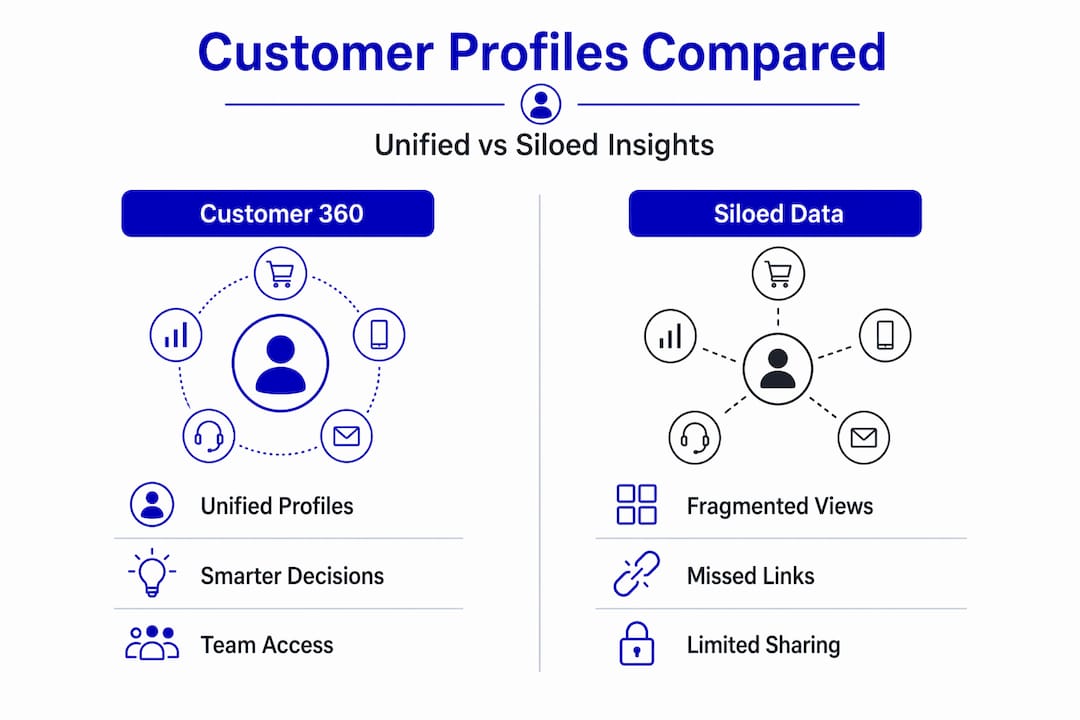
| Business function | Siloed approach | Customer 360-enabled approach |
|---|---|---|
| Sales | Rep manually checks CRM before a call | Rep sees complete purchase history, support cases, and product usage in real time |
| Customer service | Agent asks customer to repeat their issue | Agent sees full journey history and resolves in one interaction |
| Marketing | Campaign targeting based on demographics | Micro-segmentation based on real behavior and inferred intent |
| Operations | Reactive resource planning | Predictive demand signals from unified behavioral data |
Three operational use cases with strong applicability for KSA and UAE organizations:
- Next-best offer in retail and e-commerce. A unified profile that captures purchase history, browsing behavior, and loyalty tier allows your system to recommend the right product at the right moment, through the right channel. Retailers in the UAE using AI-driven analytics on top of Customer 360 data report measurable lifts in average order value and repeat purchase rates.
- Churn prevention in telecom. Telecom operators in KSA and UAE deal with high customer churn rates. A Customer 360 profile that combines usage patterns, billing sensitivity, support ticket frequency, and contract status allows churn models to identify at-risk customers weeks before they make a cancellation decision. The intervention can then be automated: a targeted retention offer, a proactive service call, or a plan adjustment recommendation.
- Proactive service in banking and financial services. When a banking customer’s transaction pattern changes significantly, or when they contact support about a product they haven’t used before, a unified profile allows the institution to respond proactively. This could mean triggering a financial advisor outreach, surfacing relevant product information in the mobile app, or flagging the account for a service review.
Regional context matters here. Organizations operating across KSA and UAE must account for Arabic-language data, dual-channel customer journeys (digital and branch-based), and sector-specific compliance requirements. Aligning business growth strategies with Customer 360 activation requires partners who understand both the technology and the regional market realities.
Why focusing on activation makes or breaks your Customer 360 investment
Here is the uncomfortable pattern we see repeatedly: organizations spend 12 to 18 months and significant budget building a Customer 360 data layer, and then they stop. The profiles exist. The data is clean. The CDP is running. And almost none of it is actually being used to drive decisions in day-to-day operations.
This is the trap that separates organizations that see strong ROI from those that treat Customer 360 as an infrastructure project rather than a business change initiative.
The conventional wisdom in data and technology circles focuses heavily on data quality, profile completeness, and platform capabilities. These things matter. But they are means, not ends. A complete customer profile sitting in a data warehouse delivers exactly zero business value until it flows into the workflows where your teams make decisions.
What we have learned from working with enterprise clients across the region is that activation must be designed before the data layer is built, not after. You should be asking: Which sales rep will see this profile and when? Which marketing workflow will trigger based on this behavioral signal? Which service agent screen will surface this purchase history? When you cannot answer those questions concretely, you are building infrastructure for infrastructure’s sake.
The leaders who drive the best outcomes from Customer 360 treat it as a workflow transformation program with a data foundation, not a data program that might eventually influence workflows. They define two or three high-value use cases before selecting technology, they measure success by workflow outcomes (conversion rate lift, churn reduction, resolution time improvement), and they expand only after proving value in the initial scope.
If you are evaluating a Customer 360 investment right now, challenge your vendors and internal teams to show you specific, activated use cases with measurable outcomes. Ask them: “Where exactly does this unified profile appear in a rep’s or agent’s daily workflow?” If the answer is vague, the investment is not ready to scale.
Our advice: align your Customer 360 roadmap with concrete business growth strategies and measure every phase against operational KPIs, not data completeness scores.
Start your Customer 360 journey with the right tech foundation
Building a Customer 360 strategy is only as effective as the technology ecosystem that supports it. A unified customer profile loses most of its value if it cannot connect to your ERP, your automation workflows, and your service delivery tools in real time.
At Singleclic, we work with enterprise organizations across KSA, UAE, and Egypt to integrate Customer 360 capabilities directly into their operational systems, including Microsoft Dynamics 365, Odoo ERP, and our own Cortex low-code platform. Whether you are starting from scratch or looking to connect existing systems, the path forward begins with defining your activation use cases and working backward to the right data architecture. Explore how enterprise process automation can accelerate your Customer 360 implementation by connecting unified customer profiles to the workflows that drive measurable results every day.
Frequently asked questions
What types of data are unified in a Customer 360 profile?
Customer 360 profiles combine transactional, interaction, behavioral, and inferred data across sales, marketing, and service channels. This goes well beyond basic demographics to include past transactions, preferences, and inferred attributes that reflect the real customer relationship.
Is Customer 360 the same as CRM?
No. Customer 360 unifies data from many systems to form a complete profile, while CRM is only one source. As Salesforce explains, Customer 360 is built from multiple customer-data sources and made usable by teams across all touchpoints, not just sales and service.
Why does identity resolution matter for Customer 360?
Identity resolution connects multiple records for the same customer, ensuring profiles are accurate enough to support effective personalization and analytics. Without it, matching errors undermine profile quality and erode customer trust.
How is Customer 360 typically implemented in organizations?
Most organizations use a Customer Data Platform (CDP) or a similar integration layer to gather, unify, and activate customer profiles. Customer 360 is frequently realized through CDP capabilities that handle data ingestion, identity resolution, and downstream activation in a single platform.
Recommended
- Unlocking Business Potential: A Comprehensive Guide to AI-Driven Analytics | Singleclic
- Customer Data Analytics for Continuous Improvement | Singleclic
- Data Analytics and Decision Intelligence — The Power Behind Smarter Business Decisions | Singleclic
- Unlock Operational Excellence: Customized Microsoft Dynamics 365 Solutions for Your Business | Singleclic