TL;DR:
- Effective project lifecycle management is crucial for ERP and CRM success, preventing delays and cost overruns. Leaders must enforce disciplined decision-making at each phase gate, ensure rigorous closure, and model accountability for optimal results. Adopting hybrid lifecycle approaches tailored to organizational requirements enhances implementation outcomes in the MENA region.
ERP and CRM deployments in KSA and UAE represent some of the largest technology investments organizations make, yet research consistently shows that a significant share of enterprise software projects run over budget, exceed timelines, or fail to deliver expected business value. The root cause is rarely the software itself. It is almost always a failure of project lifecycle management, specifically the absence of disciplined phase governance, clear decision criteria, and structured closure. This guide gives you a practical, executive-level framework for managing every stage of your ERP or CRM initiative from the first feasibility conversation to post-go-live value realization.
Table of Contents
- What is project lifecycle management and why it matters
- Project lifecycle phases: Standard vs. hybrid approaches
- Critical phase gates and how to make decisions at project transitions
- Mastering project closure: Handover and capturing lessons learned
- The hidden leverage: Why leadership discipline in PLM outperforms tools and tech
- Next steps: Elevate your project lifecycle with Singleclic
- Frequently asked questions
Key Takeaways
| Point | Details |
|---|---|
| Standard lifecycle clarity | Understanding project phases prevents missed steps and project failure. |
| Hybrid approach advantage | Combining predictive and adaptive methods fits complex MENA digital projects. |
| Gate discipline matters | Rigor at phase gates allows informed go/no-go decisions and controls risk. |
| Don’t skip closure | Documenting lessons and a strong handover protect ROI for future projects. |
| Leadership is key | Tools help, but disciplined executive oversight drives project success. |
What is project lifecycle management and why it matters
Project lifecycle management (PLM) is the structured approach of organizing, governing, and controlling a project through a defined set of phases, from initial concept to final closure. For C-level leaders sponsoring major ERP or CRM initiatives, PLM is not an administrative formality. It is the mechanism that protects your investment, aligns stakeholders, and ensures the solution actually delivers business outcomes.
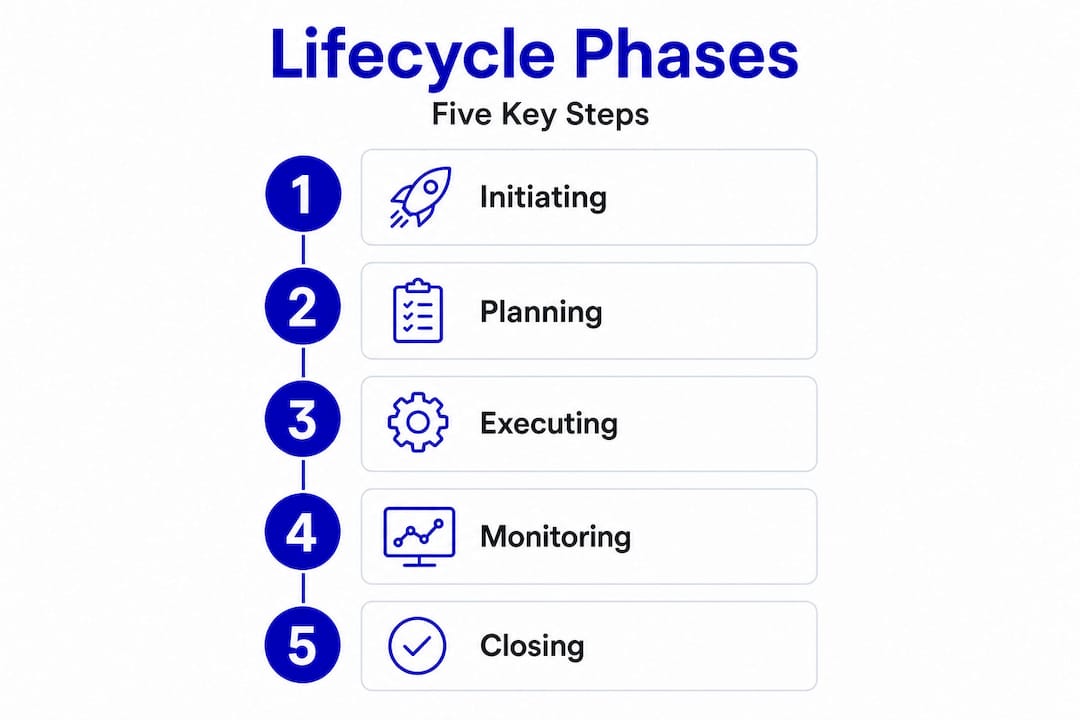
The standard project lifecycle phases per the Project Management Body of Knowledge (PMBOK) are Initiating, Planning, Executing, Monitoring & Controlling, and Closing. Each phase has distinct objectives, deliverables, and decision points. Understanding this structure gives you a shared language with your project teams and a reliable map for measuring progress.
Here is a quick summary of what each phase delivers in the context of an ERP or CRM rollout:
- Initiating: Define the business case, secure executive sponsorship, and establish high-level scope and objectives.
- Planning: Develop a detailed project plan covering scope, schedule, budget, resources, risk, and communication protocols.
- Executing: Deploy the solution, configure modules, migrate data, and conduct user acceptance testing.
- Monitoring & Controlling: Track performance metrics, manage change requests, resolve issues, and realign resources as needed.
- Closing: Formally hand over the system, document lessons learned, release project resources, and confirm benefit realization.
One common misconception is that these phases must follow a strict sequential order, with one completely finishing before the next begins. In practice, phases frequently overlap, especially in large ERP programs where planning for phase two of a rollout begins while phase one is still executing. The full lifecycle management overview illustrates how this overlap can be structured without creating confusion or governance gaps.
The business risks of skipping or compressing key phases are severe. Organizations that rush from initiation directly into execution without robust planning frequently encounter scope creep, budget overruns, and resistance from end users. In the MENA context, where regulatory requirements, Arabic language localization, and multi-entity organizational structures add genuine complexity, skipping planning phases can add months to a deployment and millions in rework costs.
“Project governance isn’t about slowing projects down. It’s about making sure every dirham invested moves the organization forward rather than funding corrections.” — Tamer Badr, Singleclic
Project lifecycle phases: Standard vs. hybrid approaches
Now that we have defined the standard lifecycle, let’s examine how MENA leaders can choose or blend approaches for modern technology deployments.
Not all ERP or CRM projects are the same. A greenfield Odoo implementation for a mid-size contractor in Riyadh looks very different from a multi-country Microsoft Dynamics 365 rollout for a regional bank. The lifecycle approach you select should reflect the nature of your requirements, your organization’s change maturity, and the risk tolerance of your stakeholders.

There are three primary lifecycle models in use today:
| Lifecycle model | Best for | Key strength | Key weakness |
|---|---|---|---|
| Predictive (Waterfall) | Stable, well-defined requirements | High predictability, clear milestones | Inflexible to change mid-project |
| Adaptive (Agile) | Rapidly evolving requirements | Fast feedback, iterative delivery | Harder to manage scope and budget |
| Hybrid | Complex ERP/CRM with mixed requirements | Balances structure with flexibility | Requires more sophisticated governance |
Lifecycle models research confirms that predictive approaches work well when requirements are stable and thoroughly understood before work begins, while adaptive approaches suit environments where business requirements evolve during the project itself. For most large ERP deployments in KSA and UAE, neither extreme is ideal on its own.
Project management phases analysis shows that PMBOK process groups often overlap in practice rather than follow strict sequence, and hybrids are frequently the best fit for ERP implementations where high-level scope is fixed but detailed configuration must adapt to user feedback.
Here is a numbered process for selecting the right lifecycle model for your initiative:
- Assess requirement stability. If your core business processes are well documented and unlikely to change, lean predictive. If they are actively evolving, lean adaptive.
- Evaluate your team’s agile maturity. Adaptive methods require trained practitioners. Jumping into sprints without experience creates chaos, not speed.
- Map your regulatory constraints. Government and banking sectors in the region often require formal sign-off at specific milestones, which favors structured predictive phases.
- Consider your vendor’s delivery model. Align your internal lifecycle model with how your implementation partner manages work to avoid friction.
- Define your risk threshold. Hybrid models add governance overhead but reduce the risk of major scope surprises in the final stages.
Pro Tip: For ERP implementations specifically, a hybrid model that uses predictive planning for infrastructure, data migration, and compliance requirements, combined with adaptive sprints for module configuration and user interface design, consistently delivers better outcomes than either pure approach. This gives you budget predictability where you need it and flexibility where your users need it most.
When you assess ERP readiness before committing to a lifecycle model, you surface organizational factors that should directly influence your choice. Organizations with limited project management maturity, for example, benefit from additional governance checkpoints that a purely adaptive model would not naturally include. Explore Agile in ERP projects and enterprise project planning for deeper guidance on structuring your approach.
Critical phase gates and how to make decisions at project transitions
Selecting the right lifecycle is step one. Success depends on disciplined decisions at each key transition. Here is how to build that rigor.
A phase gate is a structured decision point at the boundary between project phases. Phase gates act as go/no-go decisions to assess project viability before resources are committed to the next phase. Think of them as investment checkpoints rather than bureaucratic hurdles. Each gate forces your leadership team to answer a simple but critical question: “Is this project still worth continuing, and are we ready to proceed?”
The table below outlines sample gate criteria for a typical ERP implementation:
| Phase transition | Gate criteria | Decision maker |
|---|---|---|
| Initiation to Planning | Approved business case, executive sponsor confirmed, budget allocated | C-suite sponsor |
| Planning to Execution | Complete project plan, vendor contracts signed, core team assigned | Project steering committee |
| Execution to Monitoring | User acceptance testing passed, data migration validated, training completed | IT director and business owners |
| Monitoring to Closing | All scope items delivered, performance benchmarks met, support model confirmed | Project steering committee |
Before you greenlight the transition to the next phase, require your team to confirm the following:
- Scope clarity. Has the scope for the next phase been formally documented and agreed upon by business owners?
- Resource availability. Are the people, budget, and infrastructure needed for the next phase actually secured, not just planned?
- Risk reassessment. Have new risks identified during the current phase been logged, assessed, and mitigated?
- Stakeholder alignment. Do the key business owners understand and accept the plan for the next phase?
- Quality confirmation. Have the deliverables from the current phase been formally reviewed and accepted?
Pro Tip: Never skip a gate review to save time. The pressure to “just keep moving” is one of the most common reasons ERP projects run into serious trouble in the execution phase. A gate review that takes one day of executive time can prevent six weeks of rework. Review your ERP success tips for sector-specific gate criteria, especially if you operate in construction or healthcare where compliance requirements add additional review complexity.
The most effective phase gates are not long, formal ceremonies. They are focused, agenda-driven meetings with clear criteria, documented decisions, and explicit sign-off from the accountable executive. If your gate review cannot produce a signed decision within two hours, your project governance model needs simplification before you proceed.
Mastering project closure: Handover and capturing lessons learned
One phase executives frequently overlook, yet often regret mishandling, is closure and knowledge capture. Here is how to maximize ROI at the finish line.
Project closure is not the moment you go live. It is a distinct phase that begins after go-live stabilization and ends when the system is formally handed over to operations, benefits are tracked against the original business case, and the project team is formally disbanded. Underestimated closure phases lead directly to unrealized benefits when organizations skip rigorous handover and lessons learned processes.
A thorough closure phase includes the following steps:
- Formal system handover. Transfer operational ownership from the project team to IT operations and business process owners with documented runbooks and escalation paths.
- Benefits realization review. Compare actual performance metrics against the KPIs defined in the original business case. Document gaps and assign accountability for closing them.
- Lessons learned session. Conduct a structured retrospective with all key stakeholders, capturing what worked, what did not, and what the organization will do differently next time.
- Documentation finalization. Ensure all configuration documentation, user guides, training materials, and data migration records are archived and accessible.
- Resource release. Formally release project team members and close out vendor contracts, ensuring no ambiguity about ongoing obligations.
- Stakeholder communication. Communicate project completion, performance results, and next steps to all organizational stakeholders who were involved or affected.
Common mistakes organizations make during closure include:
- Treating go-live as the finish line. The system is live, but the project is not closed. Skipping formal closure creates operational ambiguity and knowledge loss.
- Skipping the lessons learned session. This is the single highest-value activity for improving your next project. Not doing it is a costly missed opportunity.
- Failing to document the as-built configuration. When the system needs modification six months later, undocumented configurations become expensive puzzles.
- Not measuring benefits against the business case. If you do not measure outcomes, you cannot justify future investment, and you cannot identify where the project underperformed.
- Leaving vendor relationships open-ended. Ambiguous contract closure creates cost exposure and unclear support boundaries.
“Closure is where organizations discover the real return on their technology investment. It is not paperwork. It is the moment you confirm whether the business case was right, and it is the foundation every future project is built on.” — Tamer Badr, Singleclic
Avoid the pitfalls of unmanaged tech deployments by building closure activities into your project plan from the start, not as an afterthought added when the team is already exhausted and leadership attention has moved to the next priority.
The hidden leverage: Why leadership discipline in PLM outperforms tools and tech
Understanding closure leads us to the bigger truth about what really drives program wins. It is not the framework you choose, the software you buy, or the methodology your vendor prefers. It is the discipline of your leadership team at every phase.
We have seen organizations in the region deploy the same ERP platform with two different leadership approaches and get dramatically different results. One organization treated the steering committee as a rubber stamp, rarely challenged project status reports, and left phase gate decisions to the project manager. Their go-live was delayed by four months and the benefits realization review never happened. The other organization held biweekly steering committee reviews, enforced gate criteria without exception, and required a documented lessons learned session before closing each project phase. They went live on schedule and documented measurable ROI within three months.
The tools were identical. The difference was leadership resolve.
Managing software requirements rigorously from the start is one of the most powerful things a C-level sponsor can model for the project team. When executives take requirements seriously, project managers take them seriously. When project managers take them seriously, vendor teams take them seriously. The discipline cascades.
The uncomfortable truth is that many ERP and CRM projects fail at the executive level, not the technical level. Scope creep starts when a senior leader bypasses the change control process. Budget overruns begin when a steering committee approves a phase gate without genuinely verifying the criteria. Knowledge loss happens when leadership considers closure a formality and releases the team before the work is done.
Your competitive advantage in PLM is not access to better technology. Every organization in KSA and UAE has access to the same platforms. Your advantage is the ability to enforce discipline at every phase, hold your teams accountable to structured decision-making, and model the behaviors you expect. That is the leadership leverage that separates successful digital transformation programs from expensive disappointments.
Next steps: Elevate your project lifecycle with Singleclic
Ready to put these concepts into transformational action? Explore these tailored solutions and resources for your next initiative.
At Singleclic, we have guided 60+ enterprise clients across KSA, UAE, and Egypt through complex ERP and CRM programs, from initial readiness assessment to post-go-live optimization. Our team of 70+ consultants and engineers brings both the technical depth and the governance rigor that major technology programs require.
Start by completing your ERP readiness assessment to identify where your organization stands before committing to a lifecycle approach. If your focus is on streamlining the processes your ERP will support, our business process automation guide for C-level leaders provides a practical framework for combining ERP implementation with workflow optimization. Whether you are deploying Odoo, Microsoft Dynamics 365, or building on our Cortex low-code platform, we bring structure, accountability, and regional expertise to every phase of your program.
Frequently asked questions
What are the five standard phases of project lifecycle management?
The PMBOK identifies the phases as Initiating, Planning, Executing, Monitoring & Controlling, and Closing, each with distinct objectives and deliverables.
What is a phase gate in the project lifecycle?
A phase gate is a go/no-go decision point used to evaluate whether a project meets defined criteria before leadership commits resources to the next phase.
When should you use a predictive, adaptive, or hybrid project lifecycle?
Predictive suits stable requirements, adaptive suits changeable environments, and hybrid combines both for the complex, multi-stakeholder nature of most large ERP and CRM programs.
Why do project closures often fail to deliver value?
Closures fail when teams skip rigorous handover and don’t capture lessons learned, which prevents organizations from confirming benefit realization and building institutional knowledge for future projects.
How can MENA businesses boost project success with lifecycle management?
MENA businesses should enforce structured phase governance and hybrid approaches that combine predictive planning rigor with adaptive flexibility, anchored by consistent executive engagement at every stage.