Most executives believe smart workflow is purely about adopting new technology. That’s only part of the story. True smart workflow combines automation, AI, and strategic process redesign to transform how organizations operate. This guide explains what smart workflow really means, how AI enhances decision-making, and actionable steps leaders across KSA, UAE, and Egypt can take to implement these solutions for measurable operational gains.
Table of Contents
- Understanding Smart Workflow: More Than Automation
- How AI Powers Smarter, Faster Business Workflows
- Implementing Smart Workflow Solutions For Organizational Success
- Comparing Smart Workflow Benefits Across Industries In KSA, UAE, And Egypt
- Explore Smart Workflow And Business Automation Solutions With Singleclic
- What Is Smart Workflow? Frequently Asked Questions
Key takeaways
| Point | Details |
|---|---|
| Smart workflow definition | Integration of AI, automation, and business process redesign, not just technology implementation. |
| AI decision impact | Organizations report 20% faster decision-making and 15% improved accuracy with AI-driven platforms. |
| Implementation approach | Start small with high-impact processes, iterate based on feedback, and prioritize change management. |
| Regional adoption | Finance, healthcare, and manufacturing sectors in KSA, UAE, and Egypt show varied AI maturity and benefits. |
| Success factors | Combine technology with process redesign, leadership commitment, and measurable KPIs for sustainable results. |
Understanding smart workflow: More than automation
Smart workflow isn’t just software deployment. It’s the strategic integration of AI, automation, and process redesign that fundamentally changes how work gets done. Workflow management transforms operations when executives recognize that technology alone won’t deliver optimization.
The core components work together:
- Technology layer: AI engines, automation tools, and integration platforms that execute tasks
- Process redesign: Rethinking workflows to eliminate bottlenecks and redundancies before automating
- Human factors: Change management, training, and cultural alignment to ensure adoption
Many leaders fall into the technology trap. According to Forbes research, a common misconception is that workflow automation is solely about technology. It’s equally about process redesign and change management. Without redesigning processes first, you’re just automating inefficiency.
“Smart workflow requires executives to think beyond tool selection. The real value comes from reimagining how teams collaborate, how decisions flow, and how information moves across the organization.”
AI enables better decisions rather than replacing human judgment. When you combine machine intelligence with human expertise, you create workflows that adapt, learn, and improve continuously. This holistic approach separates successful transformations from failed technology projects.
How AI powers smarter, faster business workflows
AI transforms workflows by providing capabilities humans can’t match at scale. Real-time data processing, predictive analytics, and pattern recognition turn reactive operations into proactive management systems. The impact shows in hard numbers.
Organizations using AI-driven workflow platforms have reported a 20% increase in decision-making speed and a 15% improvement in accuracy. That’s not incremental improvement. That’s competitive advantage.
Executives gain specific benefits:
- Actionable insights: AI analyzes thousands of data points to surface trends and anomalies that require attention
- Risk reduction: Predictive models identify potential issues before they escalate into problems
- Proactive management: Automated alerts and recommendations enable leaders to act rather than react
- Complexity handling: AI manages workflows with hundreds of variables and dependencies seamlessly
The key shift is augmentation, not replacement. AI handles volume and complexity while humans focus on strategy, relationships, and creative problem solving. AI-powered analytics deliver the intelligence layer that makes workflows truly smart.

Consider a procurement workflow. Traditional automation sends purchase orders based on inventory levels. AI-enhanced workflows predict demand fluctuations, optimize supplier selection based on performance data, flag potential supply chain risks, and recommend alternative sourcing strategies. The difference is intelligence embedded in every step.
Speed matters in 2026. Markets move faster, customer expectations rise continuously, and competitive windows narrow. AI-driven workflows compress decision cycles without sacrificing quality. You move from monthly reviews to daily optimization, from quarterly planning to real-time adaptation.
Implementing smart workflow solutions for organizational success
Successful implementation follows a clear roadmap. Leaders who rush into enterprise-wide deployments often face resistance and disappointing results. Start strategically and scale systematically.
- Assess current processes: Document existing workflows, identify pain points, and quantify inefficiencies with data
- Prioritize high-impact workflows: Focus on processes with clear ROI potential and stakeholder buy-in
- Automate and integrate AI: Deploy technology while redesigning processes for optimal flow
- Collect feedback continuously: Establish feedback loops with users to identify issues and opportunities
- Iterate and expand: Refine initial implementations before scaling to additional workflows
Leadership commitment makes or breaks transformation efforts. When executives champion change, provide resources, and model new behaviors, adoption accelerates. Cultural resistance is the biggest barrier, not technology limitations.
According to Dr. Ahmed Hassan, the key to successful workflow automation is to start small, focus on high-impact processes, and iterate based on feedback. This approach builds momentum and proves value before major investment.
Pro Tip: Launch a pilot in one department with enthusiastic stakeholders. Document quick wins with specific metrics like time saved, errors reduced, or costs eliminated. Use this success story to build support for broader rollout.
Measurable KPIs keep implementations on track. Track cycle time reduction, error rates, employee satisfaction, and cost per transaction. Enterprise workflow optimization delivers measurable ROI when you define success criteria upfront.
Common pitfalls to avoid:
- Automating broken processes without redesign
- Neglecting employee training and change management
- Underestimating integration complexity with legacy systems
- Focusing on technology features rather than business outcomes
Business process reengineering provides the foundation for smart workflows. Technology amplifies good processes and exposes bad ones. Get the processes right first.
Comparing smart workflow benefits across industries in KSA, UAE, and Egypt
Smart workflow adoption varies significantly across sectors and markets. Understanding these differences helps executives set realistic expectations and learn from parallel industries.
| Industry | Primary Benefits | AI Adoption Level | Key Metrics Improved |
|---|---|---|---|
| Financial Services | Compliance automation, fraud detection, faster loan processing | High (65-75%) | 40% faster approvals, 30% cost reduction |
| Healthcare | Patient flow optimization, diagnostic support, resource allocation | Medium (45-55%) | 25% shorter wait times, 20% better outcomes |
| Manufacturing | Predictive maintenance, supply chain optimization, quality control | Medium-High (55-65%) | 35% less downtime, 15% waste reduction |
| Government | Citizen service automation, document processing, inter-agency coordination | Low-Medium (30-40%) | 50% faster processing, improved transparency |
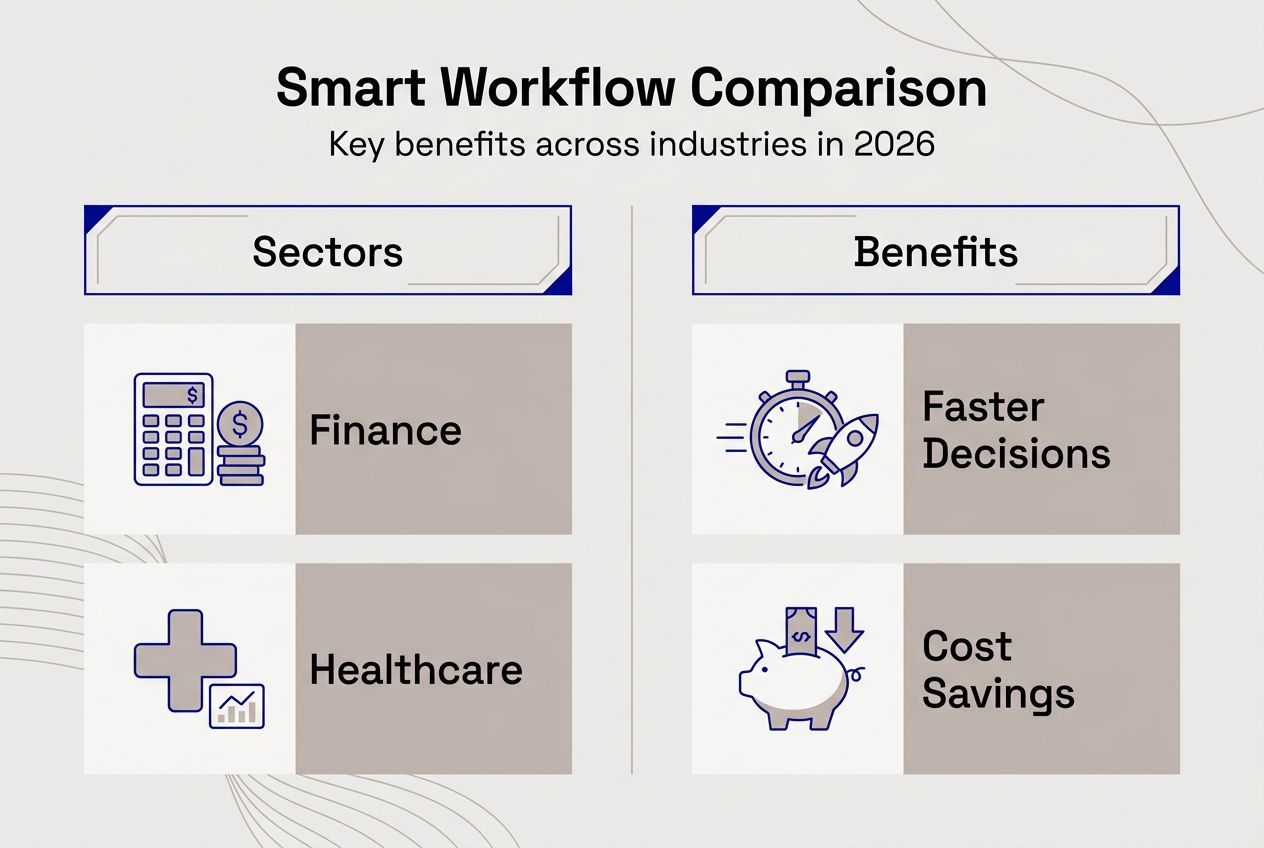
Regional adoption reflects both opportunity and challenge. KSA leads in government digital transformation initiatives. UAE excels in private sector AI integration, particularly in finance and real estate. Egypt shows strong growth in manufacturing and healthcare automation.
Cultural and regulatory factors influence implementation:
- Data sovereignty requirements: On-premise solutions gain preference for sensitive government and banking workflows
- Arabic language support: Workflows must accommodate bilingual operations and Arabic-first interfaces
- Rapid growth markets: Organizations prioritize scalability and flexibility over feature completeness
According to Gartner analysis, AI-driven workflow optimization can improve decision-making speed and accuracy across sectors. The magnitude of improvement correlates with process complexity and data quality.
Financial institutions see immediate compliance benefits. Automated regulatory reporting, transaction monitoring, and risk assessment reduce manual effort by 60-70%. Healthcare organizations improve patient satisfaction through better scheduling and resource allocation. Manufacturers cut unplanned downtime through process automation that predicts equipment failures.
The common thread is strategic implementation. Organizations that treat smart workflows as business transformation rather than IT projects consistently outperform those focused solely on technology deployment. Success requires executive sponsorship, cross-functional collaboration, and commitment to continuous improvement.
Explore smart workflow and business automation solutions with Singleclic
Implementing smart workflows requires expertise in technology, process design, and change management. Singleclic combines 10+ years of regional delivery experience with deep industry knowledge across KSA, UAE, and Egypt to help organizations transform operations.
Our business process automation guide provides executives with frameworks for evaluating automation opportunities and building business cases. Before deployment, assess ERP readiness to ensure your technology foundation supports advanced workflows.
We deliver end-to-end enterprise automation solutions combining AI, RPA, and low-code platforms. Our Cortex platform enables Arabic-enabled, on-premise workflow automation designed specifically for MENA enterprises requiring data sovereignty and unlimited scalability. From initial assessment through deployment and ongoing optimization, we partner with leaders to achieve measurable operational excellence.
What is smart workflow? Frequently asked questions
What distinguishes smart workflow from regular automation?
Smart workflow integrates AI for predictive insights and continuous learning, while regular automation simply executes predefined rules. The smart approach adapts to changing conditions and optimizes itself over time without human intervention.
How quickly can organizations see benefits from smart workflow implementation?
Pilot implementations typically show measurable improvements within 8-12 weeks. Full enterprise deployment delivers substantial ROI within 6-9 months when organizations prioritize high-impact processes and commit to change management.
What are the common challenges executives face when adopting smart workflows?
Resistance to change ranks as the top barrier, followed by integration complexity with legacy systems and difficulty quantifying ROI upfront. Success requires executive sponsorship, clear communication, and proven quick wins to build momentum.
How does AI specifically enhance workflow processes?
AI provides real-time pattern recognition, predictive analytics, and intelligent routing that manual processes can’t match. It analyzes historical data to optimize task assignment, predict bottlenecks, and recommend process improvements continuously.
Can smart workflows be customized to different industry needs?
Absolutely. Healthcare workflows prioritize patient privacy and clinical protocols, while financial workflows emphasize compliance and fraud detection. Effective platforms allow industry-specific customization while maintaining core automation and AI capabilities.
Do smart workflows require replacing existing systems?
Not necessarily. Modern workflow platforms integrate with existing ERP, CRM, and legacy systems through APIs and connectors. The goal is to orchestrate and optimize current tools rather than force wholesale replacement.