Over 80 percent of large organizations globally now rely on enterprise automation to improve efficiency and accuracy, a practice pioneered by American innovators. For CTOs and CIOs in Saudi Arabia and UAE’s healthcare and construction sectors, adopting these automation solutions presents a real opportunity to overcome manual bottlenecks and complexity. You will discover practical insights into how intelligent systems can reshape your workflows and transform operational performance where it matters most.
Table of Contents
- Enterprise Automation Defined and Explained
- Major Types of Enterprise Automation Systems
- How Enterprise Automation Improves Workflows
- Real-World Applications in Key Sectors
- Risks, Costs, and Implementation Challenges
Key Takeaways
| Point | Details |
|---|---|
| Enterprise Automation Enhances Efficiency | Organizations should leverage technologies like AI and RPA to streamline and optimize core business processes, creating interconnected operational frameworks. |
| Identify Repetitive Tasks for Automation | Conduct an audit of existing workflows to pinpoint repetitive, rule-based tasks that can be automated, improving overall productivity. |
| Implement Gradual Automation Strategies | Develop a phased approach to automation that starts with low-risk processes, addressing challenges like legacy systems and workforce training. |
| Focus on Real-Time Monitoring | Employ automation systems to enable continuous performance tracking, facilitating rapid adjustments and improved decision-making across the organization. |
Enterprise Automation Defined and Explained
Enterprise automation represents a comprehensive strategic approach where organizations leverage advanced technologies to streamline, optimize, and transform their core business processes. At its foundation, enterprise automation involves integrating multiple technologies to create intelligent, efficient operational frameworks that transcend traditional manual workflows.
The core objective of enterprise automation extends beyond simple task replacement. It aims to create an interconnected ecosystem where software, artificial intelligence, robotic process automation, and strategic decision making converge. In Saudi Arabia and UAE, enterprises are increasingly recognizing that automation is not just about reducing human intervention, but about enhancing organizational agility, improving accuracy, and unlocking strategic value through intelligent process design.
Key components of enterprise automation typically include:
- Business Process Management (BPM)
- Robotic Process Automation (RPA)
- Artificial Intelligence integration
- Machine Learning algorithms
- Workflow optimization tools
- Enterprise system integrations
Pro tip: Start your enterprise automation journey by mapping existing processes and identifying repetitive, rule-based tasks that can be easily automated using low-code platforms like Cortex.
Major Types of Enterprise Automation Systems
Enterprises across Saudi Arabia and UAE are increasingly adopting sophisticated automation systems to drive operational efficiency. Major categories of enterprise automation software encompass a diverse range of technological solutions designed to transform business processes and enhance organizational performance.
The primary types of enterprise automation systems include:
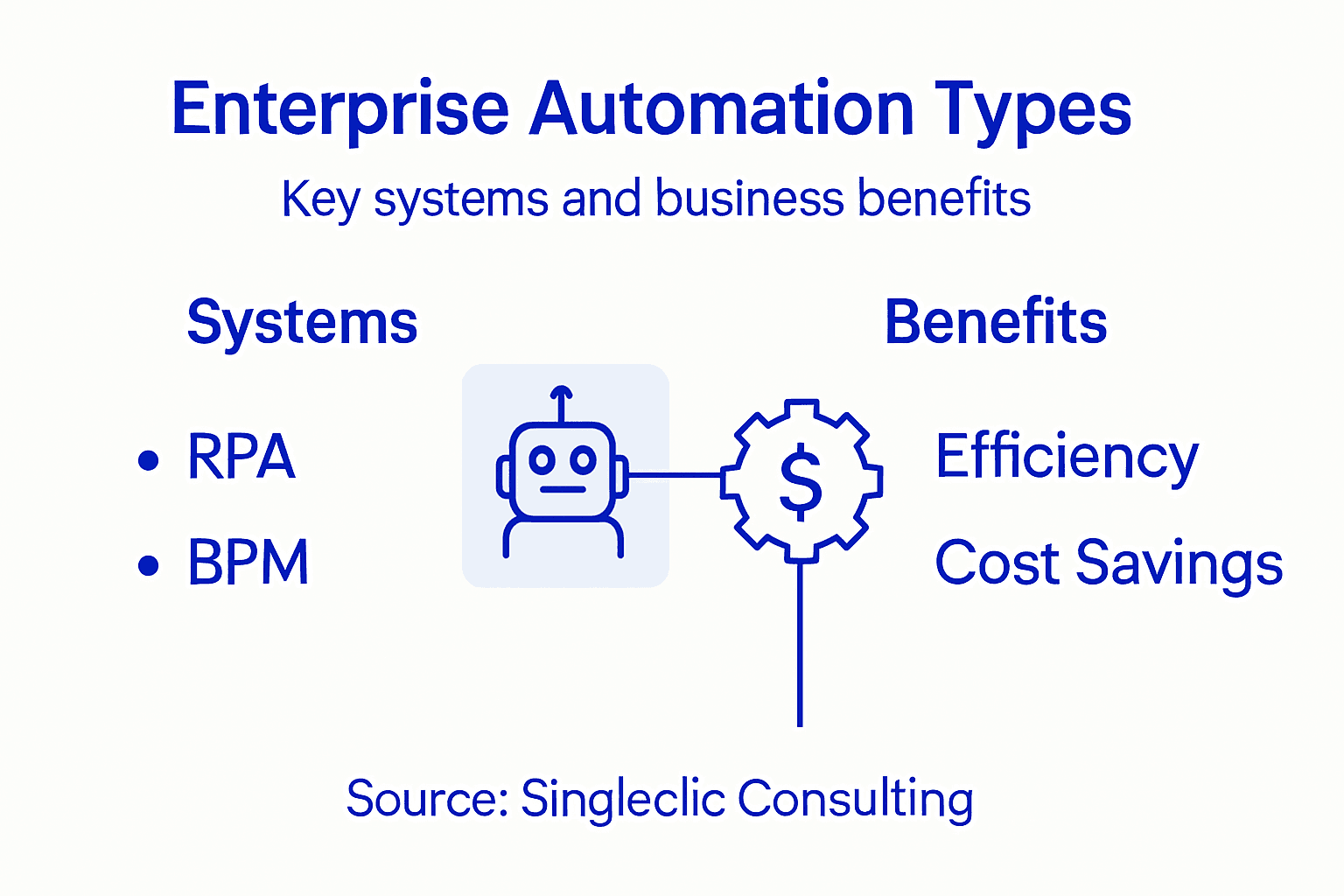
- Robotic Process Automation (RPA): Focuses on automating repetitive, rule-based tasks using software robots
- Business Process Management (BPM): Provides comprehensive tools for analyzing, designing, and optimizing end-to-end business workflows
- Process Monitoring Systems: Tracks and analyzes operational performance and identifies potential bottlenecks
- Orchestration Platforms: Coordinates complex workflows across multiple systems and applications
- Process Mining Tools: Utilizes data analytics to uncover insights and improve process efficiency
- Integration Platform as a Service (iPaaS): Enables seamless connectivity between different software applications and cloud services
These automation systems work synergistically to create what industry experts call hyperautomation or intelligent automation. By combining multiple technological approaches, organizations can develop more adaptive, efficient, and responsive operational models that dramatically reduce manual intervention and minimize human error.
Here’s a quick comparison of leading enterprise automation system types and their strategic benefits:
| Automation System Type | Main Purpose | Typical Business Benefit |
|---|---|---|
| Robotic Process Automation | Automates routine digital tasks | Frees staff for valuable work |
| Business Process Management | Optimizes workflows end-to-end | Boosts process transparency |
| Orchestration Platforms | Coordinates actions across systems | Improves cross-system output |
| Process Mining Tools | Analyzes real operations data | Reveals efficiency gains |
| iPaaS | Connects cloud and local software | Powers seamless integration |
Pro tip: Conduct a thorough audit of your existing business processes before implementing automation, identifying repetitive tasks that can be streamlined using low-code platforms like Cortex.
How Enterprise Automation Improves Workflows
Enterprise automation transforms workflows by fundamentally reimagining how organizations approach operational efficiency. By integrating disparate software systems and eliminating manual bottlenecks, businesses can create more streamlined, intelligent, and responsive process ecosystems that dramatically enhance overall productivity.

The core improvement mechanisms of enterprise automation include:
The following table summarizes how automation drives workflow improvements across organizations:
| Automation Improvement | Example Impact | Workforce Result |
|---|---|---|
| Rule-based Automation | Standardizes task handling | Reduces manual errors |
| Integration Automation | Merges disparate systems | Enables holistic data views |
| Intelligent Automation | Adapts to new scenarios | Supports better decisions |
| Real-time Monitoring | Tracks workflow performance | Enables rapid adjustments |
- Rule-based Automation: Standardizes repetitive tasks with predefined logic
- Integration-based Automation: Connects critical systems like CRM and ERP
- Intelligence-based Automation: Leverages AI and machine learning for adaptive decision making
- Real-time Performance Monitoring: Enables continuous process optimization
- Error Reduction: Minimizes human-induced mistakes through systematic workflows
In sectors like healthcare and construction across Saudi Arabia and UAE, Robotic Process Automation (RPA) significantly enhances administrative workflows, delivering remarkable benefits such as time savings, increased accuracy, and the ability to provide more personalized services. By automating complex, repetitive tasks, organizations can redirect human talent toward more strategic, creative endeavors that drive genuine business value.
Pro tip: Prioritize identifying high-volume, repetitive processes in your organization that can be easily automated using low-code platforms like Cortex, focusing on tasks with clear, predictable patterns.
Real-World Applications in Key Sectors
Robotic Process Automation and Artificial Intelligence applications are revolutionizing operational strategies across multiple critical sectors in Saudi Arabia and UAE. From healthcare to finance, enterprises are discovering innovative ways to transform traditional business processes through intelligent automation technologies.
Key sector applications include:
- Healthcare: Automating patient record management, appointment scheduling, and claims processing
- Finance: Streamlining transaction processing, fraud detection, and regulatory compliance reporting
- Manufacturing: Optimizing supply chain management, inventory tracking, and quality control processes
- Banking: Enhancing customer service, automating loan approvals, and managing risk assessments
- Human Resources: Automating recruitment screening, employee onboarding, and performance tracking
AI integration in enterprise architecture enables organizations to detect operational inefficiencies, support real-time decision making, and create more adaptive business environments. By leveraging advanced technologies, companies can mitigate risks, enhance customer experiences, and drive strategic innovation across complex business landscapes.
Pro tip: Begin your enterprise automation journey by conducting a comprehensive audit of your existing processes, identifying repetitive tasks that can be efficiently automated using low-code platforms like Cortex.
Risks, Costs, and Implementation Challenges
Implementing Robotic Process Automation (RPA) presents complex challenges that organizations in Saudi Arabia and UAE must carefully navigate. Successful enterprise automation requires a strategic approach that addresses multiple interconnected obstacles across technological, human, and organizational dimensions.
Key implementation challenges include:
- Legacy System Integration: Connecting new automation technologies with existing infrastructure
- Technical Skill Gaps: Recruiting and training personnel with specialized automation expertise
- Change Management: Overcoming organizational resistance and cultural barriers
- Initial Investment Costs: Managing significant upfront technological investments
- Regulatory Compliance: Ensuring automation meets industry-specific legal requirements
- Security Vulnerabilities: Protecting sensitive data during digital transformation
Automation implementation challenges extend beyond technical considerations, requiring comprehensive strategies that balance technological innovation with human factors. Organizations must develop robust frameworks that maintain operational safety, preserve situation awareness, and create adaptive systems capable of evolving with changing business landscapes.
Pro tip: Develop a phased automation implementation strategy, starting with low-risk processes and gradually expanding complexity while continuously training your workforce using platforms like Cortex.
Unlock the Full Potential of Enterprise Automation with Singleclic
The challenges highlighted in the article around integrating multiple technologies, overcoming legacy system hurdles, and managing complex workflows are real concerns for many organizations in Saudi Arabia, UAE, and beyond. With key goals like enhancing accuracy, reducing manual errors, and achieving real-time process optimization, it is clear that adopting a flexible, intelligent automation platform is vital for business growth.
At Singleclic, we understand these pain points deeply. Our expertise in Business Process Automation using IBM BAW, Robotic Process Automation with UiPath, and our Arabic-enabled, on-premise low-code platform Cortex directly addresses these common issues. Cortex empowers enterprises to automate repetitive, rule-based tasks and adapt workflows dynamically without downtime, ensuring your teams focus on value-added activities rather than manual bottlenecks.
Discover how your organization can elevate operational efficiency, reduce human error, and unlock strategic value through intelligent automation today. Visit Enterprise Automation Solutions at Singleclic to learn more.
Ready to transform your business processes effectively? Connect with Singleclic’s expert consultants now to start your automation journey with scalable solutions tailored for KSA, UAE, and Egypt markets. Don’t wait to enhance agility and realize true process optimization. Explore our range of services including Business Process Automation and Robotic Process Automation and move beyond digitalization into powerful enterprise transformation.
Frequently Asked Questions
What is enterprise automation?
Enterprise automation is a strategic approach that utilizes advanced technologies to streamline and optimize core business processes by creating an interconnected ecosystem of software, artificial intelligence, and workflow automation.
What are the major types of enterprise automation systems?
The major types include Robotic Process Automation (RPA), Business Process Management (BPM), Process Monitoring Systems, Orchestration Platforms, Process Mining Tools, and Integration Platform as a Service (iPaaS).
How does enterprise automation improve workflows?
Enterprise automation improves workflows by standardizing routine tasks, integrating disparate systems, adapting to new scenarios using AI, and enabling real-time performance monitoring to enhance overall productivity and efficiency.
What are some common challenges in implementing enterprise automation?
Common challenges include integrating legacy systems, addressing technical skill gaps, managing change within an organization, handling initial investment costs, ensuring regulatory compliance, and mitigating security vulnerabilities.