Yes, Odoo supports end-to-end leasing management through the Rental/Leasing module paired with Accounting, CRM, Documents, Sign, and Maintenance. Most property managers start with those five apps, running on a single database so contracts, billing, and tenant communication stay connected. If your portfolio spans multiple sites, involves Arabic-speaking staff, or needs mobile field approvals, plan for a partner-led rollout rather than a solo configuration effort.
TL;DR:
- Most leasing workflows require a combination of modules, with core features covering tenancy management, billing, document signing, and maintenance tracking.
- Real-time unit availability can be viewed through color-coded calendars and filtering options, reducing double-bookings across multiple sites.
- Automated rent collection and VAT-compliant invoicing rely on correctly configured templates and tax codes tailored to local regulations.
- Scaling portfolios beyond a few sites or involving multiple languages often necessitates custom mobile apps, regional translations, or partner-led implementations to ensure efficiency.
- An experienced partner can streamline complex setups, integrate legacy systems, and develop custom workflows using low-code tools for regional requirements.
Table of Contents
- What does odoo real estate leasing actually involve?
- How do you manage lease contracts and renewals in Odoo?
- Can you see unit availability in real time?
- How does billing and accounting work for rent collection?
- How do CRM and listings feed the leasing pipeline?
- How do maintenance requests connect to leases?
- When should you extend Odoo with mobile apps or custom modules?
- Should you build this in-house or bring in a partner?
- How Singleclic helps with Odoo leasing implementations
- Sources
What does odoo real estate leasing actually involve?
Odoo real estate leasing runs on a stack of modules rather than one standalone app, and knowing which piece does what saves weeks of trial and error during setup.
- Rental/Leasing: manages tenancy records, lease terms, pricing tiers, and recurring billing schedules tied to each unit.
- Accounting: generates journal entries automatically, reconciles rent payments, and produces VAT-ready invoices once configured for your jurisdiction.
- CRM and website/listings: captures inbound enquiries from property pages and routes them into a sales pipeline feeding directly into leasing.
- Documents and Sign: stores lease files centrally and collects e-signatures without printing a single page.
- Maintenance: links service tickets to specific units, so repair costs trace back to the right property and tenant.
Because these apps share one integrated database, a signed lease in Rental can trigger an invoice in Accounting and a contact record in CRM without anyone re-typing data three times.
How do you manage lease contracts and renewals in Odoo?
Contract management is where most leasing teams either save hours weekly or lose them to manual chasing. Odoo’s Leasing Management builds on top of Rental centralizes contracts, tenant records, and availability in one view, which makes renewals far less of a scramble.
- Create the lease record with tenant details, unit assignment, term length, deposit amount, and any attached identity or company documents.
- Apply a contract template matched to lease type (residential, commercial, short-term) and route it through Sign for tenant approval.
- Set expiry alerts 60 to 90 days ahead so renewal conversations start before the lease lapses, not after.
- Log amendments as dated records rather than overwriting the original terms, preserving a clean audit trail.
Data hygiene matters more than it sounds. Require fields for unit ID, tenant national ID or trade license, and deposit reference before a lease record can be marked active, and retain signed documents for at least the statutory period your jurisdiction requires.
Pro Tip: Build one master lease template per property type, then lock the clauses that shouldn’t change. Editable-everywhere templates are the single biggest cause of inconsistent lease terms across a growing portfolio.
Can you see unit availability in real time?
You can, using the availability calendar and Gantt-style rental view that shows occupied, reserved, and open units side by side across your entire portfolio.
- Color-coded bars flag which units are leased, held, or vacant without opening a single record.
- Blocking a date range for maintenance or inspection prevents a booking agent from accidentally double-leasing that unit.
- Multi-property managers can filter the view by building, floor, or region, keeping a 40-unit tower and a 12-villa compound on separate but comparable timelines.
For teams juggling several sites, this view replaces the shared spreadsheet that usually causes double-bookings in the first place. One glance tells a leasing agent whether a unit is truly free before they promise it to a prospect.
How does billing and accounting work for rent collection?
Recurring invoicing is where the Accounting integration earns its keep. Rent, service charges, and security deposits can each run on their own billing schedule, generated automatically instead of manually re-entered every month.
- Recurring invoice templates fire on a set day of the month for base rent and separately for service charges.
- Security deposits post to a distinct holding account, so they don’t get counted as revenue by mistake.
- Payment acquirer integrations reconcile incoming transfers against open invoices, cutting down the manual matching that eats a bookkeeper’s week.
Because Accounting and Rental operate from the same database, reconciliation happens without exporting a single spreadsheet between systems. If you’re leasing in the UAE, VAT treatment on commercial versus residential leases differs, and invoice formatting has its own compliance rules. Configure tax codes correctly at setup, and confirm the details with a local accountant or your implementation partner before go-live rather than after the first VAT filing.
How do CRM and listings feed the leasing pipeline?
A lease usually starts as a website enquiry, and Odoo’s CRM app is built to catch that enquiry and carry it through to a signed contract without losing the trail.
- Property pages publish unit details and route enquiry forms straight into a CRM pipeline instead of a shared inbox, benefiting from expert Real Estate SEO Services that help show up first and capture leads effectively.
- Pipeline stages track prospects through viewing, application, approval, and contract, so nothing falls through when a sales agent is out sick.
- Automations can schedule viewings, assign follow-up tasks, and generate a rental record automatically once an opportunity is marked won.
Pairing this with a dedicated real estate CRM setup tends to shorten the gap between first enquiry and signed lease, since agents aren’t manually re-entering the same prospect into two systems.
How do maintenance requests connect to leases?
Maintenance tickets tied to a specific unit and tenant give you a clean record of what broke, when, and what it cost, which matters when a tenant disputes a deposit deduction.
- Every ticket links to a unit and tenant record, with SLA timers tracking response and resolution time.
- Vendor bills for repairs post against that property’s expense account, feeding directly into net operating income reporting.
- Preventive maintenance schedules run on a calendar, while tenant-reported repairs enter through a portal or mobile submission.
That link between a repair ticket and the underlying lease is what turns scattered work orders into a usable cost history per property.
When should you extend Odoo with mobile apps or custom modules?
Standard Odoo covers most leasing workflows out of the box, but scale changes the calculus. Portfolios with 500+ units, multi-site operations, or a need for interactive floor maps usually outgrow the default interface fast.
- Mobile apps let leasing agents approve applications, capture unit photos, and navigate interactive maps on-site with offline sync, which matters when a viewing happens in a basement with no signal.
- Custom modules make sense once you need workflows Odoo doesn’t ship natively, and the platform’s open codebase on GitHub supports that kind of extension.
- Arabic UI and right-to-left layouts require translation configuration; Odoo’s translation resources cover the groundwork, but regional testing still matters.
Before committing to custom work, map your data model, confirm on-premise requirements if compliance demands it, and lock down your payment and e-sign integrations early, since retrofitting them later is far more expensive than planning them upfront.
Pro Tip: Pilot any custom mobile workflow on one building before rolling it across a portfolio. Field issues like map accuracy or offline sync gaps show up fast on a single site and are cheap to fix there.
Should you build this in-house or bring in a partner?
Complexity is the real trigger. If your leasing setup involves multiple integrations, Arabic-language requirements, or a tight go-live date, an in-house team configuring Odoo alone often stalls exactly where the technical detail gets specific. Pilot a small portfolio first, validate that migrated tenant data is clean, and set clear governance before scaling. If any of that sounds like your situation, a discovery call with an implementation partner beats months of trial and error.
— Tamer Badr
How Singleclic helps with Odoo leasing implementations
An experienced implementation partner can be a practical alternative to building your Odoo leasing setup alone and hoping the integrations hold. As an Odoo Silver Partner with implementation experience across KSA, UAE, and Egypt, Singleclic configures Rental/Leasing alongside Accounting, eSign, and payment gateway integrations, then builds custom mobile apps where field teams need offline approvals and interactive maps.
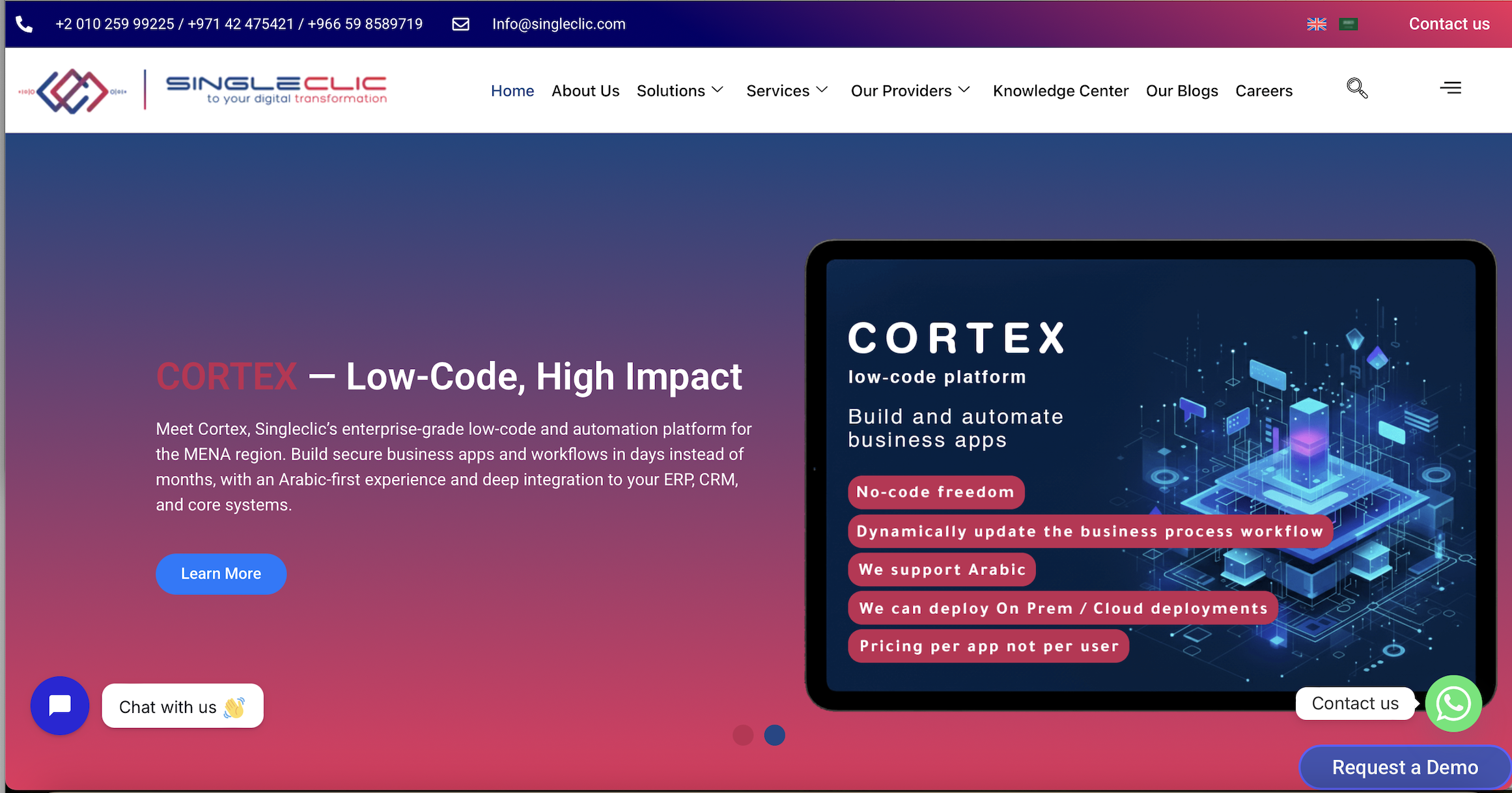
For portfolios that need workflow logic Odoo doesn’t handle natively, Singleclic extends the platform with Cortex, an Arabic-enabled, on-premise low-code platform that connects approvals, ERP, CRM, and legacy systems without runtime downtime. That matters for government and financial clients who can’t run purely cloud-based tools. If your leasing operation is outgrowing spreadsheets or a half-configured Odoo instance, request a discovery call on Odoo and Dynamics 365 implementation and get a clear scope before you commit budget.