The operating model that reliably works for offshore developers is a one-team, outcome-driven structure built on outcome ownership, an explicit communication charter, and a protected daily overlap window. Skip vendor-style hand-offs. Three moves matter this week: write a one-page communication charter with channel SLAs, provision full tooling and repo access before day one, and assign an onboarding buddy along with a concrete first-sprint outcome. The 90-day playbook and KPI checklist below turn that verdict into a routine.
TL;DR:
- Establish a clear communication charter, overlap window, and provisioning plan before onboarding offshore developers to prevent early failures.
- Shift from vendor to one-team mindset by aligning offshore and onshore staff under shared outcome ownership, roles, and standards from day one.
- Use a disciplined, minimal toolstack for async collaboration, and reserve real-time meetings for only critical, high-impact interactions within the overlap window.
- Implement structured onboarding with preboarding, assigned buddies, and phased milestones to build trust and demonstrate progress within the first 30 days.
- Maintain high code quality and security through automated CI/CD standards, role-based access controls, and legal contracts covering IP, compliance, and data residency.
Table of Contents
- Quick operational checklist to manage offshore developers this week
- Operating model and team roles: one-team versus vendor thinking
- What communication rules actually prevent offshore coordination failures?
- How do you onboard offshore developers in the first 90 days?
- Engineering standards that keep offshore code quality high
- Governance, security, and contracts before you grant access
- Metrics and KPIs that predict whether the model is working
- Hiring and vetting practices that predict remote performance
- Common pitfalls and red flags when scaling an offshore team
- How Singleclic helps regional leaders manage offshore developers
- Time zone management beyond the overlap window
- Incentive structures and motivation strategies for offshore teams
- Legal compliance nuances beyond the basic contract
- Author perspective: three lessons from running offshore teams
- How Singleclic can support your offshore development model
- Sources
Quick operational checklist to manage offshore developers this week
Most offshore engagements fail in the first two weeks, not the first two months. The damage happens before anyone notices, because access delays and vague ownership quietly compound. Fix the mechanics fast and the relationship has a real chance.
Here is the sequence that prevents the most common early failures when you manage offshore developers for the first time:
- Write a one-page communication charter. List every channel (Slack, email, video call), what it is for, the response SLA in hours, and who gets escalated to when an answer does not arrive on time.
- Lock a daily overlap window and put the weekly sync inside it. Pick the two to four hours where both time zones are awake, and protect that slot from every other meeting.
- Provision access before the first commit. Repo permissions, CI/CD pipelines, monitoring dashboards, and VPN credentials should all be live before the offshore engineer’s first working day, not requested on it.
- Assign a named buddy and a first pilot feature. The buddy answers process questions; the pilot feature gives the new hire something real to ship inside the first sprint.
None of this requires new software or a bigger budget. It requires someone on your side to decide these four things before the offshore team starts typing, which is exactly where offshore engagements typically break down when leaders assume communication will sort itself out.
Operating model and team roles: one-team versus vendor thinking
Two mental models compete for how you run an offshore team, and only one of them scales. The vendor model treats the offshore group as an external supplier: you send tickets, they send code, and a project manager translates between the two sides. It feels safe because it keeps a clean boundary, but that boundary is exactly what causes the drift. Requirements degrade in translation, ownership gets fuzzy, and nobody on the offshore side feels responsible for the outcome, only the ticket.
The one-team model collapses that boundary, as it aligns closely with how to turn user feedback into product decisions by fostering outcome ownership and clear communication. Offshore developers report into the same delivery structure as onshore staff, attend the same standups, and own outcomes rather than tasks. Capital Numbers frames this shift around outcome ownership paired with engineering standards set from day one, which is the combination that actually prevents the technical debt vendor relationships tend to accumulate quietly.
A working pod usually needs four roles:
- Onshore product owner: owns priorities, writes acceptance criteria, and is the single point of truth on “why” a feature exists.
- Offshore tech lead: owns technical decisions, code quality, and translates product intent into an execution plan without a middleman.
- Developers: own their tickets end to end, including tests and documentation, not just the code itself.
- HR business partner (HRBP): owns retention, onboarding logistics, and flags cultural or engagement issues before they become resignations.
There is a specific headcount moment where this structure needs reinforcement. Somewhere between five and seven offshore engineers, coordination overhead stops growing in a straight line and starts growing exponentially, because every new hire multiplies the number of relationships the product owner has to track directly.
Pro Tip: The moment your offshore headcount crosses five, hire or promote a local offshore lead even if the budget feels premature. Delaying that hire past seven people is far more expensive than making it a little early, because the coordination tax compounds with every new engineer added on top of an already stretched onshore owner.
For leaders weighing whether to build this pod internally or through a dedicated center, an offshore development center structure often formalizes these roles faster than an ad hoc arrangement, and a structured project team playbook can help define exactly who owns what before the pod grows.
What communication rules actually prevent offshore coordination failures?
Bad communication almost never looks like silence. It looks like noise: too many channels, unclear ownership of each one, and meetings scheduled because nobody trusted the last update. The fix is not more contact. It is designed contact, with clear rules for which tool does what.
A workable communication charter answers four questions for every channel your team uses:
- What is this channel for? Slack for quick blockers, email for anything requiring a paper trail, a project tool for status and tickets.
- What is the response SLA? Urgent Slack messages answered within two hours during overlap; non-urgent items within one business day.
- Who escalates, and to whom? If a blocker sits unanswered past its SLA, it goes to the tech lead, then the product owner, in that order.
- What gets documented versus discussed live? Decisions and specs go in writing; brainstorming and quick clarifications happen live.
On overlap hours, four is the number worth protecting. A minimum window of four hours of simultaneous availability is enough to run a real daily or weekly sync without forcing either side into a punishing schedule, provided the rest of the day runs asynchronously. Use that window for the weekly planning sync, any live design discussion, and urgent blocker resolution. Everything else, status updates, code review comments, documentation, should not need real-time presence at all.
That async discipline pays off in a way many leaders underestimate. Teams that adopt an async-first model with a defined toolstack report meaningfully higher satisfaction scores than teams running on constant live meetings, largely because engineers get uninterrupted focus blocks instead of a calendar shredded by time-zone-driven calls.
A minimal, disciplined toolstack looks like this:
- One chat tool for real-time coordination (Slack or Microsoft Teams), not two competing ones.
- One async video tool for walkthroughs and demos (Loom works well for this).
- One documentation hub that is the single source of truth for specs and decisions (Notion or Confluence).
- One issue tracker that both sides actually update (Linear or Jira), never a shadow spreadsheet running in parallel.
The anti-pattern to watch for is tool sprawl: a WhatsApp group for “quick things,” a separate Trello board nobody official uses, and a parallel email thread that duplicates what is already in the ticket. Every extra channel is one more place information can quietly die.
How do you onboard offshore developers in the first 90 days?
Onboarding is where trust gets built or lost, and it happens faster than most leaders expect. A developer’s first 90 days set the tone for the entire engagement, which is why the ramp needs structure instead of improvisation.
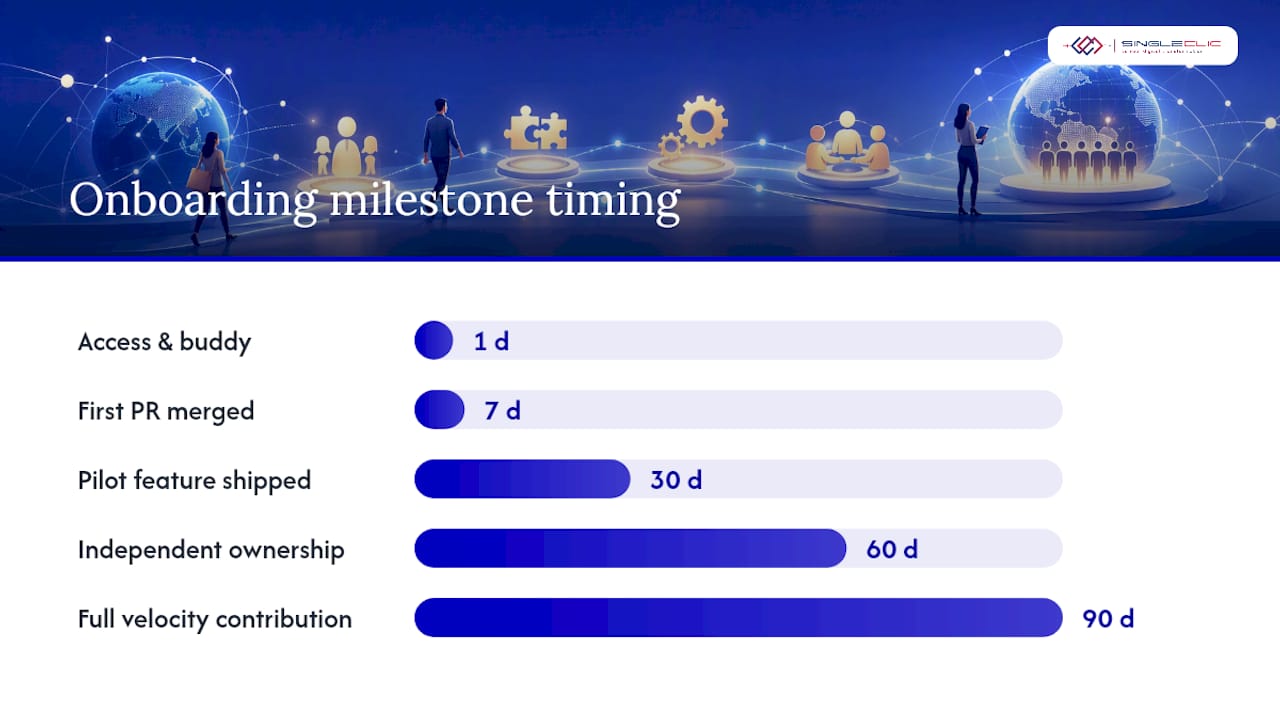
Before day one, preboarding should already be complete: repo access granted, VPN credentials issued, CI/CD pipeline access confirmed, and every tool login tested and working. Nothing kills early momentum faster than a new hire spending their first three days filing IT tickets instead of shipping code.
The buddy system carries the first week. A named onshore or senior offshore buddy owns the new hire’s questions for the first seven days, with a simple daily rhythm: a 15-minute morning check-in inside the overlap window, a midday async status update in the team channel, and a short end-of-day summary of what got done and what is blocked. By day seven, the new developer should have opened at least one real pull request against the pilot feature, even a small one.
| Milestone | Timeframe | What proves the model is working |
|---|---|---|
| Access and buddy assigned | Day 1 | All tooling live; first pairing session completed |
| First pull request merged | First week | Code review cycle completed without major rework |
| Pilot feature shipped | Day 30 | Feature in staging, acceptance criteria met |
| Independent ownership | Day 60 | Developer picks up tickets without buddy escalation |
| Full velocity contribution | Day 90 | Sprint output matches an equivalent onshore engineer |
A structured digital onboarding workflow can automate much of the preboarding checklist so nothing falls through when HR, IT, and the engineering lead are coordinating across time zones. The 30/60/90 framing itself, paired with a defined pilot feature, is consistently cited as the fastest way to prove an offshore engagement will hold up before you commit to scaling it.
Engineering standards that keep offshore code quality high
Trust in a distributed team comes from process, not proximity. You cannot look over someone’s shoulder across an eight-hour time difference, so the definition of done has to do that job instead. A solid ticket-level definition of done includes: unit tests written and passing, a pull request reviewed by at least one other engineer, a successful deploy to staging, and sign-off against the original acceptance criteria. No exceptions for “it’s a small change.”
Automated quality gates remove the need for manual policing. CI pipelines that run the full test suite on every pull request, linters that block merges on style violations, and a PR template that forces a description of what changed and why, all do the enforcement work automatically. Codifying these standards before scaling headcount is far cheaper than fixing accumulated technical debt after the team has doubled.
This is also where micromanagement habits quietly creep in, and it is worth naming directly:
- Reviewing every commit personally instead of trusting the CI gate to catch issues.
- Requiring daily status calls on top of async updates that already cover the same ground.
- Rewriting offshore-submitted code instead of leaving review comments and letting the engineer fix it.
Each of those habits signals a process gap, not a talent gap. Fix the gate, not the person.
Incident ownership across time zones needs its own rule. Assign on-call responsibility by time zone, not by seniority, so the person awake when an alert fires is the person who owns the response. Document the handoff explicitly: what was checked, what is still unknown, and what the next shift should pick up first.
Governance, security, and contracts before you grant access
Production access is not a milestone to celebrate lightly. It is a risk decision, and it needs controls in place before the first offshore engineer touches a live system.
Non-negotiable technical controls include:
- Role-based access control so each engineer only reaches the systems their work requires.
- Multi-factor authentication on every account with production or repo access.
- Regular secrets rotation, especially after any team member change.
- Audit logs on all access to sensitive systems, reviewed on a set schedule rather than only after an incident.
- An immediate offboarding procedure that revokes every credential within hours of a departure, not days.
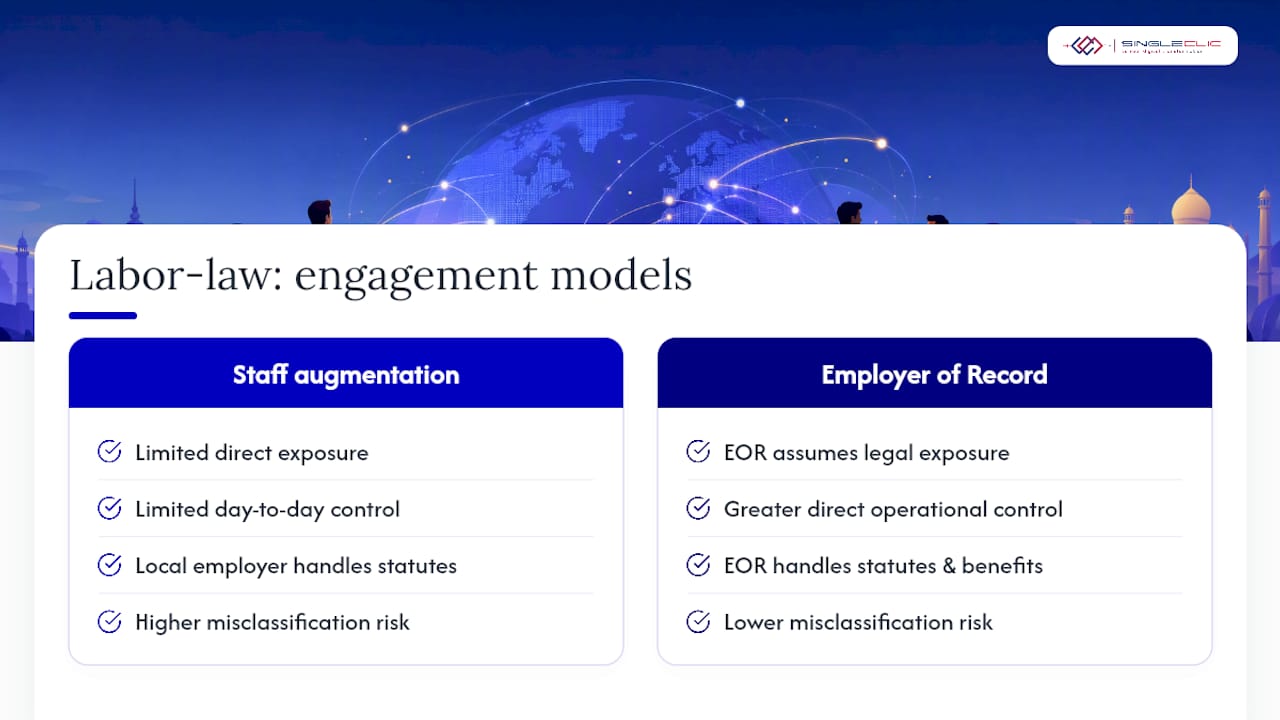
On the contract side, four items deserve legal review before signing anything: intellectual property assignment language that clearly states the company owns all work product, mutual NDAs, data residency terms for any regulated sector like healthcare, banking, or government, and a clear choice between engagement models. An Employer of Record (EOR) handles local employment compliance in the developer’s country, a staffing vendor supplies talent under the vendor’s own management, and staff augmentation places individual contractors directly under your management. Each carries different liability and control trade-offs, and the wrong choice for a regulated sector can create compliance exposure that surfaces months later.
Hand legal and operations a short checklist before the first release: confirmed IP assignment clause, signed NDA, documented data residency terms, chosen engagement model, and access controls tested end to end. Skipping this step to move faster almost always costs more time later than it saves now.
Metrics and KPIs that predict whether the model is working
Four categories of metrics tell you almost everything you need to know about an offshore engagement’s health, and none of them require exotic tooling.
| KPI category | Specific measures | What a bad trend signals |
|---|---|---|
| Delivery | Sprint velocity trend, cycle time per ticket | Overlap window too short, or requirements unclear |
| Quality | Defect density, percentage of PRs requiring rework | Definition of done not enforced consistently |
| Engagement | Employee Net Promoter Score (eNPS), voluntary attrition | Cultural friction or unclear career path |
| Communication | Blocker resolution time, SLA adherence rate | Communication charter not being followed |
A velocity trend that flattens for two sprints in a row usually means the overlap window is too thin for the complexity of current work. A rising defect density points straight back to the definition of done, specifically whether code review is actually catching issues before merge. A dropping eNPS score is the earliest warning sign of attrition, often months before anyone resigns. Rising blocker resolution time almost always means the communication charter has quietly stopped being followed.
Review velocity and blocker resolution metrics frequently, with other quality and engagement metrics at regular intervals. That cadence catches drift early enough to correct it with a conversation instead of a re-hire.
Hiring and vetting practices that predict remote performance
The best predictor of offshore success is not years of experience. It is how clearly someone writes and how well they own decisions without someone standing over them.
A written technical take-home exercise, reviewed for clarity of reasoning, not just correct output, reveals more about remote fit than a live whiteboard interview ever will. Follow it with a short pair-programming session and a code review exercise where the candidate reviews a flawed pull request. Watch how they phrase feedback: specific and constructive beats vague and polite every time. Set a standard testing bar for the exercise including unit tests, since a candidate who skips tests in an interview will skip them on the job.
Reference checks should target two things specifically: retention history at previous remote roles, and reliability during time-zone-overlap commitments. A candidate who consistently showed up for scheduled syncs at a previous employer, even inconvenient ones, is signaling exactly the discipline an offshore arrangement depends on. Written English fluency matters more than accent or verbal fluency here, since regions with strong English proficiency scores tend to produce engineers who write clearer specs and PR descriptions, which is the actual skill that keeps async collaboration from breaking down.
Common pitfalls and red flags when scaling an offshore team
Three anti-patterns account for most offshore failures, and all three are fixable within a month once you spot them.
- PM relay: every question routes through a single project manager instead of engineers talking directly. Fix it by giving the offshore tech lead direct access to the product owner.
- Separate sprints: onshore and offshore teams run different sprint calendars and “sync up” after the fact. Fix it by merging into one sprint board with one planning session inside the overlap window.
- Tool sprawl: multiple overlapping channels for the same purpose. Fix it by cutting to the minimal toolstack described earlier and enforcing it for thirty days straight.
When you spot one of these patterns, run a focused 30-day remediation sprint: name the specific behavior to change, assign one owner to enforce it, and measure the same KPIs above at the end of the window. If velocity and eNPS have not moved by day 30, the problem is likely structural, not behavioral, and it is time to reconsider the engagement model itself rather than tweaking the same one further.
Pro Tip: If you are still running PM relay after an initial adjustment period, stop tweaking the process and add a local offshore lead instead. That single hire fixes more coordination problems than another round of “communication training” ever will.
Add governance or a dedicated local lead when headcount reaches a moderate size, such as around five to seven people, or when blocker resolution time has been trending upward for two consecutive review cycles. Those are the two signals worth acting on immediately rather than waiting for a quarterly review.
How Singleclic helps regional leaders manage offshore developers
Running this playbook well requires infrastructure most in-house teams do not build until their third or fourth offshore hire, which is exactly the gap Singleclic’s managed offshoring services fill for organizations across the region.
- Managed offshore development center services that operationalize onboarding, HRBP support, and the buddy system from the first day of the engagement.
- Governance and security controls, including role-based access and audit logging, built into the engagement rather than added after a scare.
- Cortex, Singleclic’s Arabic-enabled, on-premise low-code platform, connects offshore-built applications to existing ERP, CRM, and legacy systems without months of custom integration work.
- Deep implementation experience with Microsoft Dynamics 365 and Odoo across construction, real estate, healthcare, banking, telecom, and government sectors in Saudi Arabia, the UAE, and Egypt.
- Delivery teams already structured around the pod model described above, with an established path to add a local lead as headcount scales.
For leaders in regulated sectors, on-premise deployment and data residency options remove one of the biggest blockers to giving an offshore team production access in the first place. The strategic case for an offshore development center covers how this scales beyond a single pilot team.
Time zone management beyond the overlap window
An overlap window solves the “when do we talk” problem. It does not solve the harder one: how work actually flows through a 24-hour cycle without stalling every time someone logs off. The teams that manage this well treat the time zone gap as a scheduling asset rather than an obstacle to route around.
The clearest technique is running automated checks during the offshore team’s daytime rather than the onshore team’s. Configure CI pipelines, linters, and PR gating to run while the offshore engineers are actively working, so any failure surfaces while they can still fix it, instead of sitting untouched until the next overlap window opens hours later. That single scheduling change often cuts a full day off the feedback loop on a failed build.
Structured async handoffs matter just as much as automated checks. At the end of each working day, whoever is finishing writes a short handoff note: what shipped, what is blocked, and what the next person should pick up first. This is different from a status update, because it is written specifically for someone about to start work, not someone reviewing what already happened.
Stagger deadlines around the time zone gap rather than against it. A ticket due “end of day” onshore time gives an offshore engineer almost no runway to ask a clarifying question before the deadline hits. Setting deadlines for the start of the next overlap window instead gives both sides a real chance to catch problems before they become late deliveries.
Finally, rotate who “owns” the awkward hours. If the same offshore engineer always ends up waiting alone for an onshore answer, that imbalance shows up in engagement scores before it shows up in a resignation letter.
Incentive structures and motivation strategies for offshore teams
Standard compensation bumps and end-of-year bonuses translate poorly across time zones and pay scales, mostly because they reward tenure rather than the specific things that make an offshore engagement succeed. Motivation strategies built for distributed teams need to reward visibility and ownership, not just output.
Recognition that travels well across a distributed team tends to be public and specific. Calling out a well-written pull request description in the team channel, or crediting the engineer who caught a bug before it hit staging, costs nothing and reinforces exactly the behaviors the definition of done is trying to enforce. Generic praise (“great job this sprint”) does not carry the same weight, because it does not tell anyone what to repeat.
Career pathing matters more for offshore retention than most compensation plans. An offshore developer who can see a defined path toward becoming the pod’s tech lead, or toward the local offshore lead role once headcount justifies it, has a concrete reason to stay past the first year. Without that visible path, the best engineers treat the role as a stepping stone rather than a destination.
Ownership itself is a motivator, not just a management structure. Letting an offshore engineer own a full feature from specification through production deployment, rather than a slice of a larger ticket someone else designed, consistently produces stronger engagement scores than financial incentives alone. Pair that ownership with the KPI reviews described earlier, and tie any bonus structure to the metrics the team can actually see and influence, like defect density or cycle time, rather than company-wide revenue figures they have no visibility into.
Legal compliance nuances beyond the basic contract
IP assignment and NDAs cover the contract basics, but two other compliance areas cause real problems if they get overlooked: local labor law and data protection.
Labor law exposure depends heavily on which engagement model you choose. Under staff augmentation, contractors typically remain employed by their own local entity or agency, which limits your direct labor law exposure but also limits your day-to-day control over things like working hours and leave policy. Under an Employer of Record arrangement, the EOR entity handles local statutory requirements, severance rules, and mandatory benefits in the developer’s country, which is often the safer path when you have no legal entity of your own in that jurisdiction. Misclassifying a long-term offshore contractor as a simple vendor relationship, when local law would treat them as a de facto employee, is a real risk in several outsourcing markets and worth a specific legal review before signing.
Data protection rules follow the data, not the contract. If offshore developers touch customer data covered by a regulation like the EU’s GDPR or a similar regional data protection law, that regulation’s rules on cross-border transfer and data residency apply regardless of where your company is headquartered. Regulated sectors, healthcare and banking especially, often require data residency guarantees that mean offshore developers work against masked or synthetic data in a test environment rather than live production data. Build that separation into the engagement from day one rather than retrofitting it after a compliance review flags it.
Neither of these areas has a universal answer that fits every jurisdiction, which is exactly why the contract checklist from the governance section belongs in front of legal counsel before the first release, not after.
Author perspective: three lessons from running offshore teams
The biggest misread I see from leaders new to offshore work is treating communication as a soft problem to solve later, once the “real” engineering work is underway. It is the opposite. Every technical failure I have traced back far enough turns out to be a communication failure that arrived earlier and went unaddressed. A missed acceptance criterion is a documentation gap. A blown deadline is usually an overlap window that was too thin for the complexity of the task assigned.
The second lesson is that ownership cannot be granted halfway. Teams that hand offshore engineers a feature and then route every decision back through an onshore lead are not actually delegating ownership. They are outsourcing typing. Real ownership means the offshore tech lead makes the call and lives with the consequences, same as anyone on your onshore team would.
A successful 90-day pilot looks unremarkable from the outside: a shipped feature, a flat or rising velocity trend, and an eNPS score that has not dropped. That is the whole test. If you want help operationalizing that pilot instead of building it from scratch, that is exactly the managed offshoring model worth a conversation.
— Tamer Badr
How Singleclic can support your offshore development model
If everything above sounds like the right approach but not something your team has the bandwidth to build alone, that gap is exactly what a managed offshore engagement is designed to close. Managed offshore engagements run the operational backbone, communication charters, onboarding buddies, governance controls, and pod structure, so your leadership team inherits a working model instead of building one from a blog post.
A regional delivery footprint across the UAE, Saudi Arabia, and Egypt maps directly onto the checklist covered here: managed offshore development centers with built-in HRBP support, role-based access governance ready before the first release, and Cortex as the integration layer connecting offshore-built applications to existing ERP and CRM systems. For organizations already running or planning a Microsoft Dynamics 365 environment, that integration path matters more than most vendors admit, and it’s worth understanding what Dynamics 365 actually connects before scaling an offshore team around it.
The realistic next step is a short pilot assessment: a scoped 90-day engagement with a defined pilot feature, the KPI set from this article, and a clear decision point at the end about whether to scale. Reach out to a managed offshoring provider to scope that pilot and get a realistic timeline for your specific stack and sector.
Sources
- Managing Offshore Teams Effectively: Best Practices | Newxel
- Offshore team communication: 2026 playbook | Remoteria
- How to manage an offshore development team | Capital Numbers