Executives across Saudi Arabia and UAE lose 30% of productivity to fragmented workflows and disconnected systems that slow decisions and erode collaboration. Workflow management solves this by orchestrating tasks, automating repetitive processes, and creating seamless coordination between teams. This guide explains what workflow management is, how automation delivers measurable gains, and which technologies drive real results in the Middle East market.
Table of Contents
- Understanding Workflow Management: Definition And Core Concepts
- The Business Impact: Benefits Of Workflow Automation And Process Optimization
- Technological Foundations: Erp, Crm, Rpa, And Low-Code Platforms In Workflow Management
- Common Misconceptions And Challenges In Workflow Management
- Framework For Selecting And Implementing Workflow Management Solutions
- Case Studies And Real-World Success Metrics In Saudi Arabia And Uae
- Begin Your Workflow Optimization Journey With Singleclic
Key takeaways
| Point | Details |
|---|---|
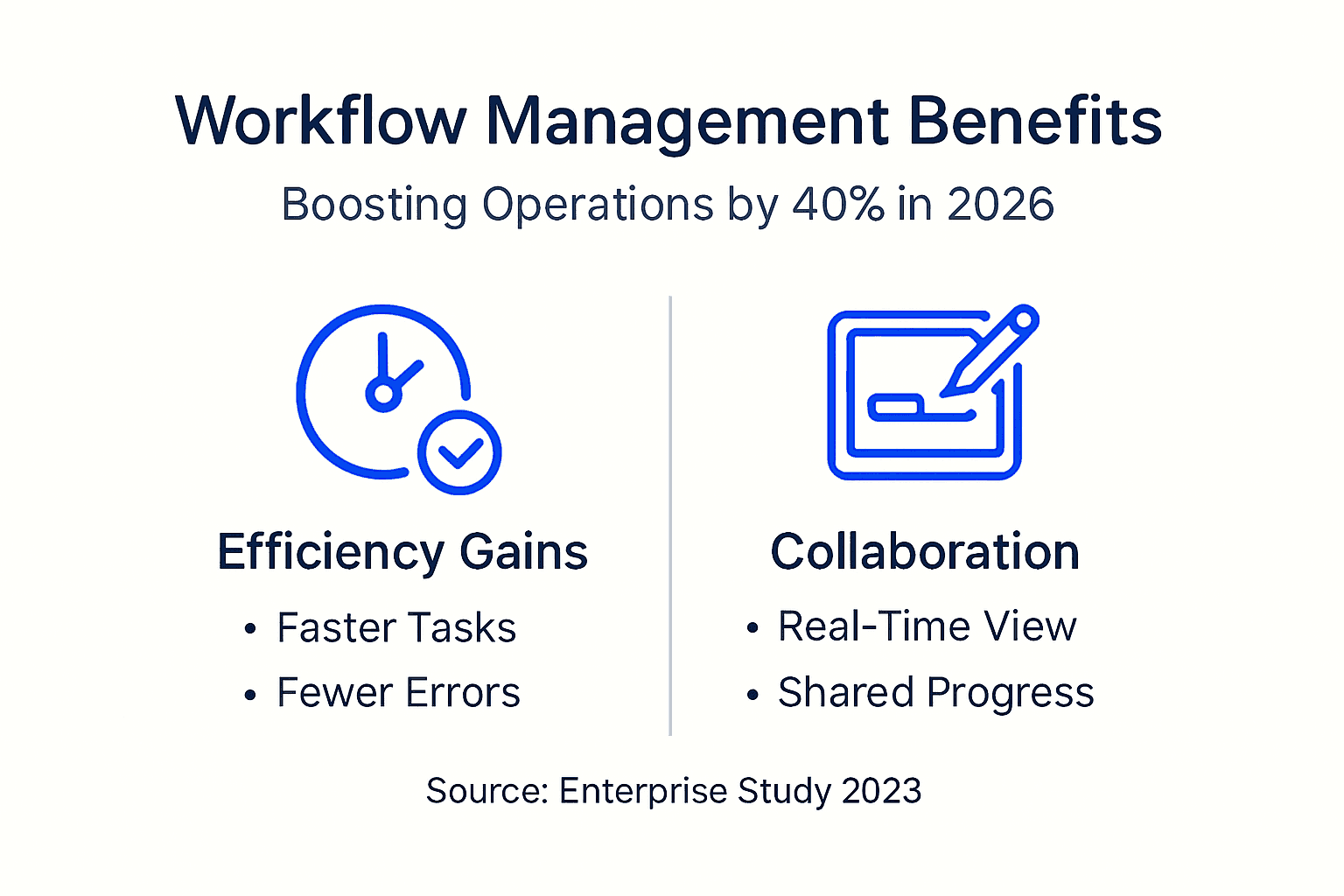
| Efficiency gains | Workflow automation increases operational efficiency by up to 40% through task orchestration and error reduction. |
| Technology enablers | ERP, CRM, RPA, and low-code platforms provide the foundation for scalable workflow management across enterprises. |
| Regional advantages | Arabic-enabled platforms with local compliance support ensure faster adoption and sustained ROI in KSA and UAE. |
| Implementation success | Organizations achieve 150–400% ROI within 12 to 18 months by aligning workflows with business goals and training teams effectively. |
| Proven results | Healthcare, banking, and telecom sectors report 20–25% cycle time reductions and improved cross-functional collaboration. |
Understanding workflow management: definition and core concepts
Workflow management is the design, execution, and continuous optimization of business processes through technology. A workflow defines the sequence of tasks, decision points, and handoffs needed to complete an objective. Workflow management adds orchestration, automation, and real-time monitoring to ensure every step happens correctly and on time.
The difference between workflow and workflow management is simple. A workflow is the process itself: invoice approval, customer onboarding, or equipment maintenance. Workflow management is the system that coordinates people, data, and actions across that process, flagging delays and routing tasks automatically.
Every workflow has four primary elements. Tasks represent individual actions or decisions. Triggers initiate workflows based on events like form submissions or schedule milestones. Roles assign responsibilities to specific users or teams. Processes connect tasks into logical sequences with conditional logic and parallel paths.
Workflow management systems orchestrate these elements in five stages. Design maps the current process and identifies bottlenecks. Automation converts manual handoffs into system-driven triggers. Monitoring tracks performance against KPIs like cycle time and error rates. Analysis compares planned versus actual execution to find gaps. Optimization refines workflows based on data insights and business changes.
Consider a typical enterprise procurement workflow. An employee submits a purchase request through an ERP portal. The system routes the request to a manager for budget approval. Once approved, procurement receives the order and selects a vendor. Finance processes payment after delivery confirmation. Without workflow management, each handoff requires emails, spreadsheets, and manual follow-ups. With digital transformation tools, the entire process runs automatically with visibility at every stage.
Pro Tip: Map your most time-consuming workflows first. Document every step, participant, and decision point. This baseline reveals where automation delivers the biggest efficiency gains and helps prioritize your implementation roadmap.
The business impact: benefits of workflow automation and process optimization
Workflow automation transforms operations by eliminating manual handoffs, reducing errors, and accelerating cycle times. Organizations in Saudi Arabia and UAE report measurable improvements across efficiency, collaboration, compliance, and employee satisfaction within months of implementation.
Automation reduces process cycle times by up to 25% by eliminating waiting periods between tasks. Approvals that once took days complete in hours. Document routing happens instantly. System-driven triggers replace email reminders and manual status checks. Teams spend less time on administrative coordination and more time on strategic work.
Cross-functional collaboration improves by 20% when workflows provide real-time visibility. Departments see exactly where requests sit in the pipeline. Bottlenecks become visible immediately, allowing managers to reallocate resources or adjust priorities. Shared dashboards replace status meetings. Everyone knows what needs attention without asking.

Error rates drop significantly because automated workflows enforce business rules and validation checks. Invoice mismatches trigger alerts before payment. Required approvals cannot be bypassed. Data entry mistakes are caught at the source. This consistency is critical for regulatory compliance in banking, healthcare, and government sectors where documentation gaps create legal and financial risk.
Employee satisfaction rises as automation removes repetitive, low-value tasks. Staff focus on problem-solving and customer interaction instead of data entry and status updates. Onboarding becomes smoother when new hires follow standardized workflows with embedded training. Turnover decreases when people feel their time is used effectively.
Key workflow automation benefits include:
- Faster decision cycles with automated routing and escalation
- Lower operational costs through reduced manual effort
- Better audit trails with complete process documentation
- Improved customer experience via consistent service delivery
- Scalability without proportional headcount increases
Pro Tip: Start automating repetitive tasks first to build momentum and demonstrate ROI quickly. Choose workflows with high volume and clear rules like invoice processing or leave requests. Early wins create organizational support for broader automation initiatives.
Technological foundations: ERP, CRM, RPA, and low-code platforms in workflow management
Four technology categories enable effective workflow management at enterprise scale. Each addresses different process requirements, and modern implementations often combine multiple platforms for comprehensive automation across departments and functions.
ERP systems unify data and processes across finance, supply chain, manufacturing, and HR. Odoo and Microsoft Dynamics 365 provide workflow engines that route approvals, trigger notifications, and enforce business logic across modules. ERPs excel at structured, transactional workflows where consistency and data integrity are critical.
CRM systems automate customer-related workflows from lead capture through post-sale support. Sales pipelines move prospects through qualification stages automatically. Service tickets route to appropriate teams based on issue type and priority. Marketing automation executes multi-channel campaigns triggered by customer behavior. CRMs optimize workflows focused on revenue generation and customer retention.
Robotic Process Automation (RPA) handles repetitive, rule-based tasks that span multiple systems. UiPath and similar platforms create software bots that mimic human actions: logging into applications, copying data between screens, generating reports, and updating records. RPA and AI-enabled workflow automation delivers fast ROI for processes with high volume and low variability.
Low-code platforms allow rapid workflow customization without extensive coding. Cortex and similar tools provide visual designers where business analysts build process flows, define approval chains, and integrate external systems through connectors. Arabic-enabled interfaces and on-premise deployment options make low-code platforms particularly valuable for MENA enterprises with language and data sovereignty requirements.
| Technology | Key Features | Best Use Cases | Limitations |
|---|---|---|---|
| ERP Systems | Unified data model, cross-module workflows, strong compliance controls | Financial processes, procurement, inventory management | Complex implementation, longer deployment cycles |
| CRM Platforms | Customer data integration, sales automation, service ticketing | Lead management, customer onboarding, support workflows | Limited reach beyond customer-facing processes |
| RPA Tools | System integration without APIs, fast deployment, scalable execution | Data migration, report generation, legacy system automation | Brittle when UI changes, maintenance overhead |
| Low-Code Platforms | Rapid development, visual design, real-time optimization | Custom workflows, departmental automation, process innovation | May require integration middleware for complex systems |
The most effective workflow strategies combine these technologies. An insurance company might use an ERP for policy administration workflows, CRM for claims processing, RPA for data extraction from scanned documents, and a low-code platform for underwriting approval chains that change frequently.
Pro Tip: Choose a platform with strong integration capabilities to future-proof your workflows. APIs, webhooks, and pre-built connectors ensure you can add new systems and data sources as your business evolves without rebuilding your automation foundation.
Common misconceptions and challenges in workflow management
Several persistent myths slow workflow adoption in Saudi Arabia and UAE enterprises. Correcting these misconceptions and preparing for regional implementation challenges improves project success rates and stakeholder buy-in.
Myth: Automation replaces jobs and reduces headcount. Reality: Automation eliminates repetitive tasks, allowing employees to focus on higher-value work that requires judgment and creativity. Organizations report improved employee satisfaction and reduced turnover when staff transition from data entry to problem-solving roles. Job displacement is rare in Middle East implementations where growth creates demand for skilled talent.
Myth: Workflow management is prohibitively expensive for mid-sized organizations. Reality: Cloud-based and low-code platforms have dramatically reduced entry costs. Many implementations achieve 150–400% ROI within 12 to 18 months through efficiency gains and error reduction. The real cost is maintaining manual processes that waste staff time and create compliance risk.
Myth: Once implemented, workflow systems run themselves without ongoing management. Reality: Effective workflow management requires continuous monitoring, optimization, and adaptation to changing business needs. Processes that worked six months ago may have bottlenecks as transaction volumes grow or regulations change. Successful organizations assign process owners and review performance metrics quarterly.
Beyond misconceptions, cultural and technical challenges affect adoption in the Middle East. Language support matters. Workflows with Arabic interfaces improve user adoption by 35% compared to English-only systems. Compliance with local data residency and privacy regulations requires on-premise or regional cloud deployment options. Addressing workflow challenges in MENA demands platforms built for regional requirements.
Resistance to change slows implementations when stakeholders fear losing control or job security. Effective change management includes early involvement of end users in design, clear communication about automation benefits, and training programs that build confidence. Pilot projects demonstrate value before enterprise rollout.
Common implementation pitfalls and solutions:
- Over-automation without process simplification creates complex workflows that are hard to maintain. Simplify first, then automate.
- Lack of executive sponsorship leads to resource constraints and competing priorities. Secure C-level commitment before starting.
- Poor integration planning causes data silos and manual handoffs between systems. Map integration requirements during design.
- Inadequate training results in workarounds and system avoidance. Provide role-based training and ongoing support.
- Missing KPIs prevent measurement of success and continuous improvement. Define metrics before implementation.
Pro Tip: Avoid over-automation without process simplification to reduce complexity and resistance. Eliminate unnecessary approval steps and consolidate redundant tasks before building automated workflows. Simpler processes are faster to implement and easier to optimize.
Framework for selecting and implementing workflow management solutions
Executives need a structured approach for choosing and deploying workflow technology that aligns with business objectives, scales across departments, and delivers measurable ROI. This framework guides decision-making from assessment through continuous optimization.
-
Assess current state and identify workflow opportunities. Map critical business processes across departments. Measure baseline performance: cycle times, error rates, resource costs, and customer satisfaction. Identify processes with high volume, clear rules, and significant manual effort. These become automation priorities.
-
Define clear objectives and success metrics. Establish specific, measurable goals for each workflow: reduce invoice processing time by 50%, cut customer onboarding from 7 days to 2 days, or eliminate 80% of data entry errors. Define KPIs that align with corporate strategy such as operational efficiency, compliance adherence, or customer experience scores.
-
Evaluate technology options against selection criteria. Compare platforms based on integration capabilities with existing systems, Arabic language and local compliance support, scalability to handle growth, ease of adoption for non-technical users, vendor stability and regional presence, and total cost of ownership including licensing, implementation, and maintenance.
-
Engage stakeholders across departments early and continuously. Include process owners, end users, IT teams, and compliance officers in solution selection and design. Their input improves requirements definition, reduces resistance, and ensures workflows reflect actual business needs rather than theoretical processes.
-
Start with pilot projects in controlled environments. Choose one or two workflows with clear ROI potential and limited complexity. Deploy, measure results against KPIs, and refine based on user feedback. Successful pilots build organizational confidence and provide templates for broader rollout.
-
Implement incrementally across departments and processes. Avoid big bang deployments that overwhelm users and strain support resources. Phase implementation by department, geography, or process complexity. Each phase should deliver measurable value before moving to the next.
-
Establish governance and continuous optimization practices. Assign process owners responsible for monitoring performance, handling exceptions, and proposing improvements. Review workflow metrics quarterly. Update processes as business requirements, regulations, or technology capabilities evolve. Workflow implementation best practices emphasize this iterative approach.
Selection criteria checklist:
- Does the platform support Arabic language for end users and administrators?
- Can it deploy on-premise or in regional data centers to meet compliance requirements?
- Does it integrate with our existing ERP, CRM, and legacy systems?
- Can business users modify workflows without coding when requirements change?
- Does the vendor provide local support and training in our time zones?
- What is the average time to value for similar organizations in our industry?
Pro Tip: Involve stakeholders across departments to ensure buy-in. Finance, operations, IT, and compliance teams all have different requirements and concerns. Early involvement converts potential blockers into advocates who champion adoption within their teams.
Case studies and real-world success metrics in Saudi Arabia and UAE
Regional enterprises across healthcare, banking, and telecom sectors have achieved quantifiable results from workflow management implementations. These examples demonstrate ROI timelines, efficiency improvements, and lessons applicable to organizations considering similar initiatives.
| Sector | Workflow Focus | Efficiency Gain | ROI Timeline | Employee Impact |
|---|---|---|---|---|
| Healthcare | Patient registration and appointment scheduling | 35% reduction in wait times, 28% increase in daily patient capacity | 14 months | 40% decrease in administrative workload |
| Banking | Loan origination and compliance documentation | 42% faster approval cycles, 65% fewer documentation errors | 11 months | Staff redeployed to customer advisory roles |
| Telecom | Customer service ticket routing and resolution | 30% improvement in first-call resolution, 22% reduction in average handle time | 9 months | 25% increase in employee satisfaction scores |
| Government | Permit and license processing | 50% reduction in processing time, 80% decrease in missing documents | 16 months | Citizens report 4.2/5 satisfaction vs 2.8/5 previously |
A major UAE healthcare provider automated patient intake workflows including registration, insurance verification, and appointment scheduling. Previously, staff manually entered data from paper forms, called insurance companies for pre-authorization, and coordinated schedules across multiple departments. The new workflow captures data electronically, verifies coverage automatically through API integrations, and assigns appointments based on provider availability and patient preferences. Wait times dropped by 35%, and the facility serves 28% more patients daily with the same staff.
A Saudi banking group implemented end-to-end loan origination workflows that route applications through credit checks, document verification, risk assessment, and final approval automatically. Manual processes required 7 to 10 days as files moved between departments via email and shared drives. Automated workflows reduced approval cycles to 4 days while improving documentation accuracy by 65%. Compliance teams gained complete audit trails showing exactly when each step occurred and who made each decision.
Regional workflow implementations address specific compliance and operational requirements:
- Arabic language support for user interfaces and system-generated communications improves adoption rates by 35% compared to English-only systems.
- On-premise deployment options satisfy data sovereignty requirements in banking and government sectors where cloud hosting creates regulatory barriers.
- Integration with local payment gateways, national ID verification systems, and ministry reporting portals streamlines workflows that span organizational boundaries.
- Configurable business rules accommodate differences between Saudi, Emirati, and Egyptian regulatory requirements within a single platform deployment.
These digital transformation success stories share common patterns. Organizations start with high-volume, well-defined processes. They involve end users in design and testing. They measure results against clear KPIs. They optimize workflows continuously based on performance data and changing business needs.
Begin your workflow optimization journey with Singleclic
Transforming fragmented processes into optimized workflows requires technology expertise, regional knowledge, and proven implementation methodologies. Singleclic brings 10 years of digital transformation experience across Saudi Arabia, UAE, and Egypt to help executives achieve measurable operational improvements.
Our Cortex low-code platform delivers Arabic-enabled workflow automation with on-premise deployment options that meet banking and government compliance requirements. Design, build, and modify complex business processes without coding. Support unlimited users. Make runtime changes without system downtime. Integrate with existing ERP, CRM, and legacy systems through pre-built connectors and APIs.
We combine workflow technology with deep industry expertise in healthcare, banking, telecom, construction, and real estate. Our 70+ consultants and engineers understand the operational challenges, regulatory requirements, and cultural factors that affect successful implementations in the Middle East. We deliver scalable solutions backed by 24/7 support and agile methodologies that adapt to your timeline and budget.
Start with our digital transformation roadmap for executives to assess your current state and identify automation priorities. Explore our business process automation guide for frameworks that align technology investments with business objectives. Learn how low-code platform solutions accelerate development and reduce dependency on scarce technical resources.
Frequently asked questions
How does workflow management differ from project management?
Workflow management optimizes repetitive, ongoing processes like invoice approvals or customer onboarding that occur hundreds or thousands of times. Project management coordinates unique, time-bound initiatives with distinct start and end dates like building a factory or launching a product. Workflows focus on efficiency and consistency. Projects focus on scope, schedule, and deliverables. Many organizations use both: project management to implement new capabilities and workflow management to operate them at scale.
What industries in Saudi Arabia and UAE benefit most from workflow management?
Healthcare, banking, telecom, government, and construction show the highest ROI from workflow automation. These sectors handle high transaction volumes, strict compliance requirements, and complex approval chains that create bottlenecks in manual processes. Healthcare optimizes patient intake and clinical protocols. Banks automate loan origination and compliance reporting. Telecom improves service provisioning and fault resolution. Government streamlines permit processing and citizen services. Construction coordinates procurement, quality control, and safety inspections.
How long does it typically take to see ROI after implementing workflow automation?
Most organizations achieve positive ROI within 9 to 18 months depending on process complexity and implementation scope. Simple, high-volume workflows like expense approvals or leave requests deliver value in weeks. Complex workflows spanning multiple departments and legacy systems take longer. Cloud-based and low-code platforms accelerate time to value by reducing technical barriers. Phased implementations deliver incremental benefits as each workflow goes live rather than waiting for complete enterprise rollout.
What are the best practices for ensuring team adoption?
Involve end users early in design and testing so workflows reflect actual work patterns. Provide role-based training that shows specific benefits for each user group. Start with processes that solve visible pain points to build credibility. Celebrate early wins and share success metrics widely. Assign workflow champions in each department to provide peer support. Make feedback easy and act on suggestions quickly. Avoid forcing adoption before systems are stable and users feel confident. Adoption improves when people see workflows making their jobs easier rather than adding administrative burden.
Can workflow management platforms handle Arabic language and local regulations?
Modern platforms designed for MENA markets provide full Arabic interfaces, right-to-left text support, and Arabic date formats. Cortex and similar low-code tools allow organizations to configure workflows that enforce Saudi, Emirati, or Egyptian regulatory requirements without custom coding. On-premise deployment options satisfy data sovereignty rules in banking and government. Integration capabilities connect to local payment gateways, national ID systems, and ministry reporting portals. Vendors with regional presence understand compliance requirements and provide support in Arabic and English during local business hours.
Recommended
- Enterprise Workflow Optimization Process for Maximum ROI
- Improving Business Processes with Automated Workflows | Singleclic
- Workflow Automation: Transforming Enterprise Efficiency
- Unlocking Efficiency: How Business Process Automation Reduces Costs and Boosts Productivity | Singleclic
- Cleaning Business Automation in 2026: What’s New in ConvertLabs (Booking, Payments, iCal + AI)
- Master Portable Seating Workflow for Outdoor Comfort – Sitpack