TL;DR:
- A structured cost estimation workflow, separating QTO, MTO, and cost layers, is essential for reliable project budgeting and control. Modern digital tools and governance practices enhance accuracy, auditability, and defense of estimates, especially in complex markets like Saudi Arabia and UAE. Applying EVM metrics, formal reserve governance, and automation helps maintain financial oversight and project viability amidst regional variability and project challenges.
A cost estimation workflow is a structured sequence of steps that produces reliable, defensible approximations of project costs to support budgeting, financial control, and funding decisions. In construction and project-based industries, the difference between a winning bid and a costly overrun often comes down to how well your estimation process is designed. PMBOK 8 defines Estimate Costs as developing an approximation of the monetary resources needed to complete project work, performed periodically as scope evolves. Project managers and financial analysts in Saudi Arabia, UAE, and Egypt are operating in some of the most capital-intensive construction markets in the world, where a weak cost estimation process is not just an inconvenience. It is a direct threat to project viability. Modern tools like Bluebeam, low-code platforms like Singleclic’s Cortex, and frameworks like PMBOK 8 have made it possible to build workflows that are both repeatable and auditable.
What does a cost estimation workflow actually include?
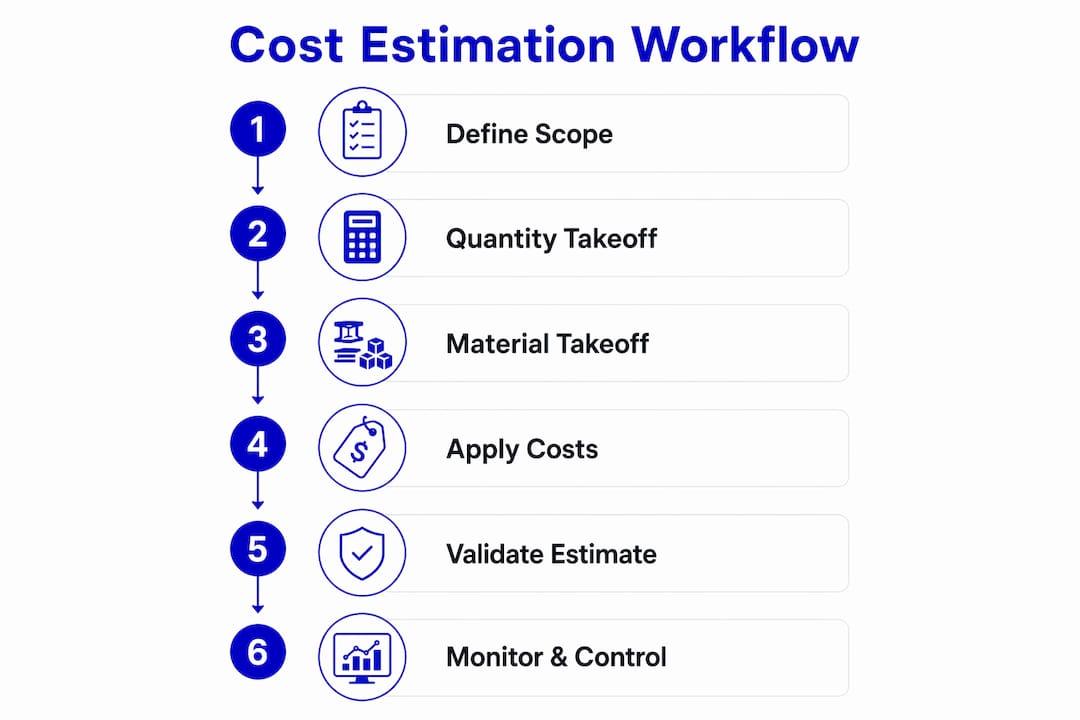
The core of any effective cost estimation workflow consists of four distinct, sequential layers: scope definition, quantity takeoff (QTO), material takeoff (MTO), and cost application. Each layer must remain separate. Mixing QTO and MTO data in the same working file is one of the most common errors in construction estimating, and it makes audits nearly impossible. When takeoff quantities are wrong, no amount of pricing adjustment can fix the final estimate.
Here is how a well-structured cost estimation process unfolds:
- Scope definition and document review. Before any numbers are entered, the estimator reviews drawings, specifications, and contracts to define what is and is not included. Ambiguity at this stage multiplies into large cost variances later.
- Quantity takeoff (QTO). The estimator measures and counts every physical item of work from the drawings. This step produces raw quantities only. No pricing happens here.
- Material takeoff (MTO). The MTO translates QTO quantities into specific material types, grades, and procurement units. This is where specifications drive decisions.
- Cost application. Unit rates, labor costs, equipment costs, and subcontractor quotes are applied to the MTO. This is the first point where a dollar figure appears.
- Indirect costs and general conditions. Indirect costs often determine profitability more than direct costs alone. Site overhead, insurance, bonds, and project management fees must be calculated separately and added with discipline.
- Reserve and contingency allocation. PMBOK 8 recommends using quantitative methods such as Monte Carlo simulation or parametric percentages to set contingency reserves consistent with the project’s risk profile. Management reserves are held separately and require distinct approval authority.
- Benchmarking and proposal generation. The completed estimate is compared against historical data and industry benchmarks before being packaged into a formal proposal or budget submission.
Two estimating techniques from PMBOK 8 are worth applying at different phases. Bottom-up estimating builds the total from individual work-package costs and is the most accurate method when scope is fully defined. Three-point estimating uses optimistic, most likely, and pessimistic values to produce a weighted average, which is better suited to early-phase estimates where uncertainty is high. Both techniques require a documented basis of estimate that explains assumptions, exclusions, and the confidence level of the figures.
Pro Tip: Keep your QTO, MTO, and cost files in separate tabs or documents with clear version labels. This single habit reduces review time significantly and makes defending your estimate in front of a client or auditor far easier.
How do digital tools and automation improve cost estimation?
Digital tools have changed the speed and accuracy of the cost estimation process more than any other single factor in the past decade. Bluebeam, for example, allows estimators to perform PDF-based takeoffs with automated measurement tools, then export directly to Excel-integrated pricing sheets. This eliminates manual transcription errors and creates a traceable audit trail from drawing to final number.

The role of AI is growing but requires careful placement within the workflow. Generative AI frameworks reduce estimator burden most effectively in preliminary conceptual estimates and in the refined estimation phase. They are less reliable for detailed cost application, where local market rates, subcontractor relationships, and project-specific conditions require human judgment. The key insight here is that automation is most effective when matched to the workflow stages where repetitive, data-heavy tasks cluster.
Low-code platforms offer a different kind of value. Rather than replacing estimators, they automate the workflow around the estimator. In Saudi Arabia and UAE, where construction programs involve multiple stakeholders, approval layers, and bilingual documentation requirements, a platform like Singleclic’s Cortex can automate estimate routing, approval notifications, version control, and data handoffs between estimating and ERP systems. Cortex supports full Arabic UI/UX and on-premise deployment, which matters for government and semi-government construction clients in KSA and UAE who require data sovereignty.
Key considerations when selecting digital tools for your estimating workflow:
- Project size and complexity. A small fit-out project does not need the same toolset as a multi-billion-dirham infrastructure program.
- Integration with ERP. Tools that cannot push data into Microsoft Dynamics 365 or Odoo create manual reconciliation work that defeats the purpose of automation.
- Version control capability. Change management in automated workflows is a documented risk. Any tool you adopt must handle estimate revisions with a clear audit trail.
- Team adoption. The best tool is the one your team will actually use consistently. Overly complex platforms increase error rates during transition periods.
Pro Tip: Before automating any part of your estimating process, map your current workflow on paper first. Identify the three steps that consume the most time or produce the most errors. Automate those first. Automating a broken process just produces wrong answers faster.
You can also explore workflow optimization approaches that apply beyond estimating to the broader project financial management cycle.
How to monitor and control your cost estimation workflow
Producing an estimate is only half the job. The other half is tracking whether that estimate holds up against actual project performance. Earned value management (EVM) is the standard framework for this, and EVM metrics including PV, EV, AC, and CPI provide the data points that connect your original estimate to real-time financial reality.
Here is what each metric tells you in practice:
- Planned Value (PV): The budgeted cost of work scheduled at a given point in time. This is your baseline.
- Earned Value (EV): The budgeted cost of work actually completed. If EV is below PV, you are behind schedule on deliverables.
- Actual Cost (AC): What you have actually spent. Comparing AC to EV gives you the Cost Performance Index (CPI).
- Cost Performance Index (CPI): EV divided by AC. A CPI below 1.0 means you are spending more than planned per unit of work completed.
- Estimate at Completion (EAC): A forecast of total project cost based on current performance trends.
| EVM metric | What it signals | Corrective action |
|---|---|---|
| CPI below 0.9 | Cost overrun trend | Review scope, renegotiate subcontracts, reduce indirect costs |
| EV significantly below PV | Schedule slippage affecting cost | Accelerate critical path activities or revise baseline |
| AC exceeding budget by phase | Estimate accuracy issue | Audit QTO/MTO layers for errors or scope creep |
| EAC trending above budget | Project-level financial risk | Escalate to management reserve governance process |
Reserve governance deserves specific attention. Contingency reserves must have documented approval paths that are distinct from management reserves. When both types of reserve are drawn from the same pool without controls, project financial reports become unreliable and cost overruns are often discovered too late to correct. The financial management plan should name who can authorize contingency drawdowns, what documentation is required, and at what threshold management reserve access is triggered.
Pro Tip: Run a monthly CPI review against your time-phased cost baseline. If CPI drops below 0.85 for two consecutive reporting periods, treat it as a formal trigger to re-estimate the remaining work rather than assuming performance will recover on its own.
Common challenges in cost estimation workflows and how to fix them
Even well-designed workflows break down under real project conditions. The most frequent problems in construction cost estimation are not technical. They are process and governance failures.
- Inconsistent quantity formats. When different estimators use different units of measure for the same work items, consolidating bids becomes a manual, error-prone exercise. Standardize your quantity format library before any estimate begins.
- Underused historical data. Most construction firms have years of completed project data sitting in spreadsheets or ERP systems that never gets used to benchmark new estimates. Building a structured cost database from past projects is one of the highest-return investments a project controls team can make.
- Manual bid leveling. Comparing subcontractor bids line by line in a spreadsheet is slow and introduces comparison errors. Digital bid leveling tools reduce this burden significantly.
- Blended QTO and MTO layers. As noted earlier, separating QTO, MTO, and cost layers in working files simplifies review and error isolation. Blending them is a shortcut that creates long-term audit problems.
- Version control failures. In Saudi Arabia and UAE construction programs, estimates go through multiple revision cycles as design develops. Without a formal version control protocol, teams frequently price the wrong drawing revision, which can result in significant bid errors.
- Optimism bias in early estimates. Early-phase estimates in fast-moving markets like Riyadh and Dubai are often under-scoped to win approval. When detailed design reveals the true scope, the gap between the approved budget and the real cost creates project-level financial stress. Three-point estimating and explicit contingency reserves are the structural fix for this problem.
Regional factors also matter. In KSA and UAE, material escalation clauses, import duties, and labor mobilization costs for expatriate workforces add layers of complexity that standard estimating templates from Western markets do not account for. Your cost calculation methods must include local market intelligence, not just published rate books.
For a practical framework on selecting the right contractor software to support these workflows, the contractor software selection checklist from Ample Express covers the key evaluation criteria for 2026.
Key takeaways
A structured cost estimation workflow that separates QTO, MTO, and cost layers, applies EVM controls, and governs reserves formally is the foundation of reliable project financial management in construction.
| Point | Details |
|---|---|
| Separate workflow layers | Keep QTO, MTO, and cost application in distinct files to protect auditability and simplify error correction. |
| Apply reserve governance | Document approval authorities for contingency and management reserves separately to prevent informal drawdowns. |
| Use EVM metrics consistently | Track CPI and EAC monthly to catch cost overruns early enough to take corrective action. |
| Match automation to burden clusters | Automate the steps that consume the most time or produce the most errors, not the entire workflow at once. |
| Account for regional complexity | Estimates in Saudi Arabia and UAE must include local escalation, duties, and labor mobilization costs that generic templates miss. |
My honest take on cost estimation in the MENA construction market
I have worked with project controls teams across KSA, UAE, and Egypt for over a decade, and the pattern I see most consistently is this: organizations invest heavily in estimating software but underinvest in the governance structures that make estimates defensible. A team using Bluebeam with a weak approval workflow will still produce estimates that get challenged, revised informally, and ultimately abandoned when the project hits trouble.
The regional market adds specific pressure. In Saudi Arabia, Vision 2030 programs are moving at a pace that compresses pre-contract estimating timelines significantly. In UAE, the sheer volume of concurrent mega-projects means subcontractor pricing is volatile and historical benchmarks go stale quickly. In both markets, I have seen firms win contracts on estimates that were technically accurate but financially undefendable because the reserve governance was not formalized.
The combination that actually works is structured workflow plus low-code automation plus disciplined reserve governance. When you automate the routing and approval of estimates through a platform like Cortex, you get a timestamped, auditable record of every revision and every approval. That record is what protects you when a client disputes a change order six months into construction.
Automation is not a replacement for estimating expertise. It is the infrastructure that lets your experts focus on judgment calls instead of administrative tasks. The firms that understand this distinction are the ones producing estimates that hold up under scrutiny.
— Tamer
How Singleclic helps you build a better estimation workflow
Singleclic works with construction and project-based organizations across Saudi Arabia, UAE, and Egypt to build estimation and financial management workflows that are both automated and auditable. Through Cortex, our Arabic-enabled low-code platform, you can design custom estimate routing, approval, and version control workflows without writing a single line of code. Cortex integrates directly with Odoo and Microsoft Dynamics 365, so your cost data flows from estimate to budget to ERP without manual re-entry. If you are evaluating whether your organization is ready to formalize its ERP readiness for cost management, Singleclic’s assessment framework gives you a clear starting point. You can also explore business process automation approaches that apply directly to the estimating and financial planning cycle.
FAQ
What is a cost estimation workflow?
A cost estimation workflow is a structured sequence of steps, from scope definition through quantity takeoff, cost application, and reserve allocation, that produces a defensible project cost approximation. PMBOK 8 defines this process as Estimate Costs, performed periodically as project scope evolves.
How do QTO and MTO differ in construction estimating?
Quantity takeoff (QTO) measures raw physical quantities from drawings, while material takeoff (MTO) translates those quantities into specific material types and procurement units. Keeping them in separate files protects auditability and makes error correction faster.
What EVM metrics should project managers track?
The four core metrics are Planned Value (PV), Earned Value (EV), Actual Cost (AC), and Cost Performance Index (CPI). A CPI below 1.0 signals that the project is spending more than planned per unit of completed work and requires corrective action.
How does AI fit into a cost estimation process?
Generative AI reduces estimator burden most effectively in conceptual and refined estimation phases. It requires structured version control to avoid rework, and human judgment remains necessary for detailed cost application where local market conditions drive accuracy.
Why do construction estimates in Saudi Arabia and UAE need special treatment?
Estimates in KSA and UAE must account for material escalation clauses, import duties, expatriate labor mobilization costs, and volatile subcontractor pricing driven by concurrent mega-project demand. Standard Western estimating templates do not capture these variables without local calibration.