Managing complex processes in healthcare and banking across Saudi Arabia and the UAE demands fast, reliable decisions to keep organizations agile and efficient. Workflow automation stands out by systematically coordinating tasks with technology, reducing manual effort while improving productivity and accuracy. For CTOs and CIOs aiming to lead digital transformation, this article will clarify core principles of workflow automation and outline solution types that enable sustained operational improvement at scale.
Table of Contents
- Defining Workflow Automation and Core Principles
- Types of Workflow Automation Solutions
- How Workflow Automation Works in Practice
- Key Benefits for Healthcare and Banking
- Risks, Security, and Implementation Challenges
Key Takeaways
| Point | Details |
|---|---|
| Workflow Automation is Vital | Workflow automation enhances organizational efficiency by streamlining complex business processes and reducing manual tasks. |
| Embrace Low-Code Platforms | Utilizing low-code platforms allows organizations to design automation solutions without extensive programming knowledge, enabling quicker implementation. |
| Focus on Core Principles | Establish structured and repeatable processes that are easy to map, execute, and monitor for maximum automation effectiveness. |
| Address Security and Change Management | Develop robust security frameworks and a comprehensive change management strategy to navigate implementation challenges successfully. |
Defining Workflow Automation and Core Principles
Workflow automation represents a strategic technological approach that transforms how enterprises manage complex business processes. At its core, workflow automation systematically coordinates and streamlines operational tasks by leveraging technology to reduce manual intervention and enhance organizational efficiency. Workflow management systems serve as critical middleware that integrate disparate application systems and support interorganizational processes.
The fundamental principles of workflow automation center on creating structured, repeatable processes that can be digitally mapped, executed, and monitored. These systems focus on breaking down complex workflows into discrete, manageable activities with clear dependencies and execution sequences. By applying standardized workflow patterns, organizations can design adaptive and robust process frameworks that transcend traditional technological limitations.
Key characteristics of effective workflow automation include seamless interoperability, comprehensive administrative monitoring, and the ability to gather critical performance statistics. Enterprises in Saudi Arabia and the UAE are increasingly recognizing workflow automation as a transformative strategy for operational excellence. Modern solutions like our low-code platform Click Flow enable organizations to design complex business processes without extensive coding, supporting real-time optimization and runtime workflow modifications.
Pro Tip: Begin your workflow automation journey by mapping existing processes thoroughly, identifying repetitive tasks, and prioritizing automation opportunities that deliver immediate operational impact.
Types of Workflow Automation Solutions
Workflow automation solutions have evolved to encompass a diverse range of technologies designed to streamline and optimize business processes across various industries. Robotic Process Automation (RPA) stands out as a critical technology that enables organizations to automate rule-based, repetitive tasks through intelligent bots that mimic human interactions with digital systems. These bots can execute complex workflows without modifying existing IT infrastructure, providing a flexible and non-invasive approach to process optimization.

The landscape of workflow automation solutions includes several key categories that cater to different organizational needs. Business Process Automation (BPA) focuses on holistic process redesign and optimization, while Intelligent Automation (IA) combines RPA with advanced cognitive technologies like artificial intelligence and machine learning. Workflow automation technologies range from simple drag-and-drop workflow builders to sophisticated no-code development platforms, enabling organizations in Saudi Arabia and the UAE to customize and implement complex process workflows with minimal technical expertise.
Modern workflow automation solutions offer unprecedented flexibility through tools like low-code platforms, which democratize process design and implementation. These platforms, such as our Click Flow solution, allow business users to create intricate workflows without extensive programming knowledge. By integrating technologies like APIs, CRM systems, and intelligent automation tools, organizations can develop comprehensive automation strategies that enhance operational efficiency, reduce manual errors, and accelerate digital transformation initiatives across multiple business domains.
Pro Tip: Conduct a thorough audit of your existing processes and prioritize automation opportunities by identifying repetitive, rules-based tasks that consume significant human resources and are prone to manual errors.
Here’s a summary of common workflow automation solution types and their business impact:
| Solution Type | Key Technologies | Typical Use Cases | Business Impact |
|---|---|---|---|
| Robotic Process Automation | Intelligent bots, screen scraping | Invoice processing, data entry | Reduces manual effort, speeds tasks |
| Business Process Automation | Workflow engines, integration tools | End-to-end process redesign | Streamlines operations, boosts reliability |
| Intelligent Automation | AI, machine learning, RPA | Automated decision making | Improves accuracy, enables complex automation |
| Low-Code Platforms | Drag-and-drop, API connectors | Custom workflow design | Empowers users, fast deployment |
How Workflow Automation Works in Practice
Workflow automation translates complex business processes into streamlined, digital sequences through strategic technological orchestration. Workflow automation operates by establishing precise triggers and rules that automatically initiate task sequences across different systems and organizational teams. When a specific event occurs, the automation platform instantaneously routes tasks, updates records, sends notifications, and triggers subsequent actions without requiring manual human intervention.
The practical implementation of workflow automation follows a structured methodology that begins with comprehensive process analysis. Organizations must first identify manual workflows that currently impede operational efficiency, such as paper-based forms or email-driven communications. This initial assessment involves meticulously mapping existing processes, understanding workflow dependencies, identifying potential bottlenecks, and defining clear start and end points for digital transformation.
In practice, workflow automation leverages low-code platforms and drag-and-drop interfaces that enable business users to design, implement, and monitor complex automated processes with minimal technical expertise. These platforms, like our Click Flow solution, connect various enterprise applications through APIs, creating intelligent workflows that can adapt to changing business requirements. For organizations in Saudi Arabia and the UAE, this approach means dramatically reducing manual errors, accelerating process execution, and creating more agile, responsive operational environments that can quickly scale to meet evolving business challenges.
Pro Tip: Prioritize workflow automation initiatives by first mapping your most time-consuming and repetitive processes, then systematically select those with the highest potential for efficiency gains and error reduction.
Key Benefits for Healthcare and Banking
Workflow automation transforms critical sectors by addressing systemic inefficiencies and revolutionizing operational processes. In healthcare, automation dramatically reduces administrative burdens, enabling medical professionals to redirect their focus from repetitive tasks to patient care. By streamlining scheduling, patient record management, and compliance tracking, these technologies create more responsive and efficient healthcare ecosystems that improve both clinical outcomes and organizational performance.
In the banking sector, automation technologies dramatically enhance operational efficiency, particularly in transaction processing, compliance monitoring, and customer service interactions. Robotic Process Automation and artificial intelligence enable banks to reduce error rates, accelerate service delivery, and create more personalized customer experiences. For organizations in Saudi Arabia and the UAE, these technologies represent a critical pathway to digital transformation, allowing financial institutions to compete more effectively in an increasingly digital marketplace.
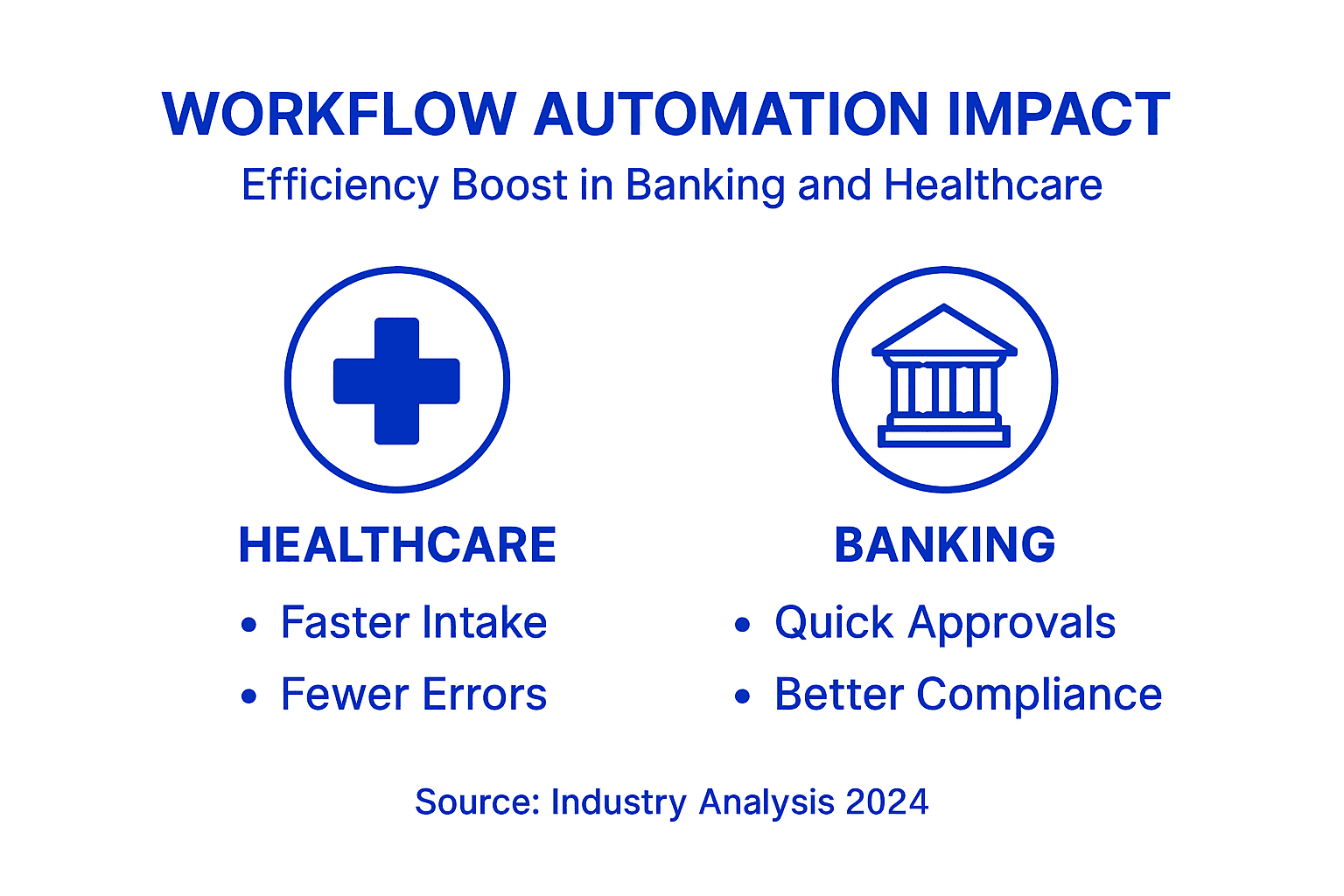
Both healthcare and banking benefit from workflow automation by fundamentally reimagining how complex processes are managed. Our low-code platform, Click Flow, enables organizations to design custom automation solutions that address unique operational challenges. By connecting disparate systems, eliminating manual data entry, and creating intelligent workflow sequences, these technologies unlock unprecedented levels of efficiency, accuracy, and strategic agility across enterprise environments.
Pro Tip: Conduct a comprehensive audit of your existing processes, identifying repetitive tasks and bottlenecks that are prime candidates for immediate automation and efficiency improvement.
The following table compares workflow automation benefits for healthcare versus banking sectors:
| Benefit Area | Healthcare Example | Banking Example | Organizational Outcome |
|---|---|---|---|
| Efficiency | Automated patient record management | Accelerated transaction processing | Reduced delays, faster service |
| Accuracy | Improved compliance tracking | Lower error rates in transactions | Higher data quality, fewer mistakes |
| Strategic Agility | Scalable appointment scheduling | Personalization of customer service | More flexible, adaptable operations |
Risks, Security, and Implementation Challenges
Workflow automation implementation challenges extend far beyond technical complexities, encompassing organizational, cultural, and strategic dimensions. Organizations in Saudi Arabia and the UAE must navigate intricate technological integration landscapes, addressing potential misalignments between technical teams and business stakeholders that can derail digital transformation efforts. Successful implementation requires establishing clear communication protocols, adopting standardized process modeling approaches, and creating centralized centers of excellence to govern automation initiatives.
Security represents a critical concern in workflow automation, particularly in sensitive sectors like banking and healthcare. Implementation of Robotic Process Automation (RPA) introduces potential vulnerabilities related to unauthorized system access, data breaches, and privacy risks. Organizations must develop comprehensive security frameworks that include robust authentication mechanisms, encryption protocols, and continuous monitoring systems to protect critical business information while maintaining the efficiency gains offered by automation technologies.
Human factors pose significant implementation challenges, including workforce resistance, skills gaps, and job displacement concerns. Low-code platforms like our Click Flow solution can mitigate these challenges by democratizing process design and enabling employees to participate actively in digital transformation. By providing intuitive interfaces and extensive training resources, organizations can transform potential resistance into collaborative innovation, helping employees understand automation as an enhancement rather than a replacement of human capabilities.
Pro Tip: Develop a comprehensive change management strategy that includes transparent communication, targeted training programs, and clear pathways for employee reskilling to successfully navigate workflow automation implementation challenges.
Unlock the Full Potential of Workflow Automation with Singleclic
The article highlights key challenges like managing complex business processes, reducing manual errors, and accelerating digital transformation in sectors like healthcare and banking across Saudi Arabia and the UAE. If your organization is looking to overcome these pain points—such as inefficient workflows, security concerns, and workforce adaptation—you need a partner that understands these critical needs and can deliver tailored solutions. Leveraging terms like low-code platforms, Robotic Process Automation (RPA), and real-time process optimization, this content points directly to the transformational power of intelligent automation.
At Singleclic, we bring over 10 years of regional expertise in Business Process Automation and digital transformation that elevates your operations beyond mere digitalization. Our proprietary low-code platform, Click Flow, allows you to design complex workflows effortlessly while supporting seamless integration, Arabic UI, and runtime changes without downtime. Whether you are in healthcare, banking, telecom, or government, our scalable solutions backed by ERP & CRM Implementation and AI-driven automation empower your teams to work smarter and faster.
Don’t let manual bottlenecks and costly errors hold your enterprise back. Explore how Singleclic’s innovative automation technologies can transform your business processes today. Visit our website to start your journey toward intelligent, adaptive workflows that unlock operational excellence and competitive advantage right now.
Frequently Asked Questions
What is workflow automation?
Workflow automation is a strategic technological approach that streamlines and coordinates complex business processes, reducing manual intervention and enhancing organizational efficiency.
How does workflow automation work in practice?
Workflow automation transforms business processes into digital sequences by establishing precise triggers and rules that automatically initiate task sequences across different systems without requiring manual human intervention.
What are the key benefits of workflow automation for organizations?
The key benefits of workflow automation include improved efficiency, reduced manual errors, enhanced accuracy, and increased operational agility, facilitating quicker responses to evolving business challenges.
What types of technologies are used in workflow automation?
Common technologies in workflow automation include Robotic Process Automation (RPA), Business Process Automation (BPA), Intelligent Automation (IA), and low-code platforms, which enable customization and implementation of complex workflows with minimal technical expertise.