TL;DR:
- The inception phase determines whether a project should begin by producing signed artifacts and securing approval. It focuses on scope, feasibility, stakeholder alignment, risks, and formal authorization before planning starts. Completing inception efficiently prevents scope creep and ensures a shared understanding among key decision-makers.
A successful inception phase process produces five core outputs and ends with a signed go/no-go decision — not a stack of slides. Before a single sprint is planned or a resource is allocated, your team needs to answer one question clearly: Should we do this project now? Inception is the structured, time-boxed effort that gets you to that answer. Atlassian’s project initiation guidance identifies a project charter and a formal business case as the minimum artifacts required for enterprise-level authorization. Disciplined Agile (PMI) adds team formation and scope alignment to that baseline.
Declare inception complete only when you have all five of these in hand:
- Project charter — signed by the sponsor, with objectives, constraints, and authorization to proceed
- Business case — costs, expected benefits, and key risks summarized for decision-makers
- Stakeholder register — every person or group with influence or interest, mapped by role
- Feasibility or architecture spike result — a short proof-of-concept that confirms the technical approach is viable
- Initial backlog or MVP canvas — a prioritized list of features or outcomes that defines the minimum viable scope
If any of these is missing, inception is not done. Planning should not start.
Table of Contents
- What the inception phase is and why it differs from planning
- Step-by-step activities that make up the inception phase
- What deliverables you need at the end of inception
- Who should attend inception sessions and what each role owns
- How long inception takes and what it costs
- A practical one-week lean inception agenda
- How to make a go/no-go decision and hand off to planning
- Key Takeaways
- Why disciplined inception matters more than most teams realize
- Singleclic runs fast, low-risk inceptions for ERP and CRM projects
- Useful sources and templates
What the inception phase is and why it differs from planning
The inception phase is the first formal stage of a project lifecycle. Its job is to answer should we do this? Planning answers how will we do it? Treating them as the same activity is the most common cause of scope creep on software and ERP projects. Inception is a decision gate. Planning is an execution blueprint. Conflating them produces teams that start building before the “why” is agreed upon.
In client-facing work, inception is also where you translate the sales promise into a deliverable scope and get the client’s formal sign-off before any delivery work begins. That translation prevents the misunderstandings that surface six months into a project.
The primary objectives your team must accomplish to close inception are:
- Establish a shared vision and scope — define what the project will and will not include.
- Confirm technical and business feasibility — validate that the solution is buildable and financially justified.
- Align stakeholders — get the right people to agree on goals, constraints, and success criteria.
- Identify initial risks — surface the top threats to delivery so mitigation can begin early.
- Secure funding and authorization — obtain formal approval to move into planning and execution.
PMI’s Disciplined Agile framework frames this as “just enough” work to get a team going — not an exhaustive analysis, but a focused effort to align on scope, architecture strategy, and release direction before the first iteration begins.
Step-by-step activities that make up the inception phase
The activities below are ordered. Run them in sequence during your inception workshops or distributed discovery sessions.
- Intake and scoping — capture the project request, define the problem statement, and set the outer boundaries of scope. What is in? What is explicitly out?
- Stakeholder mapping — identify every person or group with influence or interest. Assign engagement levels (inform, consult, decide).
- Problem statement and success criteria — write a one-paragraph problem statement and define two to four measurable success criteria the team will use to evaluate outcomes.
- Initial requirements and MVP definition — gather high-level functional needs. For software projects, draft an MVP canvas or feature priority list. Avoid detailed user stories at this stage.
- Feasibility spikes or prototypes — when major technical risks exist, run short proof-of-concept work to validate the approach. A spike is time-boxed, typically one to three days, and produces a binary answer: feasible or not.
- Risk identification — list the top five to ten risks. Rate each by likelihood and impact. Assign an initial owner.
- Rough sizing and estimate — produce a high-level effort range (not a detailed plan). Use T-shirt sizing, story points, or analogous estimation. The goal is a budget-order-of-magnitude figure, not a commitment.
- Authorization and sign-off — present findings to the sponsor. Get a formal go/no-go decision and document it.
This sequence maps directly to Disciplined Agile’s inception goals: forming the team, aligning with enterprise direction, exploring scope, identifying architecture strategy, and planning the release.
Pro Tip: Set a hard timebox for your feasibility spike before it starts. Without a fixed end date, technical exploration expands to fill available time. A three-day spike with a defined output question (“Can we integrate with the legacy ERP via REST API?”) produces a decision. An open-ended spike produces a research report nobody acts on.
What deliverables you need at the end of inception
Every inception effort, regardless of size, should close with a defined artifact set. Scale the formality to project size and risk — small projects can use lightweight versions while large enterprise efforts need full documentation.
| Deliverable | Minimum contents | Who owns it |
|---|---|---|
| Project charter | Objectives, scope boundaries, sponsor name, authorization signature, constraints | Project manager |
| Business case | Problem statement, cost estimate, expected benefits, key risks, ROI rationale | Sponsor / PM |
| Stakeholder register | Name, role, interest level, engagement approach | PM |
| Feasibility / architecture spike report | Question asked, approach tested, result (feasible/not), recommendation | Tech lead |
| Initial backlog / MVP canvas | Prioritized features or outcomes, acceptance criteria for MVP | Product owner |
| Risk register | Risk description, likelihood, impact, owner, initial mitigation | PM |
| Sign-off criteria | Agreed conditions that must be true before planning begins | Sponsor + PM |
Mini-template: project charter (paste and adapt)
Project name: [Name]
Objective: [One sentence — what this project will achieve and for whom]
Scope includes: [Bullet list of in-scope items]
Scope excludes: [Bullet list of explicit exclusions]
Sponsor: [Name, signature]
Authorization date: [Date]
Mini-template: MVP canvas (paste and adapt)
Vision: For [user type] who [need], the product is [solution] that [key benefit].
MVP features: [Feature 1], [Feature 2], [Feature 3]
Success metric: [Measurable outcome by which MVP will be judged]
Store these templates in your project repository or knowledge base so every new project starts from the same baseline. For teams running ERP or CRM inceptions, a readiness assessment adds a fourth column: system integration dependencies.
Who should attend inception sessions and what each role owns
Skipping key decision-makers during inception leads to wasted effort. If the question “Why are we doing this project now?” cannot be answered by the people in the room, inception is premature. Defer it until sponsorship is secured.
| Role | Must attend? | Responsibilities during inception |
|---|---|---|
| Project sponsor | Yes — go/no-go decisions require them | Articulates the “why now,” approves the business case, signs the charter |
| Product owner | Yes | Defines MVP scope, prioritizes initial backlog, accepts or rejects requirements |
| Tech lead / architect | Yes | Leads feasibility spikes, assesses technical risk, recommends architecture approach |
| Project manager | Yes | Facilitates sessions, owns the charter and risk register, tracks timebox |
| Key business stakeholders | Yes for scoping sessions | Provide domain requirements, validate success criteria |
| Subject matter experts | Consult asynchronously | Answer specific domain questions; not required for all sessions |
| Facilitator | Recommended for large groups | Keeps sessions on track, manages conflict, enforces timeboxes |
For large stakeholder sets, regulatory-constrained projects, or cross-border initiatives, expand the roster to include a compliance officer, a legal representative, and a change management lead. Their input during inception prevents costly rework when regulatory requirements surface mid-delivery.
Separating inception from planning also clarifies who owns what: the sponsor owns the go/no-go decision, the PM owns the process, and the product owner owns the scope definition.
How long inception takes and what it costs
Timeline depends on four factors: project complexity, technical novelty, stakeholder count, and the level of organizational risk tolerance. Here are practical benchmarks:
- Small internal initiative — a focused one-day workshop or even a one-hour mini-inception when the “why” is already clear and stakeholders are few.
- Typical agile or lean inception — one week is the standard timebox for most software initiatives when the business case is reasonably understood.
- Average agile team — PMI’s Disciplined Agile practice notes observe that inception efforts average approximately 11 workdays across agile and lean teams.
- Large cross-functional or high-uncertainty effort — multiple short inception iterations, each validating a different dimension of feasibility before committing to planning.
Statistic: PMI’s Disciplined Agile practice data shows agile teams average approximately 11 workdays on inception activities — roughly two calendar weeks when accounting for scheduling gaps.
Cost drivers during inception include:
- Stakeholder engagement time (often the largest hidden cost — senior leaders at $200–$500/hour add up fast across multi-day workshops)
- Facilitator fees if using an external consultant
- Engineering time for feasibility spikes or proof-of-concept builds
- Vendor or consultant assessments (common in ERP/CRM selections)
- Travel and workshop logistics for distributed teams
Decision rule for timebox size: choose a one-week lean inception when the business case is clear, stakeholders are available, and technical risk is moderate. Choose a multi-iteration inception when the technical approach is genuinely unknown, regulatory constraints are complex, or the stakeholder set spans multiple organizations.
A practical one-week lean inception agenda
Lean inception approaches compress discovery into five focused workdays without sacrificing the rigor that go/no-go decisions require. Use this agenda as a starting point and adjust for your team’s context.
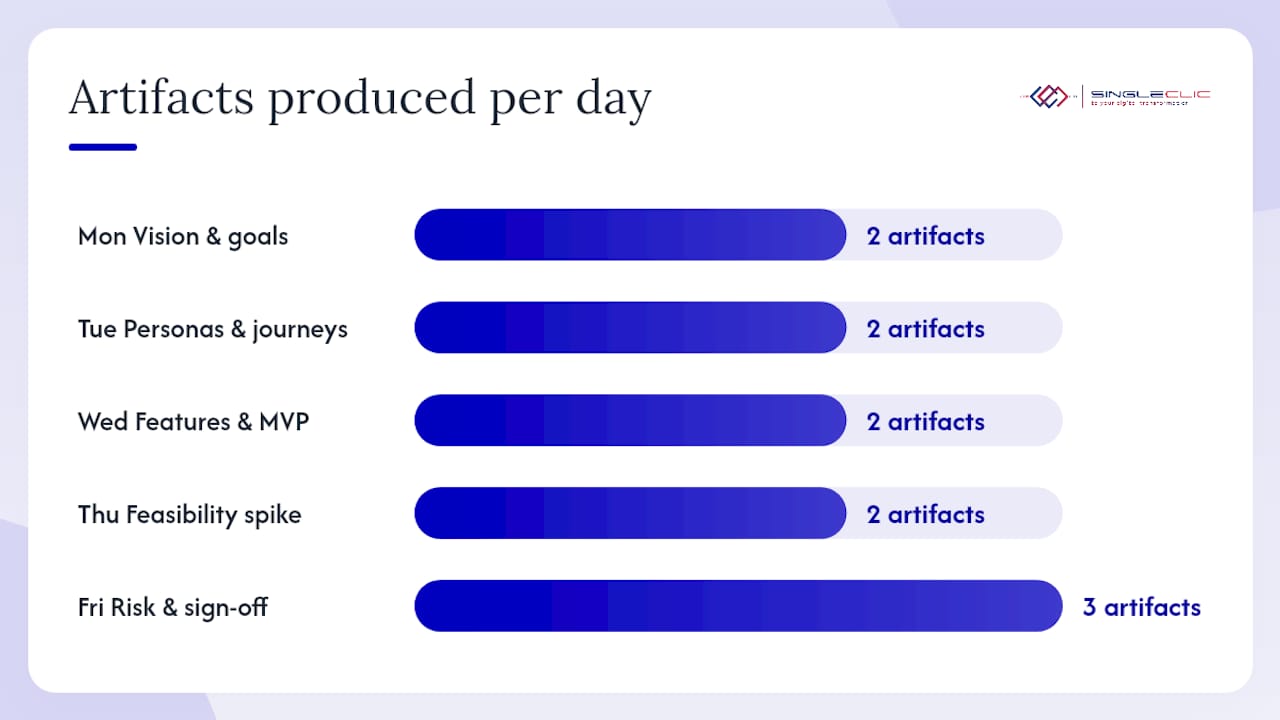
| Day | Focus | Key activities | Artifacts produced |
|---|---|---|---|
| Monday | Vision and goals | Product vision exercise, goal mapping, success criteria definition | Vision statement, success criteria list |
| Tuesday | Personas and journeys | User persona workshops, journey mapping, pain point identification | Persona cards, journey map |
| Wednesday | Features and MVP | Feature brainstorming, MVP canvas, prioritization (must-have vs. nice-to-have) | MVP canvas, feature priority list |
| Thursday | Feasibility spike | Technical spike or prototype, architecture review, integration assessment | Spike result report, architecture feasibility summary |
| Friday | Risk, sizing, and sign-off | Risk register completion, rough sizing, go/no-go presentation to sponsor | Risk register, high-level estimate, signed charter |
Facilitation tips that keep the week on track:
- Open each day with a 10-minute recap of the previous day’s decisions. Undocumented decisions evaporate overnight.
- Timebox every exercise. A feature brainstorm capped at 45 minutes produces a working list. An open-ended one produces a whiteboard nobody photographs.
- Handle absent stakeholders by assigning a proxy with decision authority. A stakeholder who “will review later” is a blocker, not a participant.
- Use a shared digital workspace (Miro, Confluence, or a Cortex-enabled workflow board) so remote participants contribute in real time.
Pro Tip: If Thursday’s feasibility spike returns a “not feasible” result, do not push to Friday’s sign-off. Call a sponsor checkpoint immediately. A failed spike is valuable information — it means the scope, the technology choice, or both need to change before planning begins.
When should you extend beyond a week? Add a second iteration when the technical risk is high and the spike raised more questions than it answered, or when regulatory stakeholders require formal review cycles. A one-hour mini-inception is sufficient for small internal process changes where the team already knows the domain and the sponsor is in the room.
For teams building agile workflows, the lean inception agenda maps cleanly onto Sprint Zero practices.
How to make a go/no-go decision and hand off to planning
The go/no-go decision closes inception. It is a formal checkpoint, not an informal conversation. Use this checklist before calling the decision:
- Business case is approved — the sponsor has reviewed costs, benefits, and risks and confirmed the investment is justified.
- Technical feasibility is confirmed — the spike or prototype returned a positive result, or risks are documented and accepted.
- Stakeholder alignment is achieved — key stakeholders have reviewed and agreed on scope, success criteria, and constraints.
- Funding is authorized — budget is allocated or formally committed for the planning and execution phases.
- Charter is signed — the project sponsor has signed the project charter, creating formal authorization.
- Risk register is complete — top risks are documented with owners and initial mitigation approaches.
If any item is unresolved, the decision is “no-go” or “defer.” Document the reason and the conditions that would change the outcome.
Handoff artifacts for planning: pass the signed charter, prioritized initial backlog or MVP canvas, high-level effort estimate, architecture feasibility summary, and risk register to the planning team. These five artifacts give planning everything it needs to build a detailed schedule and resource plan without re-litigating scope decisions.
Governance ritual to close inception: schedule a 30-minute inception close meeting with the sponsor, PM, and product owner. Walk through the go/no-go checklist, confirm all artifacts are stored in the project repository, log the decision in your project management system, and formally kick off planning. This ritual takes 30 minutes and prevents the ambiguity that causes teams to drift between inception and planning for weeks.
For enterprise-scale governance, the close meeting should also include a brief change control orientation so the planning team knows how scope changes will be managed from day one.
Key Takeaways
The inception phase process is a time-boxed decision gate that produces five signed artifacts and a formal go/no-go ruling before planning begins.
| Point | Details |
|---|---|
| Inception answers “should we?” | Planning answers “how?” — keep them separate to prevent scope creep and misaligned teams. |
| Five artifacts close inception | Charter, business case, stakeholder register, feasibility spike result, and MVP canvas are the minimum set. |
| Timebox to 11 workdays or less | Industry data shows agile teams average approximately 11 workdays on inception; lean inception workshops often finish in a single focused week when the business case is clear. |
| Sponsor attendance is non-negotiable | If the sponsor cannot answer “why now?”, defer inception until they can — wasted inception is expensive. |
| Singleclic accelerates inception | Singleclic’s facilitated inception packages and Cortex low-code prototyping compress ERP/CRM inception to one focused week with a signed charter and MVP canvas at the end. |
Why disciplined inception matters more than most teams realize
The conventional wisdom says inception is about documentation. Get the charter signed, write the business case, move on. That framing misses the real value. Inception is team formation and alignment work. The artifacts are evidence that alignment happened — they are not the alignment itself.
Two failure patterns show up repeatedly in ERP and CRM projects. The first: a team runs a thorough inception, produces all five artifacts, and then hands them to a planning team that was not in the room. The planning team re-litigates scope in the first sprint because they have no shared context, only documents. The fix is straightforward: the core inception participants must carry forward into planning. Continuity of people matters as much as continuity of artifacts.
The second pattern is subtler. Teams treat the feasibility spike as a formality — they run it, get a “feasible” result, and move on without asking what assumptions the spike relied on. Six months later, those assumptions break under production load or integration complexity. A disciplined spike defines its assumptions explicitly and flags them as risks in the register. That way, planning inherits known risks with owners, not hidden ones that surface as crises.

Inception done well is short, decision-focused, and slightly uncomfortable — because it forces the sponsor to commit before the team has all the answers. That discomfort is the point. A sponsor who will not sign a charter until every question is answered is not ready to sponsor a project.
Singleclic runs fast, low-risk inceptions for ERP and CRM projects
For organizations evaluating Microsoft Dynamics 365 or Odoo, a poorly structured inception is the single biggest predictor of implementation failure. Singleclic’s inception engagement gives you a facilitated one-week workshop, a Cortex low-code prototype to validate your core process flows before a line of configuration is written, and a signed charter with a prioritized MVP canvas at the end of day five.
The engagement includes a feasibility spike against your existing systems, a stakeholder register built in your first session, and a governance setup so your planning team inherits a clean, authorized scope. Cortex connects your approval workflows, ERP data, and legacy systems from day one, so the prototype you validate during inception becomes the foundation of your production environment, not a throwaway exercise.
If your team is heading into an ERP or automation project and inception has not been formally structured yet, that is the right moment to act. Contact Singleclic to book a rapid inception package and start planning with confidence.
Useful sources and templates
- The Inception Phase — Disciplined Agile (PMI): PMI’s authoritative breakdown of inception goals for agile teams, including team formation, scope alignment, and architecture strategy.
- Practice: Coaching inception (PMI Disciplined Agile): Practical guidance for team leads running inception, including timebox benchmarks and iteration patterns for high-uncertainty projects.
- What Is Project Initiation? Key Steps, Deliverables & Tips (Atlassian): Atlassian’s project initiation guide covering charter and business case requirements, scalable formality, and the initiation-vs-planning distinction.
- Lean inception (Martin Fowler): The foundational reference for one-week lean inception workshops, including the MVP canvas and persona exercises used in the agenda above.
- Agile inception and alignment (Public Agile): Practical guidance on sponsor readiness and the “why now” test for determining whether inception is premature.
- Concept: Inception Phase (OpenUP): OpenUP’s technical framing of inception, including guidance on feasibility spikes and proof-of-concept work for high-risk technical decisions.
- Project initiation: 6 steps to start your project right (Teamwork.com): A practitioner-focused walkthrough of initiation steps for client-facing and professional services projects.