A BPM Center of Excellence is a centralized governance body that turns scattered, department-by-department process projects into a repeatable enterprise capability. Its job is standards, coaching, and portfolio oversight, not doing every process fix itself. Organizations that build one well get three things: faster alignment between process work and strategy, consistent delivery quality across teams, and a way to actually measure the ROI of automation instead of guessing at it. The rest of this guide walks through the models, roles, governance artifacts, KPIs, and staffing choices that separate a CoE that lasts from one that quietly dissolves after 18 months.
TL;DR:
- Building a centralized BPM CoE ensures consistent standards, reusable assets, and measurable ROI, but requires dedicated leadership and proper staffing to prevent failure.
- A mature CoE progresses from building awareness and pilot projects to full strategic alignment with enterprise goals, which often needs governance adjustments.
- Staffing must include a dedicated lead, process owner, architect, analyst, and platform administrator, with active oversight to avoid turf disputes and facilitate change.
- Effective portfolio governance depends on clear artifacts like RACI charts, BPMN standards, and approval workflows to balance flexibility and control.
- Using low-code platforms and partnering with external expertise can accelerate CoE deployment and help scale BPM initiatives faster.
Table of Contents
- What does a bpm center of excellence actually do?
- Which CoE model fits your organization: centralized, federated, or hybrid?
- Who staffs a BPM CoE, and how should you assign accountability?
- How do you govern the process portfolio without slowing everything down?
- How should you staff delivery and build BPM skills over time?
- What KPIs prove a BPM CoE is worth the budget?
- What should a CoE govern at the platform and infrastructure level?
- Singleclic’s approach: an implementation pattern and checklist
- Leadership lessons for sustaining a CoE
- How Singleclic helps build and run a BPM Center of Excellence
- Sources
- FAQ
What does a bpm center of excellence actually do?
A BPM Center of Excellence is a centralized governance body responsible for setting BPM standards, providing methodological expertise, and making sure individual process projects serve the broader strategy rather than a single department’s convenience, according to a Fraunhofer study on BPM CoE governance. That mandate breaks down into a handful of concrete services rather than a vague oversight role.
- Governance and methodology: it owns the modeling standards, approval workflows, and design rules that every process initiative has to follow.
- Process portfolio management: it takes in improvement requests from across the business, scores them, and decides what gets built next and in what order.
- Shared assets and reusable services: templates, common APIs, audit and error-logging components, and modeling libraries live here so teams stop rebuilding the same plumbing, a point BPMInstitute.org makes explicitly about avoiding duplicated work.
- Training and enterprise reporting: onboarding new process owners, running change enablement, and publishing value reports up to leadership.
Think of it less like an IT department and more like a shared legal or finance function: everyone touches it, but nobody outside it owns the standards.
Which CoE model fits your organization: centralized, federated, or hybrid?
There is no universal blueprint. A fully centralized model puts all process architects and analysts in one team that services the whole enterprise, which gives tight control but can bottleneck on demand. A federated model embeds process specialists inside business units while a small central team sets standards, which scales faster but risks inconsistent quality if governance is weak. Most large organizations land on a hybrid: a lean central CoE that owns standards, tooling, and portfolio decisions, with liaison analysts sitting inside operations, finance, or healthcare units.
Academic research on CoE design frames maturity as a progression through three capability levels:
- Diffusion — the organization is building basic BPM awareness; the CoE is small, mostly training people and running pilot projects.
- Convergence — separate improvement efforts start coordinating under shared standards; the CoE begins enforcing modeling notation and reuse.
- Strategic alignment — process architecture connects directly to enterprise strategy, and the CoE governs a full portfolio with measurable value tracking, per the academic framework for BPM CoE capability levels.
Moving between levels usually requires a governance change, not just more headcount. Diffusion to convergence typically needs an executive sponsor willing to enforce standards across departments that previously did things their own way.
Who staffs a BPM CoE, and how should you assign accountability?
Understaffing the CoE, or worse, staffing it with borrowed time from people who already have full-time jobs, is one of the fastest ways to kill it. BPMInstitute.org identifies a consistent set of essential roles in a mature CoE:
- CoE lead — owns the charter, budget, and executive relationships; this needs to be a dedicated role, not a side project.
- Process owner — accountable for outcomes of a specific end-to-end process, usually a business-side executive.
- Process architect — designs the enterprise process framework and enforces modeling consistency.
- Process analyst — does the hands-on mapping, gap analysis, and requirements work for individual initiatives.
- BPMS or tool administrator — manages the platform, permissions, and technical integrations.
- Change manager and performance specialist — handle adoption, training, and the KPI reporting that keeps leadership informed.
Part-time leadership is a documented failure pattern. Active, dedicated senior oversight is critical because it is what lets a CoE lead mediate the political friction that comes with redefining who owns a process that used to belong exclusively to one department, a dynamic BPMInstitute.org’s practitioner guidance describes directly.
Pro Tip: Build a simple RACI chart before you staff a single cross-functional process. If you can’t name who is Accountable versus who is just Consulted, the CoE will spend its first six months refereeing turf disputes instead of shipping improvements.
How do you govern the process portfolio without slowing everything down?
Governance fails in two opposite directions: too loose, and every team reinvents its own standards; too rigid, and nothing ships without a six-week review cycle. The fix is a small set of core artifacts, applied consistently.
- RACI charts for every cross-functional process, so accountability survives personnel changes.
- Modeling standards, typically built on BPMN, so a process map from one department reads the same way in another. Understanding BPMN as a modeling notation is a prerequisite for anyone drafting these standards.
- Approval workflows that define who signs off on a new or changed process before it goes live.
- Templates for intake requests, business cases, and post-implementation reviews.
Portfolio prioritization needs its own scoring criteria: business impact, technical complexity, compliance or regulatory risk, and the cost of leaving a broken process unfixed. A BPM governance framework overview from BPTrends makes the case that governance has to align with existing corporate governance structures, not sit as an isolated island the rest of the business ignores. Built-in governance patterns that enforce these rules at the platform level, rather than relying on manual review, tend to scale far better as the portfolio grows.
Reusable technical services deserve a mention on their own. A shared catalog of common APIs, audit trails, and error-handling components means the fifth process automation project doesn’t rebuild what the first one already solved.
How should you staff delivery and build BPM skills over time?
Three delivery models cover most organizations: a fully internal team, a blended model that pairs internal process owners with external implementation specialists, or a managed services arrangement where delivery is largely outsourced under CoE governance. The right choice depends on how fast you need to move and how much institutional BPM knowledge already exists in-house.
Low-code platforms change the staffing math meaningfully. When process architects can configure workflows visually instead of writing custom code for every integration, a smaller technical team can support a larger process portfolio, and time to value shrinks from months to weeks on straightforward automations.
- Start business-side training with process mapping and requirements-gathering basics.
- Give IT staff platform-specific certification paths for whatever BPMS or low-code tool the CoE standardizes on.
- Rotate analysts through the CoE on a fixed term so BPM literacy spreads back into business units instead of staying siloed.
What KPIs prove a BPM CoE is worth the budget?
Executives fund what they can measure. A CoE that can’t produce a dashboard within its first two quarters will struggle to defend headcount at renewal time. The KPI set that holds up under scrutiny usually includes:
- Cycle time for the processes under CoE governance, tracked before and after each initiative.
- First-time-right rate, meaning how often a process completes without rework or exception handling.
- Cost per transaction, which turns automation gains into a number finance actually cares about.
- Project-level ROI, published per initiative rather than as one blended enterprise figure.
- Adoption rate, since a technically successful process that nobody uses delivers zero value.
Automation and process mining tools help here directly. They provide transparency and monitoring that make it possible to catch process exceptions and SLA breaches as they happen rather than during a quarterly audit, a point SS&C Blue Prism’s governance guidance raises in the context of automated process controls.
Publish results quarterly at minimum, tied to specific initiatives rather than vague enterprise-wide claims. A leadership team that sees “Initiative 4 cut invoice processing cycle time and paid for its own implementation cost within the reporting period” trusts the CoE more than one that hears “process efficiency is improving.”
What should a CoE govern at the platform and infrastructure level?
The CoE doesn’t need to run IT operations, but it does need a voice in platform decisions that affect every process built on top of them. A basic checklist covers:
- Deployment model: on-premise versus cloud, decided by data residency and regulatory requirements, especially for banking, government, and healthcare workloads common across MENA.
- Localization: full Arabic UI support matters when process owners and frontline staff work in Arabic day to day, not just in English-language dashboards.
- Integration capability: how well the platform connects to existing ERP, CRM, and legacy systems without custom middleware for every link.
- Runtime change management: whether workflows can be updated without downtime, and how version history is tracked.
- Operations: monitoring, SLAs, and a clear support model so process failures get triaged fast, not discovered during month-end reporting.
Reviewing BPM tooling examples and outcomes from other organizations is a useful way to stress-test a shortlist before committing to one platform enterprise-wide.
Singleclic’s approach: an implementation pattern and checklist
Organizations often spend more than a decade building BPM, ERP, and CRM programs for banks, healthcare networks, and government agencies across Saudi Arabia, the UAE, and Egypt. That work shaped a practical delivery pattern: assess the current process landscape and governance gaps, run a pilot on one high-value process, formalize governance and role assignments based on pilot results, then scale using standardized templates.
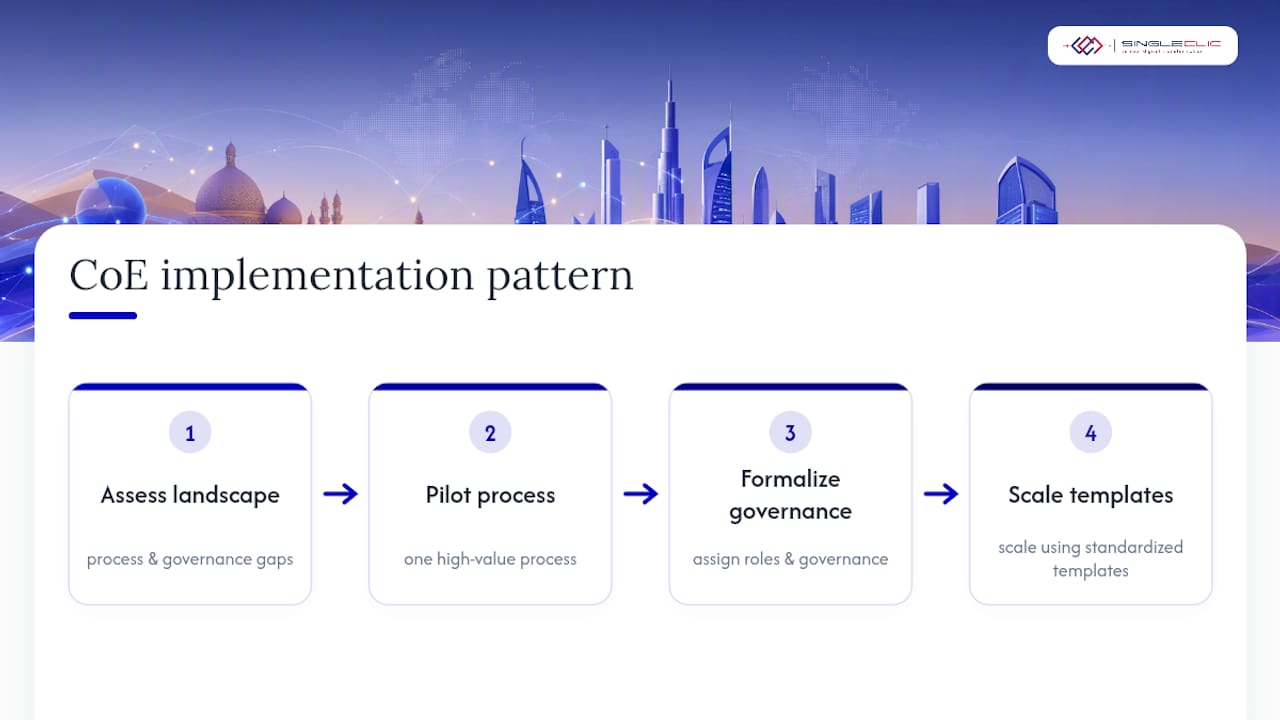
A low-code and BPM platform like Cortex can support this pattern directly by connecting approvals, ERP, CRM, data, and legacy systems under one workflow layer, with full Arabic UI, on-premise deployment for regulated sectors, and runtime workflow changes that don’t require downtime. For organizations weighing IBM BAW against a low-code alternative, that combination often determines how fast the CoE can move from pilot to enterprise scale.
Leadership lessons for sustaining a CoE
Most CoEs don’t fail at launch. They fail at month fourteen, when the founding sponsor moves on and nobody enforces the standards anymore. Active, dedicated executive sponsorship is what carries a CoE through the political friction of telling a department head that their process now follows someone else’s modeling rules.
The recurring mistakes are predictable: buying a BPM tool before defining governance, running a portfolio with no scoring criteria so the loudest department always wins priority, and appointing a CoE lead who keeps their old job on the side. None of these are fatal if caught early.
The fix isn’t complicated. Run a small pilot, publish its ROI honestly, and enforce the same standards on the second project as the first. Momentum comes from consistency, not from a bigger launch event.
— Tamer Badr
How Singleclic helps build and run a BPM Center of Excellence
Singleclic is the practical alternative to hiring a large internal BPM staff before you know your governance model works. Instead of a slow build-it-yourself effort, Singleclic pairs business process automation expertise with IBM BAW implementation experience and Cortex, its Arabic-enabled, on-premise low-code platform, so a CoE pilot can go live in weeks rather than quarters.
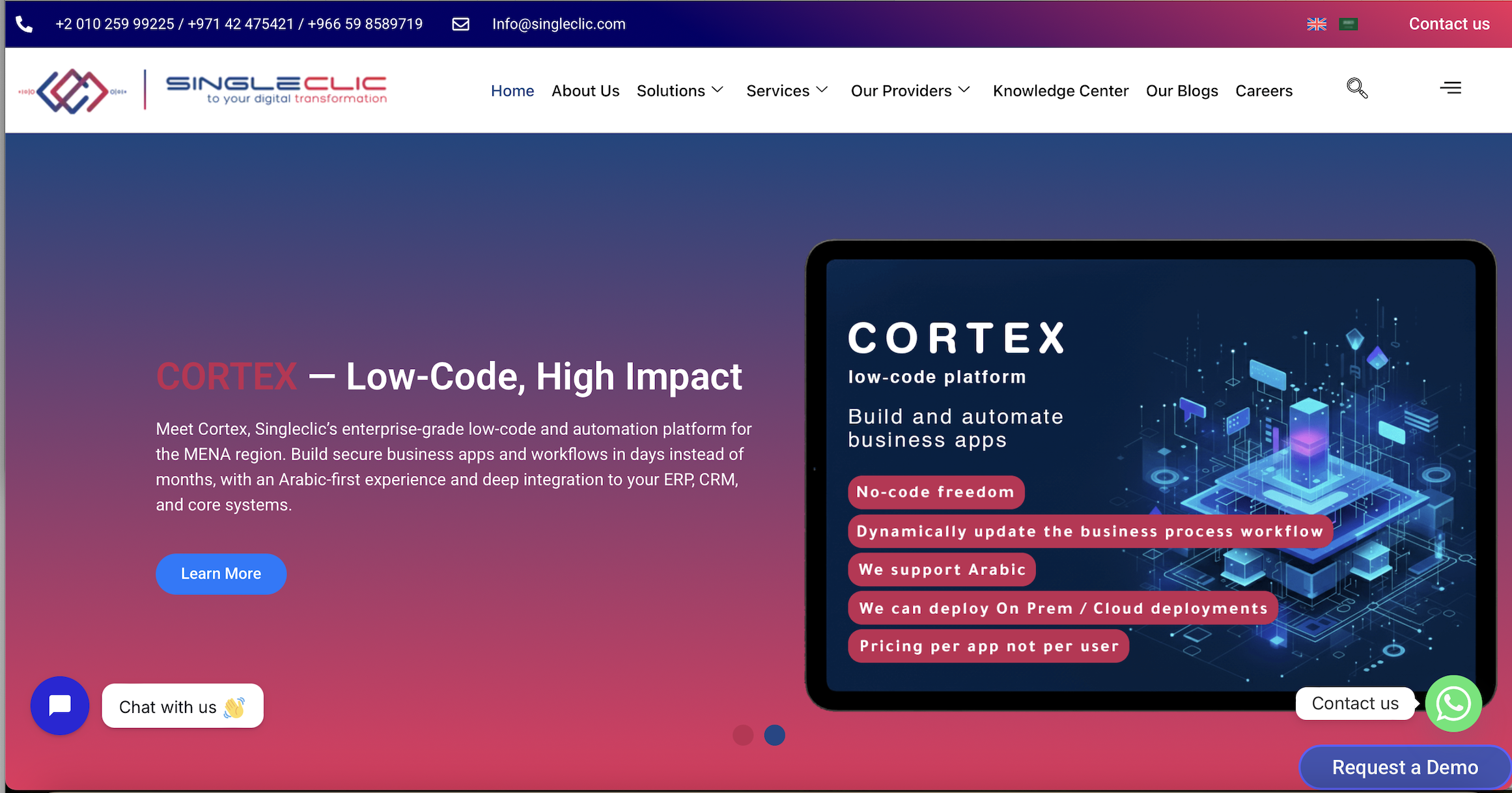
A typical engagement starts with a discovery assessment of your current process landscape and governance gaps, moves into a pilot on one high-priority process, and expands into full governance setup and skills enablement once the pilot proves out. For organizations already running Microsoft Dynamics 365 or Odoo, integration experience means the CoE’s shared services connect to existing ERP and CRM systems instead of operating as a disconnected layer.
Visit Singleclic’s services page to see the full range of BPA, low-code, and integration offerings, and request a discovery call to scope what a CoE pilot would look like inside your organization.
Sources
FAQ
What is BPM in a company?
BPM, or business process management, is the discipline of designing, running, monitoring, and improving an organization’s workflows so they consistently deliver the intended outcome. A BPM Center of Excellence is the governance structure that makes this discipline repeatable across departments rather than dependent on one team’s ad hoc effort.
What does BPM stand for in SAP?
Inside SAP and most enterprise software contexts, BPM stands for the same thing it does everywhere else: business process management, the practice of modeling and automating end-to-end workflows. SAP systems typically plug into a broader BPM governance layer rather than replacing the need for one.
Which is better, BPM or BPO?
They solve different problems, so “better” depends on the goal. BPM is a governance and improvement discipline you build internally to design and automate your own workflows, while BPO (business process outsourcing) hands specific process execution to a third party; many mature organizations use BPM governance to decide which processes are even worth outsourcing.
What does a “BPM job” mean?
A BPM job usually refers to a role like process analyst, process architect, or BPM CoE lead, focused on mapping, standardizing, or automating business workflows. These roles sit inside or report to a BPM Center of Excellence and typically require skills in process modeling notation like BPMN and familiarity with a BPMS platform.
How much does it cost to set up a BPM Center of Excellence with Singleclic?
Pricing depends on your process portfolio size, chosen platform, and whether you need a pilot engagement or full-scale rollout, so Singleclic doesn’t publish a flat rate. Current service details and a path to a custom quote are available on the Singleclic services page.