TL;DR:
- Most ERP project failures result from poor planning and governance, not outdated technology.
- Effective support services, including hypercare and change management, are crucial for successful digital transformation.
- Shifting to proactive, strategic support improves system adoption, performance, and long-term value in regional organizations.
Three out of four ERP projects fail due to inadequate planning and governance, not because the technology was wrong. That single statistic should stop every C-level executive in their tracks. Across KSA, UAE, and Egypt, organizations are investing millions into ERP, CRM, and AI platforms, yet too many of these initiatives stall, underdeliver, or collapse entirely within the first year. The technology is rarely the culprit. The missing piece is almost always the support infrastructure surrounding it. This article examines why support services are the true engine of operational efficiency and how you can use them as a strategic lever rather than an afterthought.
Table of Contents
- Why support services are vital for digital transformation
- Support strategies for ERP: From readiness to hypercare
- Reinventing CRM support: Beyond speed to AI-driven outcomes
- The essential role of change management and OCM in technology adoption
- Our perspective: Moving from reactive support to strategic enablement
- Accelerate your digital transformation with the right support
- Frequently asked questions
Key Takeaways
| Point | Details |
|---|---|
| Support is critical | Effective support services dramatically reduce technology failure rates and drive real business value. |
| AI changes support metrics | Modern CRM support focuses on AI-driven outcomes, such as higher resolution rates and lower handle times. |
| Change management matters | Strong support for organizational change management ensures new technology is actually adopted. |
| Avoid costly pitfalls | Skipping hypercare or extending parallel runs too long can lead to costly mistakes and project setbacks. |
| Think strategic, not reactive | Embedding support as a strategic function from the start maximizes digital transformation ROI. |
Why support services are vital for digital transformation
The term “support services” is often misunderstood in enterprise circles. Many executives picture a help desk staffed with technicians who answer tickets. That narrow view is exactly why so many digital transformations fail to deliver their promised return on investment.
In the context of ERP, CRM, and AI deployments, support services cover a much wider spectrum:
- Hypercare: An intensive post-launch phase where dedicated teams monitor the system around the clock, resolve edge cases, and prevent defects from compounding.
- Change management: Structured programs that prepare employees to adopt new tools, adjust workflows, and align with new processes. Effective change management for tech adoption is one of the most reliable predictors of long-term success.
- Training and enablement: Role-specific, ongoing training that goes beyond a one-time onboarding session.
- Help desk and escalation support: Tiered support structures that route issues to the right expertise level quickly.
- Process governance: Oversight mechanisms that ensure the system continues to serve business objectives as the organization evolves.
When any of these elements is missing or underfunded, the consequences are measurable. Research shows that no dedicated hypercare leads to 70% of defects surfacing within the first 30 days after go-live. That is not a minor inconvenience. For a hospital, a bank, or a government agency, a 70% defect rate in the first month can mean operational paralysis.
“The most sophisticated ERP or AI platform in the world cannot save an organization that has not invested in the human and process infrastructure to support it.” — Tamer Badr, Singleclic
The regional context makes this even more urgent. In KSA, UAE, and Egypt, digital transformation timelines are often compressed due to regulatory mandates, Vision 2030 targets, and competitive market pressures. Rapid deployments leave little room for error, which means the quality of your support services must be proportionally higher, not lower.
Support strategies for ERP: From readiness to hypercare
ERP implementations are among the most complex technology projects any organization undertakes. They touch finance, procurement, HR, supply chain, and operations simultaneously. The support lifecycle for an ERP project is not a single phase. It is a continuous sequence of structured activities, each with its own risks and success criteria.
Here are the four core ERP support phases every executive should understand:
- Readiness assessment: Before a single line of configuration is written, your support team should audit existing processes, identify integration risks, and establish baseline metrics. This phase is where most organizations cut corners, and where the seeds of future failure are planted.
- Implementation support: During the build and configuration phase, support teams manage data migration quality, user acceptance testing, and issue tracking. This is not passive oversight. It requires active intervention.
- Hypercare: The 30 to 90 days immediately following go-live. This is the highest-risk window in any ERP project. Defects that are not caught here tend to become embedded in daily operations, making them exponentially more expensive to fix later.
- Continuous support and optimization: After stabilization, support shifts toward performance monitoring, process improvement, and system evolution. This phase is where your ERP investment either compounds in value or slowly depreciates.
The data on ERP failure is sobering. 75% of ERP projects fail due to inadequate planning and governance, and the most costly mistakes almost always occur during the transition from go-live to stabilized operations. This is the window where user frustration peaks, workarounds proliferate, and data integrity issues multiply.
One specific risk that is frequently underestimated is the parallel run. Running old and new systems simultaneously is a standard risk mitigation strategy, but it carries a hidden cost. When a parallel run exceeds four weeks, the financial and operational burden becomes significant. Teams are doing double the work, data reconciliation becomes a full-time job, and user confidence in the new system erodes. The goal should be a clean, well-supported cutover, not an indefinite parallel operation.
| ERP support phase | Primary risk | Support action required |
|---|---|---|
| Readiness assessment | Scope gaps and data quality | Process audit and gap analysis |
| Implementation | Integration failures | Active testing and issue tracking |
| Hypercare | Early defects and user resistance | Dedicated escalation leads, 24/7 monitoring |
| Continuous support | System drift and underutilization | Performance reviews and retraining |
Understanding digital transformation pitfalls specific to your sector is equally important. Healthcare organizations, for example, face unique compliance requirements that make hypercare even more critical. Similarly, organizations exploring resource planning automation need support frameworks that account for the complexity of automated workflows intersecting with human decision-making. When you factor in cloud-based deployments, cloud migration success rates are significantly higher when dedicated support teams are embedded from the planning stage.
Pro Tip: Assign a dedicated support escalation lead during the hypercare phase whose sole responsibility is triaging and resolving issues within defined SLA windows. This single role can cut defect carry-over rates dramatically and protect your go-live investment.
Reinventing CRM support: Beyond speed to AI-driven outcomes
CRM support has historically been measured by one metric above all others: average handle time, or AHT. The logic was simple. Faster resolution equals better service. But that model is increasingly outdated, and organizations that cling to it are leaving significant value on the table.
Modern CRM support, especially when AI is integrated, demands a fundamentally different set of success metrics. Research on contact center performance shows that the shift from speed-based to AI-specific metrics is already underway, with resolution rates improving by 30 to 50% and assisted AHT dropping by 20 to 35% in organizations that adopt hybrid AI-human support models. That is a transformational improvement, not an incremental one.
Here is what that shift looks like in practice:
- Traditional CRM support: Measured by AHT of 4 to 7 minutes, ticket volume, and first-call resolution. Humans handle everything. Speed is the primary KPI.
- AI-only CRM support: Chatbots and automated workflows handle all interactions. Fast but brittle. Struggles with nuanced or emotionally charged customer situations.
- Hybrid AI-human CRM support: AI handles routine inquiries, data retrieval, and initial triage. Human agents step in for complex cases, exceptions, and relationship-critical interactions. This model consistently outperforms both alternatives.
| Support model | AHT | Resolution rate | Customer satisfaction (CSAT) |
|---|---|---|---|
| Traditional (human only) | 4 to 7 minutes | Moderate | Variable |
| AI only | Under 2 minutes | Lower for complex cases | Often lower |
| Hybrid AI-human | Reduced by 20 to 35% | 30 to 50% higher | Consistently higher |
The practical implications for CRM strategy are significant. If your support team is still optimizing purely for speed, you are likely sacrificing resolution quality and customer satisfaction. AI-driven analytics in CRM can help you identify exactly where AI should take over and where human judgment is irreplaceable.
Organizations in the region are also discovering that AI chatbots for customer experience work best when they are backed by strong support governance. A chatbot without a clear escalation path and human oversight is a liability, not an asset. The real power comes from predictive AI in CRM that anticipates customer needs before they become support tickets, reducing volume at the source while improving the overall experience.
Pro Tip: Audit your current CRM support metrics and identify which interactions are genuinely routine versus which ones require human empathy or judgment. Build your AI deployment around that distinction, not around cost reduction alone.
The essential role of change management and OCM in technology adoption
Organizational change management, commonly referred to as OCM, is the discipline of preparing people, processes, and culture to absorb and sustain a new technology. It is also the most consistently underfunded element of digital transformation projects across the MENA region.
Here is a direct truth: poor OCM causes adoption failure more reliably than almost any technical deficiency. You can deploy the most advanced ERP or CRM platform available, and if your people do not understand why it exists, how it benefits them, and how to use it effectively, the investment will not deliver its intended value.
“Change is the business, not an add-on. Organizations that treat OCM as a checkbox activity consistently underperform those that treat it as a core strategic function.” — Tamer Badr, Singleclic
Effective OCM in the context of ERP, CRM, and AI deployments involves a structured sequence of support actions:
- Awareness campaigns: Before go-live, communicate the purpose, benefits, and timeline of the new system to all affected stakeholders. Silence breeds resistance.
- Role-specific training programs: Generic training does not work. Finance teams need different training than warehouse managers. Tailor the content to the actual daily workflows of each user group.
- Champion networks: Identify influential users within each department who receive advanced training and serve as internal advocates. These champions are your most powerful adoption tool.
- Feedback loops: Create structured channels for users to report friction points, confusion, and workarounds. This intelligence is invaluable for refining both the system and the support approach.
- Reinforcement and recognition: Acknowledge and reward teams that adopt the new system effectively. Behavioral change requires positive reinforcement, not just instruction.
Investing in efficient change management workflows pays dividends that extend far beyond the initial deployment. Organizations that build OCM into their digital blueprint from the start see faster time to value, lower support ticket volumes, and higher long-term system utilization. Those that treat OCM as an optional extra often find themselves revisiting the same adoption problems six months or a year after go-live, at significantly greater cost.

The regional dimension matters here too. In KSA, UAE, and Egypt, workforce diversity is high, with teams that span multiple languages, cultural backgrounds, and varying levels of digital literacy. A one-size-fits-all OCM approach will not work. Support services must be designed with that diversity in mind, offering multilingual training materials, culturally aware communication strategies, and flexible learning formats.
Our perspective: Moving from reactive support to strategic enablement
After more than a decade of delivering digital transformation projects across KSA, UAE, and Egypt, we have observed a consistent pattern. The organizations that extract the most value from their ERP, CRM, and AI investments are not necessarily those with the largest budgets or the most sophisticated technology. They are the ones that treat support services as a strategic function, not a cost center.
This distinction sounds simple, but it requires a genuine shift in how executives think about support. Reactive support, which means waiting for problems to surface and then fixing them, is the default model in most organizations. It is also the most expensive model, because problems that are not caught early become embedded in operations, where they are far harder and costlier to resolve.
Strategic support, by contrast, is proactive. It means embedding support expertise at every phase of your digital initiative, from the initial planning conversations through integration design, go-live, and long-term scaling. It means your support team is in the room when architectural decisions are made, not called in afterward to clean up the consequences.
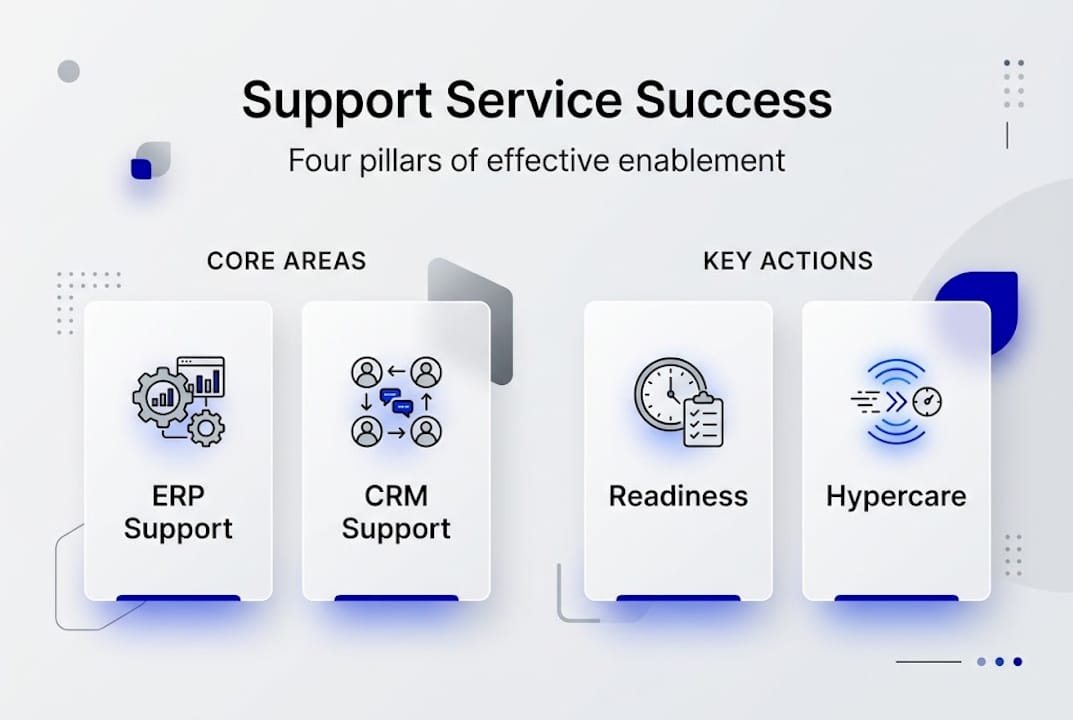
The lessons we have learned from working with clients like Emirates Health Services, QNB, and Emaar Misr point to a consistent truth: most failures trace back to support being an afterthought. The technology worked. The vendor delivered. But the organization was not ready to absorb and sustain the change, because support was not built into the blueprint.
Executives who want to lead effectively in this environment should rethink their business process automation strategies with support embedded from the outset. That means budgeting for hypercare before you need it, building OCM into your project governance structure, and selecting implementation partners who treat after-sales support as a core deliverable, not an optional add-on.
Pro Tip: When evaluating technology partners, ask specifically about their hypercare model, their OCM methodology, and their post-go-live support SLAs. The answers will tell you more about likely project success than any product demo.
Accelerate your digital transformation with the right support
The insights in this article point to one clear conclusion: the quality of your support services determines whether your digital investments deliver their promised value. Technology is the vehicle. Support is the engine.
At Singleclic, we have built our entire delivery model around this principle. From the first planning workshop to long-term system optimization, our 70+ consultants and engineers across KSA, UAE, and Egypt are embedded as strategic partners, not transactional vendors. Whether you are navigating a complex ERP deployment, scaling a CRM platform with AI, or building automated workflows, our leadership insight on process automation and deep regional expertise ensure your investment compounds over time. Explore how AI in ERP transformation and AI business process automation can be the next step in your organization’s journey beyond digitalization and into true optimization.
Frequently asked questions
Why do so many ERP projects fail despite good technology?
Failure usually stems from inadequate support services like planning, governance, and organizational change, not the technology itself. 75% of ERP projects fail for exactly these reasons.
How can support services improve CRM outcomes?
Modern support uses AI to boost resolution rates and customer satisfaction while still relying on humans for complex cases. AI-specific metrics show resolution rates improving by 30 to 50% in hybrid support models.
What is hypercare and why is it crucial?
Hypercare is the intensive post-launch support phase designed to catch and resolve early defects before they become embedded in operations. Without it, 70% of defects surface in the first 30 days and go unresolved.
How can organizations in MENA ensure technology adoption sticks?
Invest in support-driven change management and ongoing, role-specific training to foster user acceptance and business alignment. Poor OCM is one of the leading causes of digital project failure in the region.
What are the risks of extending parallel runs during system migrations?
Prolonged parallel runs beyond four weeks significantly raise operational costs and strain team capacity. Parallel runs exceeding four weeks are consistently linked to higher total project costs and slower stabilization.