TL;DR:
- Business-IT alignment ensures technology directly supports organizational goals for improved efficiency and regulation adherence.
- Continuous C-suite engagement and shared accountability are critical for sustaining effective business-IT alignment.
- Frameworks like the MIT Strategic Alignment Model guide collaborative planning, gap analysis, and governance for successful implementation.
Most C-suite leaders in KSA and UAE have experienced the frustration firsthand: technology investments that deliver technical wins but zero measurable business impact. The root cause is almost always the same. IT operates in one lane, business strategy operates in another, and nobody owns the bridge between them. This perception of IT as a pure cost center is not just outdated, it is actively damaging. When technology strategy and business strategy reinforce each other, organizations consistently see higher efficiency, stronger compliance posture, and real competitive advantage. This article gives you the frameworks, practical steps, and regional context to make that alignment real.
Table of Contents
- What is business-IT alignment?
- Strategic frameworks for business-IT alignment
- Application in complex organizations: Addressing silos and governance gaps
- Practical steps to achieve alignment: Success factors for KSA/UAE enterprises
- A fresh perspective: Why business-IT alignment remains misunderstood
- Drive operational excellence with tailored business-IT solutions
- Frequently asked questions
Key Takeaways
| Point | Details |
|---|---|
| Defines alignment | Business-IT alignment integrates technology and business strategies for mutual reinforcement and efficiency gains. |
| Framework guidance | Strategic models like MIT provide actionable blueprints for executives to bridge operational and technology goals. |
| Addresses complex pitfalls | Success depends on overcoming silos and governance gaps with persistent co-ownership by business and IT leaders. |
| Region-specific solutions | Hybrid cloud and AD migrations are essential for KSA/UAE compliance while enabling scalable operations. |
| Actionable steps | Measurable KPIs and transparent metrics drive lasting alignment and organizational excellence. |
What is business-IT alignment?
Business-IT alignment is the degree to which your technology strategy directly supports and advances your overall business strategy. It is not about having the latest systems. It is about making sure every IT decision, from infrastructure choices to software selection, is made in deliberate service of your organizational goals.
The most widely used framework for thinking about this relationship is the MIT Strategic Alignment Model, which integrates business strategy, IT strategy, organizational infrastructure, and IT infrastructure into a single, coherent model. The model operates along two key dimensions:
- Strategic fit: How well your external strategy (what you want to achieve in the market) aligns with your internal capabilities (how you are structured and resourced to deliver).
- Functional integration: How well business decisions and IT decisions translate and reinforce each other across departments and functions.
When both dimensions are strong, organizations move faster, waste less, and respond to market shifts with far greater confidence.
Why does it matter in numbers? Research consistently shows that organizations with mature business-IT alignment report significantly higher operational efficiency and lower IT-related rework costs. Companies with strong alignment are able to redirect resources from reactive firefighting to proactive innovation, which is exactly the kind of shift that KSA and UAE enterprises need as they accelerate toward Vision 2030 and UAE national digital economy targets.
“Business-IT alignment is not an IT problem. It is a leadership problem with an IT dimension.” — Tamer Badr, Singleclic
For organizations in KSA and UAE, regional compliance requirements make this alignment especially critical. Regulatory frameworks like ZATCA (Zakat, Tax and Customs Authority) in Saudi Arabia and SAMA (Saudi Central Bank) financial technology mandates require that IT systems are not just functional but directly traceable to specific business and compliance outcomes. This is not something you can achieve when your IT team is operating in a silo, responding to tickets rather than shaping strategy.
Investing in leadership transformation efficiency starts with recognizing that alignment is a shared executive responsibility. Your CIO and your CEO need to be building strategy together, not reviewing each other’s outputs after the fact. When you commit to that joint ownership model, you create the conditions for true organizational efficiency.
Following a structured business growth roadmap gives your organization the navigational clarity to ensure every technology investment traces directly back to a measurable business priority. Without that roadmap, even well-intentioned IT investments drift into misalignment over time.
Strategic frameworks for business-IT alignment
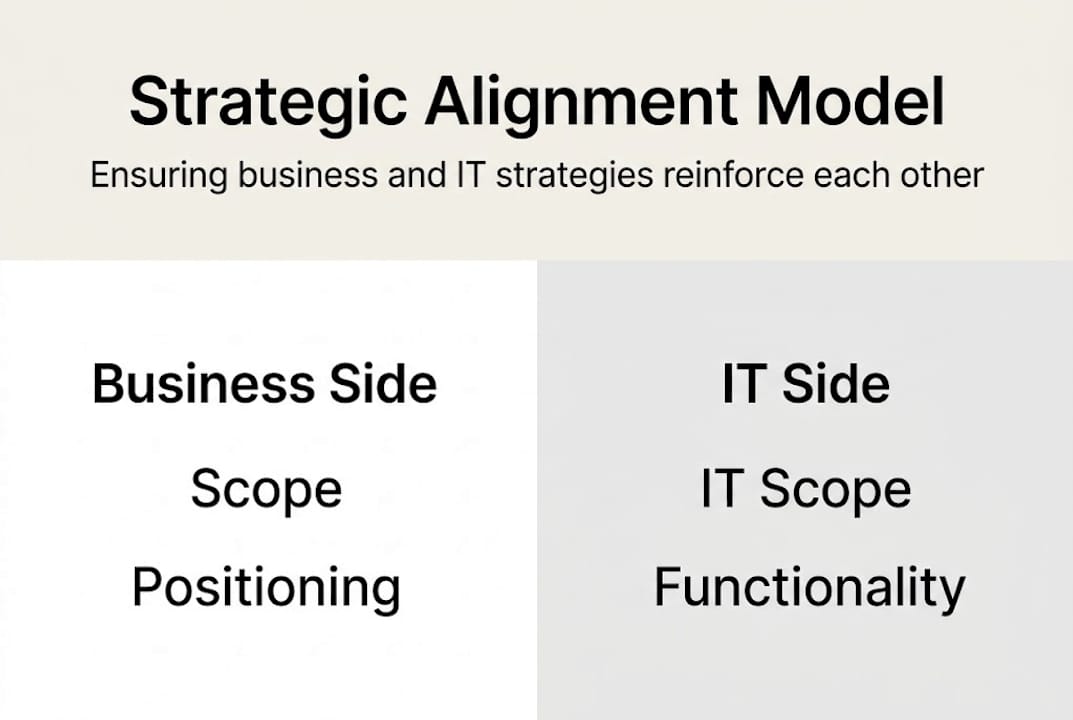
Understanding the concept is one thing. Knowing how to structure your alignment effort is another. The MIT Strategic Alignment Model provides a proven architecture for this work, built around four domains: business strategy, IT strategy, organizational infrastructure, and IT infrastructure.
Here is how those components relate to each other in practice:
| Dimension | Business side | IT side |
|---|---|---|
| Strategic fit | Business scope, competitive positioning | IT scope, technology architecture choices |
| Functional integration | Business processes, organizational skills | IT processes, system capabilities |
The table above clarifies something important: alignment is not a handoff. It is a continuous, bidirectional relationship. Business strategy shapes IT choices. IT capabilities inform and sometimes expand what is possible for business strategy.
Steps to deploy a strategic alignment framework in your organization:
- Conduct a joint strategy session. Bring C-suite and IT leadership into the same room with the explicit goal of mapping IT initiatives to business objectives. This is not a presentation meeting. It is a working session.
- Audit current-state alignment. Map every major IT system and program against a specific business outcome. Any system that cannot be traced to a measurable business goal is a candidate for rationalization.
- Identify strategic fit gaps. Where is the business moving that IT cannot support yet? These gaps define your investment priorities.
- Identify functional integration gaps. Where do IT processes and business processes create friction rather than flow? These gaps define your process improvement priorities.
- Assign co-ownership. Every major IT initiative should have both a business owner and an IT owner who are jointly accountable for outcomes.
- Establish a governance cadence. Monthly alignment reviews between business and IT leadership prevent drift. Quarterly strategic recalibrations ensure the model stays current as business conditions change.
Pro Tip: In KSA and UAE, co-ownership between business and IT leadership is not a best practice, it is a survival requirement. Organizations that treat alignment as purely an IT function consistently underperform on digital transformation ROI because business leaders disengage from accountability the moment something goes technically complex.
When you are aligning ERP strategy with your business model, the framework above gives you a structured lens to evaluate whether your ERP choices genuinely serve your strategic direction or simply automate existing inefficiencies. Following a C-level transformation roadmap ensures that alignment is not treated as a one-time exercise but as an ongoing executive discipline.
Application in complex organizations: Addressing silos and governance gaps
Large enterprises in KSA and UAE face a particular challenge that smaller organizations do not. Complexity scales faster than governance. As organizations grow, IT functions tend to fragment across departments, each building their own systems, processes, and vendor relationships. The result is a network of silos that actively block alignment.
The most common pitfalls in complex organizations include governance gaps where no single body owns alignment decisions, siloed IT teams that optimize for their own function rather than business outcomes, and the persistent “cost center” mentality where IT is measured on spend reduction rather than value creation.

| Challenge | Strategic solution |
|---|---|
| Siloed IT departments | Enterprise architecture governance board with cross-functional mandate |
| Weak compliance traceability | Compliance mapping embedded into IT project charters |
| IT as cost center | Outcome-based IT budgeting tied to business KPIs |
| Fragmented tech stack | Rationalization program with hybrid cloud integration layer |
| Slow change response | Agile IT governance with quarterly strategy recalibration |
Vision 2030 in Saudi Arabia and UAE digital economy initiatives add a layer of urgency to this picture. Hybrid cloud and Active Directory migrations are increasingly necessary not just for performance but for regulatory compliance with ZATCA and SAMA requirements. This means your IT architecture decisions carry direct legal and financial risk if they are made without a business governance layer.
“When IT is treated as a cost center, the organization pays twice: once in budget, and again in missed opportunity.” — Tamer Badr, Singleclic
Practical steps to bridge business-IT gaps in complex organizations:
- Establish an alignment governance body with both business and IT representation. This group owns the alignment framework and has authority to resolve cross-functional conflicts.
- Mandate business cases for all IT projects. Every technology initiative must articulate its expected business outcome in measurable terms before funding is approved.
- Implement transparency dashboards that show IT performance metrics alongside business performance metrics in a single view. When leaders see both together, they make better decisions.
- Conduct regular architecture reviews to identify where fragmented systems are creating process friction and compliance risk.
- Build a shared language between business and IT teams. Many alignment failures start as communication failures. Investing in shared terminology and joint training closes that gap faster than any technology tool.
Understanding the right enterprise software for CTOs is also a critical piece of this picture. The wrong system choices entrench silos further, while the right choices create natural integration points that make alignment easier to sustain over time.
Practical steps to achieve alignment: Success factors for KSA/UAE enterprises
With the governance model established and the pitfalls mapped, the question becomes operational: how do you actually execute sustained business-IT alignment in a KSA or UAE enterprise context? Here is a proven blueprint.
Step-by-step implementation approach:
- Start with joint strategic planning. Before any technology decisions are made, convene a cross-functional working group that includes business unit leaders, the CIO, and the CFO. The output of this session is a single document: a technology strategy that maps to your business strategy point by point.
- Map your compliance requirements. In KSA and UAE, ZATCA e-invoicing mandates, SAMA cybersecurity framework requirements, and UAE data residency regulations must be built into your technology architecture from the start, not retrofitted later. Compliance mapping should be a standard deliverable in your alignment framework.
- Modernize your technology stack with alignment in mind. Legacy systems are one of the most common sources of business-IT misalignment because they were built around old business models. A structured modernization program, prioritized by business impact, moves you toward a stack that naturally supports current strategy.
- Execute hybrid cloud and Active Directory migrations. For KSA and UAE enterprises subject to ZATCA/SAMA compliance requirements, hybrid cloud architecture provides the flexibility to scale while keeping sensitive data in compliant environments. AD migrations ensure identity management is robust enough to support multi-system governance.
- Establish alignment KPIs. If you cannot measure it, you cannot manage it. Define specific, business-facing metrics for your alignment program: time-to-market for new products enabled by IT, compliance audit pass rates, process cycle time reduction, and revenue per IT investment dollar.
- Create a continuous feedback loop. Alignment degrades without active maintenance. Monthly operational reviews and quarterly strategic recalibrations keep the model current as business conditions evolve.
Pro Tip: Set your alignment KPIs at the business outcome level, not the technical output level. “System uptime of 99.9%” is a technical metric. “Order processing cycle time reduced by 30%” is an alignment metric. The difference matters enormously when you are reporting to a board or steering committee that thinks in business terms.
Key success factors for sustained alignment:
- Active C-suite sponsorship. Alignment programs that are delegated entirely to IT consistently fail. The CEO and CFO must visibly champion the initiative.
- Transparency as a discipline. Regular, honest reporting on alignment progress, including gaps and failures, builds the trust needed for sustained co-ownership.
- Shared goals, not shared blame. Business and IT leaders must be measured on the same outcomes, not on their individual functional performance alone.
- Investment in change management. Technology changes are often straightforward. Behavioral changes, especially around shared accountability, require deliberate change management effort.
Reviewing your cloud migration efficiency approach ensures your infrastructure modernization directly supports alignment goals. Understanding your hybrid cloud choices is equally important, as the architecture you select will either enable or constrain your ability to stay compliant and agile simultaneously.
A fresh perspective: Why business-IT alignment remains misunderstood
After working with over 60 enterprise clients across KSA, UAE, and Egypt, the pattern is clear: most organizations treat alignment as a project, not a posture. They convene a strategy workshop, produce a document, and consider the work done. Within six months, silos have reformed and the document sits unread.
The uncomfortable truth is that alignment is not about frameworks. Frameworks are just scaffolding. What actually determines alignment outcomes is the consistency of C-suite engagement over time. When the CEO checks alignment in every strategic review, it stays aligned. When alignment becomes “an IT thing,” it drifts within quarters.
Vision 2030 and UAE digital economy mandates are accelerating the urgency here. Organizations that achieve genuine alignment are positioned to capture government contract opportunities, meet regulatory requirements ahead of enforcement, and scale operations without proportional cost increases. Those that do not are already falling behind, even if their financial statements have not shown it yet.
The organizations that get the most AI business value are also the ones with mature alignment, because AI initiatives require data infrastructure, governance structures, and process clarity that only come from sustained business-IT coordination.
Treat alignment as a leadership discipline, not a technology project. That single shift in mindset produces more operational improvement than any software implementation on its own.
Drive operational excellence with tailored business-IT solutions
The frameworks and steps in this article give you the strategic foundation. The next step is putting them into practice with the right implementation partner and tools.
At Singleclic, we specialize in helping KSA and UAE enterprises translate business-IT alignment from strategy into operational reality. Whether you are mapping your business process management foundations, accelerating results through business process automation, or beginning with an ERP readiness assessment, our team of 70+ consultants brings deep regional expertise and proven delivery frameworks to every engagement. Let us help you move from misalignment to measurable operational excellence.
Frequently asked questions
What is the first step to align business and IT in a regulated environment?
The first step is joint strategic planning involving both C-suite and IT leaders to map compliance and operational priorities together, ensuring technology decisions are grounded in regulatory and business requirements from the outset.
How does the MIT Strategic Alignment Model improve efficiency?
The MIT Strategic Alignment Model ensures business and IT strategies reinforce each other through strategic fit and functional integration, reducing duplication, eliminating misaligned investments, and accelerating process performance across the organization.
Why do many alignment initiatives fail?
Most fail because of siloed ownership and weak governance, combined with metrics that measure technical outputs rather than business outcomes, which removes accountability from the executives who need to sustain the effort.
How can KSA/UAE organizations ensure compliance while scaling IT?
Implementing hybrid cloud and AD migrations provides a compliant architecture that meets ZATCA and SAMA regulatory requirements while giving organizations the scalability needed to grow without creating new governance risks.