Saudi Arabia achieved 98% public service digitization in 2024 and now ranks 4th globally for digital services. As AI spending in the Kingdom heads toward $1.9 billion by 2027, executives face a critical question: how do you transform your workforce to seize these opportunities? This guide explains what digital upskilling truly means, why it’s strategic for Gulf organizations, and how to implement it successfully.
Table of Contents
- The Rise Of Digital Upskilling In Saudi Arabia And UAE
- Understanding Digital Upskilling And Its Strategic Impact
- Addressing Talent Challenges With Skills-Based Hiring And Upskilling Maturity Models
- Navigating Risks And Maximizing Value In Digital Upskilling Initiatives
- Empower Your Digital Transformation With Singleclic
- Frequently Asked Questions
Key takeaways
| Point | Details |
|——-|———||
| Digital upskilling is strategic | It strengthens workforce capabilities and directly supports Vision 2030 goals across Saudi Arabia and UAE. |
| Regional investments demand new skills | Saudi Arabia leads in AI and cybersecurity spending, creating urgent need for updated digital competencies. |
| Skills-based hiring accelerates progress | Combining maturity models with skills-based hiring aligns workforce development with business objectives. |
| Upskilling reduces talent gaps | Strategic programs future-proof organizations against automation risks and talent shortages. |
| Integration maximizes outcomes | Proper implementation boosts retention, productivity, and competitive agility across Gulf enterprises. |
The rise of digital upskilling in Saudi Arabia and UAE
Saudi Arabia ranked 4th globally in digital services as of 2024, with 98% public service digitization achieved. This achievement reflects how seriously Gulf nations take technology adoption. The UAE runs similar programs, with government platforms like Jahiz streamlining procurement and digital workflows across federal entities.
Vision 2030 drives Saudi Arabia’s digital-first economic diversification strategy. The Kingdom isn’t just buying technology. It’s reshaping entire sectors around digital capabilities, from healthcare to finance to construction.
Saudi Arabia’s AI spending is projected to reach $1.9 billion by 2027 and add $135 billion to GDP by 2030. These numbers create massive demand for AI engineers, data scientists, cybersecurity specialists, and digital strategists. Public sector initiatives now equip thousands of employees with future-ready digital skills.
Key regional digital trends include:
- Rapid expansion of cloud infrastructure and data centers across KSA and UAE
- Government mandates for digital service delivery in healthcare, education, and finance
- Growing cybersecurity investments to protect critical infrastructure
- AI integration in customer service, logistics, and government operations
- Smart city projects requiring IoT, data analytics, and automation expertise
These trends demand a workforce capable of implementing, managing, and optimizing advanced technologies. Organizations that invest in digital transformation roadmap 2025 planning recognize that technology alone doesn’t deliver results. Skilled people who understand how to apply these tools strategically make the difference. Gulf nations have learned from successful digital government projects in MENA that workforce capability is the true bottleneck, not technology availability.
Understanding digital upskilling and its strategic impact
Digital upskilling means systematically upgrading your employees’ technology skills to meet evolving business needs. It’s not a one-time training event. It’s an ongoing process of developing competencies in areas like data analysis, cloud platforms, automation tools, AI applications, and cybersecurity.
When organizations embed upskilling into talent and business strategies, they enhance retention and future-proof workforces. The benefits extend far beyond checking compliance boxes. Strategic digital upskilling delivers:
- Sustained talent pipeline: You build capabilities internally rather than competing for scarce external talent
- Organizational agility: Teams adapt faster to new technologies and market shifts
- Higher retention rates: Employees value growth opportunities and stay longer
- Innovation capacity: Digitally skilled teams identify improvement opportunities others miss
- Competitive advantage: Your organization executes digital strategies competitors can’t match
Many executives assume any technology training counts as digital upskilling. That’s a costly mistake. Effective upskilling aligns with your organization’s actual digital maturity level. Training employees on advanced AI tools when your systems still run on legacy infrastructure wastes resources and frustrates staff.
Common challenges include skill gaps that widen faster than training can close them, employee burnout from poorly designed programs, and misaligned training that doesn’t match real job requirements. The role of digital leaders KSA emphasizes matching upskilling investments to organizational readiness.
Pro Tip: Align upskilling initiatives with your organization’s current technology maturity level to maximize ROI and avoid overwhelming your workforce with premature advanced training.
The five stages of upskilling maturity provide a framework for workforce development planning:
- Ad hoc: Training happens reactively when problems emerge
- Opportunistic: Some structured programs exist but lack strategic coordination
- Systematic: Training aligns with business goals and follows consistent processes
- Integrated: Upskilling connects across departments and informs hiring, promotion, and succession planning
- Optimizing: Continuous improvement cycles refine programs based on business outcomes and emerging needs
Most Gulf organizations operate between stages two and three. Moving to integrated and optimizing stages requires executive commitment and cross-functional collaboration.
Addressing talent challenges with skills-based hiring and upskilling maturity models
Skills-based hiring evaluates candidates on demonstrated competencies rather than credentials alone. This approach aligns perfectly with Saudi Vision 2030’s emphasis on workforce capabilities over traditional qualifications. It opens talent pools and identifies high-potential candidates overlooked by credential-focused screening.
Skills-based hiring reduces screening time by up to 60% in Saudi Arabia and improves interview-to-offer rates. Traditional hiring focuses on degrees and years of experience. Skills-based hiring tests actual abilities through practical assessments, case studies, and portfolio reviews.
| Approach | Focus | Benefits | Limitations |
|---|---|---|---|
| Traditional credential hiring | Degrees, certifications, years of experience | Easy to screen, perceived credibility | Misses non-traditional talent, slower to adapt |
| Skills-based hiring | Demonstrated competencies, practical assessments | Faster screening, broader talent pools, better job fit | Requires robust assessment tools, cultural shift |
Combining skills-based hiring with mature upskilling programs creates a powerful talent strategy. You hire for current capabilities and growth potential, then systematically develop those capabilities through structured programs. This reduces talent shortfalls and accelerates digital skills boost KSA UAE execs growth outcomes.
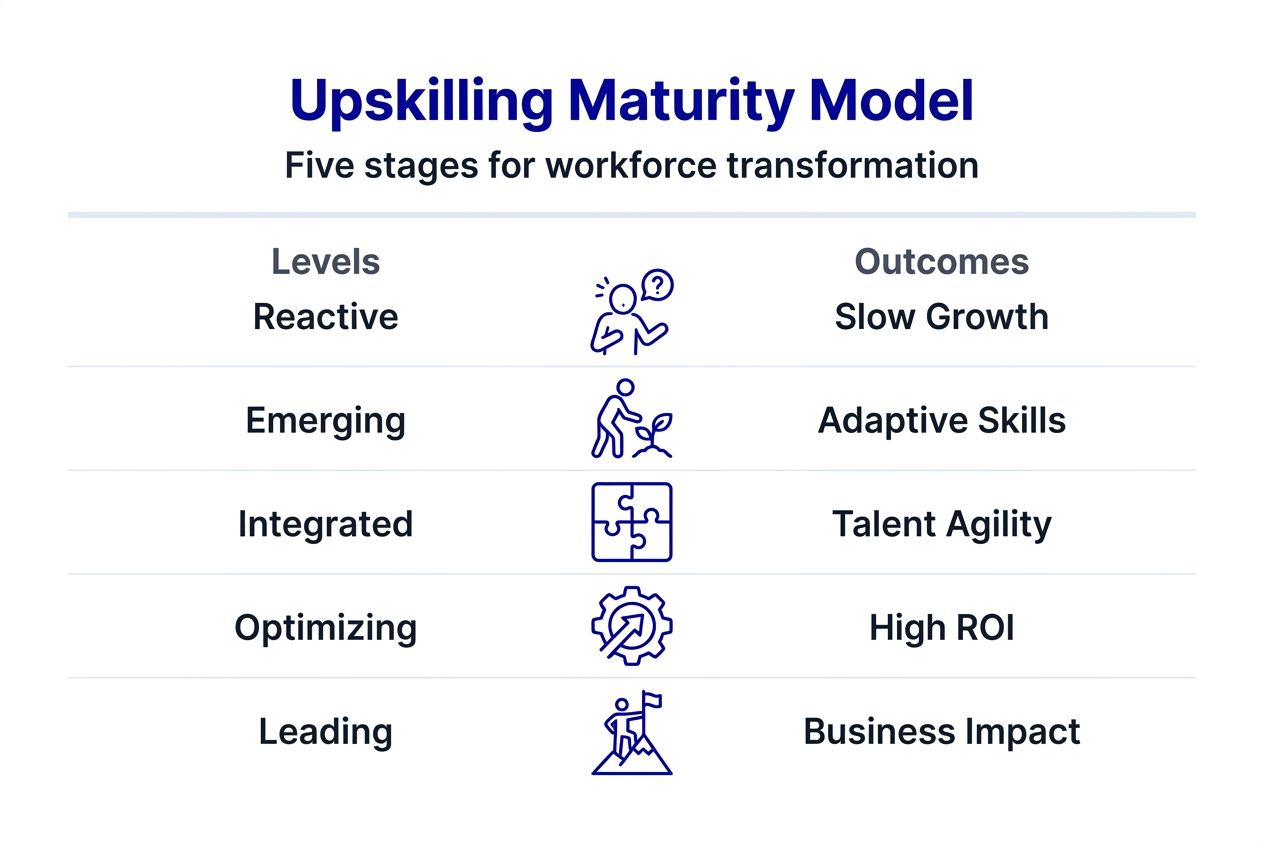
The Upskilling Maturity Model offers a five-level framework from reactive to proactive workforce development. Understanding where your organization sits on this spectrum helps you design realistic next steps.
| Maturity Level | Characteristics | Business Outcomes |
|---|---|---|
| Level 1: Ad hoc | Reactive, uncoordinated training | High skill gaps, frequent talent shortages |
| Level 2: Opportunistic | Some programs, limited strategy | Inconsistent results, unclear ROI |
| Level 3: Systematic | Aligned training, defined processes | Measurable improvements, better retention |
| Level 4: Integrated | Cross-functional coordination, strategic hiring | Competitive advantage, innovation capacity |
| Level 5: Optimizing | Continuous improvement, data-driven refinement | Market leadership, exceptional agility |
Pro Tip: Start with a skills audit to identify critical gaps before expanding upskilling investments, ensuring your programs address real business needs rather than generic training trends.
Gulf organizations that combine skills-based hiring with level four or five maturity achieve remarkable results. They fill positions faster, onboard employees more effectively, and see higher productivity from day one. More importantly, they build cultures where continuous learning becomes the norm, not an exception.
Navigating risks and maximizing value in digital upskilling initiatives
Digital upskilling investments fail when executives treat them as purely HR initiatives disconnected from business strategy. Overinvesting in technology without considering long-term talent development risks overwhelming employees and wasting resources. Three common pitfalls plague Gulf organizations.
Skill misalignment occurs when training focuses on trendy technologies rather than business-critical capabilities. Your team learns blockchain development when your actual need is data analytics for supply chain optimization. Employee burnout results from poorly paced programs that pile training onto already full workloads without adjusting responsibilities. Premature upskilling efforts target advanced capabilities before foundational digital literacy is established.
Syncing upskilling with organizational IT maturity and business strategies prevents these problems. If your ERP system is five years behind industry standards, training employees on cutting-edge AI integration makes no sense. Upgrade foundational systems first, then build advanced capabilities.
Successful digital transformation roadmap C-level success programs follow phased approaches:
- Phase 1: Assessment – Audit current capabilities, identify critical gaps, define target competencies
- Phase 2: Foundation – Establish digital literacy baseline across all employees
- Phase 3: Specialization – Develop role-specific advanced skills for key positions
- Phase 4: Integration – Connect training to performance management, promotion criteria, and succession planning
- Phase 5: Optimization – Continuously measure outcomes and refine programs based on business results
Continuous measurement matters more than perfect planning. Track metrics like skill acquisition rates, application of new skills in daily work, impact on key business outcomes, employee satisfaction with programs, and retention rates for upskilled employees. Adjust programs quarterly based on what the data shows.
Leadership involvement determines success. When executives actively participate in upskilling, model continuous learning, and tie programs to strategic priorities, organizations achieve dramatically better results. When leadership delegates upskilling entirely to HR, programs become compliance exercises that deliver minimal value.
“Technology investments without corresponding workforce development create expensive systems that sit underutilized. The real transformation happens when skilled people apply technology strategically to solve business problems that matter.”
Key actions to safeguard upskilling success include engaging stakeholders across departments early in program design, monitoring leading and lagging KPIs monthly, adapting content based on employee feedback and business changes, celebrating wins publicly to build momentum, and connecting upskilling directly to career advancement opportunities. These practices separate programs that transform organizations from those that merely consume budgets.
Empower your digital transformation with Singleclic
You’ve learned how digital upskilling drives workforce capability and supports Vision 2030 goals across Saudi Arabia and UAE. Now it’s time to implement these insights in your organization.
Singleclic delivers the expertise Gulf executives need to design and execute effective digital transformation strategies. Our team understands the unique challenges facing organizations in KSA and UAE because we’ve guided 60+ enterprises through similar journeys. We combine world-class technology with deep regional knowledge to help you build digitally capable workforces that drive real business outcomes.
Explore our digital transformation office guide to structure your transformation team effectively. Review our digital transformation roadmap for C-level success to align technology and talent strategies. Discover how our business process automation guide for C-level leaders accelerates workforce readiness while improving operational efficiency.
We’re not just a vendor. We’re your partner in moving beyond digitalization into true optimization.
Frequently asked questions
What exactly is digital upskilling and why does it matter now?
Digital upskilling is the ongoing process of developing employee competencies in technologies like AI, data analytics, cloud platforms, and automation to meet evolving business needs. It matters now because Gulf organizations face rapid digital transformation driven by Vision 2030 and massive technology investments that require skilled workforces to deliver ROI.
How does digital upskilling differ from traditional employee training?
Traditional training focuses on immediate job tasks and compliance requirements. Digital upskilling builds forward-looking capabilities that prepare employees for technologies and workflows that don’t exist yet. It’s strategic, continuous, and directly tied to business transformation goals rather than just filling knowledge gaps.
What challenges do Saudi and UAE organizations face with digital upskilling?
Skill gaps widen faster than training programs can address them, especially in AI and cybersecurity. Cultural resistance to continuous learning slows adoption. Many organizations lack strategic alignment between upskilling investments and actual business priorities. Without proper assessment of technology maturity, training efforts target capabilities employees can’t yet apply.
Should we hire new talent or upskill existing employees?
Combine both strategies through skills-based hiring paired with mature upskilling programs. External hiring brings fresh perspectives and fills immediate gaps. Upskilling existing employees preserves institutional knowledge, improves retention, and costs less than recruiting specialized talent in competitive markets. The best approach balances both based on your specific needs.
What role does the Upskilling Maturity Model play in workforce planning?
The five-level maturity model helps executives assess current capabilities and design realistic next steps. It shows whether your organization operates reactively or strategically, identifies gaps in coordination and measurement, and provides a roadmap from ad hoc training to optimized, data-driven programs that deliver competitive advantage.
How do we measure ROI on digital upskilling investments?
Track skill acquisition rates through assessments, monitor application of new capabilities in daily work, measure impact on key business metrics like productivity and quality, survey employee satisfaction with programs, and compare retention rates for upskilled versus non-upskilled employees. Connect these metrics to strategic outcomes like faster project delivery or reduced operational costs.