Companies across the American market are discovering that nearly 70 percent of process improvement projects fall short without a strategic approach. Business process optimization matters more than ever as organizations balance rising costs, rapid technology shifts, and growing customer expectations. Understanding how modern strategies streamline operations and boost agility helps leaders avoid common pitfalls while maximizing results in today’s competitive landscape.
Table of Contents
- Defining Business Process Optimization Today
- Types of Business Process Optimization Approaches
- How Modern Automation Technologies Transform Processes
- Industry Use Cases in MENA and Beyond
- Risks, Barriers, and Implementation Mistakes
Key Takeaways
| Point | Details |
|---|---|
| Business Process Optimization is Essential | Organizations must systematically analyze and enhance workflows to maximize efficiency and drive performance improvements. |
| Adoption of Advanced Technologies | Leveraging automation tools and AI can significantly streamline processes and enhance decision-making capabilities. |
| Holistic Implementation Approach | Successful business process optimization requires a balance of technological innovation, strategic thinking, and robust change management. |
| Sector-Specific Applications | Diverse industries, especially in the MENA region, are increasingly recognizing the transformative potential of business process optimization. |
Defining Business Process Optimization Today
Business Process Optimization represents a strategic approach that enables organizations to systematically improve and streamline their operational workflows. At its core, this methodology focuses on analyzing, redesigning, and enhancing existing business processes to maximize efficiency, reduce operational costs, and drive sustainable performance improvements.
The fundamental goal of business process optimization is to create more agile and responsive organizational systems. Business Process Standardization helps organizations achieve consistency across underlying processes, supporting service delivery excellence and optimizing both costs and benefits. Companies in Saudi Arabia and the UAE are increasingly recognizing that effective process optimization can transform their competitive landscape, allowing them to adapt quickly to market changes and customer demands.
Key components of modern business process optimization include:
- Comprehensive workflow analysis
- Identifying performance bottlenecks
- Implementing data-driven improvement strategies
- Leveraging advanced technologies like low-code platforms and automation tools
Successful business process optimization requires a holistic approach that combines technological innovation, strategic thinking, and continuous improvement. By systematically examining each operational workflow, organizations can eliminate redundancies, reduce errors, and create more streamlined, efficient systems that directly contribute to bottom-line performance.
Types of Business Process Optimization Approaches
Business Process Optimization encompasses multiple strategic approaches designed to enhance organizational performance and efficiency. Organizations can leverage various methodologies to systematically improve their operational workflows, each offering unique insights and transformation potential for businesses across different industries.
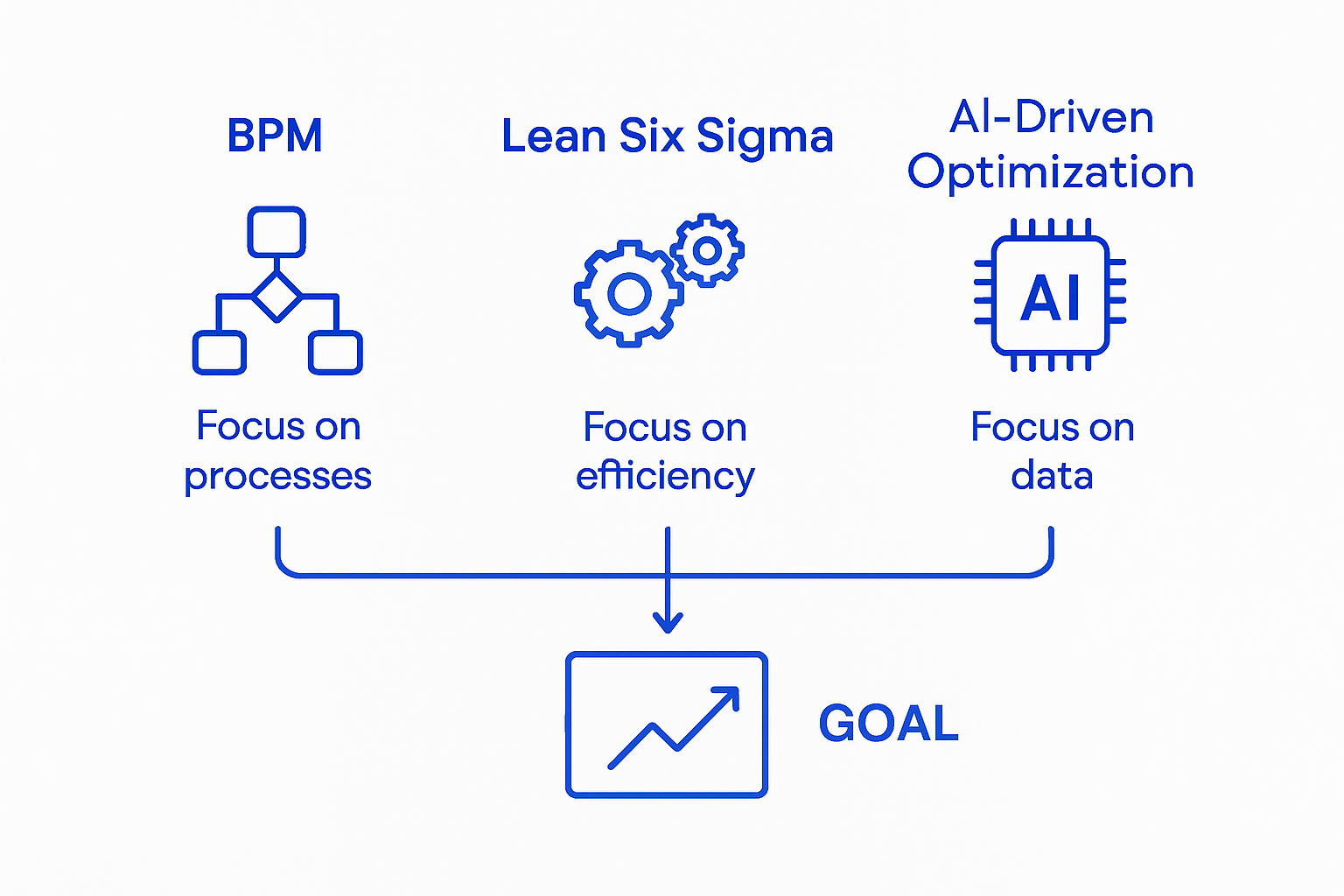
Business Process Management (BPM) represents one of the most comprehensive optimization frameworks. The BPM lifecycle, as proposed by Dumas, provides a systematic methodology that enables thorough analysis, strategic improvement identification, and ongoing refinement of business processes. This approach is particularly valuable for companies in Saudi Arabia and the UAE seeking to create more adaptive and responsive organizational structures.
Key approaches to business process optimization include:
- Process Mapping and Analysis: Visualizing current workflows to identify inefficiencies
- Lean Six Sigma: Reducing waste and minimizing variation in processes
- Artificial Intelligence-Driven Optimization: Utilizing advanced predictive models to enhance decision-making
- Continuous Improvement Frameworks: Implementing iterative approaches to process enhancement
Moreover, advanced techniques like the Failure Mode and Effects Analysis (FMEA) method are increasingly being enhanced by artificial intelligence. By leveraging machine learning models such as Random Forest and XGBoost, organizations can now predict potential risks and streamline assessment processes with unprecedented accuracy, transforming traditional optimization strategies into data-driven, predictive frameworks.
How Modern Automation Technologies Transform Processes
Modern automation technologies are revolutionizing the way organizations approach business process management, creating unprecedented opportunities for efficiency and innovation. These advanced technological solutions are transforming traditional workflows by integrating intelligent systems that can analyze, predict, and optimize complex organizational processes with remarkable precision.

Artificial Intelligence and Big Data integration has emerged as a game-changing approach to process optimization. By adopting a sophisticated three-layer architecture that incorporates data processing, AI algorithms, and business logic, organizations can now achieve intelligent management of their entire process lifecycle. This breakthrough enables real-time process monitoring and optimization, particularly valuable for businesses in Saudi Arabia and the UAE seeking competitive advantages in rapidly evolving markets.
Key automation technologies driving process transformation include:
- Robotic Process Automation (RPA): Automating repetitive manual tasks
- Machine Learning Algorithms: Predictive process modeling
- Advanced Analytics: Real-time performance monitoring and optimization
- Intelligent Workflow Management: Dynamic process reconfiguration
Moreover, cutting-edge techniques like multi-objective process discovery are expanding the boundaries of automation. By employing advanced algorithmic approaches such as dichotomous crossover and mutation operators, organizations can now generate multiple process model candidates, allowing decision makers to select the most suitable solution based on specific environmental constraints and organizational requirements.
Industry Use Cases in MENA and Beyond
Business Process Optimization has become a critical strategy for organizations across diverse sectors, transforming operational capabilities and driving strategic innovation. The Middle East and North Africa (MENA) region has emerged as a dynamic landscape where companies are rapidly adopting advanced process management techniques to enhance competitiveness and operational efficiency.
Business Process Management (BPM) methodologies have demonstrated remarkable potential across multiple industries. In the healthcare sector, systematic reviews have highlighted the effectiveness of BPM in optimizing clinical processes, improving overall service quality and patient care delivery. Universities and educational institutions are also leveraging these techniques to streamline administrative workflows, reduce communication barriers, and enhance student support services.
Industry-specific use cases in the MENA region include:
- Banking and Finance: Automating compliance reporting and risk management processes
- Healthcare: Standardizing patient intake and treatment documentation
- Government Services: Digitalizing citizen interaction and document processing
- Education: Streamlining student enrollment and academic administrative tasks
- Real Estate: Optimizing property management and transaction workflows
The versatility of business process optimization extends beyond traditional sector boundaries. Organizations in Saudi Arabia and the United Arab Emirates are increasingly adopting advanced technologies to create more agile, responsive, and efficient operational frameworks. By implementing intelligent automation solutions, these businesses can reduce administrative overhead, minimize human error, and create more transparent, data-driven decision-making processes that drive sustainable competitive advantages.
Risks, Barriers, and Implementation Mistakes
Business process optimization initiatives are complex undertakings that demand strategic planning and nuanced execution. While the potential benefits are significant, organizations frequently encounter substantial challenges that can derail their transformation efforts, making a comprehensive understanding of potential risks critical for successful implementation.
Resource allocation strategies represent one of the most complex decision-making challenges in process optimization. Organizations in Saudi Arabia and the United Arab Emirates must carefully navigate the intricate landscape of technological investment, human capital deployment, and strategic prioritization to ensure successful digital transformation initiatives.
Common risks and implementation barriers include:
- Cultural Resistance: Employees reluctant to adopt new technological workflows
- Insufficient Change Management: Lack of comprehensive staff training and engagement
- Technological Incompatibility: Legacy systems that cannot integrate with new automation tools
- Inadequate Data Governance: Poor quality or inconsistent data undermining optimization efforts
- Unrealistic Expectations: Overestimating immediate transformation potential
The Business Process Management (BPM) lifecycle provides a structured approach to mitigating these risks. By systematically addressing process identification, analysis, redesign, implementation, monitoring, and optimization, organizations can create a robust framework that fosters collaboration, enhances communication among stakeholders, and ensures a shared understanding of transformation objectives. Successful implementation requires a holistic approach that balances technological innovation with human-centric organizational development.
Drive Operational Excellence with Singleclic’s Business Process Solutions
Many organizations in Saudi Arabia, the UAE, and beyond face challenges such as inefficient workflows, resistance to change, and lack of real-time process optimization as they pursue business process optimization. This article highlights the importance of strategic workflow analysis, leveraging automation technologies, and adopting frameworks like Business Process Management to unlock true operational agility and reduce costs.
At Singleclic, we understand these challenges and help you overcome them by combining cutting-edge automation tools like Robotic Process Automation (RPA) with enterprise-grade Business Process Automation using IBM BAW and BonitaSoft. Our unique Arabic-enabled low-code platform, Cortex, empowers you to design, automate, and evolve complex processes without code while supporting real-time optimization and deep integration — key factors in avoiding implementation risks and boosting efficiency.
Take the first step toward transforming your business processes. Visit us at Singleclic to discover how our tailored digital transformation, ERP/CRM implementation, and AI-powered solutions can elevate your operations NOW. Don’t let organizational complexity slow you down. Optimize smarter, faster, and more connected with a trusted partner who knows how to deliver lasting results.
Frequently Asked Questions
What is business process optimization?
Business process optimization is a strategic approach that enables organizations to systematically improve and streamline their operational workflows, focusing on maximizing efficiency, reducing costs, and enhancing performance.
What are the key components of business process optimization?
Key components include comprehensive workflow analysis, identifying performance bottlenecks, implementing data-driven improvement strategies, and leveraging advanced technologies like automation tools and low-code platforms.
What methodologies are used in business process optimization?
Common methodologies include Business Process Management (BPM), Lean Six Sigma, artificial intelligence-driven optimization, and continuous improvement frameworks, each designed to enhance performance and efficiency.
What are the common risks associated with implementing business process optimization?
Common risks include cultural resistance from employees, insufficient change management practices, technological incompatibility with legacy systems, and inadequate data governance affecting optimization efforts.
Recommended
- Business Processes in ERP: Streamlining Operations for Maximum Efficiency | Singleclic
- Business Process Automation Solutions | Singleclic
- Operations Digitization Process: Streamline Your Enterprise | Singleclic
- Unlocking Business Growth with Odoo CRM: 6 Key Benefits for CEOs and SMBs | Singleclic
- Understanding Managing Customer Expectations in Diesel Services – My WordPress