TL;DR:
- Most digital project failures in the GCC stem from organizational, strategic, and cultural issues rather than technology flaws.
- Leadership alignment, change management, and a strong digital culture are critical for successful transformation.
- Using agile methodologies, conducting organizational readiness assessments, and defining clear ROI metrics improve project success.
Between 55% and 89% of digital projects fail to deliver their intended results, depending on which research firm you ask. For C-level executives in Saudi Arabia and UAE, that statistic is not an abstract industry problem. It is a direct threat to capital, competitive position, and national transformation goals. The instinct is to blame the technology, the vendor, or the platform. But the data tells a different story. The real culprits are organizational, strategic, and cultural. This article exposes the failure patterns most relevant to GCC leaders and gives you a clear framework for avoiding them.
Table of Contents
- The real reasons digital projects fail: Beyond technology
- Leadership missteps and governance gaps
- Cultural resistance and the skills deficit
- Methodology mistakes: Scope creep, poor requirements, and legacy systems
- Special challenges for GCC leaders: AI, ROI, and the execution gap
- A fresh perspective: Stop blaming technology, fix the fundamentals instead
- Next steps: Accelerate digital project success with expert guidance
- Frequently asked questions
Key Takeaways
| Point | Details |
|---|---|
| Strategy before technology | Organizational and cultural readiness are more critical than tech choices for digital project success. |
| Leadership alignment | C-level buy-in, visible governance, and clear priorities directly drive project outcomes. |
| Invest in skills and culture | Ongoing training and change programs are essential in overcoming GCC-specific digital barriers. |
| Methodology matters | Agile, iterative approaches outperform traditional methods in managing scope and ROI. |
| Local challenges for GCC | AI adoption is high but real value depends on closing gaps in execution and ROI measurement. |
The real reasons digital projects fail: Beyond technology
Most executives assume that when a digital project collapses, a technical flaw is responsible. A buggy ERP. A poorly integrated platform. An AI model that did not perform. This assumption is expensive and wrong.
McKinsey and BCG research consistently shows that execution, governance, and change management are the primary failure drivers, not the technology itself. Across the GCC, governments have invested heavily in digital infrastructure, and connectivity and platform availability are genuinely world-class. Yet productivity gains remain elusive because the human and organizational layers have not kept pace.
The most common non-technical reasons digital projects fail include:
- Unclear strategy and ROI definition before a single line of code is written
- Weak or absent change management, leaving employees resistant and unprepared
- Leadership misalignment, where sponsors lose interest or shift priorities mid-project
- Skills gaps that prevent teams from using new tools effectively
- Poor governance structures that allow decisions to drift without accountability
- Digital culture’s impact being underestimated at the planning stage
“Technology is rarely the limiting factor. The organizations that succeed are the ones that treat digital transformation as a people and process challenge first, and a technology challenge second.” — Tamer Badr, Singleclic
This matters deeply for GCC leaders navigating transformation pitfalls in regulated and relationship-driven industries. Understanding the transformation success factors that actually move the needle starts with accepting that the platform you choose is the last variable, not the first.
Pro Tip: Before committing budget to any new technology, run a structured organizational readiness assessment. Evaluate leadership alignment, change capacity, and skills availability. If those are not solid, delay the technology decision.
Leadership missteps and governance gaps
Once you accept that technology is not the core problem, leadership accountability becomes impossible to avoid. 47% of digital project failures are directly attributed to a lack of executive buy-in, according to McKinsey. That is not a minor contributing factor. That is the single largest cause of failure across industries and geographies.
C-level leaders in Saudi Arabia and UAE face a unique pressure: ambitious national transformation timelines, board expectations, and a fast-moving competitive landscape. This combination often pushes organizations to launch projects before governance structures are ready.
The most common leadership errors that derail digital projects include:
- Launching without executive alignment, where different leaders have different definitions of success
- Shifting priorities mid-project, pulling resources and attention away before results are achieved
- Delegating too deeply, treating transformation as an IT project rather than a business strategy
- Ignoring early warning signals from project teams about scope, budget, or adoption risks
- Failing to build a governance structure with clear decision rights, escalation paths, and accountability
“In the GCC, the CEO’s visible commitment is not just symbolic. It directly determines whether middle management cooperates or quietly resists. Without that signal from the top, transformation stalls at the second tier.” — Tamer Badr, Singleclic
The leadership role in transformation is not ceremonial. It requires sustained attention, structured oversight, and willingness to make difficult calls when projects drift. Building a solid transformation roadmap and following a transformation checklist gives your leadership team the scaffolding to stay aligned through complexity.
Cultural resistance and the skills deficit
Leadership sets the direction, but culture determines whether the organization actually moves. 31% of CEOs identify cultural resistance as the primary reason their digital initiatives fail. That number reflects a real pattern: employees protect familiar workflows, middle managers guard their authority, and teams find ways to work around new systems rather than adopt them.

In the GCC, this challenge is compounded by a specific regional dynamic. Gulf digitalization has advanced rapidly at the infrastructure level, but productivity metrics have barely moved because skills and private sector adoption have not kept pace.
| Challenge area | Regional indicator | Business impact |
|---|---|---|
| Digital skills gap | Low advanced digital proficiency in workforce | Underutilization of platforms |
| Cultural resistance | 31% of CEOs cite it as primary failure cause | Adoption failure post-launch |
| Productivity stagnation | Infrastructure investment not reflected in output | Negative ROI on transformation spend |
| Private sector lag | Public sector leads; private sector adoption slower | Uneven competitive landscape |
The cultural factors that most often block project traction include:
- Change fatigue from too many initiatives launched in quick succession
- Fear of job displacement driving passive resistance to automation
- Siloed thinking that prevents cross-functional adoption
- Lack of visible wins that would build momentum and trust in new systems
- Insufficient investment in upskilling strategies before and during rollout
Organizations that succeed at cultural transformation typically identify change champions inside each business unit, people who believe in the initiative and can translate it for their peers. They also invest in boosting digital skills before go-live, not after problems emerge.
Pro Tip: Identify three to five respected employees in key departments and involve them in the project from the design phase. Their peer credibility will do more for adoption than any formal training program.
Methodology mistakes: Scope creep, poor requirements, and legacy systems
Even when leadership is aligned and culture is supportive, projects can still fail from the inside. The mechanics of how a project is planned and executed matter enormously.
Poor requirements definition contributes to 45% of IT project failures. Legacy system incompatibility affects 54% of organizations attempting transformation. Scope creep, the gradual expansion of project boundaries beyond what was originally agreed, impacts 34% of initiatives. These are not edge cases. They are the norm.
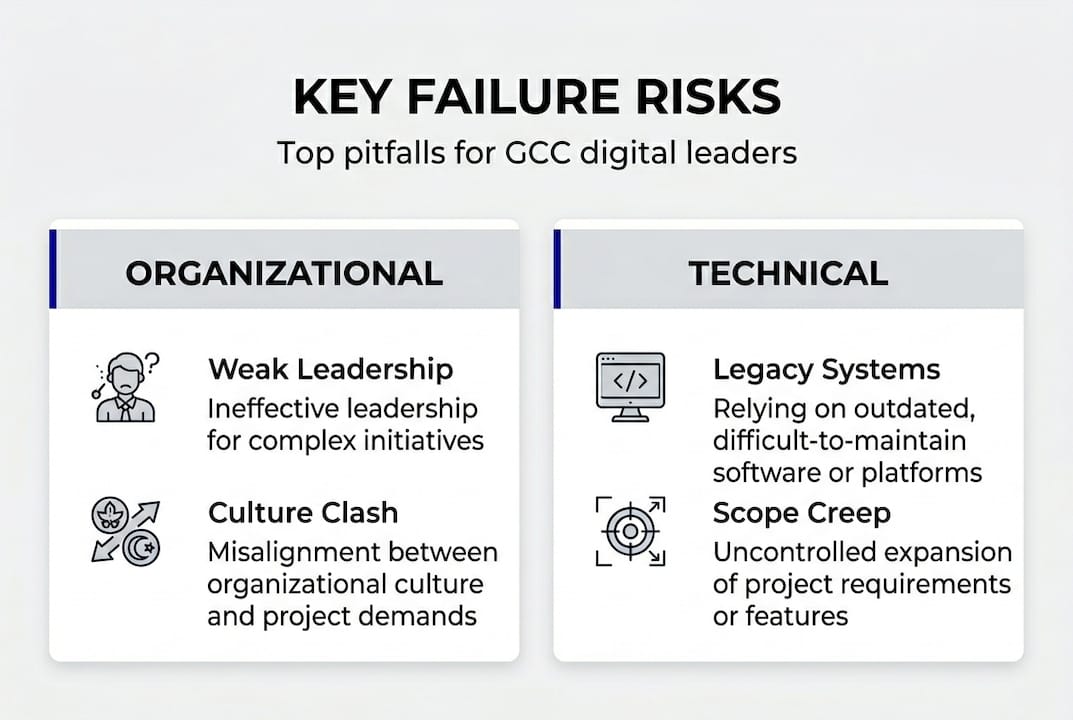
The financial consequences are equally striking. 25% of digital projects overrun their budgets by more than 50%, and 40% deliver no measurable ROI at all. That last figure should concern every executive who has approved a transformation budget.
| Approach | Agile | Waterfall |
|---|---|---|
| Best suited for | Complex, evolving projects | Stable, well-defined projects |
| Risk exposure | Lower, caught early through sprints | Higher, problems surface late |
| Flexibility | High, scope adjusts iteratively | Low, changes are costly |
| Stakeholder visibility | Continuous feedback loops | Limited until delivery |
| GCC fit | Strong for digital transformation | Risky for large-scale change |
Agile methodologies consistently outperform waterfall approaches for complex digital projects, particularly where requirements are likely to evolve. The iterative model catches problems early, keeps stakeholders engaged, and delivers visible progress that sustains executive support.
To reduce methodology risk, follow these steps:
- Define requirements with business owners, not just IT teams, before vendor selection
- Audit legacy systems for integration complexity before committing to timelines
- Set a formal scope change process with executive sign-off required for additions
- Choose agile delivery for transformation projects with more than six months of runway
- Establish ROI metrics upfront so measurement is built into delivery, not added afterward
Avoiding common pitfalls in methodology selection is one of the clearest paths to a successful business growth roadmap.
Special challenges for GCC leaders: AI, ROI, and the execution gap
Saudi Arabia and UAE are among the most aggressive AI adopters in the world. 88% of Middle East organizations have adopted AI in some form, a rate that outpaces most mature markets. But adoption and value delivery are two different things. 59% of those same organizations struggle to measure the ROI of their AI investments.
This gap between enthusiasm and execution is the defining digital challenge for GCC leaders right now. The unique pressures include:
- Expectation inflation, where AI is positioned as a transformation cure-all rather than a tool requiring integration and governance
- Short delivery cycles driven by national program timelines that compress planning and testing phases
- Unclear success metrics, where projects are declared complete at go-live rather than measured over 12 to 24 months
- Vendor dependency, where organizations lack internal capability to manage, adapt, or optimize AI tools post-deployment
- Data readiness gaps, where AI systems are deployed on top of fragmented or low-quality data
“The Middle East has the ambition and the investment. What is missing is the measurement discipline. AI without a clear ROI framework becomes a cost center, not a competitive advantage.” — Tamer Badr, Singleclic
To close the execution gap, GCC leaders need to develop post-launch ROI frameworks before any AI project begins. Define what success looks like at 90 days, 6 months, and 12 months. Assign ownership for measurement. Treat the post-go-live period as the most important phase, not the finish line. Staying current on digital trends 2026 will help you anticipate where the next execution gaps are likely to emerge.
A fresh perspective: Stop blaming technology, fix the fundamentals instead
After more than a decade of working with enterprises across KSA, UAE, and Egypt, we have seen a consistent pattern: organizations that succeed at digital transformation are not the ones with the best platforms. They are the ones that did the unglamorous work first.
The industry has a bias toward technology announcements. New platform launches, AI pilots, and digital strategy decks generate excitement. Governance redesign, culture programs, and skills investment do not make headlines. But they are what actually determine outcomes.
The uncomfortable truth is that slow, visible, iterative wins build more lasting momentum than ambitious big-bang launches. A team that successfully adopts one automated workflow and sees the time savings will advocate for the next initiative. A team that survives a chaotic ERP rollout will resist the next one.
Before your next technology investment, audit your digital culture focus and governance structure honestly. Ask whether your leadership team is genuinely aligned or just nominally supportive. The answer to that question will tell you more about your project’s odds than any vendor demo.
Pro Tip: Conduct a culture and governance audit before approving technology budgets. If alignment is weak, fix that first. The technology will still be there in six months.
Next steps: Accelerate digital project success with expert guidance
Understanding why projects fail is valuable. Knowing how to prevent failure in your specific context is what moves organizations forward.
At Singleclic, we work with C-level leaders across Saudi Arabia, UAE, and Egypt to reduce transformation risk through structured readiness assessments, agile delivery frameworks, and business process management approaches that are built for GCC enterprise realities. Whether you are evaluating an ERP readiness assessment before a major implementation or looking for guidance on Agile ERP delivery, our team of 70+ consultants brings regional expertise and proven methodology to every engagement. The goal is not just digitalization. It is optimization that lasts.
Frequently asked questions
What is the main reason digital projects fail in Saudi Arabia and UAE?
Most digital projects fail due to organizational and cultural issues rather than technology flaws, with cultural resistance cited by 31% of CEOs as the primary cause. Leadership misalignment and weak change management amplify these failures significantly.
How can executives reduce scope creep and budget overruns?
Adopting agile over waterfall for complex projects and locking down requirements with business owners before vendor selection are the two most effective controls. A formal scope change process with executive sign-off adds an additional layer of protection.
Why is ROI often elusive for digital transformation?
40% of digital projects deliver no measurable ROI because success metrics are not defined before launch and measurement ownership is not assigned. Without a post-launch ROI framework, there is no way to distinguish a successful project from an expensive one.
What role does leadership play in successful digital transformation?
Executive buy-in drives or destroys 47% of project outcomes, making it the single largest controllable success factor. Visible, sustained sponsorship from the C-suite signals to the entire organization that the initiative is real and non-negotiable.
How does AI adoption impact digital projects in the Middle East?
With 88% AI adoption across the region, the Middle East leads in deployment but 59% of organizations struggle to measure returns. High adoption without measurement discipline turns AI investments into cost centers rather than competitive advantages.