TL;DR:
- Process standardization reduces variation and creates consistent, repeatable procedures across organizations. It provides a clear foundation for measuring performance and enabling continuous improvement through structured documentation, governance, and digital tools. Embedding standards into operational systems ensures sustainable adoption and supports scalable growth.
Process standardization is defined as the practice of reducing unnecessary variation in how work gets done by creating uniform, repeatable procedures that produce consistent results across an organization. According to APQC, standardization creates clarity, confidence, and fewer errors in work execution. For business leaders in Saudi Arabia, UAE, and Egypt managing multi-team or multi-site operations, this discipline is the foundation of scalable efficiency. Frameworks like the APQC Process Classification Framework (PCF) and methodologies like Lean Six Sigma give organizations a shared language to build on. Modern tools, including low-code platforms, now make it faster than ever to document, distribute, and enforce those standards at scale.
What is process standardization and why does it matter?
Process standardization is the deliberate effort to define how a task should be performed, document that method, and apply it consistently across every person, team, or location that executes it. The goal is not uniformity for its own sake. It is to eliminate the variation that causes errors, delays, and unpredictable outcomes.

APQC’s research shows that without a common structure or shared language, standardization conversations inside organizations become “interpretation battles,” creating friction and inefficiency instead of alignment. This is especially common in organizations operating across multiple geographies, such as a construction firm with projects in both Riyadh and Dubai, where each site may develop its own way of handling procurement or quality checks.
The strategic value is clear. When every team follows the same validated method, you can measure performance accurately, identify where breakdowns occur, and fix them at the root. Standardization also reduces onboarding time because new employees have documented procedures to follow rather than relying on tribal knowledge from colleagues.
What are the core elements of process standardization?
Effective process standardization rests on four building blocks: process definitions, documentation, governance, and review cycles.
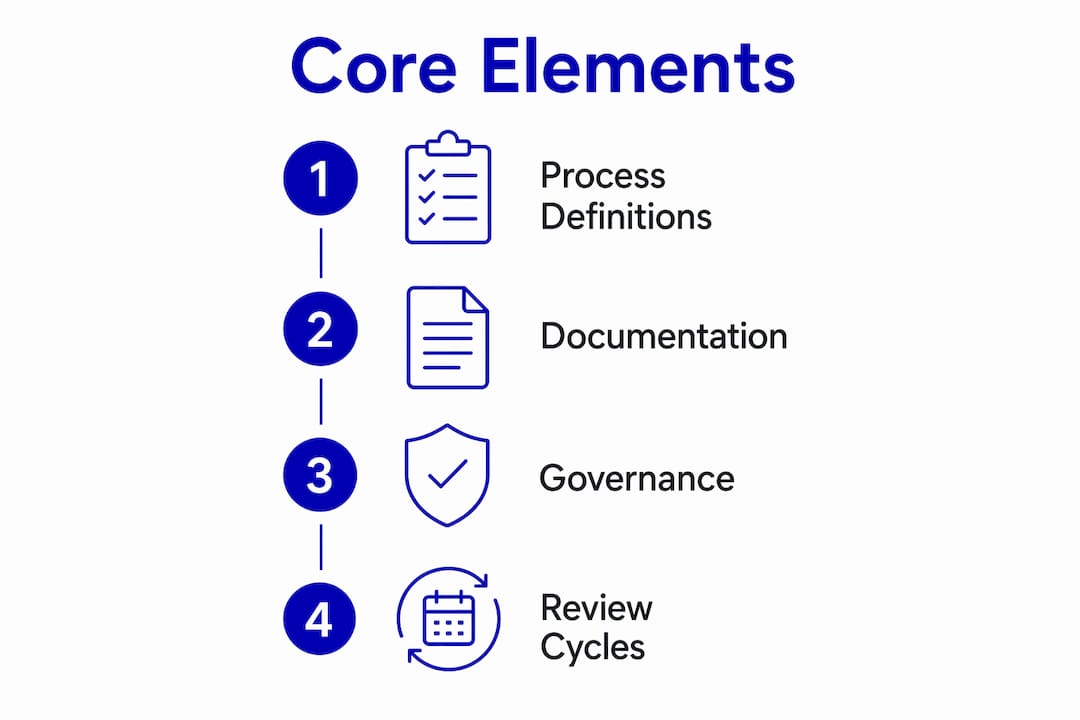
Process definitions remove ambiguity by specifying what a process does, where it starts, where it ends, and who is responsible. Without this, two teams can use the same process name to describe completely different workflows.
Documentation types vary by purpose and audience:
- Policies set the rules and boundaries for how work must be done.
- Procedures describe the sequence of steps to execute a process.
- Standard Work Instructions (SWIs) provide operator-level detail, including safety steps, quality checkpoints, and decision points.
ISO 9001 Clause 7.5 draws a critical distinction between documents (living guidance that can be updated) and records (immutable proof that a process was executed). Confusing the two is a common audit failure. A procedure manual is a document; a completed inspection checklist is a record.
Governance is what prevents standards from drifting back to local variation. APQC stresses that frameworks alone are insufficient without governance structures to keep standards discoverable, accessible, and enforced in daily workflows. Governance includes assigning process owners, defining update approval chains, and setting review schedules.
Review cycles treat standards as living documents. A standard that was accurate two years ago may no longer reflect current technology, regulations, or customer requirements.
| Element | Purpose |
|---|---|
| Process definitions | Remove ambiguity about scope, ownership, and boundaries |
| Standard Work Instructions | Provide step-by-step operator guidance with quality checkpoints |
| ISO 9001 document controls | Distinguish living guidance from immutable execution records |
| Governance framework | Prevent drift and keep standards accessible and enforced |
| Periodic review cycles | Keep standards current with operational and regulatory changes |
Pro Tip: Assign a named process owner to every documented standard. Without ownership, standards go stale within 12 to 18 months as operations evolve and no one updates the documentation.
How does standardization support Lean and Six Sigma improvement?
Process standardization and continuous improvement are not competing ideas. Standardization is the prerequisite for improvement. You cannot reliably improve a process you cannot consistently repeat.
In Lean manufacturing and service operations, this relationship is formalized in the Standardize, Do, Observe, Improve, Restandardize cycle. The Lean TPS model treats standardized work as a dynamic baseline, not a rigid freeze. When a team follows a standard consistently, any deviation becomes immediately visible. That visibility is what enables problem-solving and targeted improvement.
In Six Sigma’s DMAIC methodology, the Control phase is where standardization does its most important work. After a project team has identified and validated a process improvement, the Control phase locks that improvement in place through updated standard work instructions. Without this step, teams revert to old habits within weeks, and the gains disappear.
The practical steps for connecting standardization to continuous improvement follow a clear sequence:
- Document the current best-known method as the starting standard before any improvement work begins.
- Execute the standard consistently across all relevant teams or sites to generate reliable performance data.
- Observe deviations and treat them as signals, not failures. Deviations reveal where the standard is unclear or where the process has a genuine problem.
- Improve the process using data from observed deviations, then validate the new method.
- Restandardize by updating the SWI to reflect the improved method and communicating the change to all process participants.
“Standardized work is not meant to freeze improvement. It provides a stable baseline for measuring the impact of every change you make.” — GBMP Lean Institute
A common failure mode in Lean Six Sigma programs is updating process maps on a whiteboard or in a software tool without aligning operator-facing SWIs. The visual map changes, but the person on the floor still follows the old instruction. That gap breaks control entirely.
Pro Tip: Schedule SWI reviews quarterly or semi-annually as a standing calendar item. Treat an outdated SWI the same way you would treat a broken machine. Both stop the process from working correctly.
How do process standardization and process optimization differ?
Process standardization and process optimization are related but distinct disciplines. Understanding the difference helps you sequence your improvement investments correctly.
Process standardization establishes consistency. It answers the question: “Are we doing this the same way every time?” Process optimization improves performance. It answers: “Are we doing this the best possible way?”
The relationship between the two is sequential. Standardization must come first because optimization requires a measurable baseline. If three teams execute the same process three different ways, you cannot determine which version to optimize or whether a change actually improved anything.
| Dimension | Process standardization | Process optimization |
|---|---|---|
| Primary goal | Reduce variation and create consistency | Improve speed, quality, or cost performance |
| Prerequisite | Process definition and documentation | Consistent execution of a standard |
| Measurement focus | Compliance with the defined method | Performance against KPIs like cycle time or error rate |
| Outcome | Predictable, repeatable results | Better results than the previous baseline |
The APQC Process Classification Framework supports both disciplines by giving organizations a common taxonomy for naming and categorizing processes. When a healthcare organization in the UAE uses PCF-aligned process names, its teams in Abu Dhabi and Dubai can benchmark performance against each other using the same definitions. That benchmarking is only possible because standardization created a shared reference point.
A practical example: a bank in Saudi Arabia standardizes its loan application review process across all branches. Once every branch follows the same steps, the bank can measure average review time per branch, identify the two branches with the longest cycle times, and run a targeted optimization project. Without the standardization step, the cycle time data would be meaningless because each branch was measuring a different process.
How to implement process standardization effectively
Successful implementation of process standardization depends on three factors: leadership commitment, a shared process language, and the right digital infrastructure.
Executive sponsorship is non-negotiable. APQC identifies lack of executive buy-in and employee resistance as the primary barriers to successful standardization programs. Without visible leadership support, middle managers treat standardization as an administrative burden rather than a strategic priority, and adoption stalls.
Building a shared process language means agreeing on how processes are named, categorized, and described before documentation begins. The APQC PCF provides a ready-made taxonomy that covers most enterprise functions. Organizations in Saudi Arabia and UAE that operate across sectors like construction, healthcare, and banking benefit from adopting a layered approach: use PCF or a similar high-level taxonomy for shared understanding, then develop detailed SOPs and SWIs for executable tasks.
Key implementation steps include:
- Map existing processes before writing standards. You need to understand what actually happens before you can define what should happen. A business process mapping exercise surfaces undocumented variations and informal workarounds.
- Prioritize high-impact processes first. Start with processes that directly affect customer experience, revenue, or regulatory compliance. Quick wins build organizational confidence in the program.
- Write SWIs with precision. Effective standard work instructions include purpose, scope, safety requirements, step-by-step actions, and quality checkpoints. Vague language is the most common reason standards get ignored.
- Use digital tools to make standards accessible. A standard that lives in a shared drive folder no one can find is not a standard. Low-code platforms, process management tools, and ERP systems like Microsoft Dynamics 365 or Odoo can embed standards directly into the workflows where work happens.
- Establish a governance cadence. Assign process owners, set quarterly review dates, and create a clear change approval process. Governance is what separates a living program from a one-time documentation project.
For organizations in the UAE and Saudi Arabia undergoing Vision 2030-aligned digital transformation, low-code platforms offer a practical path to making standards both accessible and enforceable. Platforms like Singleclic’s Cortex allow teams to design and automate workflows in Arabic, deploy on-premise for regulated industries like banking and government, and update process logic at runtime without downtime. This means your standards stay current without requiring a development cycle every time a procedure changes.
Pro Tip: Run a 90-day pilot on one high-visibility process before rolling out organization-wide. A successful pilot generates internal advocates who make broader adoption significantly easier.
Key takeaways
Process standardization succeeds when organizations combine clear documentation, named governance ownership, and digital tools that embed standards into daily workflows rather than storing them in documents no one reads.
| Point | Details |
|---|---|
| Definition matters first | Define process scope and ownership before writing any documentation. |
| Documents vs. records | ISO 9001 Clause 7.5 requires treating living procedures and execution records as distinct controlled items. |
| Standardize before optimizing | Consistent execution must precede optimization because improvement requires a measurable baseline. |
| Governance prevents drift | Assign process owners and schedule regular reviews to keep standards current and enforced. |
| Digital tools close the gap | Low-code platforms and ERP systems make standards accessible inside the workflows where work actually happens. |
Why I think most standardization programs fail before they start
I have worked with organizations across Saudi Arabia, UAE, and Egypt on process transformation projects, and the pattern is consistent. Teams invest weeks documenting processes, produce detailed procedure manuals, and then watch adoption collapse within six months. The documentation sits in a folder. The team goes back to doing things their own way.
The failure is almost never about the quality of the documentation. It is about treating standardization as a documentation project rather than a change management effort. APQC is direct on this point: driving standardization is ultimately a leadership and culture challenge, not a technical one.
What actually works is embedding standards into the tools people use every day. When a process step is built into an ERP workflow or a low-code platform like Cortex, the employee does not need to remember to consult the procedure manual. The standard is the system. That is the only version of standardization that survives contact with a busy operational environment.
The regional context matters here too. Organizations in Saudi Arabia and UAE are scaling fast, often adding headcount and new locations simultaneously. Without embedded standards, every new hire and every new site introduces new variation. The compounding effect of that variation is what makes scaling painful and expensive. Standardization is not a bureaucratic exercise. It is the infrastructure that makes growth manageable.
— Tamer
How Singleclic helps you build standards that stick
Singleclic works with enterprises across Saudi Arabia, UAE, and Egypt to move process standardization from documentation into execution. Through ERP and CRM implementations using Odoo and Microsoft Dynamics 365, business process automation with IBM BAW and BonitaSoft, and Cortex, Singleclic’s Arabic-enabled low-code platform, organizations can design, automate, and enforce standardized workflows without writing code. For C-level leaders ready to connect standardization to measurable operational outcomes, the business process automation guide is a strong starting point. Teams evaluating low-code options for the MENA region can explore the low-code platform guide for a detailed comparison of deployment models and capabilities.
FAQ
What is the process standardization definition in simple terms?
Process standardization is the practice of defining one consistent method for executing a task and applying it across all teams, sites, or individuals who perform that task. The goal is to reduce variation and produce predictable, repeatable results.
What are the main benefits of process standardization?
The primary benefits include fewer errors, faster onboarding, measurable performance baselines, and the ability to identify and fix problems at the root cause. APQC research confirms that standardization creates clarity and confidence in work execution across organizations.
How does process standardization relate to process optimization?
Standardization creates consistency; optimization improves performance. Standardization must come first because optimization requires a stable, measurable baseline. Without consistent execution, you cannot determine whether a change actually improved anything.
How do you standardize processes without creating rigid bureaucracy?
Treat standard work instructions as living documents with scheduled reviews, assign named process owners, and use digital tools to make updates fast and accessible. The Lean TPS cycle of Standardize, Observe, Improve, and Restandardize keeps standards current without freezing improvement.
What tools support process standardization for enterprises in Saudi Arabia and UAE?
ERP platforms like Odoo and Microsoft Dynamics 365, BPM tools like IBM BAW, and low-code platforms like Singleclic’s Cortex all support process standardization by embedding documented standards directly into operational workflows. Cortex specifically supports Arabic UI and on-premise deployment for regulated industries in the MENA region.