TL;DR:
- Business process analysis (BPA) systematically evaluates workflows to identify inefficiencies and drive operational improvements. It serves as a diagnostic tool, revealing real process issues before automation, and is essential for organizations facing regulatory and rapid growth challenges in the MENA region. Combining qualitative insights with system data, BPA enables targeted redesigns, continuous monitoring, and agile implementation through low-code platforms like Cortex.
Business process analysis (BPA) is the systematic evaluation of organizational workflows to identify inefficiencies, reduce costs, and improve operational performance. The role of process analysis extends far beyond documentation. It is the diagnostic engine that tells you exactly where your operations break down, where time and money disappear, and what needs to change. For business leaders in Saudi Arabia, the UAE, and across the MENA region, where regulatory complexity and rapid growth create constant operational pressure, BPA is not optional. It is the foundation of every serious efficiency initiative.
What is the role of process analysis in business operations?
Business process analysis is defined as a multi-step, end-to-end review of workflows that examines what works, what does not, and how performance can be improved across cycle times, costs, errors, compliance, and customer experience. This definition matters because it frames BPA as a performance tool, not a documentation exercise. Organizations that treat it as paperwork miss the entire point.
The broader discipline that contains BPA is business process management (BPM). Within BPM, process analysis sits at the diagnostic stage. It answers the question: “What is actually happening?” before any redesign or automation begins. Without this step, automation projects frequently accelerate broken processes rather than fix them.
ISO 9001 Clause 4.4 requires organizations to define processes, their interactions, ownership, performance indicators, and risks. This is not a compliance checkbox. It is a structural requirement that forces leadership to think in systems rather than silos. Organizations operating in regulated MENA sectors, including banking, healthcare, and government, already face this requirement. BPA is the practical method for meeting it.
What process analysis techniques and frameworks actually work?
The most widely used process analysis techniques include process mapping, flowcharts, SIPOC diagrams (Supplier, Input, Process, Output, Customer), and value stream mapping. Each serves a different purpose, and choosing the wrong one wastes time.
The table below compares the most common techniques by use case:
| Technique | Best used for | Output |
|---|---|---|
| Process mapping / flowcharts | Visualizing current-state workflows | Step-by-step flow diagram |
| SIPOC diagram | Scoping a process and identifying stakeholders | High-level summary table |
| Value stream mapping | Identifying waste in manufacturing or service flows | Visual map with time and value data |
| Process mining | Analyzing event logs from ERP or CRM systems | Data-driven process discovery |
| Root cause analysis | Diagnosing specific failure points | Cause-and-effect diagram |
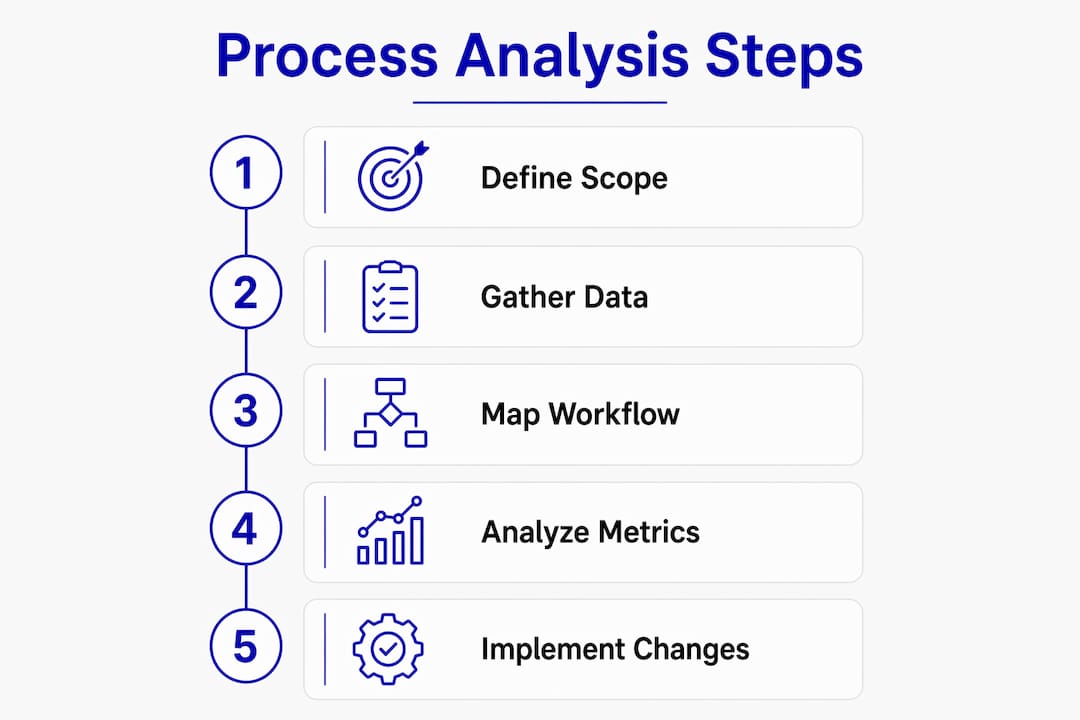
For structured execution, Zapier’s 6-step framework provides a repeatable cycle: define scope, gather data, map the current state, identify friction points, design improvements, and monitor results. This framework is practical because it forces teams to gather real data before drawing any maps. Most failed BPA projects skip the data-gathering step and jump straight to mapping.
The distinction between qualitative and quantitative approaches is also worth understanding. Qualitative analysis relies on interviews, observations, and workshops. Quantitative process mining pulls event logs directly from systems like Microsoft Dynamics 365 or Odoo to reveal actual execution paths. Quantitative methods are more accurate but require clean system data. In practice, the strongest analyses combine both.
Pro Tip: Never build your process map from how managers describe the workflow. Shadow the actual operators, review system logs, and compare both. The gap between the described process and the real one is where your biggest efficiency losses hide.
How process analysis improves efficiency and organizational effectiveness
Separating value-adding from non-value-adding (NVA) work is the core analytical act that drives measurable improvement. Once NVA activities are quantified, redesign efforts become focused rather than speculative.

The numbers from real implementations are compelling. A Lean Kaizen project applied to payroll and reimbursement processes in a GCC/KSA context reduced turnaround time by 32% and cut non-value-adding time by 48%, while also reducing manpower requirements. These results came from structured process analysis followed by targeted redesign, not from buying new software.
The table below summarizes the categories of efficiency gains that BPA typically delivers:
| Efficiency area | Typical impact | Mechanism |
|---|---|---|
| Cycle time | 20–40% reduction | Eliminating handoff delays and approval bottlenecks |
| Error rate | Significant decrease | Standardizing steps and adding validation checkpoints |
| Compliance readiness | Improved audit scores | Documented ownership and control triggers |
| Employee productivity | Higher output per person | Removing redundant tasks and clarifying responsibilities |
| Customer experience | Faster response times | Reducing internal friction that delays delivery |
Beyond the numbers, BPA changes team behavior by setting clear process boundaries and ownership. When every team member knows exactly which steps belong to them, firefighting drops. Managers stop being pulled into operational interruptions and can focus on strategic work. This behavioral shift is one of the most underrated benefits of process analysis in business.
SafetyCulture describes BPA as a multi-step evaluation that gathers data, analyzes processes visually, and creates resource-backed action plans with defined timelines. The action plan component is what converts analysis into results. Analysis without a structured improvement plan produces reports that sit in folders.
Pro Tip: After completing your process map, run a “waste audit” by categorizing every step as value-adding, business-necessary, or pure waste. Business-necessary steps (like compliance approvals) cannot be eliminated but can often be accelerated. Pure waste steps should be removed immediately.
What challenges do organizations face when implementing process analysis?
The most common failure in process analysis is creating idealized maps rather than capturing actual, real-world workflows. This leads to audit discrepancies and improvement plans that do not match operational reality. Teams describe the process as it should work, not as it does work, and the resulting map is fiction.
Other frequent obstacles include:
- Lack of cross-functional input. Processes rarely stay within one department. Without representation from every function that touches a workflow, maps are incomplete and improvements create new bottlenecks elsewhere.
- Insufficient data monitoring after implementation. Continuous monitoring and governance are what make improvements stick. Without defined KPIs and review cycles, teams revert to old habits within weeks.
- Resistance to change. Process analysis often exposes inefficiencies tied to specific roles or teams. Without leadership commitment and clear communication, the analysis becomes politically sensitive and stalls.
- Documentation overload in regulated environments. In audit-heavy sectors, organizations typically maintain 15 to 30 documented procedures from BPA outputs to meet regulatory expectations. Managing this volume requires a governance structure, not just a shared drive.
Low-code platforms address several of these challenges directly. They allow process owners to update workflows, add monitoring dashboards, and adjust approval rules without waiting for IT development cycles. For MENA organizations operating under tight regulatory timelines, this agility is a practical advantage.
How can leaders in Saudi Arabia and UAE use process analysis for digital transformation?
Saudi Arabia’s Vision 2030 and the UAE’s national digitalization programs have created both the mandate and the urgency for operational transformation. Process analysis is the prerequisite step that makes ERP implementations, automation projects, and AI deployments actually deliver on their promised returns.
The connection between BPA and ERP readiness is direct. Organizations that map and clean their processes before an ERP go-live reduce implementation risk significantly. Those that skip this step spend months post-launch fixing workflows inside the system rather than running the business.
Key applications for leaders in the region include:
- ERP pre-implementation analysis. Map current processes in finance, procurement, and HR before configuring Odoo or Microsoft Dynamics 365. This prevents the system from inheriting existing inefficiencies.
- Automation targeting. Use process analysis to identify the highest-volume, most repetitive tasks. These are the best candidates for RPA with UiPath or BPM automation with IBM BAW.
- AI readiness assessment. AI tools require clean, well-defined process inputs. BPA clarifies data flows and decision points, making AI integration more reliable.
- Regulatory compliance mapping. In Saudi Arabia’s banking and healthcare sectors, process analysis supports the documentation requirements of regulators like SAMA and CBAHI.
Low-code platforms empower MENA businesses to rapidly automate and optimize workflows uncovered by process analysis without heavy IT resources. Singleclic’s Cortex platform is built specifically for this context. It supports full Arabic UI/UX, on-premise deployment for banks and government entities, and real-time process optimization with runtime workflow changes that require no downtime. For organizations that need to act on process analysis findings quickly, Cortex removes the IT bottleneck entirely.
Analyzing business processes for automation is not a one-time project. The organizations that sustain efficiency gains treat process analysis as a continuous practice, revisiting their maps quarterly and updating their automation rules as the business evolves.
Key takeaways
Process analysis delivers lasting operational improvement only when it captures real workflows, involves cross-functional teams, and closes the loop with continuous monitoring and governance.
| Point | Details |
|---|---|
| Define before you automate | Map and clean your processes before any ERP or automation deployment to avoid inheriting inefficiencies. |
| Use real data, not descriptions | Combine system event logs with operator observations to capture actual workflows, not idealized ones. |
| Quantify NVA activities | Separating value-adding from non-value-adding work focuses redesign efforts and makes impact measurable. |
| Close the loop with monitoring | Define KPIs and review cycles after implementation so improvements are sustained, not reversed. |
| Leverage low-code for agility | Platforms like Cortex allow process owners to update and automate workflows without IT dependency. |
Why most process analysis projects stop short of real change
In my experience working with enterprises across Saudi Arabia, the UAE, and Egypt, the gap between a completed process analysis and a transformed operation is almost always a governance problem, not a methodology problem. Teams produce excellent maps, identify real waste, and then hand the findings to a committee that meets quarterly. By the time a decision is made, the process has already changed again.
The shift that actually produces results is treating process analysis as an operational discipline rather than a project. The organizations I have seen sustain efficiency gains are the ones that assign named process owners, set monthly review cycles, and connect their process maps directly to their automation and ERP configurations. When a workflow changes in the business, it changes in the system the same week.
I also want to push back on the idea that process analysis requires a large consulting engagement to be effective. Some of the most impactful analyses I have seen were done by internal teams using a structured framework, a few days of observation, and a low-code platform to implement the changes. The methodology matters far more than the budget. What you cannot shortcut is the honesty required to map what actually happens, not what the process manual says should happen.
— Tamer
How Singleclic helps you act on process analysis findings
Identifying inefficiencies is only half the work. The other half is implementing changes fast enough to matter. Singleclic works with business leaders across Saudi Arabia, the UAE, and Egypt to translate process analysis findings into working automations, ERP configurations, and governance structures. Whether you are preparing for an Odoo or Microsoft Dynamics 365 implementation, deploying IBM BAW for BPM, or building workflow automation with Cortex, Singleclic’s team of 70+ consultants and engineers brings the regional expertise to make it real. Start with the ERP implementation checklist built specifically for the Middle East, or explore the C-level automation guide to see how process-driven transformation scales.
FAQ
What is the role of process analysis in business?
Process analysis is the systematic evaluation of workflows to identify inefficiencies, clarify ownership, and improve metrics including cycle time, cost, error rate, and compliance. It is the diagnostic step that precedes any effective process redesign or automation initiative.
What are the main process analysis techniques?
The most widely used techniques are process mapping, SIPOC diagrams, value stream mapping, and process mining. Each serves a different scope and data requirement, and the strongest analyses combine qualitative observation with quantitative system data.
How does process analysis improve efficiency?
By identifying and eliminating non-value-adding activities, process analysis reduces turnaround times and costs. A Lean Kaizen case in the GCC reduced payroll turnaround time by 32% and cut non-value-adding time by 48% through structured BPA and redesign.
How does ISO 9001 relate to process analysis?
ISO 9001 Clause 4.4 requires organizations to define processes, their interactions, ownership, and performance indicators. Process analysis is the practical method for meeting this requirement and building a quality management system that supports continuous improvement.
What role do low-code platforms play in process analysis?
Low-code platforms like Singleclic’s Cortex allow organizations to implement process improvements and automate workflows without waiting for IT development cycles. This is particularly valuable in Saudi Arabia and UAE, where regulatory timelines and growth pressures demand rapid operational responses.