TL;DR:
- The customer lifecycle encompasses stages from awareness to advocacy that require tailored management strategies. Proper lifecycle management enhances retention, lifetime value, and competitive advantage, especially in Gulf markets. Employing CRM and low-code tools with clear ownership ensures continuous growth and long-term customer loyalty.
The customer lifecycle is defined as the sequence of stages a customer passes through in their relationship with a business, from initial awareness all the way through to loyalty and active advocacy. Understanding this lifecycle is not a theoretical exercise. For marketers and business leaders in Saudi Arabia, the UAE, and across the region, it is the operational backbone of every retention and growth strategy worth building. Customer lifecycle management (CLM) gives your organization a shared language for ownership, measurement, and action at every stage of the customer relationship.
What is customer lifecycle and what are its core stages?
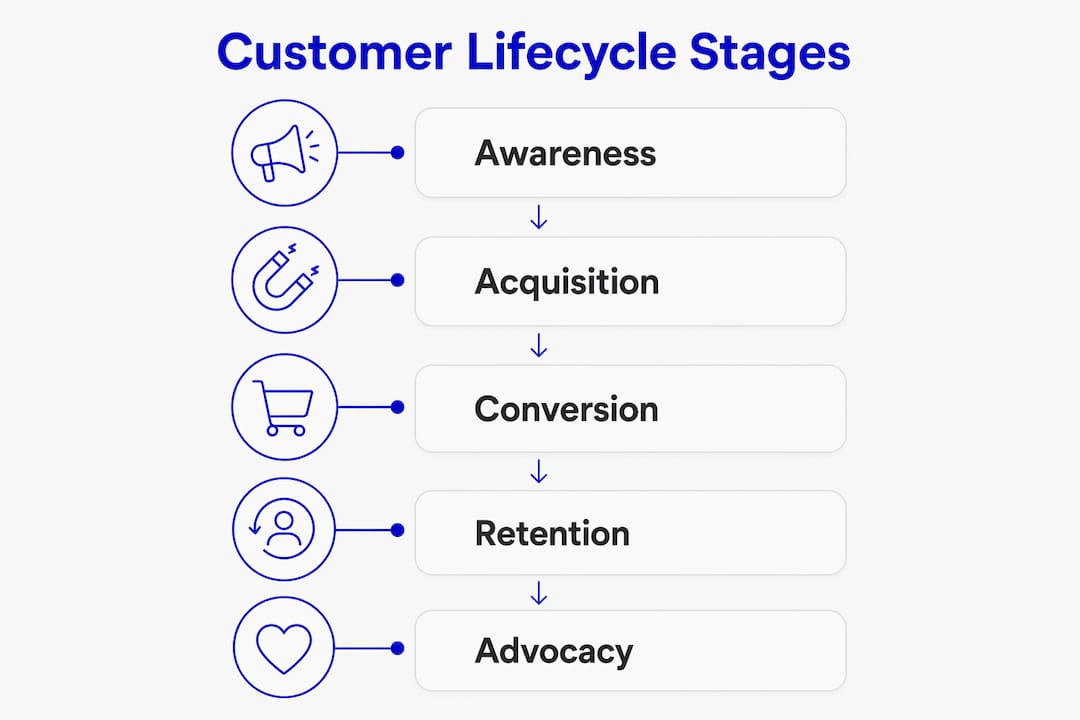
The five core stages of the customer lifecycle are awareness, acquisition, conversion, retention, and loyalty or advocacy. Each stage has distinct objectives, customer behaviors, and business responsibilities. Understanding how they connect is the first step toward managing them effectively.

One critical point most organizations miss: the lifecycle is circular and dynamic, not a straight line. Customers can skip stages, revisit earlier ones, or cycle back after a period of inactivity. A loyal customer who churns during a service disruption does not start over at zero. They re-enter at a stage your team must identify quickly.
Here is how each stage functions in practice:
| Stage | Customer behavior | Business goal |
|---|---|---|
| Awareness | Discovers the brand via search, social, or referral | Generate visibility and qualified reach |
| Acquisition | Engages with content, signs up, or requests information | Capture interest and contact data |
| Conversion | Makes a first purchase or signs a contract | Close the sale and confirm value |
| Retention | Continues using the product or service over time | Reduce churn and increase usage depth |
| Loyalty/Advocacy | Refers others, leaves reviews, renews proactively | Maximize lifetime value and referrals |
In a UAE retail context, a customer might discover a brand through an Instagram ad (awareness), download a loyalty app (acquisition), make a purchase during Ramadan promotions (conversion), and then refer three colleagues through a referral code (advocacy). Each of those moments requires a different response from your team.
Pro Tip: Map your current customer base against these five stages right now. Most businesses discover that 60 to 70 percent of their customers are stuck between conversion and retention, with no deliberate program to move them forward.
How does customer lifecycle differ from the customer journey?
This distinction matters more than most marketers realize, and confusing the two leads to real strategic gaps. The customer lifecycle is a business-centric, high-level view of where customers sit in their relationship with your organization. The customer journey is a customer-centric map of the specific touchpoints, emotions, and decisions a person experiences along the way.
Lifecycle thinking standardizes ownership and messaging across business stages. Journey thinking improves the customer experience at the individual touchpoint level. You need both, but they serve different purposes.
Here is how the distinction plays out operationally:
- Lifecycle tells your sales team that a customer is in the “retention” stage and needs a renewal outreach in 30 days.
- Journey tells your customer success team that the same customer had a frustrating onboarding call three months ago and has only used 40 percent of the product features.
- Lifecycle informs your marketing team which segment to target with a re-engagement campaign.
- Journey tells your UX team where users are dropping off in the mobile app.
- Lifecycle sets the KPIs: churn rate, renewal rate, net promoter score.
- Journey identifies the specific friction points causing those numbers to move.
For businesses operating across Saudi Arabia and the UAE, where customer expectations are shaped by both global digital standards and strong local relationship norms, combining lifecycle structure with journey empathy is what separates average retention from genuine loyalty. A bank in Riyadh using Microsoft Dynamics 365 can track lifecycle stage at the account level while simultaneously mapping the WhatsApp-based customer engagement touchpoints that define the actual experience.
Why lifecycle management drives growth for Middle Eastern businesses
Effective lifecycle management reduces churn, increases customer lifetime value, and builds brand advocacy. These are not soft benefits. They translate directly into revenue predictability and competitive positioning in markets where customer acquisition costs are rising.
The most common failure point is not the early stages. Retention and advocacy receive far less investment than awareness and conversion, even though they drive the majority of long-term value. A telecom company in Dubai that spends heavily on subscriber acquisition but has no structured onboarding program will see churn spike in months two and three. The acquisition investment is wasted.
CRM-driven lifecycle programs using tools like Salesforce, Odoo, or Microsoft Dynamics 365 integrate customer data across departments to enable tailored communication and automated workflows at each stage. This is not a luxury for large enterprises. In the UAE and Saudi Arabia, where digital transformation adoption is accelerating, mid-sized businesses that deploy CRM-backed lifecycle programs gain a measurable edge over competitors still relying on manual follow-up.
Low-code platforms are changing the speed at which businesses can adapt their lifecycle programs. Singleclic’s Cortex platform, built specifically for MENA enterprises with full Arabic UI/UX and on-premise deployment, allows organizations to modify lifecycle workflows in real time without writing code. A healthcare provider in Riyadh can update its patient retention workflow on a Tuesday afternoon without waiting for a development sprint. That agility is now a competitive requirement, not a nice-to-have.
Pro Tip: Track your growth metrics by lifecycle stage, not just by overall revenue. A business with strong acquisition numbers but declining retention rates is burning cash, not building value.
How to practically manage and optimize each lifecycle stage
Managing the customer lifecycle well requires stage-specific tactics, the right technology, and cross-departmental alignment. Here is a practical framework for each stage:
-
Awareness. Invest in Arabic-language SEO, regional social media presence on platforms like Snapchat and TikTok (both heavily used in Saudi Arabia), and thought leadership content that addresses local business challenges. Generic global campaigns underperform in the Gulf because they miss cultural and linguistic context.
-
Acquisition. Use CRM tools to capture and qualify leads at the point of first contact. Odoo CRM and Microsoft Dynamics 365 both support automated lead scoring, which helps your sales team prioritize follow-up based on engagement signals rather than gut instinct. CRM-powered journeys at this stage set the tone for everything that follows.
-
Conversion. Reduce friction in the purchase or sign-up process. In B2B contexts across the UAE, this often means shortening proposal cycles and enabling digital contract signing. The faster you confirm value for a new customer, the stronger the foundation for retention.
-
Retention. This is where most businesses underinvest. Breaking retention into measurable sub-outcomes such as onboarding success, feature adoption, and renewal readiness gives you actionable data instead of a single churn rate that tells you nothing about where the problem actually lives. Build a structured onboarding program, assign customer success ownership, and set automated check-in triggers in your CRM.
-
Loyalty and advocacy. Design referral programs, loyalty rewards, and community touchpoints that give satisfied customers a reason to talk about you. In the Middle East, word-of-mouth and personal referrals carry exceptional weight. A well-designed advocacy program in a market like Jeddah or Abu Dhabi can outperform a paid acquisition campaign at a fraction of the cost.
-
Data and analytics. Use customer data analytics to identify which stage transitions are leaking the most customers. If 30 percent of converted customers never complete onboarding, that is your highest-priority fix, not a new awareness campaign.
-
Cross-departmental integration. Cross-departmental data integration is critical in CLM because customer progression does not stop at the marketing handoff. Sales, customer success, finance, and product teams all hold data that affects lifecycle decisions. A unified CRM or ERP system is the infrastructure that makes this possible.
Customer retention automation tools can handle the repetitive touchpoints at scale, freeing your team to focus on high-value relationship moments that require human judgment.
Key takeaways
The customer lifecycle is the single most important framework for connecting acquisition investment to long-term revenue, and businesses that manage it with stage-specific rigor consistently outperform those that treat it as a marketing concept rather than an operational system.
| Point | Details |
|---|---|
| Five core stages | Awareness, acquisition, conversion, retention, and advocacy each require distinct tactics and ownership. |
| Lifecycle vs. journey | Lifecycle is business-centric stage management; journey is customer-centric experience mapping. Use both. |
| Retention is underinvested | Most businesses over-index on acquisition and neglect retention, where long-term value is actually built. |
| CRM and low-code tools | Platforms like Odoo, Microsoft Dynamics 365, and Cortex enable data-driven, agile lifecycle management. |
| Regional context matters | Saudi Arabia and UAE markets require Arabic-language, culturally aware lifecycle programs to drive real loyalty. |
What working with lifecycle programs in the Gulf taught me
I have worked with organizations across Saudi Arabia, the UAE, and Egypt on CRM and process automation projects for over a decade. The pattern I see most consistently is this: businesses invest heavily in awareness and conversion, celebrate the acquisition numbers, and then lose those customers quietly over the following six months because no one owns the retention stage.
The lifecycle framework is only as good as the accountability structure behind it. When I ask a client who owns the retention stage, I often get silence or a vague answer about “the account management team.” That ambiguity is where customer lifetime value goes to die. The businesses that get this right assign explicit ownership, set stage-specific KPIs, and review them in the same meeting where acquisition numbers are discussed.
In the Gulf specifically, I have seen low-code platforms change the game for mid-sized businesses that cannot afford long development cycles. When a healthcare client in Riyadh needed to update their patient re-engagement workflow mid-quarter, they did it in Cortex in two days. That kind of speed is what turns a lifecycle strategy document into a living operational system.
My advice to marketers and business leaders in the region: stop treating the customer lifecycle as a diagram on a slide. Build a stage-by-stage ownership map, connect it to your CRM data, and review it monthly. The CRM implementation practices that support this are not complex. They just require commitment and the right technology partner.
— Tamer
How Singleclic supports your lifecycle management programs
Singleclic works with organizations across Saudi Arabia, the UAE, and Egypt to implement CRM and ERP systems that turn lifecycle strategy into measurable outcomes. As an Odoo Silver Partner and Microsoft Dynamics 365 integrator, Singleclic connects your sales, marketing, and customer success data into a single operational view. The Cortex low-code platform adds the agility to adapt lifecycle workflows without development delays, supporting everything from Arabic-language onboarding sequences to automated renewal alerts. If you are ready to move from lifecycle awareness to lifecycle execution, start with the CRM adoption guide built specifically for Saudi Arabia and UAE business leaders, or review the ERP implementation checklist to assess your current infrastructure readiness.
FAQ
What is customer lifecycle in simple terms?
The customer lifecycle is the sequence of stages a customer moves through in their relationship with a business, from first discovering the brand to becoming a loyal advocate. It typically includes awareness, acquisition, conversion, retention, and loyalty.
How many stages does the customer lifecycle have?
Most models define five core stages: awareness, acquisition, conversion, retention, and loyalty or advocacy. Some industry-specific models add onboarding or renewal as distinct phases.
What is the difference between customer lifecycle and customer journey?
The customer lifecycle is a business-focused view of which stage a customer occupies in their relationship with your organization. The customer journey maps the specific touchpoints and experiences the customer encounters along the way.
Why is retention the most critical lifecycle stage?
Retention and advocacy drive the majority of long-term revenue and brand growth, yet most businesses underinvest in them relative to acquisition. Improving retention by even a small margin has a compounding effect on customer lifetime value.
What tools support customer lifecycle management?
CRM platforms like Odoo and Microsoft Dynamics 365, combined with low-code tools like Singleclic’s Cortex platform, provide the data integration and workflow automation needed to manage each lifecycle stage with precision and speed.