TL;DR:
- API management involves controlling the entire API lifecycle, including governance, security, and developer engagement. It separates control and data planes to ensure uptime and reduces governance gaps as API volume grows. Implementing best practices and choosing suitable platforms enhances secure, scalable digital ecosystems, especially in the Middle East’s evolving regulatory landscape.
API management is the coordinated practice of designing, securing, publishing, monitoring, and governing APIs across their full lifecycle. It goes far beyond running an API gateway. Platforms like Google Cloud API Management, Azure API Management, and AWS API Gateway each handle runtime traffic, but API management as a discipline also covers lifecycle governance, developer engagement, analytics, and security policy enforcement. For IT leaders and business executives in Saudi Arabia and UAE, where digital transformation is accelerating across banking, healthcare, and government sectors, understanding this distinction is the difference between building a fragile integration layer and building a real digital asset.
What is API management and how does it work?
API management is defined as the full set of processes, tools, and policies used to control how APIs are created, published, secured, monitored, and retired. The industry term for this discipline is “API lifecycle management,” and it covers far more than what a gateway alone can do.

The architecture splits into two planes. The control plane handles policy configuration, developer onboarding, lifecycle governance, and analytics. The data plane is the gateway itself, which processes live API traffic at runtime. Separating these two planes prevents production downtime during policy updates. You can change authentication rules or rate limits without restarting the gateway, which matters enormously when your APIs serve thousands of concurrent users.
A complete API management setup includes these core components:
- Developer portal: A self-service hub where internal teams and external partners find documentation, test endpoints, and onboard without filing IT tickets.
- Security policies: Authentication (OAuth 2.0, API keys), rate limiting, and IP allowlisting applied consistently across all APIs.
- Analytics dashboard: Real-time visibility into traffic volumes, error rates, latency, and consumer behavior.
- Lifecycle governance: Formal processes for versioning, deprecation timelines, and design standards like OpenAPI specifications.
- Automation layer: Automated provisioning and configuration that reduces manual work when onboarding new API consumers.
Pro Tip: Map your API inventory before selecting a platform. Organizations that skip this step often deploy a gateway and call it “API management,” then discover governance gaps six months later when API volume doubles.
Why does API management matter for organizations in Saudi Arabia and UAE?
Effective API management is the foundation of secure, scalable digital integration. 65% of organizations now use APIs to connect external services and data. That adoption rate creates real operational pressure: more APIs mean more attack surfaces, more version conflicts, and more developer friction.
The strategic benefits break down into five areas:
- Security and access control. Centralized policy enforcement means every API follows the same authentication and authorization rules. There are no rogue endpoints with weak credentials.
- Developer productivity. Self-service developer portals reduce onboarding time and cut the internal IT burden. Developers find what they need without opening a support ticket.
- Visibility and monitoring. Analytics dashboards surface usage patterns, performance bottlenecks, and error spikes before they become outages.
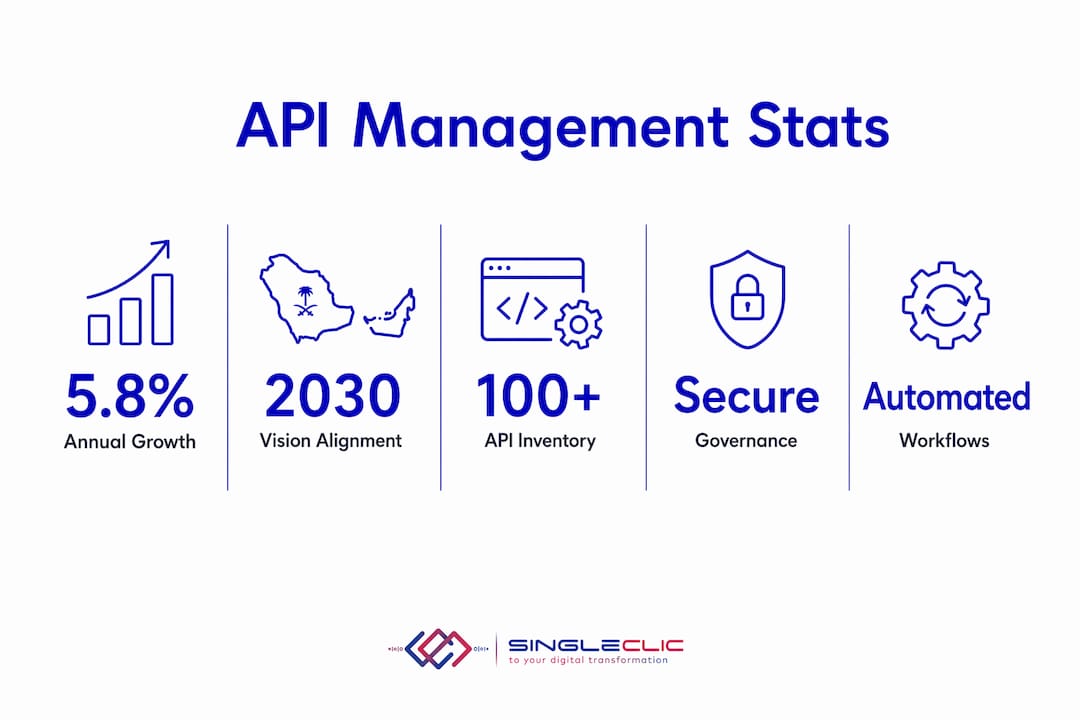
- Scalability without sprawl. Structured API management becomes non-negotiable once an organization manages more than 10 APIs. Below that threshold, a simple gateway may suffice. Above it, governance gaps compound quickly.
- Multi-source integration. Proper API management lets you pull data from multiple backend systems through a single, secure interface, which simplifies the user experience for both customers and internal staff.
For enterprises in Saudi Arabia and UAE, these benefits connect directly to Vision 2030 and UAE Digital Economy Strategy objectives. Government entities, banks, and healthcare providers in the region are building API ecosystems to connect citizen services, payment rails, and clinical data. Without governance, those ecosystems become liabilities.
Enterprise API adoption grows at 5.8% annually as of 2026. That growth rate means the governance gap widens every year for organizations that delay structured API management.
What are the best practices for API management?
The most effective API management programs treat APIs as products, not plumbing. That mindset shift changes how teams design, publish, and retire APIs.
- Standardize with OpenAPI. Define every API using the OpenAPI Specification before writing a single line of code. This forces design clarity and enables automatic documentation generation.
- Version deliberately. Use semantic versioning (v1, v2) and publish deprecation timelines at least six months in advance. Consumers need time to migrate.
- Enforce security at the gateway, not the application. Rate limiting, OAuth 2.0 validation, and IP filtering belong in the management layer, not scattered across individual services.
- Build a usable developer portal. A portal with interactive testing (Swagger UI or similar) reduces integration errors and speeds up partner onboarding. Enterprise portals built with low-code technologies can cut portal development time significantly.
- Automate policy deployment. Use CI/CD pipelines to push policy changes to the gateway. Manual configuration at scale introduces inconsistency.
- Separate control and data planes. Policy changes without gateway restarts protect uptime and allow dynamic management as your API ecosystem grows.
The most common pitfall in the region is treating an API gateway as a complete solution. A gateway handles traffic. It does not handle lifecycle governance, developer self-service, or analytics. Relying solely on a gateway creates operational blind spots as API volume and complexity increase.
Pro Tip: For organizations in Saudi Arabia and UAE operating under SAMA or MOHAP data regulations, build compliance controls directly into your API security policies from day one. Retrofitting compliance onto an existing API layer is expensive and disruptive.
How do popular API management platforms compare?
The four platforms most commonly evaluated by enterprises in the Middle East are Google Cloud API Management (Apigee), Azure API Management, AWS API Gateway, and MuleSoft Anypoint Platform. Each has a distinct profile.
| Platform | Strengths | Limitations | Best fit |
|---|---|---|---|
| Google Apigee | Advanced analytics, developer portal, policy engine | Higher cost, steeper learning curve | Large enterprises with complex ecosystems |
| Azure API Management | Deep Microsoft 365 and Dynamics 365 integration | Less flexible outside Azure stack | Organizations already on Microsoft infrastructure |
| AWS API Gateway | Fast setup, pay-per-use pricing, tight AWS integration | Limited built-in developer portal | Cloud-native teams on AWS |
| MuleSoft Anypoint | Full integration platform, strong governance tools | High licensing cost | Enterprises needing API and integration in one platform |
For organizations in Saudi Arabia and UAE running Microsoft Dynamics 365 or Odoo, Azure API Management and MuleSoft offer the tightest integration paths. API management platforms provide centralized governance, security, monitoring, and developer tools that address inconsistent access control and limited usage visibility.
Low-code platforms add a practical layer on top of these tools. Singleclic’s Cortex platform, built specifically for MENA enterprises, integrates with enterprise API layers and allows teams to build and automate workflows without writing code. Cortex supports full Arabic UI/UX and on-premise deployment, which matters for banks and government entities in Saudi Arabia and UAE with strict data residency requirements. Pairing a platform like Cortex with a dedicated API management solution gives IT teams governance at the API layer and agility at the workflow layer. Low-code platforms improve business agility by reducing the time between API availability and business process adoption.
API management automation turns APIs into strategic business assets by reducing manual provisioning work and accelerating partner and customer integration. That acceleration is measurable in faster go-to-market timelines for digital products.
Key takeaways
API management is the full lifecycle discipline that separates organizations with secure, scalable digital ecosystems from those managing a growing pile of ungoverned endpoints.
| Point | Details |
|---|---|
| More than a gateway | API management covers governance, security, analytics, and developer portals, not just runtime traffic. |
| Control and data planes | Separating these two planes prevents downtime when updating policies at scale. |
| Governance threshold | Organizations managing more than 10 APIs need structured management to maintain security and visibility. |
| Developer portals matter | Self-service portals reduce IT burden and speed up partner onboarding across the API ecosystem. |
| Low-code accelerates adoption | Platforms like Cortex connect API layers to business workflows without requiring code, which is critical for MENA enterprises. |
API management in the Middle East: what I’ve learned from the ground
Working with enterprises across Saudi Arabia and UAE for over a decade, I’ve seen the same pattern repeat. An organization deploys an API gateway, declares the integration problem solved, and then struggles two years later when API volume has tripled and nobody knows who owns which endpoint or what security policy applies.
The real issue is organizational, not technical. API management requires someone to own the API catalog, enforce design standards, and communicate deprecation timelines to consuming teams. Most organizations in the region have not yet assigned that ownership clearly. The technology is available. The governance culture is still catching up.
What I find genuinely encouraging is the shift I’m seeing among CIOs in banking and healthcare in Saudi Arabia and UAE. They are starting to treat APIs as products with owners, roadmaps, and SLAs. That mindset is what separates organizations that scale their digital ecosystems from those that accumulate technical debt.
Low-code platforms are changing the equation in a practical way. When a business analyst can build a workflow that consumes an API without writing code, the distance between IT delivery and business value shrinks. That is where Cortex fits into the picture for many of our clients. It is not a replacement for API management governance. It is the layer that makes governed APIs useful to the business faster.
My advice: do not wait until you have 50 APIs to think about management. Start the governance conversation at 10. The cost of retrofitting governance onto a sprawling API ecosystem is far higher than building it in from the beginning.
— Tamer Badr
How Singleclic supports API-driven digital transformation
Singleclic works with IT leaders and business executives across Saudi Arabia, UAE, and Egypt to build integration architectures that hold up at scale.
Whether you are implementing Microsoft Dynamics 365, deploying Odoo, or building automated workflows with IBM BAW, Singleclic connects your systems through governed API layers that meet regional compliance requirements. The Cortex low-code platform adds Arabic-enabled workflow automation on top of your API ecosystem, so business teams can act on integrated data without waiting for development cycles. For organizations planning a broader digital transformation, the ERP implementation checklist for the Middle East is a practical starting point for aligning your integration and API strategy with your ERP rollout. Singleclic’s 70+ consultants and engineers across KSA, UAE, and Egypt are ready to support you at every stage.
FAQ
What is API management in simple terms?
API management is the set of tools and processes used to design, secure, publish, monitor, and retire APIs throughout their lifecycle. It goes beyond a gateway to include governance, analytics, and developer self-service.
How is API management different from an API gateway?
An API gateway handles live traffic routing and enforcement at runtime. API management includes the gateway plus lifecycle governance, developer portals, analytics, and security policy management across all APIs.
When does an organization need API management?
Structured API management becomes necessary once an organization manages more than 10 APIs. Below that number, a simple gateway may be sufficient, but governance gaps grow quickly beyond that threshold.
Which API management platform is best for enterprises in Saudi Arabia and UAE?
Azure API Management suits organizations on Microsoft infrastructure, while MuleSoft Anypoint fits enterprises needing a combined integration and API platform. The right choice depends on your existing technology stack and compliance requirements.
How does low-code fit into an API management strategy?
Low-code platforms like Singleclic’s Cortex connect governed APIs to business workflows without requiring development resources. This reduces the time between API availability and business process adoption, which is particularly valuable for MENA enterprises with Arabic language and on-premise deployment requirements.