TL;DR:
- Agile project management organizes work into short, iterative cycles to continuously deliver value and adapt to change.
- It applies across industries like healthcare, construction, banking, and government, not just software.
Agile project management is a step-by-step approach that organizes work into short, iterative cycles to deliver value continuously while adapting to change. Unlike traditional waterfall methods, agile breaks large projects into manageable sprints, typically lasting 1–4 weeks, with two weeks being the most common. This structure gives project managers and team leaders the flexibility to respond to shifting requirements without derailing the entire project. For organizations in Saudi Arabia and UAE navigating fast-moving digital transformation, agile is not just a software methodology. It is a management philosophy that applies across construction, healthcare, banking, and government sectors. Pairing agile with low-code platforms accelerates decision-making and reduces delivery friction at every stage.
What are the essential agile project management steps?
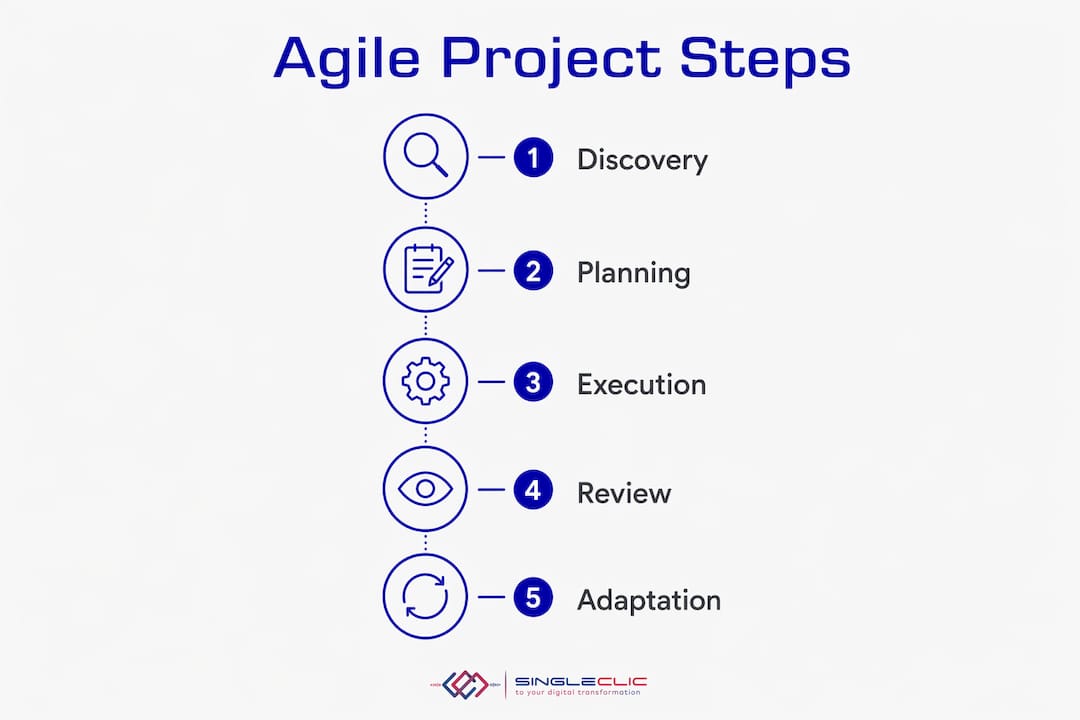
The agile project management process cycles through four stages: Plan, Build, Review, and Adapt. These stages repeat every sprint, creating a rhythm that keeps teams aligned and work moving forward. Before the first sprint begins, teams run a discovery phase to define scope, identify stakeholders, and build the initial product backlog.

The discovery phase is where most projects either succeed or fail before they start. A clear, prioritized backlog with defined acceptance criteria gives sprint teams a stable foundation. Without it, sprint planning becomes guesswork and teams waste cycles clarifying requirements that should have been settled weeks earlier.
| Step | Purpose | Output |
|---|---|---|
| Discovery and backlog creation | Define scope and prioritize work | Prioritized backlog with acceptance criteria |
| Sprint planning | Select backlog items and set sprint goals | Sprint backlog and team commitments |
| Sprint execution (Build) | Develop and test selected items | Working product increment |
| Sprint review | Demonstrate work to stakeholders | Feedback and updated backlog |
| Sprint retrospective (Adapt) | Reflect on process and team health | Improvement actions for next sprint |
Cross-functional teams are the engine of agile execution. Each team should include members with the skills to complete a sprint independently, without waiting on other departments. This structure eliminates handoff delays and keeps delivery velocity consistent across the project lifecycle.
Pro Tip: Create a one-page sprint charter at the start of each sprint. It should list the sprint goal, team members, key dependencies, and the definition of done. Teams that use sprint charters report fewer mid-sprint scope changes.
Standardized templates for user stories and backlog items speed up sprint planning and reduce ambiguity. A user story template that includes the role, goal, and acceptance criteria takes less than five minutes to fill out and saves hours of clarification during the sprint.
How to conduct daily and sprint activities for effective agile execution?
The daily scrum is a 15-minute structured meeting that answers three questions: What did I complete yesterday? What will I work on today? What is blocking my progress? This format keeps the team synchronized without turning a standup into a status report marathon.
Sprint execution is where collaboration matters most. Team members should communicate blockers the moment they surface, not wait for the next daily scrum. Many teams use a shared digital board to track work in real time, so the entire team sees progress without needing to ask for updates.
The sprint review is a formal demonstration of completed work to stakeholders. Its purpose is to gather feedback, not to celebrate. Stakeholders who see working software or a working process increment give more specific, useful feedback than those who review documents or slide decks.
Sprint retrospectives improve team health and process quality when they address how the team works, not just what the team built. A retrospective that only discusses product issues misses the point. The most valuable retrospectives surface friction in communication, tooling, or workflow that slows the team down sprint after sprint.
Best practices for agile meetings:
- Keep daily scrums to exactly 15 minutes. Use a timer.
- Hold sprint reviews with real stakeholders, not just internal team members.
- Run retrospectives in a psychologically safe environment where honest feedback is expected.
- Document retrospective action items and assign owners before the meeting ends.
- Rotate the retrospective facilitator to prevent the same voices from dominating.
Pro Tip: If your daily scrum consistently runs over 15 minutes, the problem is not the format. It is that team members are solving problems in the meeting instead of surfacing them. Use the daily standup format to identify blockers, then schedule a separate working session to resolve them.
What prerequisites and tools support successful agile project management?
Agile adoption fails most often because of leadership, not process. Successful agile implementation requires leadership commitment, cultural adaptation, and flexibility rather than rigid adherence to any single framework. Leaders who treat agile as a tool rollout rather than an organizational shift will see teams go through the motions without the mindset change that makes agile work.
Organizational readiness means more than buying software. Teams need clear ownership of backlog items, authority to make decisions within their sprint, and access to stakeholders who can give timely feedback. Without these conditions, agile ceremonies become theater.
The right tools support agile without replacing judgment. Generic categories of tools that teams commonly use include:
| Tool category | Primary use |
|---|---|
| Backlog management platforms | Prioritize, assign, and track backlog items across sprints |
| Collaboration and communication tools | Keep distributed teams aligned in real time |
| Reporting and metrics dashboards | Track velocity, cycle time, and sprint completion rates |
| Low-code workflow platforms | Build and adjust process workflows without developer dependency |
Low-code platforms deserve specific attention for teams in Saudi Arabia and UAE. Low-code platforms improve business agility by letting teams modify workflows at runtime without waiting for development cycles. Singleclic’s Cortex platform, built specifically for MENA enterprises, supports full Arabic UI/UX and on-premise deployment, which matters for banks and government entities operating under strict data residency requirements.
Backlog management also depends on documentation discipline. Agile does not mean no documentation. It means the right documentation at the right time. Standard templates for user stories and backlog items promote clarity and prevent the common failure mode where teams spend sprint time debating what a requirement actually means.
How to measure, refine, and scale agile project management practices?
Velocity and cycle time are the two most effective metrics for measuring agile team performance. Velocity measures how much work a team completes per sprint. Cycle time measures how long a single item takes from start to finish. Together, they reveal whether a team is improving or hitting a ceiling.
Retrospective data feeds directly into metric improvement. If cycle time is increasing, retrospective discussions will usually surface the cause: unclear requirements, external dependencies, or team capacity issues. The metric tells you something is wrong. The retrospective tells you why.
Scaling agile across multiple teams introduces coordination challenges that single-team agile does not face. Hybrid models that combine agile with traditional project management methods are increasingly used in regulated or high-risk environments. A construction project in Riyadh or a healthcare IT rollout in Dubai may need fixed milestones and compliance checkpoints alongside iterative sprints. Hybrid agile gives you both.
Key practices for scaling and refining agile:
- Establish a shared definition of done across all teams working on the same product.
- Run cross-team synchronization meetings at the end of each sprint, not just within teams.
- Use future-proofing workflow strategies to build continuous monitoring into your delivery process.
- Assign a dedicated agile coach or process owner when scaling beyond three teams.
- Review and update your backlog prioritization framework at least once per quarter.
Pro Tip: Velocity is a planning tool, not a performance score. Never use velocity to compare teams or pressure individuals. Teams that feel measured on velocity will game the metric by inflating story point estimates.
Cultural context matters when scaling agile in Saudi Arabia and UAE. Organizations in these markets often have hierarchical decision structures that conflict with agile’s emphasis on team autonomy. The solution is not to abandon hierarchy but to define clear decision boundaries. Teams make sprint-level decisions independently. Leadership makes strategic decisions. Both layers need explicit agreement on where one ends and the other begins.
What common pitfalls occur in agile project management and how can they be avoided?
Rushing the discovery phase is the single most common cause of agile project failure. Teams eager to start building skip the work of defining a clear backlog, then spend the first three sprints reworking requirements that were never properly specified.
Critical caution: A vague backlog is not a starting point. It is a liability. Every sprint you run without clear acceptance criteria multiplies the cost of course correction later. Invest the time upfront to define backlog items with owners, criteria, and priority. Well-executed discovery phases strongly predict project success and reduce sprint friction.
The misconception that agile ignores documentation causes real damage. Teams that skip documentation in the name of “moving fast” create technical debt and onboarding problems that slow them down for months. The fix is standardized templates, not lengthy documents. A one-page user story with clear acceptance criteria is documentation. A 40-page requirements specification is not agile.
Applying the same iterative rigor used in development to the maintenance phase causes burnout. Maintenance work does not fit neatly into sprint cycles. Teams forced to run full sprint ceremonies for minor bug fixes and routine updates lose motivation quickly. Adjusted practices, such as a Kanban-style flow for maintenance work, sustain performance without burning out the team.
Practical tips to avoid the most common agile pitfalls:
- Treat discovery as a formal project phase with its own deliverables and timeline.
- Use a change management workflow to handle scope changes without disrupting active sprints.
- Collect team feedback in retrospectives with the same rigor you apply to product feedback.
- Switch maintenance work to a flow-based model instead of forcing it into sprint cycles.
- Never skip a retrospective because the sprint went well. Good sprints have lessons too.
Key takeaways
Agile project management succeeds when teams follow a disciplined cycle of planning, building, reviewing, and adapting, supported by clear backlogs, honest retrospectives, and leadership that trusts the process.
| Point | Details |
|---|---|
| Discovery phase is non-negotiable | A prioritized backlog with acceptance criteria prevents wasted sprint cycles and scope confusion. |
| Four-stage cycle drives consistency | Plan, Build, Review, and Adapt repeated every sprint keeps teams aligned and delivery predictable. |
| Metrics guide improvement | Velocity and cycle time reveal performance trends; retrospectives explain the causes behind the numbers. |
| Scaling requires coordination | Cross-team synchronization and hybrid models handle regulated or complex multi-team environments. |
| Low-code platforms accelerate agility | Runtime workflow changes without developer dependency reduce delivery friction, especially in MENA markets. |
Agile is a philosophy, not a checklist
I have worked with project teams across Saudi Arabia and UAE who adopted agile frameworks perfectly on paper and still struggled to deliver. The ceremonies were correct. The tools were in place. But the teams were waiting for approval on every decision, which is the opposite of what agile requires.
Agile as a management philosophy replaces command-and-control structures with autonomous, cross-functional teams. That shift is cultural, not procedural. No framework installs culture. Leadership has to model it, protect it, and reinforce it every sprint.
The organizations I have seen get the most out of agile are the ones that customize their practices to their context. A government entity in Riyadh runs agile differently than a fintech startup in Dubai. Both can succeed. Neither should copy a framework template designed for a Silicon Valley software company and expect it to fit without adjustment.
Pairing agile with technology that matches your context accelerates results. Enterprise agility in the Middle East requires tools that support Arabic workflows, on-premise deployment, and integration with legacy systems. That is not a nice-to-have. It is a prerequisite for adoption in regulated sectors.
My honest advice: start with one team, one product, and one real stakeholder. Run three sprints before you evaluate whether agile is working. Most teams that abandon agile do so after one sprint, which is not enough time to see the cycle work. Give it time, measure honestly, and adjust based on what your retrospectives tell you.
— Tamer Badr
How Singleclic supports your agile delivery
Singleclic brings over 10 years of agile delivery experience across Saudi Arabia and UAE, working with organizations in healthcare, banking, construction, and government. Whether you are implementing Microsoft Dynamics 365, Odoo, or building custom workflows, Singleclic’s teams operate in sprint-based cycles that keep projects on track and stakeholders informed.
Cortex, Singleclic’s Arabic-enabled low-code platform, lets your teams build and adjust workflows at runtime without writing code. That means faster decisions, fewer bottlenecks, and agile processes that actually scale. If you are planning a technology implementation and want a field-tested approach, the ERP implementation checklist for the Middle East is a practical starting point built specifically for organizations in KSA and UAE.
FAQ
What are the core agile project management steps?
The core steps are discovery and backlog creation, sprint planning, sprint execution, sprint review, and sprint retrospective. These repeat every sprint, typically on a two-week cycle.
How long should an agile sprint last?
Sprints last 1–4 weeks, with two weeks being the most common duration. Shorter sprints increase feedback frequency; longer sprints suit more complex work items.
What is the purpose of a sprint retrospective?
A sprint retrospective focuses on improving how the team works, not just what it built. It surfaces process, communication, and tooling issues that slow delivery over time.
How do you measure agile team performance?
Velocity and cycle time are the primary metrics. Velocity tracks work completed per sprint; cycle time measures how long individual items take from start to finish.
Can agile work in non-software industries?
Agile applies across construction, healthcare, banking, and government sectors. The core cycle of Plan, Build, Review, and Adapt works for any project that benefits from iterative delivery and regular stakeholder feedback.