TL;DR:
- Effective resource allocation involves continuously adjusting team skills, budget, and equipment to maximize productivity while avoiding overload. Accurate data and skill-based assignment are crucial, with automation and real-time tools enhancing efficiency, especially in growing markets like Saudi Arabia and UAE. Regular plan updates and shared visibility help organizations scale sustainably and reduce burnout.
Resource allocation optimization is defined as the ongoing process of matching your organization’s people, skills, budget, and equipment to project demands in a way that maximizes output without overloading your teams. It goes further than basic allocation, which simply answers “who works on what.” Optimization is the continuous adjustment that reduces waste and improves results over time. For business leaders in Saudi Arabia and UAE managing complex, multi-sector operations, getting this right is not optional. 71% of knowledge workers reported burnout in 2020, and poor resource planning is a primary driver of that number.
How to optimize resource allocation: what you need before you start
The most common reason resource plans fail is not a lack of strategy. It is a lack of accurate data. Before you can make sound allocation decisions, you need a complete picture of what you actually have.

Start by building a centralized resource inventory. This means documenting every team member’s skills, current availability, and capacity, alongside all equipment, tools, and budget pools. Without a single source of truth, managers work from outdated spreadsheets and informal knowledge, which leads directly to double-booking, skill mismatches, and missed deadlines. A centralized resource inventory is the foundation every other technique depends on.
You also need the right project data before assigning anyone to anything:
- Project scope and deliverables: What does done actually look like, and what skills does it require?
- Priority ranking: Which projects generate the most value or carry the highest risk if delayed?
- Historical workload data: How long did similar tasks take in previous cycles?
- Capacity windows: When are team members actually available, accounting for meetings, training, and leave?
One critical distinction leaders often miss is the difference between availability and capability. A team member can be available on paper but completely wrong for a task. Skill-based allocation yields higher quality outcomes than availability-based assignment. Assigning work based on who is free, rather than who is qualified, produces poor deliverables and expensive rework.
Pro Tip: Build your resource inventory in a live system, not a static spreadsheet. Availability changes daily, and a document that is two weeks old is already misleading you.
What are the most effective resource allocation strategies?
Once your data is in order, you can apply structured techniques to distribute resources with precision. The following sequence works for most organizations, from construction firms in Riyadh to healthcare networks in Dubai.
-
Score and rank your projects. Use a weighted scoring model that factors in revenue impact, strategic alignment, deadline urgency, and resource cost. This removes subjective prioritization and gives you a defensible ranking when stakeholders push back.
-
Apply resource leveling. Resource leveling adjusts project timelines to prevent any single person or team from being overloaded. If two high-priority projects compete for the same engineer, leveling shifts one project’s start date rather than burning out the engineer.
-
Use resource smoothing where timelines are fixed. Unlike leveling, smoothing keeps deadlines intact and redistributes work within the available float. It is the right technique when a client deadline cannot move.
-
Map your critical path. The critical path method identifies the sequence of tasks that directly determines your project’s end date. Assign your strongest resources to critical path tasks first, then fill non-critical tasks with remaining capacity.
-
Build visual resource schedules. A Gantt-style or capacity heat map gives every manager a real-time view of who is allocated to what, and where gaps or overloads exist. Visual schedules catch conflicts before they become crises.
-
Run predictive capacity planning. Leveraging past project data forecasts future resource needs with far more accuracy than gut instinct. If your Q3 projects historically require 30% more developer hours than Q2, your plan should reflect that before Q3 begins.
The table below compares three core allocation techniques by use case:
| Technique | Best used when | Key trade-off |
|---|---|---|
| Resource leveling | Timelines are flexible | May extend project duration |
| Resource smoothing | Deadlines are fixed | Requires available float in the schedule |
| Critical path method | Identifying highest-impact tasks | Requires accurate task duration estimates |
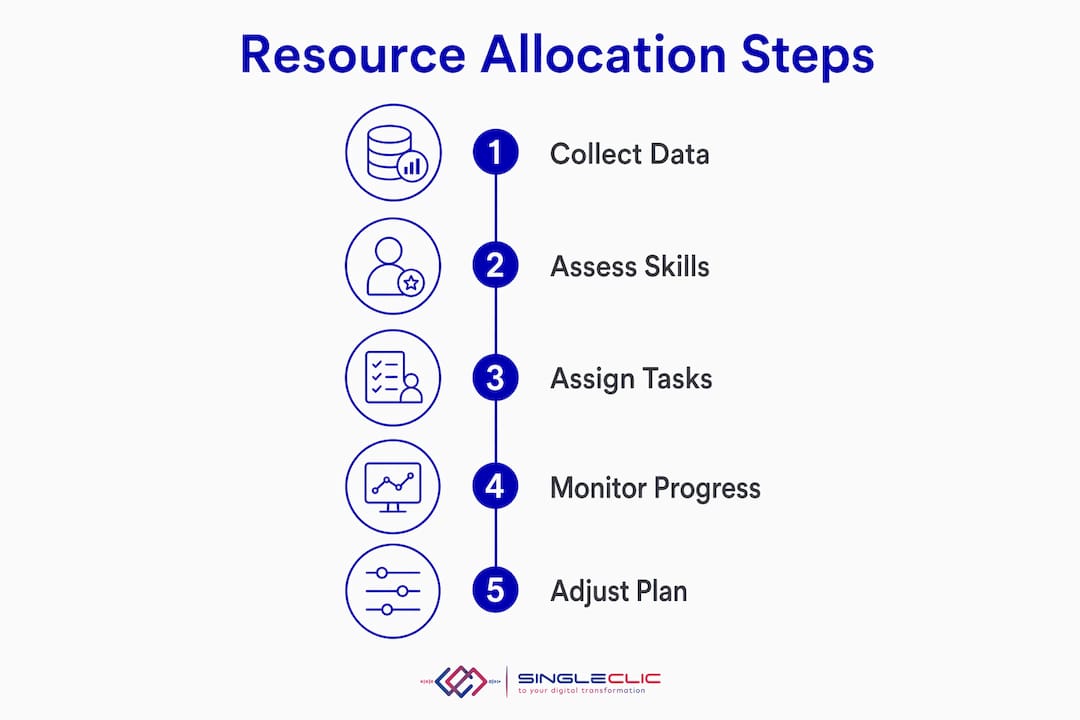
Pro Tip: Treat your first allocation plan as a hypothesis, not a final answer. Plans require regular updates as execution data comes in. Build a weekly review checkpoint into your process from day one.
What are the most common resource optimization challenges?
Even well-designed plans run into predictable problems. Knowing what they are lets you address them before they derail a project.
-
Targeting 100% utilization. This is the single most damaging mistake in resource management. Managers targeting 75–80% utilization achieve sustainable performance. The remaining 20–25% acts as a buffer for administrative work, unexpected issues, and context switching. A team running at full capacity has no room to absorb anything that goes wrong.
-
Ignoring skills in favor of availability. When a project needs a data analyst and you assign a project coordinator because they are free, you are not saving time. You are creating rework. Skill gaps produce quality problems that cost more to fix than the original delay would have.
-
Using static plans. A resource plan built at project kickoff and never updated is a liability. Scope changes, team members go on leave, and priorities shift. Allocation is a hypothesis tested by execution; the plan must evolve with reality.
-
Siloed decision-making. When department heads allocate resources independently, the same person ends up committed to three projects at once without any single manager seeing the full picture. Cross-department communication is not a soft skill. It is a structural requirement for efficient resource distribution.
“The goal is not to fill every hour on every calendar. The goal is to deliver the right work at the right quality with the people best suited to do it. Buffer time is not wasted time. It is the margin that keeps your organization from breaking.”
Solutions to these challenges follow a consistent pattern: build buffer into every plan, run capacity reviews at least monthly, and give all managers visibility into a shared resource pool. AI-powered workforce analytics can surface overallocation risks before they become visible to the naked eye.
How do automation and tools improve resource allocation efficiency?
Manual resource management works at small scale. At enterprise scale, it breaks. The volume of variables, from shifting priorities to real-time availability changes, exceeds what any spreadsheet or weekly meeting can handle.
Automated scheduling tools can assign tasks based on expertise and availability simultaneously, removing the guesswork from day-to-day allocation. Centralized dashboards give every manager a live view of workload balance across the entire organization. The practical benefits include:
- Skill matching at scale: The system filters available resources by required competency, not just open calendar slots.
- Workload alerts: Managers receive notifications when a team member crosses a defined utilization threshold, before burnout sets in.
- Predictive bottleneck detection: Historical data flags periods where demand is likely to exceed capacity weeks in advance.
- Real-time reallocation: When a project scope changes, the system recalculates impacts across all connected assignments instantly.
For enterprises in Saudi Arabia and UAE, the case for this kind of tooling is particularly strong. Vision 2030 in Saudi Arabia and the UAE’s national digitalization agenda are driving rapid project growth across construction, healthcare, banking, and government. That growth multiplies the complexity of resource management faster than manual processes can keep up.
Integrating resource management directly into your ERP and CRM systems creates the single source of truth that good allocation requires. When project data, HR data, and financial data live in the same platform, allocation decisions are grounded in reality rather than assumptions. Enterprise project planning built on connected systems produces measurably better outcomes than planning done in isolation.
Key Takeaways
Effective resource allocation optimization requires accurate data, skill-based assignment, realistic utilization targets, and continuous plan updates grounded in real execution data.
| Point | Details |
|---|---|
| Build a centralized inventory | Document skills, availability, and capacity in one live system before making any allocation decisions. |
| Target 75–85% utilization | Reserve buffer capacity to absorb unexpected work and prevent team burnout. |
| Match skills, not just availability | Assign resources based on capability first; availability-only decisions produce costly rework. |
| Treat plans as living documents | Update allocation plans weekly using real execution data, not just at project kickoff. |
| Use automation for scale | Automated scheduling and centralized dashboards catch overallocation risks that manual tracking misses. |
What I have learned about resource optimization after a decade in the field
After working with enterprises across Saudi Arabia, UAE, and Egypt, I have seen one pattern repeat itself more than any other. Organizations invest heavily in planning tools and then treat the output as a finished product. The plan goes into a folder, and the team goes back to reacting.
The leaders who get resource optimization right treat their allocation plan the way a pilot treats a flight plan: it is the starting point, not the destination. Every week, they compare what was planned against what actually happened, and they adjust. That discipline is harder to build than any software implementation, but it is what separates organizations that consistently deliver from those that constantly firefight.
I also want to push back on the idea that data alone solves this problem. Data tells you what is happening. Human judgment tells you what matters. A predictive model might flag that your top engineer is at 90% utilization. Your judgment tells you whether that is a problem or a temporary sprint before a planned break. The best resource managers I have worked with combine both. They use dashboards and analytics to stay informed, and they use experience to interpret what the numbers mean.
For leaders in Saudi Arabia and UAE specifically, I would add one more thing. The pace of project growth in this region is exceptional right now. That growth is an opportunity, but it also compresses the margin for error in resource management. The organizations that build disciplined, data-driven allocation practices now will be the ones that scale without breaking their teams.
— Tamer Badr
How Singleclic supports resource allocation optimization
Organizations across Saudi Arabia and UAE are managing more projects, more complexity, and more pressure to deliver efficiently than ever before.
Singleclic’s Microsoft Dynamics 365 solutions give business leaders a connected platform where project data, HR capacity, and financial resources live in one place. That means allocation decisions are based on real numbers, not assumptions. With built-in automation, workload alerts, and predictive analytics, your managers spend less time chasing spreadsheets and more time making decisions that move projects forward. Singleclic has delivered these solutions for enterprises including Emirates Health Services, QNB, and Miahona in Saudi Arabia. If your teams are ready to move from reactive resource management to proactive optimization, explore tailored Dynamics 365 solutions built for your sector.
FAQ
What is the difference between resource allocation and resource optimization?
Resource allocation assigns people and assets to specific tasks. Resource optimization is the ongoing process of adjusting those assignments to maximize output and reduce waste over time.
What is the ideal utilization rate for resource planning?
The optimal utilization rate is 75–85%. Planning beyond that leaves no buffer for unexpected work, which leads to delays and burnout.
Why do resource plans become outdated so quickly?
Project scope, team availability, and priorities all change during execution. A plan built at kickoff reflects conditions that no longer exist within weeks, which is why weekly updates are necessary.
How does skill-based allocation differ from availability-based allocation?
Skill-based allocation assigns work to the most qualified person available. Availability-based allocation assigns work to whoever is free, which frequently produces poor quality and rework.
What role does ERP play in resource allocation optimization?
An ERP system centralizes project, HR, and financial data in one platform. That visibility lets managers make allocation decisions based on accurate, real-time information rather than siloed or outdated data.