UAE facilities teams get the most value from an integrated, UAE-localized ERP and CAFM platform that combines planned preventive maintenance, mobile field operations, and e-invoicing readiness, not a standalone CMMS. This approach gives you portfolio-wide visibility across sites and keeps you ahead of UAE e-invoicing timelines. The practical next step is a short data readiness scan, followed by a shortlist of implementation partners who have delivered similar projects in the region.
TL;DR:
- Prioritize work order tracking, preventive maintenance scheduling, asset hierarchies, inventory, vendor contracts, space and energy reporting, and offline mobile tools for technicians.
- Ask vendors to demonstrate Arabic interfaces and reports, documented integrations, sector appropriate hosting, UAE client references, data residency, and full costs beyond licensing.
- Standardize asset names, location hierarchies, and required equipment attributes before migration; inconsistent spreadsheets can delay launch and undermine maintenance and lifecycle reporting.
- A single site with few integrations may launch within months, while enterprise deployments take longer as connected systems, data quality, and scope expand.
- Plan Accredited Service Provider onboarding early because UAE electronic invoicing follows phased deadlines, with large taxpayers first and smaller taxpayers and government entities later.
Table of Contents
- Core features and capabilities UAE organizations must prioritize
- How to evaluate and choose an ERP/CAFM partner for UAE facilities
- Implementation considerations and timeline for UAE organizations
- Data and integration readiness: asset records, ERP links, and e-invoicing compliance
- Deployment options and localization choices for UAE
- Why integrated ERP and CAFM outperform a standalone CMMS
- How Singleclic helps UAE facilities teams implement the right ERP
- FAQ
- Sources
Core features and capabilities UAE organizations must prioritize
Institutional facilities leaders in the UAE are moving away from standalone CMMS tools toward integrated platforms that manage space, occupancy, and sustainability reporting alongside maintenance, driven by enterprise-wide visibility needs and ESG reporting requirements, according to market research on UAE integrated facility management. That shift changes what belongs on your shortlist.
A procurement-ready checklist for a facilities management ERP or CAFM platform in the UAE should include:
- A service desk and work order engine that logs, routes, and tracks every request from raise to close.
- A planned preventive maintenance (PPM) scheduler that automates recurring tasks by asset, trade, or compliance cycle.
- An asset master and hierarchy that links equipment to buildings, floors, and zones for lifecycle reporting.
- Spare parts and inventory management tied to work orders, so technicians see stock availability before dispatch.
- Contract and SLA management for vendors, with renewal alerts and performance tracking.
- Space and occupancy management for utilization reporting and hybrid workplace planning.
- Energy and sustainability reporting that rolls up consumption and ESG metrics across the portfolio.
- A mobile field app for technicians, including offline work orders and barcode or RFID scanning.
Mobile capability deserves separate attention because UAE portfolios are often spread across multiple towers, campuses, or industrial sites. Technicians need offline-capable mobile apps that sync once connectivity returns, mobile approvals for supervisors on-site, and route optimization that reduces windshield time between jobs. Barcode and RFID scanning speed up asset checks and reduce manual data entry errors that otherwise corrupt your asset register over time.
Analytics and portfolio dashboards tie these pieces together. A facilities director overseeing a multi-building portfolio needs a single view of open work orders, PPM compliance rates, and energy trends, not separate spreadsheets for each building. The post-pandemic shift toward hybrid work has accelerated demand for Integrated Workplace Management Systems in the UAE specifically because organizations want to optimize space utilization, energy consumption, and occupant productivity in one system rather than bolting maintenance software onto a separate space-planning tool.
These priorities line up with how UAE buyers actually operate. Portfolios here tend to be multi-site, hard FM functions like HVAC and MEP carry heavy compliance weight, and energy efficiency reporting is increasingly tied to sustainability mandates from landlords, free zones, and government clients.
Pro Tip: Before you shortlist vendors, list every asset type and trade your team services today. A platform that handles your HVAC and fire safety assets well but ignores elevators or landscaping will leave gaps you discover only after go-live.
How to evaluate and choose an ERP/CAFM partner for UAE facilities
Choosing a vendor for a UAE facilities management ERP project comes down to a small number of axes that matter more than feature lists. Localization, integration depth, deployment flexibility, and total cost of ownership separate platforms that work from ones that stall mid-project.
- UAE localization: Confirm the platform offers a genuine Arabic UI and Arabic-language reports, not a partial translation layer bolted onto an English core.
- Integration capability: Ask how the system connects to your finance ERP, procurement, HR, and building management systems, and whether that connection uses documented APIs or custom middleware.
- Deployment options: Verify whether the vendor supports on-premise deployment for regulated sectors like banking, healthcare, or government, alongside cloud options for faster updates.
- Local support and references: Request references from organizations of similar size and sector operating in the UAE, not generic global case studies.
- Cybersecurity and data residency: Confirm where data is hosted, how it is encrypted, and whether the vendor can meet your sector’s data residency rules.
- Total cost of ownership: Get a full breakdown covering licensing, implementation, integration, training, and ongoing support, not just the subscription fee.
When you sit down with a shortlisted vendor, a handful of direct questions will separate a mature partner from one still learning the UAE market. Ask about their e-invoicing Accredited Service Provider (ASP) support and onboarding timeline, how they approach data migration and asset naming standardization, what integration middleware and APIs they use for ERP and finance connections, what a sample SLA and support coverage window looks like, and how they structure training and change management for your staff.
Watch for warning signs during these conversations: vague answers about integration plans, no UAE-based client references, or no clear plan for ASP onboarding ahead of e-invoicing deadlines. Any of these should raise questions before you sign.
How heavily you weight each criterion depends on your organization’s size and asset complexity. A single-building commercial landlord can tolerate a lighter integration footprint than a healthcare group running multiple facilities with biomedical equipment and strict compliance obligations.
Pro Tip: Ask every shortlisted vendor the same five questions, in the same order, and score the answers side by side. Inconsistent answers to basic integration questions usually predict inconsistent delivery later.
Implementation considerations and timeline for UAE organizations
A facilities management ERP project in the UAE typically moves through discovery and requirements gathering, data assessment and cleansing, configuration, integration with ERP and finance systems, a pilot phase, full roll-out, and a hypercare period once the system goes live.
Timelines vary with scope. A single-site deployment with limited integrations can be configured and launched within a few months. An enterprise multi-site rollout with deep integrations into finance, HR, and building management systems can take substantially longer, depending on how many systems need to connect and how clean the underlying data is going in.
Several factors drive cost beyond the base license:
- Integration work with existing ERP, finance, HR, and BMS platforms.
- Customization to match specific workflows or regulatory reporting formats.
- Data migration and cleansing, particularly for organizations with years of spreadsheet-based asset records.
- Training and change management across facilities, finance, and technician teams.
- On-premise infrastructure costs where regulated sectors require local hosting.
UAE-specific pitfalls tend to repeat across projects. Inconsistent asset naming conventions across buildings are a common cause of delay, since legacy spreadsheets rarely use a single naming standard. Underbudgeted change management is another recurring issue, as technicians accustomed to paper work orders need structured training to adopt mobile workflows. Delayed onboarding of an Accredited Service Provider for e-invoicing compliance can also stall finance integration if it is not planned early in the project timeline.
Data and integration readiness: asset records, ERP links, and e-invoicing compliance
Getting your facilities system to talk to the rest of your enterprise starts with the data you feed it. A clean asset register is the foundation everything else depends on.
Before go-live, your asset register cleanup should cover:
- Standardizing naming conventions across every building and site in the portfolio.
- Building clear location hierarchies, from site down to floor, zone, and individual asset.
- Mapping the attributes each asset needs for PPM scheduling and lifecycle reporting.
Inconsistent asset naming across buildings commonly forces UAE implementations to spend substantial time mapping legacy spreadsheets into a unified schema before predictive insights work, according to research on the UAE facilities management market. This data-cleansing step is one of the most time-intensive parts of a UAE implementation, and skipping it is a leading cause of delayed go-live dates.
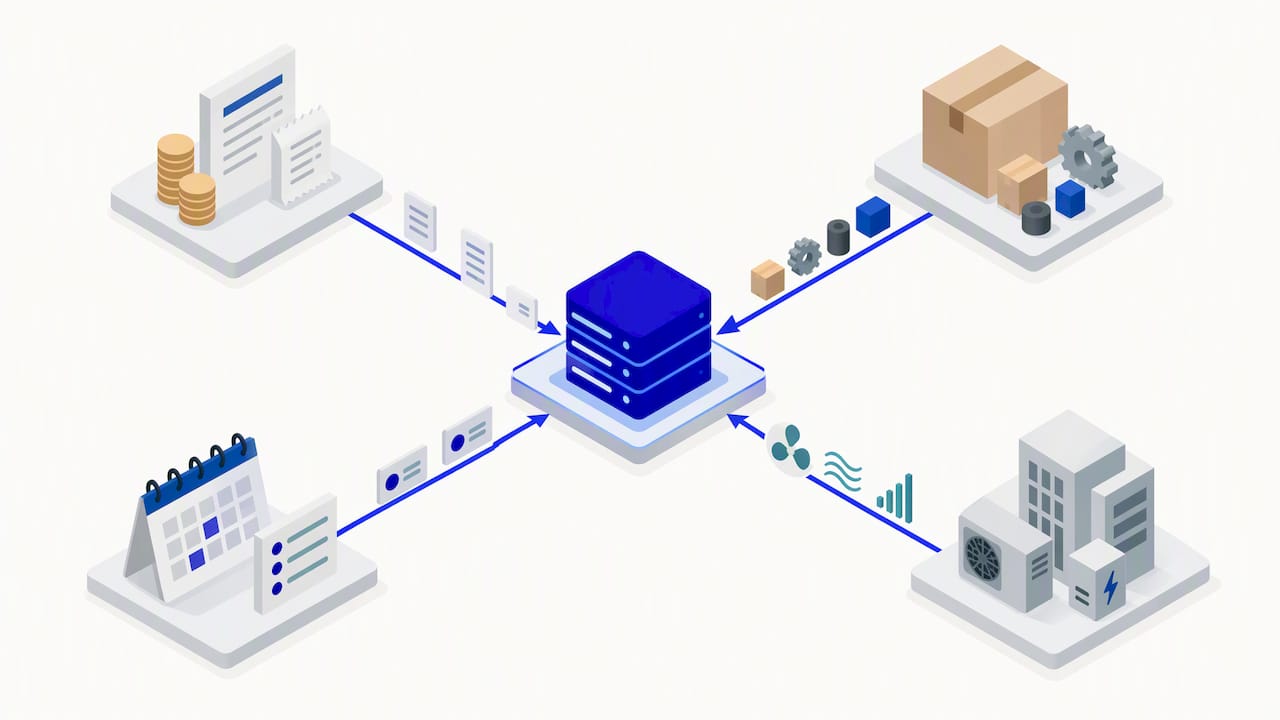
Integration priorities typically follow a clear order: finance and accounts systems for invoicing and cost allocation, procurement systems for spare parts, HR systems for technician rosters and scheduling, and building management systems for real-time telemetry on HVAC and energy use. Planning the ERP payment integration for UAE side early avoids rework once your facilities data starts flowing into finance.
On the compliance side, Ministerial Decision No. 243 of 2025 defines the UAE Electronic Invoicing System, invoice formats, and the role of Accredited Service Providers, while Ministerial Decision No. 244 of 2025 sets phased implementation dates, with large taxpayers onboarding first and smaller taxpayers and government entities following in later phases. Build ASP onboarding into your project plan rather than treating it as a finance-only afterthought, and review your e-invoicing readiness checklist before finance integration begins. For data residency, confirm directly with your vendor and legal counsel which jurisdictions meet your sector’s compliance requirements.
Deployment options and localization choices for UAE
Deployment choice depends on your sector and governance posture. On-premise deployment may suit organizations that prioritize data control, while cloud deployment may suit those prioritizing faster updates and lower infrastructure overhead. Cloud deployment suits organizations prioritizing faster updates and lower infrastructure overhead.
Localization checklist items to confirm before signing:
- A genuine Arabic UI and Arabic-language reports, not a partial translation.
- Local date, time, and currency formatting throughout the system.
- VAT and e-invoicing settings configured for UAE requirements from day one.
Security and compliance considerations are important for banking, healthcare, and government clients. Confirm hosting and integration requirements with the relevant stakeholders. Support expectations should match UAE working hours, with multilingual support and a clear local escalation path when something breaks.
Why integrated ERP and CAFM outperform a standalone CMMS
A standalone CMMS solves work orders well and stops there. Connecting maintenance data to finance, procurement, and compliance can help organizations use maintenance records as part of broader planning. Lifecycle visibility and e-invoicing readiness are not add-ons: they can help a system support growth and remain useful as needs change.
— Tamer Badr
How Singleclic helps UAE facilities teams implement the right ERP
We work with UAE organizations as an ERP implementation partner, bringing Microsoft Dynamics 365 and Odoo implementation experience alongside our own Cortex low-code platform for workflow and approval automation.
Our relevant services for a facilities management ERP project include:
-
D365 and Odoo implementation and integration for finance, procurement, and HR connections.
-
Cortex for automating approvals, maintenance workflows, and legacy system connections.
-
Data migration and asset master standardization to clean up legacy spreadsheets before go-live.
Our typical engagement runs from a data readiness scan through an integration plan, a pilot phase, full roll-out, and hypercare support once your team is live. If you are planning a facilities management ERP project in the UAE, reach out through our services page to request an assessment.
FAQ
Which ERP is mostly used in UAE?
Microsoft Dynamics 365 and Odoo are options UAE enterprises can evaluate, including in sectors where localization and integration depth matter. The right choice depends on your sector, budget, and existing systems rather than a single dominant platform.
What should a UAE facilities management ERP include at minimum?
At minimum, look for a service desk, PPM scheduling, an asset master and hierarchy, contract management, and a mobile field app with offline capability. Integration with finance and e-invoicing readiness are equally important for UAE compliance.
How long does a facilities management ERP implementation take in the UAE?
A single-site deployment with limited integrations may launch sooner than an enterprise multi-site rollout with deep ERP and finance integrations. Timelines vary with scope, data cleanliness, and the number of systems being connected.
What are the top CAFM software capabilities buyers compare?
Buyers typically compare work order management, PPM scheduling, asset tracking, mobile field apps, and portfolio analytics across available platforms. Several industry roundups list facilities management software options available in the UAE with varying strengths in these areas.
Does Singleclic support e-invoicing readiness for facilities ERP projects?
Finance integration planning is covered alongside the facilities management rollout itself.
Sources
- United Arab Emirates Integrated Facility Management Market Size, Share & 2031 Growth Trends Report
- United Arab Emirates (UAE) Integrated Workplace Management System (IWMS) Market (2025-2031) | Trends, Outlook & Forecast
- UAE Facilities Management Market Share, Companies & Trends Report 2026-2032
- The Electronic Invoicing System