Banking process automation in the UAE cuts onboarding time, strengthens AML and KYC screening, and reduces fraud losses, but only when it is built around CBUAE rules on outsourcing, data residency, and AI governance. The outcomes are real. The constraints are not optional, and skipping them turns a promising pilot into a compliance liability.
TL;DR:
- KYC automation must capture verified consent, use secure interfaces and accredited data providers, and retain transaction logs for at least five years.
- Under CBUAE outsourcing rules, the master system of record must remain in the UAE unless regulators approve an exception, and vendors must provide audit access.
- Open Finance projects require participation in a licensed API Hub and at least two factor authentication within consent flows, rather than retrofitted batch connections.
- Before scaling machine learning, banks should document every model, explain automated decisions, and preserve human review for high impact outcomes such as loan decisions.
- Start with consent and logging before identity checks, and test a single branch or product line before connecting automation to the master system of record.
Table of Contents
- Current state of automation and AI adoption in UAE banking
- Core use cases operations teams should prioritize
- Operational benefits and measurable outcomes to expect
- Regulatory and risk checklist for UAE banks
- Building a banking automation roadmap: plan, pilot, scale
- A regional perspective on implementing banking automation in the UAE
- What UAE banking leaders should prioritize right now
- How Singleclic helps UAE banks automate with confidence
- FAQ
- Sources
Current state of automation and AI adoption in UAE banking
UAE banks are moving fast on enabling technologies, and regulators are shaping how that happens rather than standing in the way. The Guidelines for Financial Institutions adopting Enabling Technologies cover APIs, cloud, AI, biometrics, and distributed ledger technology, and set out risk-based governance expectations alongside authentication standards for API access. That guidance has pushed early automation toward a predictable set of projects: digital onboarding flows that replace paper intake, straight-through payment processing that removes manual reconciliation steps, and AML screening that runs continuously instead of in nightly batches.
Open Finance is changing the integration picture too. The Open Finance Regulation establishes a licensed API Hub model with consent-based data sharing and a minimum of two-factor authentication, which means banks can no longer bolt automation onto legacy batch jobs. They need composite APIs built for consent handling and strong authentication from the start.
Three patterns show up repeatedly in early deployments:
- Digital onboarding that replaces manual document collection with verified digital identity checks.
- Straight-through payment processing that removes manual reconciliation between core banking and settlement systems.
- Continuous AML screening that replaces periodic batch reviews with real-time transaction monitoring.
Core use cases operations teams should prioritize
Not every automation project delivers the same return, and UAE operations teams get the most value from a short list of well-defined use cases rather than a broad, unfocused rollout.
- Payment processing and settlement. API-first integration between core banking platforms and payment rails removes manual reconciliation and shortens settlement cycles, particularly when reconciliation logic is built into the workflow rather than handled afterward in spreadsheets.
- Loan decisioning. Data enrichment pulls in credit bureau and transaction history automatically, while machine learning scoring models speed up the first pass. Human approval gates stay in place for anything above a defined risk threshold, which keeps the process aligned with CBUAE’s expectations around human oversight.
- KYC and onboarding. Automated identity verification integrates with the UAE’s KYC digital platform, which the Federal Decree-Law on the Know Your Customer digital platform governs. The law requires verified customer consent, secure electronic interfaces, and accredited data providers, with KYC transaction logs retained according to regulatory retention requirements.
- AML and sanctions screening. Continuous screening against updated watchlists reduces the backlog that periodic batch reviews create, and tighter matching logic cuts down on false positives that waste analyst time.
- Fraud detection. Real-time anomaly detection on transaction patterns catches suspicious activity before settlement rather than after a customer complaint.
- Arabic-language customer service automation. Automated response and routing in Arabic reduces call center load and improves response consistency for Arabic-speaking customers.
Pro Tip: Start KYC automation with the consent and logging requirements first, then layer in identity verification. Retrofitting consent records after a platform is live is far more expensive than building them in from day one.
Operational benefits and measurable outcomes to expect
Automation only earns its budget when it shows up in metrics operations leaders already track. The clearest ones are onboarding time, transaction processing cost per item, AML false-positive rates, and FTE hours redirected from manual review to exception handling.
- Onboarding time drops when identity verification and document checks run automatically instead of through manual back-office review.
- AML false positives fall when screening logic is tuned and continuous, reducing the volume of alerts analysts must clear manually.
- Audit remediation effort shrinks when consent and transaction logs are captured automatically at the point of KYC verification, which the Know Your Customer decree-law requires banks to retain for at least five years.
Faster onboarding and fewer manual touchpoints are the two outcomes examiners and operations teams notice first, since both show up directly in customer complaint volumes and in the audit trail regulators review during inspections.
Regulatory and risk checklist for UAE banks
Every automation program in a UAE bank has to clear four regulatory hurdles before it goes near production data. Treat these as design constraints, not compliance paperwork to finish later.
- Outsourcing controls. The CBUAE outsourcing regulation requires board-approved policies for material arrangements, a materiality assessment for each vendor relationship, and audit access for the Central Bank into any outsourced process.
- Data residency. The same outsourcing rules require the master system of record to stay inside the UAE unless the Central Bank specifically approves an exception, which shapes where automation platforms and their databases can physically sit.
- Open Finance and API consent. Any automation that touches customer data sharing under the Open Finance Regulation needs licensed API Hub participation and at least two-factor authentication baked into the consent flow.
- AI governance. The Guidance Note on responsible AI adoption asks licensed financial institutions to maintain a documented model inventory, build in explainability for automated decisions, and keep meaningful human oversight over high-impact outcomes.
| Control area | Primary requirement | Source |
|---|---|---|
| Outsourcing | Board-approved policy, audit access for CBUAE | CBUAE outsourcing regulation |
| Data residency | Master system of record stays onshore unless approved | CBUAE outsourcing regulation |
| Open Finance | Licensed API Hub, two-factor authentication | Open Finance Regulation |
| AI governance | Model inventory, explainability, human oversight | AI/ML guidance note |
Building a banking automation roadmap: plan, pilot, scale
Moving from assessment to a scaled automation program works best as a deliberate sequence rather than a rush to deploy.
- Assess and prioritize workflows by compliance impact and transaction volume, starting with processes where manual steps create the most audit risk.
- Design for compliance from the start, building consent capture, logging, and data residency into the architecture rather than adding them after a pilot succeeds.
- Vet vendors on audit rights and onshore infrastructure, confirming SLAs explicitly specify UAE-based data storage and CBUAE audit access before signing.
- Pilot with human-in-the-loop controls, validating model outputs against manual decisions before removing human review from any high-impact step.
- Scale with ongoing monitoring, keeping a live model inventory and scheduling periodic reviews as transaction volume and regulatory guidance evolve.
Pro Tip: Run your first pilot on a single branch or product line before touching the master system of record. It gives you real performance data without putting an onshore data residency exception on the table.
A regional perspective on implementing banking automation in the UAE
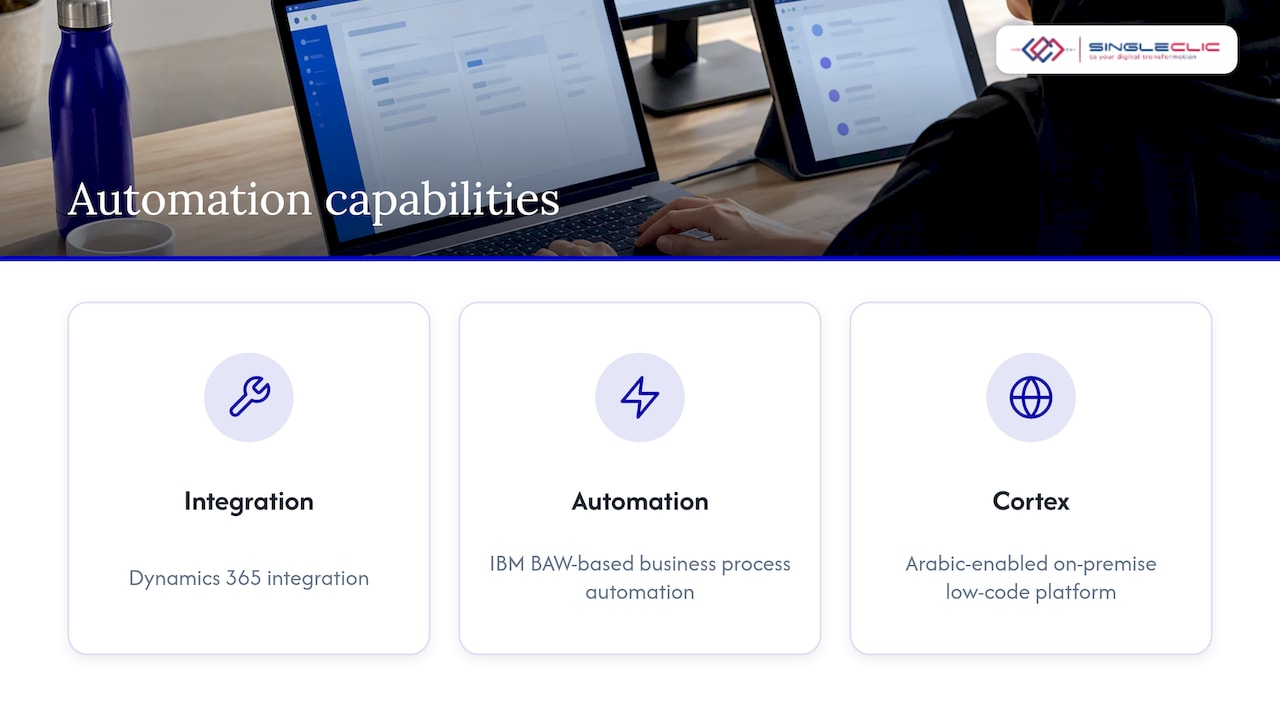
We bring Dynamics 365 integration, IBM BAW-based business process automation, and our Arabic-enabled, on-premise Cortex low-code platform to banking automation projects across the region. That combination lets us build workflows that keep the master system of record onshore, preserve CBUAE audit access, and deliver Arabic-first interfaces for both staff and customers without exporting sensitive data outside the UAE.
What UAE banking leaders should prioritize right now
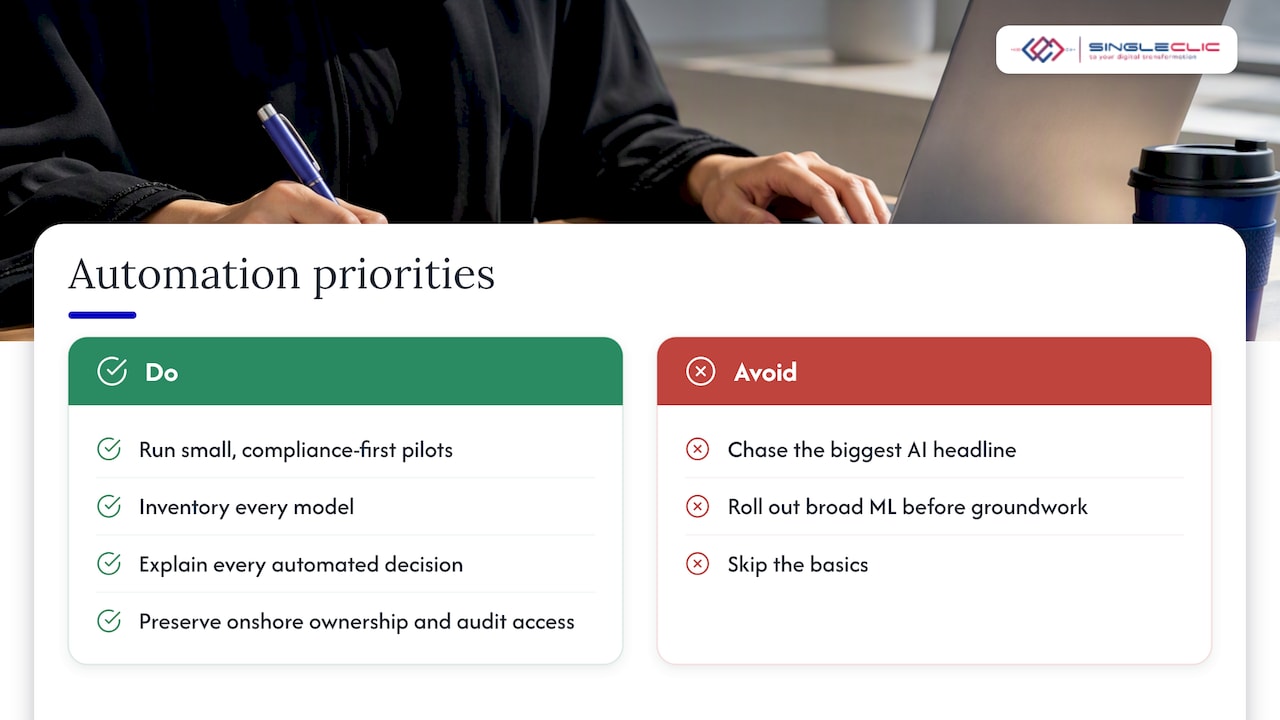
The banks moving fastest on automation are not the ones chasing the biggest AI headline. They are the ones running small, compliance-first pilots in onboarding and AML screening, where the regulatory requirements are already well defined and the payback is quick to measure.
Before any broad machine learning rollout, get the basics right: a documented model inventory, clear explainability for every automated decision, and vendor contracts that preserve onshore data ownership and Central Bank audit access. Skip that groundwork and you inherit a remediation project instead of an efficiency win.
— Tamer Badr
How Singleclic helps UAE banks automate with confidence
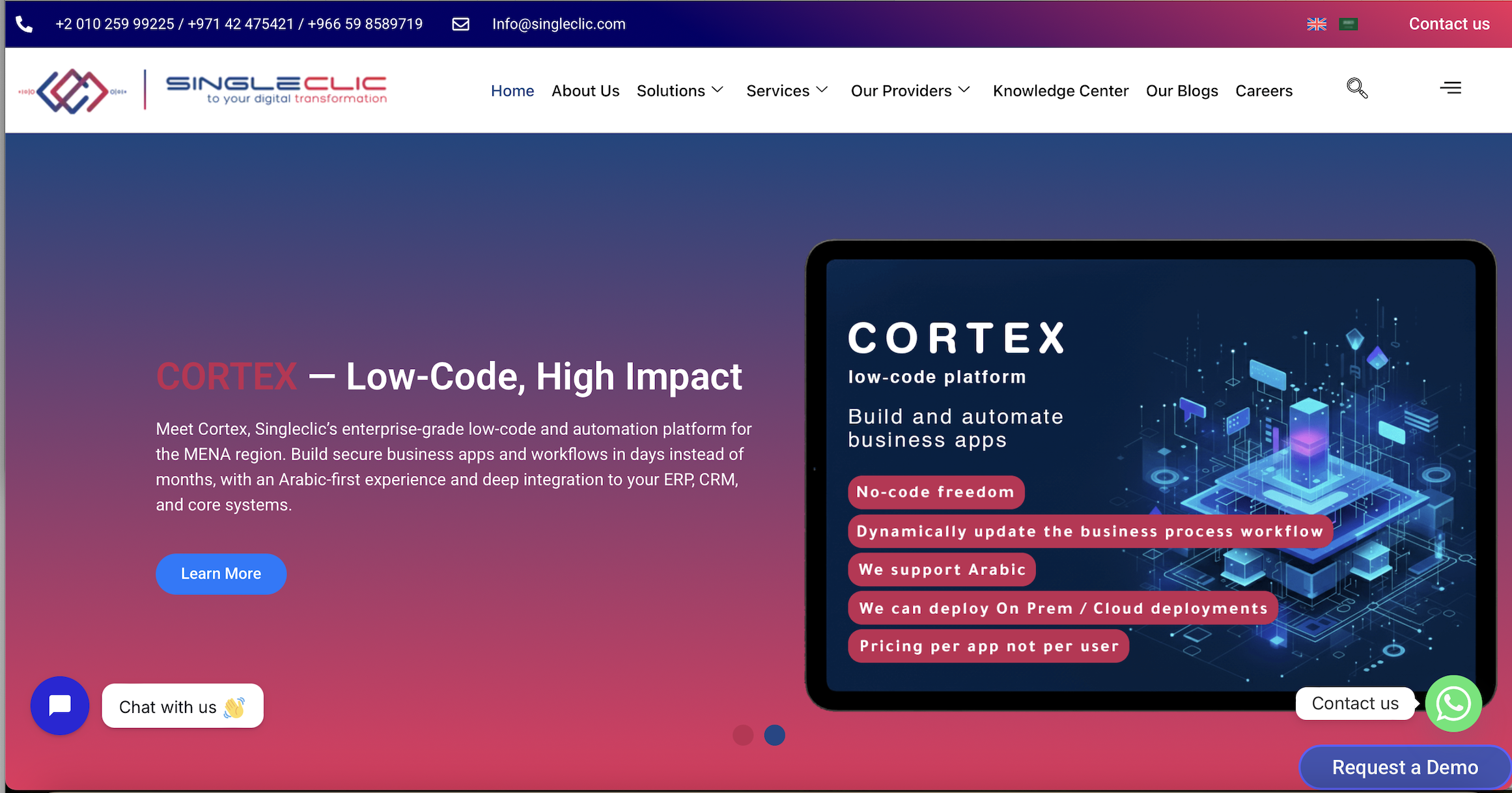
We help UAE banks turn these use cases into working systems rather than slide decks. Our business process automation work with IBM BAW, combined with Dynamics 365 banking integration for reconciliation and core banking workflows, lets us build automation that fits CBUAE outsourcing and data residency requirements from day one. For banks that need Arabic UI, on-premise deployment, or integration across legacy systems, our Cortex platform connects approvals, ERP, CRM, and workflow data without sending it offshore.
A practical first step is a focused compliance and capability review: which processes carry the most audit risk, where onboarding or AML screening can be automated fastest, and what your current vendor contracts say about data residency. Reach out to scope a pilot and we can map out where automation delivers the fastest, safest return.
FAQ
What does banking process automation mean for UAE banks specifically?
It means automating workflows like onboarding, payments, and AML screening while keeping the master system of record onshore under CBUAE outsourcing rules. UAE banks cannot treat automation as a purely technical project since data residency and audit access shape the architecture from the outset.
How does UAE KYC platform integration affect automation projects?
The Know Your Customer decree-law requires verified consent, secure electronic interfaces, and accredited data providers, with transaction logs kept for at least five years. Any onboarding automation has to build these controls into the workflow rather than add them later.
What AI governance rules apply to UAE banks using machine learning?
The CBUAE guidance note on AI and ML asks licensed financial institutions to maintain a model inventory, ensure explainability, and keep human oversight over high-impact automated decisions. This applies to credit scoring, fraud detection, and any other model that affects customer outcomes.
Can UAE banks store automation data outside the country?
Only with specific Central Bank approval. The outsourcing regulation requires the master system of record to stay in the UAE unless an exception is granted, so most automation platforms are designed around onshore infrastructure.
Does Singleclic offer banking-specific automation services in the UAE?
We provide business process automation, Dynamics 365 banking integration, and our Cortex low-code platform for UAE financial institutions, with Arabic UI support and on-premise deployment options. Specific project scope and pricing are confirmed during a direct consultation.
Sources
- CBUAE rulebook: Outsourcing regulation (banks)
- Federal Decree-Law on the Know Your Customer digital platform
- Guidance note on the consumer protection and responsible adoption of AI/ML by licensed financial institutions