Bank executives across Saudi Arabia and the United Arab Emirates face mounting pressure to reduce costs while strengthening compliance and customer satisfaction. Automation has rapidly shifted from a future prospect to a critical need, transforming traditional banking and real estate models into more agile, intelligent operations. By adopting tools like Robotic Process Automation, machine learning, and advanced analytics, organizations gain foundational pillars of modern finance systems that cut expenses, improve accuracy, and secure decisive advantages against regional competition.
Table of Contents
- Major Types Of Financial Automation Tools
- How Automation Optimizes Banking Operations
- Automation In Real Estate Finance Processes
- Compliance, Risk, And Cost Considerations
Key Takeaways
| Point | Details |
|---|---|
| Robotic Process Automation (RPA) Efficiency | RPA significantly reduces processing times and costs by automating high-volume tasks, enhancing operational efficiency in financial institutions. |
| Machine Learning and AI Integration | Leveraging machine learning and natural language processing allows for improved decision-making and real-time risk detection in financial operations. |
| Compliance and Risk Management | Automation requires rigorous compliance mapping and risk monitoring to ensure regulatory adherence and minimize potential biases in decision-making algorithms. |
| Cost Considerations in Automation | Organizations should budget for additional costs related to training, integration, and ongoing maintenance to ensure successful implementation of automation technologies. |
…
Major Types of Financial Automation Tools
Robotic Process Automation (RPA) stands as one of the most transformative technologies in modern banking. RPA mimics human workflows by automating repetitive, rule-based tasks like account opening, loan processing, and transaction verification. In the UAE and Saudi Arabia, financial institutions are deploying RPA to handle high-volume operations with minimal human intervention, reducing processing time from days to hours. Banks in Riyadh and Dubai have reported 40-60% reductions in manual processing costs after implementing RPA solutions. The technology works best when combined with other automation tools to create comprehensive operational efficiency.
Beyond RPA, the financial sector relies heavily on machine learning and natural language processing for advanced analytics and decision-making. These tools power predictive systems that forecast market trends, assess credit risk, and identify fraudulent transactions in real-time. Machine learning algorithms analyze millions of transactions daily, learning patterns that human analysts would miss. Meanwhile, natural language processing enables chatbots to handle customer inquiries, extract data from documents, and process regulatory filings automatically. Real estate companies leveraging these technologies can predict property values, analyze market sentiment, and automate lease agreement reviews with remarkable accuracy.
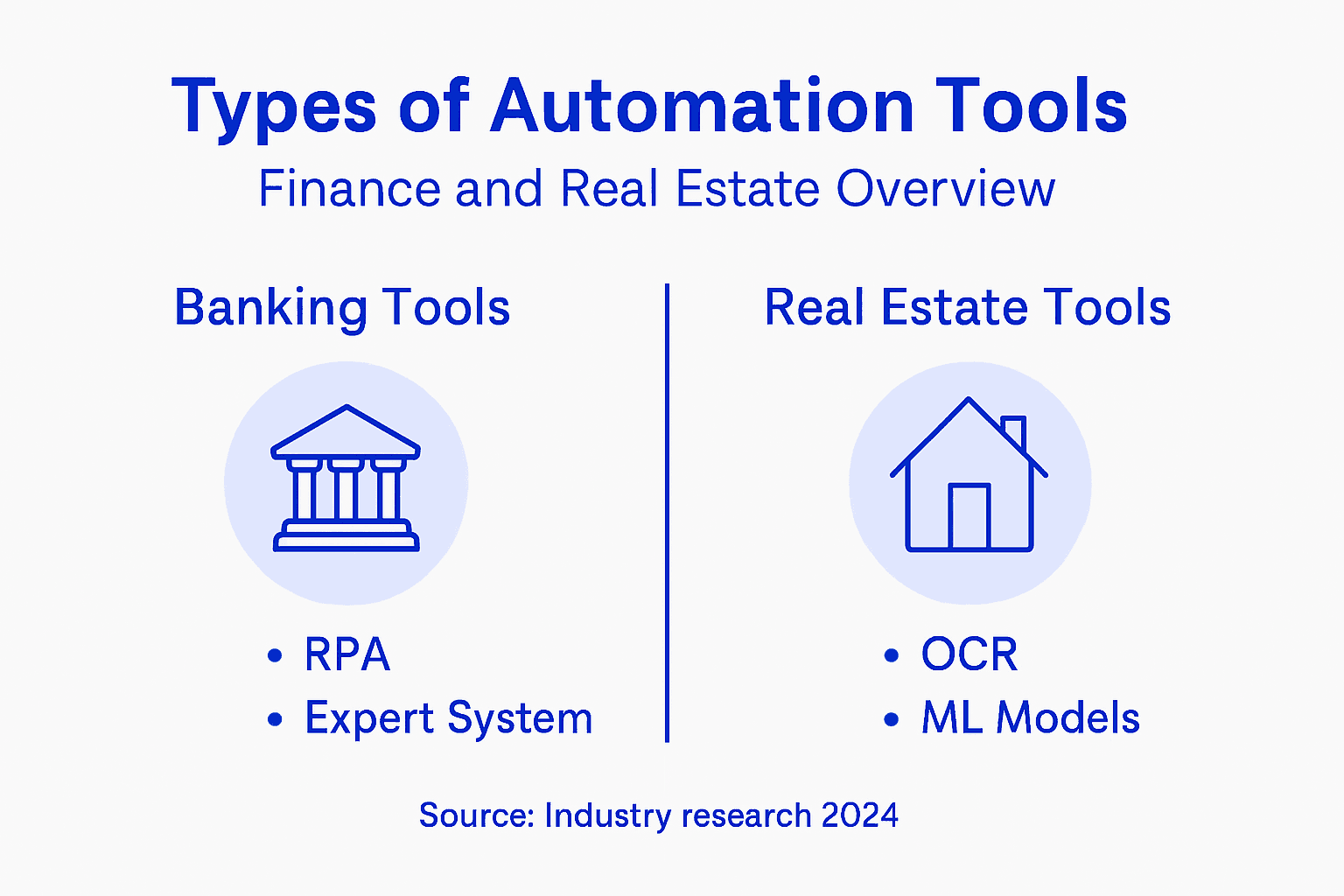
Expert systems represent another critical category, offering rule-based decision-making that mimics expert human judgment. These systems excel in compliance and regulatory functions, ensuring financial institutions meet local requirements in KSA and UAE markets. Data analytics platforms complement these tools by transforming raw transaction data into actionable intelligence. Your organization can implement these technologies through a low-code platform like Cortex, which enables you to design complex automation workflows without extensive coding. Cortex provides Arabic-enabled interfaces and supports on-premise deployment, making it ideal for regional financial institutions seeking rapid implementation without compromising data security.
Here’s a summary of how key financial automation tools benefit financial institutions:
| Tool Type | Main Function | Business Impact |
|---|---|---|
| Robotic Process Automation | Automates repetitive, high-volume tasks | Cuts costs by 40-60%, speeds up processing |
| Machine Learning | Analyzes transactions, predicts trends | Enables real-time risk detection and forecasting |
| Natural Language Processing | Automates communications and document handling | Improves client service, reduces manual errors |
| Expert Systems | Consistent rule-based decision-making | Enhances compliance and reduces regulatory risk |
| Data Analytics Platforms | Converts raw data to insights | Supports faster, better executive decisions |
- RPA: Handles high-volume transactional tasks with 24/7 availability
- Machine Learning: Identifies patterns and predicts outcomes across lending and trading
- Natural Language Processing: Automates document processing and customer interactions
- Expert Systems: Maintains regulatory compliance with consistent decision-making
- Data Analytics: Transforms operational insights into competitive advantage
Pro tip: Start your automation journey by mapping your highest-volume, most repetitive processes first. These typically deliver the fastest ROI and build organizational momentum for larger digital transformation initiatives.
How Automation Optimizes Banking Operations
When automation technologies take hold in a banking environment, the results are almost immediately visible. Repetitive manual tasks that once consumed hours of employee time get handled in minutes. Consider a typical loan application process: without automation, a banker manually reviews documents, enters data into multiple systems, verifies information against databases, and coordinates approvals across departments. With AI-powered automation technologies, the entire workflow accelerates dramatically. Document verification happens through optical character recognition, credit risk assessment runs automatically using predictive models, and approvals route intelligently based on predefined rules. Banks in the UAE have reported processing loan applications in hours rather than days, directly improving customer satisfaction and competitive positioning.
The operational benefits extend far beyond speed. Automation reduces human error in transaction processing, strengthens fraud detection by analyzing patterns across millions of daily activities, and frees skilled employees to focus on complex decision-making and customer relationships. Advanced machine learning strategies optimize workflows across departments, from credit evaluations to transaction monitoring. Cost savings typically range from 25% to 40% in operational expenses, depending on the scope of implementation. Saudi Arabian banks leveraging these technologies have reduced manual data entry errors by up to 95%, creating more reliable financial records and enhancing regulatory compliance.
Your organization doesn’t need to start with massive system overhauls. Begin by identifying your highest-cost, most error-prone processes. These often exist in back-office operations: reconciliation, settlement, compliance reporting, and customer onboarding. A low-code platform like Cortex enables you to build automation workflows that connect existing systems without extensive coding. This approach lets you deliver results quickly while your IT team manages larger infrastructure decisions. You can modify workflows in real-time as business needs change, without system downtime or additional development cycles.
Key Optimization Areas
- Customer Onboarding: Reduce from weeks to days through automated identity verification and document processing
- Transaction Monitoring: Detect fraudulent patterns instantly using behavioral analytics
- Compliance Reporting: Generate regulatory reports automatically with zero manual compilation
- Credit Risk Assessment: Evaluate loan applications in minutes using predictive scoring
- Settlement Processing: Eliminate reconciliation delays through straight-through processing
Pro tip: Measure the time and cost of your current processes before implementing automation, then track the same metrics quarterly after deployment to demonstrate ROI to stakeholders and justify further investments.
Automation in Real Estate Finance Processes
Real estate finance operates within a uniquely complex ecosystem. Property transactions involve multiple stakeholders, extensive documentation, regulatory compliance across jurisdictions, and critical timelines that impact deal closure. This complexity makes real estate one of the most automation-resistant sectors, yet also one with the greatest potential for improvement. Intelligent automation combining RPA and AI addresses these challenges by automating document processing, accelerating application reviews, and streamlining contract workflows. Real estate finance companies in Dubai and Abu Dhabi have discovered that automation reduces property evaluation timelines from weeks to days, enabling faster lending decisions and higher customer satisfaction.
The specific bottlenecks automation targets are well-defined. Document handling represents the largest pain point in real estate transactions. When a buyer applies for mortgage financing, lenders must verify employment history, review tax returns, assess property valuations, and cross-check title documents. Each step traditionally requires manual data entry and verification across disconnected systems. Automation handles this through optical character recognition that extracts data from documents automatically, machine learning models that validate information against regulatory databases, and workflow engines that route approvals based on predetermined rules. Saudi Arabian real estate developers working with automated lending platforms have reported 60% faster closing cycles, directly translating to improved cash flow and competitive advantage in competitive markets.

Digitalization in real estate also addresses data standardization challenges that have historically impeded progress. Real estate transactions involve inconsistent data formats across different regions, varying legal requirements, and outdated regulatory frameworks that complicate automation. Organizations implementing business process automation overcome these obstacles by creating standardized data models, mapping regulatory requirements into workflow rules, and building flexible systems that adapt to local market conditions. Your real estate finance operation can implement these solutions through a low-code platform like Cortex, which allows you to design custom workflows specific to Saudi Arabian or UAE property markets without extensive coding resources.
Critical Real Estate Finance Automation Areas
- Mortgage Application Processing: Automate document collection, income verification, and property appraisal coordination
- Title Verification: Streamline ownership verification and encumbrance checks across government databases
- Compliance Reporting: Generate regulatory filings automatically for different emirate or provincial requirements
- Payment Processing: Automate collection scheduling, remittance reporting, and default management
- Lease Administration: Handle lease renewal tracking, rent calculations, and tenant communications automatically
Pro tip: Start automation with mortgage application processing, as this single process typically consumes 35-40% of real estate finance team capacity and delivers visible ROI within the first 90 days of implementation.
Compliance, Risk, and Cost Considerations
Automation in finance delivers tremendous operational benefits, but it introduces new compliance and risk dimensions that require careful management. Financial institutions in the UAE and Saudi Arabia operate under strict regulatory frameworks from the Central Bank of the UAE, Saudi Arabia Monetary Authority, and local financial regulators. Financial services compliance has grown increasingly complex due to regulatory changes, geopolitical instability, and technology innovation. When you implement automation, you must ensure that every automated decision, every data transformation, and every workflow step aligns with local and international compliance requirements. A loan approval algorithm that works flawlessly in one jurisdiction might violate lending standards in another. The cost of non-compliance runs high: regulatory fines, reputational damage, license restrictions, and operational disruptions that far exceed the savings generated by automation.
Artificial intelligence and automation technologies introduce distinct risk categories that traditional financial operations never faced. Algorithmic bias, privacy concerns, and cybersecurity threats emerge when machine learning models make financial decisions based on historical data patterns. If your training data contains historical biases in lending practices, your AI model will perpetuate those biases automatically, potentially violating fair lending regulations. Privacy risks intensify when automation systems process sensitive customer financial information across multiple platforms. Cybersecurity becomes more critical as automated systems create new attack surfaces and dependencies. A breach affecting your automation infrastructure could compromise thousands of customer records instantly. You must build governance structures that audit automated decisions regularly, monitor model performance for bias and accuracy degradation, and maintain human oversight on high-risk decisions.
Cost considerations extend beyond the initial implementation. While automation reduces headcount and manual processing costs, it requires investment in technology infrastructure, ongoing maintenance, staff retraining, and compliance monitoring. Organizations often underestimate the hidden costs: data quality improvements needed before automation can work reliably, integration efforts to connect legacy systems, and expertise required to manage AI models effectively. Budget an additional 15 to 20% above your initial automation investment for these operational necessities. Real estate finance organizations implementing automation in the UAE have found that proper compliance infrastructure, risk monitoring, and staff training add 6 to 12 months to implementation timelines compared to technology deployment alone.
Below is a comparison of risk and cost factors organizations should manage during financial automation projects:
| Factor | Typical Challenge | Key Preventive Action |
|---|---|---|
| Compliance | Diverse local regulations | Map rules to workflows early |
| Algorithmic Bias | Biased historical data | Conduct regular bias audits |
| Data Security | Increased attack surfaces | Apply encryption, monitor access |
| Cost Overruns | Hidden expenses post-launch | Budget for training, integration, maintenance |
| Human Oversight | Over-automation risks | Maintain final decision authority |
Risk Management Priorities
- Model Governance: Establish audit trails for all automated decisions with quarterly bias assessments
- Data Security: Implement encryption, access controls, and real-time monitoring for customer information
- Compliance Mapping: Document how each automated workflow satisfies specific regulatory requirements
- Human Oversight: Maintain approval authority for high-risk decisions and exceptions
- Testing Protocols: Run parallel operations comparing automated and manual results before full deployment
Pro tip: Engage your compliance and risk teams during automation planning, not after technology selection, to ensure your solution architecture supports regulatory requirements and reduces implementation delays caused by post-deployment compliance concerns.
Unlock Seamless Financial Automation with Singleclic
The journey toward transforming banking and real estate finance operations through automation demands more than just technology. As highlighted in “Automation in Finance: Transforming Banks and Real Estate,” common challenges like repetitive manual workflows, compliance complexities, and data security risks call for intelligent, adaptable solutions. If your organization faces slow loan processing, mounting regulatory pressures, or fragmented real estate finance workflows, you are not alone. Key pain points such as mortgage application delays, risk of algorithmic bias, and the demand for real-time process optimization are critical hurdles that require more than isolated fixes.
Singleclic is here to help you turn these challenges into opportunities. Our expertise in Business Process Automation, Robotic Process Automation, and enterprise AI, combined with our Arabic-enabled Cortex low-code platform, empowers your teams to automate complex financial processes with ease while ensuring compliance and reducing risks. We understand the importance of maintaining human oversight alongside AI-powered automation and deliver solutions perfectly tailored to the regulatory landscape of KSA, UAE, and Egypt.
Accelerate your digital transformation journey today with Singleclic and experience how our proven methodologies and scalable solutions make financial and real estate process automation fast, secure, and compliant. Visit Singleclic now to explore how you can move beyond digitalization and elevate your business through true optimization.
Frequently Asked Questions
What are the main types of automation tools used in finance?
The main types of automation tools in finance include Robotic Process Automation (RPA), machine learning, natural language processing, expert systems, and data analytics platforms. Each serves distinct functions such as automating repetitive tasks, analyzing data, and ensuring compliance.
How does automation improve the loan application process in banking?
Automation significantly speeds up the loan application process by using technologies like optical character recognition for document verification and machine learning for credit risk assessment, reducing processing times from days to hours and enhancing customer satisfaction.
What challenges does financial automation face regarding compliance and risk?
Financial automation faces challenges such as diverse local regulations, algorithmic bias from historical data, data security risks, and the need for human oversight to ensure that automated decisions align with regulatory requirements.
How can real estate finance benefit from automation?
Real estate finance can benefit from automation by streamlining processes such as mortgage application processing, title verification, and compliance reporting, resulting in faster transaction cycles and improved operational efficiency.